The Zand Shiite Kurdish State
This article explores the short-lived but impactful Zand Shiite Kurdish State (1751-1779) in 18th-century Iran, founded by Karim Khan Zend, and discusses the complex linguistic and religious diversity within Kurdish society.

Dear Readers:
Throughout history, Kurds have established empires, kingdoms, states, dynasties, independent principalities, and autonomous regions, some short-lived, others enduring. Research conducted each year illuminates the obscure aspects of Kurdish history, gradually lifting the veil of mystery surrounding Kurds, and revealing unknown realities with clarity.
The Zand Shiite Kurdish State, established in Iran in the 18th century (between 1751-79), is one of those short-lived but highly influential states that history has forgotten or caused to be forgotten. In this article, I will briefly provide information about the Zand Shiite Kurdish State.
Before delving into the Zand Dynasty, I would like to schematically present unknown or little-known facts about religion and language concerning Kurds, to inform the average reader:
LANGUAGE AND RELIGION AMONG KURDS
Dear Readers:
The word "Kurd" is perceived in daily life and political literature as a "homogeneous" or "uniform" entity. It is assumed that all Kurds speak the same language, believe in the same religion, and use the same alphabet.
This is a grave misconception. All political solutions and manifestos marketed under the guise of "Solution to the Kurdish Question" are a lie and a deception of the electorate, without a full grasp of the multifaceted reality of Kurdish society.
Kurdish society is not merely an issue for the people living in the geography of Kurdistan. Nearly 2 million Kurds live in the North Khorasan region of Iran, but "North Khorasan" is not part of the geography of Kurdistan. Similarly, the population of Central Anatolian Kurds (Cihanbeyli, Şereflikoçhisar, Kulu, Haymana, etc.) is close to 2 million, but the Central Anatolian Region is not part of the geography of Kurdistan. Kurds living in the countries of the former Soviet Union are also outside the geography of Kurdistan. (We know that today, Kurds no longer live in the historical region named "Red Kurdistan" located between Armenia and Azerbaijan.)
I believe it is now time to recognize Kurds, who resemble a colorful rose garden, in all their aspects and reality.
LANGUAGE AMONG KURDS
In the diagram below, I present a schematic representation of six Kurdish languages with "Independent Language" status. I regret to say that many Kurdish intellectuals, Kurdish Institutes, and similar individuals and institutions still define languages like "Kurmanji, Sorani, etc." as "dialects of Kurdish."
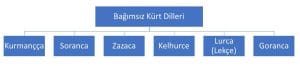
Diagram of Independent Kurdish Languages
I want to ask this question: Suppose languages like Kurmanji, Sorani, and Zazaki are sub-dialects of a super-language called "Kurdish." Which language is meant by this language named "Kurdish"? Which language is Kurdish?
Is there another "Kurdish" language besides the independent Kurdish languages shown in the diagram above?
When I wrote, "There is no such language as Kurdish," there were many reactions. I still say: There is no single language called "Kurdish," but there are Independent Kurdish Languages. It is a fact that there are significant grammatical, morphological, and phonetic differences between these independent languages. Of course, there are dialects. For example, well-known accents or sub-dialects like Serhedi and Behdinani are sub-dialects of the Independent Kurmanji Language. Similarly, the Erdelanî, Silêmanî, Mukiryanî, Germiyanî accents are dialects of the Independent Sorani Language. The Şeyhbızın accent, widely spoken among Central Anatolian Kurds, is a dialect of Kalhuri, and the Bahtiyari, Mamasani accents are dialects of Lurish.
Another serious problem arises in the Turkish spelling of words like Kurmanji and Sorani.
Turkish: "Ben Kurmançça biliyorum." (I know Kurmanji.)
Kurmanji: "Ez Kurmancî dizanim." (I know Kurmanji.)
Many Kurdish writers, combining these two sentences, write "Kurmanci" instead of "Kurmançça" when writing in Turkish. This is a mistake! Similarly, they prefer to write "Soranice" instead of "Soranca." This is also a mistake! Writing "Goranice" instead of "Goranca" is also a mistake.
Examples:
"Ben bir Alman’ım. Almanca konuşurum." (I am a German. I speak German.)
"Ben bir Fransız’ım. Fransızca konuşurum." (I am a French. I speak French.)
"Ben bir Türk’üm. Türkçe konuşurum." (I am a Turk. I speak Turkish.)
"Ben bir Kürd’üm. Kürtçe konuşurum." (Note: The letter T became D due to vowel harmony)
"Ben bir Zaza’yım. Zazaca konuşurum." (I am a Zaza. I speak Zazaki.)
"Ben bir Kurmanç’ım. Kurmançça konuşurum." (Wrong: I am a Kurmanc.)
"Ben bir Soran’ım. Soranca konuşurum." (Wrong: I am a Sorani.)
"Ben bir Goran’ım. Goranca konuşurum." (Wrong: I am a Gorani.)
"Ben bir Lur’um. Lurca konuşurum." (I am a Lur. I speak Lurish.)
Another major mistake is writing "Kürd" or "Kurd" instead of "Kürt." For example, when one wants to write "the future of Kurds," sentences like "Kürdlerin geleceği" or "Kurdlerin geleceği" are written, which contradict Turkish vowel harmony. If the letter "D" is intended to declare Kurdish identity or defy assimilation, this is a sign of wretchedness and an inferiority complex.
As you know, the elective course program was implemented last year. In this list, "Kurmancca" was written instead of "Kurmançça." This is also a mistake! These errors are not accepted by me, but by the rules of Turkish phonetics.
Some readers also think: "Imperialists created different Kurdish dialects to divide the Kurds."
This claim is also completely invalid. The 11th-century poet Ali Hariri wrote his book "Divan" in Kurmanji. Ahmed Hani (Ehmedê Xanî) wrote his books in Kurmanji in the 16th century; he even dedicated his book named Nûbihara Biçûkan to children by writing "ji bo zarokên Kurmanca," meaning "for Kurmanji children." The first Kurdish novel written by the famous Soviet Kurdish writer Ereb Şemo (Erebê Şemo) is titled "Şivanê Kurmanca." Please forget imperialist conspiracy theories!
RELIGION / SECT AMONG KURDS
The issue of RELIGION among Kurds has not been fully explained or settled in people's minds. Turks assume that they are Sunni/Hanafi, but Kurds are Sunni/Shafi'i. This shallow view, just like in languages, does not reflect the existing richness and reality of Kurdish society.
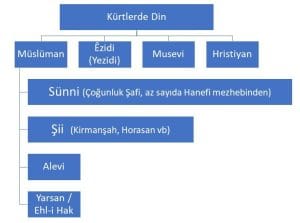
LANGUAGE-RELIGION GROUPS AMONG KURDS
Throughout history, "language-religion" groups have spontaneously formed among Kurds. Each "language-religion" group established its own state, principality, or dynasty during its historical journey, and then passed the baton to another Kurdish group.
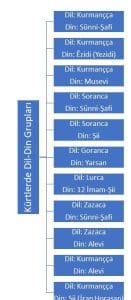
As seen in the diagram above, there are more than ten GROUP identities among Kurds. In some, such as the Êzidi, Alevi, and Jewish groups, "religious/sectarian identity" is prominent, while in others, "language" identity takes precedence. I must immediately state that there are serious historical disconnections between these groups. If we take Turkey as an example, we see four important groups standing out:
LANGUAGE RELIGION / SECT
- Kurmanji Sunni /Shafi'i (Mount Ararat Rebellion/Resistance)
- Kurmanji Alevi (Koçgiri Rebellion/Resistance)
- Zazaki Sunni / Shafi'i (Sheikh Said Rebellion / Resistance)
- Zazaki Alevi (Dersim Rebellion / Resistance)
As you can see, each of the four rebellions/resistances that continued between 1921-1938 belonged to a different Kurdish (Language-Sect) group. When one rebelled or resisted, it could not receive help from the other three. This is the main reason for the failure of Kurdish Rebellions/Resistances.
KURDISH LANGUAGE ALPHABETS
The six languages I listed above under the "Independent Kurdish Languages" diagram have been transcribed into written language using different alphabets. The difference in alphabets has further fragmented the language-religion grouping within the Kurdish Nation. Although the use of the Cyrillic Alphabet declined after the collapse of the Soviet Union, thousands of novels, research books, newspapers, and documents were published using this alphabet. If Kurds want to keep their memory alive, they must know the Cyrillic Alphabet.
I would like to draw your attention to which alphabets are used in which countries for the transcription of the Independent Kurmanji Language alone:
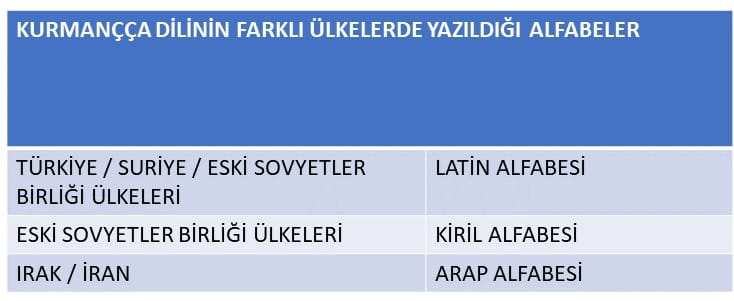
This means that, for example, three Kurmanji speakers who write Kurmanji in Latin, Cyrillic, and Arabic alphabets will be able to communicate easily when they meet, but they will not be able to understand each other in written language. It's a very complicated situation, isn't it?
Again, for example, a Jewish, an Êzidi, an Alevi, a Shiite, and a Shafi'i Kurmanji speaker will be able to understand each other by speaking Kurmanji when they meet, but during prayer time, each will go to a different place to perform their own religious ritual.
Politicians who cannot understand the mosaic structure of the Kurdish Nation always ignore this reality of Kurdish Society when they set the goal of "Great Independent Kurdistan" for all Kurds, or when political parties in Turkey emphasize "Federal Kurdistan" or "Democratic Republic" discourses to solve the "Kurdish Question" in Turkey. A certain border, the same language, and the same religion are necessities for the formation of a "Federal" structure.
Furthermore, we must add that since socialist ideology disregards religions (or considers them unimportant), socialist Kurdish intellectuals for many years disregarded religions and dreamed of Kurdish state formations. However, today we know that in Alevism, Judaism, and Êzidism, religious identity is more dominant and important than linguistic identity.
A federal state necessitates a "uniform" understanding. For example, the Catalan region of Spain is a federal region. The borders of the Catalan Region are clear. Everyone speaks the same language, uses the same alphabet, and all are Catholic.
Another striking example is the Flemish and Walloon regions in Belgium. In 1985, I was working in Antwerp in the Flemish region. The Flemish-Walloon border passed right through the middle of a village. I remember very serious discussions in the media about whether a few houses belonged to the Flemish region or the Walloon region. Similarly, I know that serious discussions are still ongoing about which street or neighborhood in Brussels is on the Flemish or Walloon border.
Such a situation does not exist in Turkish Kurdistan. There is no border village by village, street by street. If political parties advocating for federation aim to forcibly draw borders, prioritize one language, one religion, one alphabet, and suppress or destroy others, this approach, in short, means attempting the impossible and dragging the Kurdish people into civil war both internally and with the central government.
In Turkey, neither "Democratic Republic" nor "Federation" are realistic political solutions. They mean nothing more than causing the Kurds to lose time. Instead of acting according to the reality of the day, it means pushing the people to seek solutions in a world of "dreams." I believe that NGOs and Political Parties, working hand in hand, can develop constructive, realistic, and expectation-meeting solution models through workshops and similar meetings.
Let's not forget: "Kurds are not limited to Kurdistan; nor is Kurdistan solely the country of Kurds." The "Kurdish Nation" is not an endemic nation, meaning tied to a specific land or limited by a specific land; it is a universal nation.
Was Saladin not a universal leader that every nation wanted to claim? Was Ziryab not a universal figure that every nation wanted to claim? Kurds can continue their existence as long as they are the guardians of "Universal Justice." History has entrusted Kurds with the responsibility of being the guardians of "universal justice." Kurds have always lost, and will lose, when they think small.
Models that take this reality into account must be developed. Otherwise, what is being done is political demagoguery and deception. Political projects that protect and develop the linguistic and religious richness and mosaic structure of the Kurds are meaningful; the rest is a waste of time.
ESTABLISHMENT OF THE ZAND SHIITE KURDISH STATE
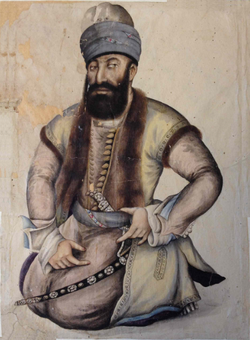
The Zand Shiite Kurdish State or Dynasty was established in 1750 over a large part of present-day Iran. (In Persian, the term Selseleye Zandiye/Zandi Dynasty is used for the Zand State.)
Before moving on to the establishment of the Zand State, I would like to provide information about the Lurs, who founded this dynasty, and the Luristan region where they lived.
LURISTAN
Luristan, which falls within the historical geography of Kurdistan, is today the name of one of Iran's 31 provinces. The province is located among the Zagros Mountains. The population of the Luristan region was determined to be 1,716,527 people in 2006. Its area is approximately 28,392 km2. Its current administrative center is the city of Khorramabad.
As I showed in the diagrams above, the Lurs are a branch of the Kurds. They speak Lurish. They adhere to the Twelver Shiite faith.
COLLAPSE OF THE AFSHAR DYNASTY AND KARIM KHAN ZAND
The Safavid State ruled Iran between 1501-1736. When the last Safavid Shah died, the army commander Nader Shah seized power and established a great state. However, the state's lifespan was short. When Nader Shah died in 1747, a three-year power vacuum emerged in Iran. It was at such a time that Karim Khan Zend seized power in 1751 and established the Zand Kurdish State.
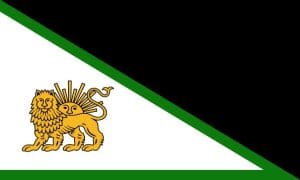
Karim Khan belonged to the Zend tribe, which was part of the Lur (a branch of the Kurds) Tribal Confederation. His tribe, like other Kurdish tribes during the Safavid era, was exiled to North Khorasan, but Karim Khan brought the Zend tribe back to the Zagros Mountains.
Karim Khan, the leader of the Zend tribe, first conquered the southern and central regions of Iran. He made Shiraz his capital. The reason for this was to have the chance to abandon Shiraz and take refuge in the nearby Zagros Mountains if a serious attack occurred. (Karim Khan made Tehran the second capital in 1778.)
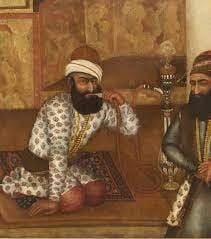
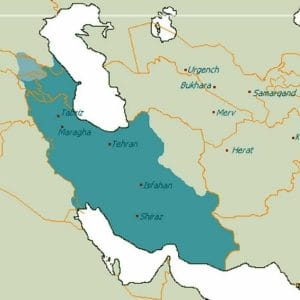
Karim Khan Zend soon expanded his borders, conquering all of Iran except the Khorasan and Balochistan regions, and some parts of Iraq. Present-day Georgia, Armenia, and Azerbaijan, although autonomously governed by khans in practice, also came under the control of the Zand State. Similarly, the island of Bahrain in the Persian Gulf was included within the borders of the Zand State.
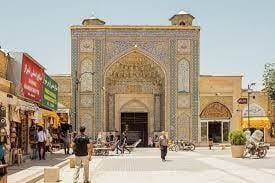
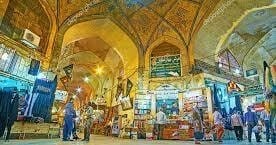
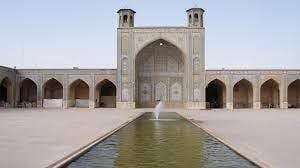
During Karim Khan's time, Iran experienced its most peaceful and prosperous period. The city of Shiraz became a center of magnificent architectural structures and art. He inherited the legacy of the Achaemenid and Sasanian Empires established in Iran in the pre-Islamic era, and the architectural art of that period was revived. Not content with this, he rebuilt the tombs of Hafez and Saadi Shirazi, the two greatest poets of medieval Iran. The art that emerged during the Zand Dynasty developed to such an extent that it formed the basis of the art and craftsmanship understanding of the Qajar Dynasty, which would rule Iran in later years.
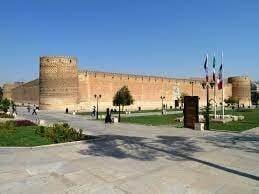
When Karim Khan died in 1779, a struggle for leadership began among his heirs, and the Dynasty rapidly lost its power. The last ruler, his nephew Lotf Ali Khan Zend, was killed by the Qajars in 1794, bringing an end to the Zand State.
THE PERSONALITY OF KARIM KHAN ZAND
The Oxford Encyclopedia of Islam describes Karim Khan as follows: "Karim Khan has gone down in history as the most humane, most forgiving, and most generous ruler of Iran in the Islamic Period."
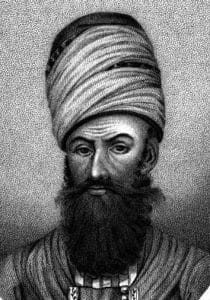
After the 1979 Islamic Revolution, the first action of the new Islamic government was to ban and remove the names of past Iranian rulers given to streets and avenues. The names of two main streets in Shiraz were Karim Khan Zend and Lotf Ali Khan Zend. The people of Shiraz opposed this change and revolted. The government then gave up on changing the names of these two streets.
Karim Khan Zend gave himself the title "Vakil-e Ra'aya" (Regent of the People). He refused to use the title "Shahanshah," meaning "King of Kings," saying: "I am the servant of my people. I am just a regent to solve their problems. I am neither their King nor their Shahanshah. I am the Regent of the People."
During Karim Khan Zend's reign, the Iranian geography, which had been ravaged by wars for centuries, finally took a deep breath. Karim Khan encouraged the development of agriculture; he established trade relations with England, the greatest empire of the time. Bushehr, on the Persian Gulf coast, became a major trade center. Thanks to profitable trade agreements with the "East India Company," the world's largest company, the welfare level of the people increased. He lowered taxes; he implemented a fair judicial system.
In 1763, Karim Khan minted silver coins in the city of Ganja. Karim Khan was a Shiite believer but was quite moderate in terms of adhering to religious rituals. He minted some coins in the name of the 12 Imams and the Mahdi.
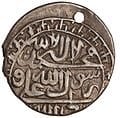
Front and back of silver coins minted by Karim Khan Zend in Ganja
Karim Khan valued art and architecture. Painting reached its peak. Especially flower, animal, and human designs carved in marble and glazed tiles left their mark on the period.
During Karim Khan's time, the country found peace. Banditry on roads between cities ended. Historians have analyzed Karim Khan's period by likening it to "Democracy" and "Democratic Values System" in today's sense. After Karim Khan, democracy never returned to Iran.
Iranian historian and sociologist Saeed Naficy writes in his book "History of Zandiya":
"No administration in the post-Islamic period was as just and well-governed as the Zand Dynasty. Karim Khan possessed chivalry, virtue, justice, morality, and kindness. Karim Khan Zend was one of the most beloved rulers in history. He served as an ethical model for humanity. Karim Khan did not oppress the Iranian people, did not destroy settlements, and did not harm anyone's livelihood. Furthermore, considering Karim Khan's experiences and struggles, the extraordinary difficulties he endured are astonishing, and his courage is noteworthy."
William S. Haas, a sociologist and historian from Columbia University, spent his military service during World War II training US troops in Iran. He conducted in-depth research on Iranian history. He makes the following assessment about Karim Khan Zend:
"After the death of Nader Shah, Karim Khan Zend of the southern Zend tribe took over the administration. He was one of the most amiable and humane rulers to govern the Iranian throne. His memory still holds a cherished place in the minds of the Persian people. His era and country were like a true oasis of happiness in a world full of oppression and tyranny."
REFORMS OF KARIM KHAN ZAND
- Ensuring order, peace, and security in the country
- Social justice
- Religious freedom (Separation of religious and state affairs)
- Accountability in government
- Lowest tax rates
- Establishment of the Office of the People's Advocate
- Re-establishment and promotion of international trade
- Development of foreign relations
- Elimination of piracy and terrorism in the Persian Gulf by Arab tribes
- Actively protecting the rights of ethnic and religious minorities
- Establishment of education in the country
- Revitalization of the economy, including agriculture, crafts, and trade
- Making the financial responsibility of the state transparent (accountability)
- Creation of reserves in silos for emergencies and famine
- Patronage of art, poetry, and cultural activities
- Showing mercy to the enemies of the state
- Declaration of the right to "happiness" as a government principle by decree
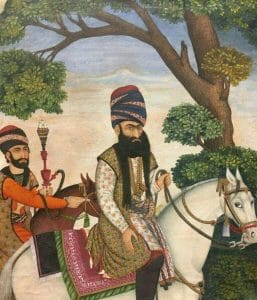
Historian Sir John Malcolm writes about the period of Karim Khan Zend:
"The land of Iran knew two just rulers: the first was Cyrus the Great, and the second was Karim Khan Zend. Both respected and protected different religions, ethnic groups, and languages."
CONCLUSION
Dear Readers:
You may have wondered why I first discussed the linguistic and religious structure of the Kurds, and then the Shiite Zand Kurdish State established in Iran in the 18th century.
As shown in the diagrams above, there are more than ten Kurdish Language-Religion (Sect) groups. Considering historical information, we also know that their relations were not good.
The Kurdish Federation in Northern Iraq was established with immense difficulty. The parties experienced a very serious civil war lasting three years (1994-97). Thousands of Peshmerga died. While Jalal Talabani invited the Iranian Revolutionary Guards to Erbil, Massoud Barzani received help from Saddam Hussein, the butcher of Halabja, and seized Erbil with his support. In short, there is a hidden and wounded fault line in Southern Kurdistan. While Sorani is brought to the forefront, Kurmanji is kept at the primary school level. In short, in Southern Kurdistan, Kurds are trying to assimilate Kurds. A dire situation!
Many Kurdish intellectuals hope that in the future, Kurmanji and Sorani will integrate into a single language, forming a unified structure in Southern Kurdistan. This is not true. Both groups continue the federation through sacrifices. If Iraq weakens significantly tomorrow, the Kurmanji and Sorani regions will likely separate, and two different federal structures will emerge. Or, conversely, if Iraq (the central government) becomes very strong, the Kurmanj and Sorani will blame each other, as happened in Kirkuk, and either separate through civil war or quietly, but the border war will always continue. If all of Southern Kurdistan, for example, spoke Kurmanji-Shafi'i (or one of the other religions) or Sorani-Shafi'i (or one of the other religions), an Independent Kurdistan would have been easily established.
You might ask me this question: What is the bond that unites all Kurdish groups in the world? We know that this bond is not a common homeland, language, or religion. The only reality that brings these groups closer is the "Common Historical Suffering" they have endured for centuries.
From the Central Anatolian Kurds to North Khorasan; from Diyarbakır to Erbil; from Mahabad to Qamishli; from Sinjar to the former Soviet Republics and Europe, all Kurds, regardless of language or religion, have experienced and continue to experience pain and tragedy on their historical journey. It is this "COMMON SUFFERING" that we all must embrace without discrimination. And its antidote is the approach and understanding of "Universal Justice."
The great Kurdish leader Karim Khan Zend proved that people, whether Kurdish or not, can unite on the basis of "happiness" with a tolerant, egalitarian, and just approach. Our duty is to continue on our path in line with Karim Khan Zend's values.
An American historian says: "Human history has known four just, generous, and forgiving leaders: Alexander the Great, Cyrus the Great, Saladin, and Karim Khan Zend."
It is our duty to continue the legacy of universal justice of Saladin and Karim Khan Zend. Both first won the love of Arabs, Turkmens, Persians, Armenians, Assyrians, that is, other peoples, and finally, the Kurds...
If, as Kurds, we pursue the cause of "universal justice," we will continue to write our existence and identity into history.