What Is "Yaşar Kaya" Syndrome?
This article defines "Yaşar Kaya Syndrome," a political phenomenon in Kurdish politics, tracing its origins through the life of Yaşar Kaya and outlining its symptoms and lack of known cure.
Dear readers! First and foremost, as we enter 2020, I wish you all health and happiness. I hope everything goes as you wish. I sincerely hope you stay away from various disease syndromes. As you know, we don't just struggle with "physical" health problems. In fact, at the current stage of medicine, the easiest thing to treat is "physical" health problems. MRI systems, tomography machines, micro-surgery, and many other medical devices and tools make doctors' jobs easier, and patients recover quickly. However, solutions to our "psychological" problems cannot be found so quickly. Our surroundings are full of people suffering from psychological problems. Some of these "psychological" problems, when untreatable, are defined as "syndromes." Their treatment is not easy, and moreover, they appear regularly.
The world of politics, just like the human body, is full of its own unique diseases and syndromes. Throughout thousands of years of human history, various political syndromes have emerged and found their place in political literature. For example, you have all heard the name of US President Donald Trump. Have any of you heard of the concept of "Donald Trump Syndrome"? The prominent features of this syndrome are:
· You will create such a feeling of hatred in the hearts of the people that they won't even have a chance to evaluate you.
· You will later meet and raise a toast with the foreign leader you cursed.
· You will deny today what you said yesterday, and then confirm it again the day after.
Since our topic is not Donald Trump or other leaders, I don't want to delve deeper into these examples.
In the Kurdish political world, a unique syndrome developed starting from the 1990s: "Yaşar Kaya Syndrome." Since this syndrome, which found its name in political literature as "Yaşar Kaya Syndrome," is contagious and tends to spread, especially among the youth, I dedicate today's article to defining this syndrome.
HOW DID THE NAME "YAŞAR KAYA SYNDROME" EMERGE?
Yaşar Kaya, the namesake of "Yaşar Kaya Syndrome," was born in 1938 in the village of Muça (Gülpınar) in Iğdır. Muça is a quiet Kurdish village, 15 km from Iğdır. Even if you go to Muça today, there is no proper road within the village.
Yaşar Kaya's family is extremely poor. His father, Ferman, has two wives. Ferman raises animals and engages in trade. He also has a house in Iğdır. Ferman's important characteristic is that he is an agent under the command of Hüsnü Bingöl, the MIT (National Intelligence Organization) Inspector for the Eastern Anatolia Region. As you can see in the picture below, he posed as a person ready to carry out every order given, leaning his head on his boss's shoulder with a feeling of gratitude and subservience.
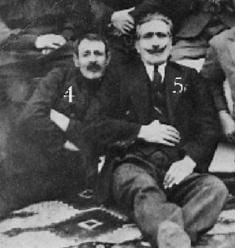
Image: (From left to right) Ferman Kaya and MIT Chief Hüsnü Bingöl
Retired Major Hüsnü Bingöl served as the MAH (MİT) Regional Inspector between 1932 and 1954. Since Iğdır borders two countries (Iran and the Soviet Union), he settled there, specifically tracking Communist agents. Ferman seriously undertook the tasks assigned to him, and having received intelligence training, he frequently crossed the Aras River to communicate with contacts in Soviet Armenia.
Ferman's sons grew up. Hüsnü Bingöl showed loyalty, sending Ferman's son, Yaşar Kaya, to Kabataş High School as a boarding student without tuition, and enrolling his other son in a military school.
After finishing high school and enrolling in the Faculty of Economics and Commercial Sciences in Istanbul, Yaşar Kaya soon found himself among Kurdish youths interested in politics. He put into practice a basic principle of espionage he learned from his father: "Wherever the government's enemies are, you must be among them, and even be a leader if necessary! You must prove that you are more aggressive than them. You must propose or implement actions they haven't thought of. You must act so eagerly that you prove to them you have no fear of 'going to prison' or 'being killed.' Thus, those who harbor secret plans and hostilities against the government and the state will gather around you, you will secretly continue your espionage duties, and you will camouflage yourself."
Yaşar Kaya did not deviate from his father's advice and took part in the 49ers Kurdish movement that erupted in 1959. He was one of two people who took the petition, signed by Kurdish youths and intellectuals to be sent to the President, to the post office. He was detained for several years. He became acquainted with every shade of Kurdish politics. Upon his release, he published a magazine called DENG. Thanks to these two events, he established close contact with the most important figures of the Kurdish movement, regularly reporting their plans and intentions to MIT. Soon, MIT dismantled all Kurdish organizations within Turkey, eliminating many, such as KDP chairman Sait Elçi, through unsolved murders.
MIT has a principle of protecting its valuable agents. Yaşar Kaya retreated into silence. For example, his name was not even mentioned during the 1971 Military Coup. In the 1973 elections, he wanted to be a CHP (Republican People's Party) candidate for Kars Deputy, but CHP District Chairman Mecit Hun did not support Yaşar Kaya, stating that he maintained an equal distance from all candidates. The reason for this was Mecit Hun's knowledge of the Yaşar Kaya family's close relationship with MIT.
Mecit Hun, who could not enroll in university despite graduating first from Erzurum High School due to Hüsnü Bingöl's "Kurdish nationalist" report, could not continue his education. Moreover, his father, Ahmed Şemo, had to travel by phaeton from Iğdır to Doğubayazıt every week due to a fabricated court case opened by Hüsnü Bingöl in Doğubayazıt. On such a day, he fell ill at the Çillê pass and passed away.
Yaşar Kaya harbored deep animosity towards Mecit Hun, but he had to wait until the 1990s for revenge. In the 1980s, he maintained a low profile. If you had met Yaşar Kaya in the 1980s, it would have taken a thousand witnesses to realize that he was the person who took part in the 49ers Kurdish Movement and published the DENG magazine. Until the 1990s, he worked as a technician for Siemens and was not involved in any political activity. He lived a normal life but closely followed the PKK movement.
MIT, seeking to play a role in the increasingly important PKK and Kurdish movement, knocked on Yaşar Kaya's door again. Yaşar Kaya, who, like his father, did not compromise on his sense of loyalty, was appointed head of the DEP party, which was established in affiliation with the PKK, at MIT's request and with their facilitation. A newspaper named Özgür Gündem was put at his service. Yaşar Kaya finally began to spew out the feelings of revenge he had harbored for years. He successively declared the leading figures of the Eastern Anatolia Region as traitors, MIT agents, state agents, and Ergenekon members. He targeted them. With the list he provided, unsolved murders were put into practice. He had the house of Mecit Hun, whom he could not defeat, bombed, and Mecit Hun's son Ahmet Hun's four children and wife were injured by shrapnel. While a Kurdish intellectual like Medet Serhat, who had no connection with the PKK, fell victim to an unsolved murder, Yaşar Kaya, a PKK member, miraculously suffered no harm, dispersing suspicions with token arrests.
Soon, Yaşar Kaya was in Europe. He held all the secrets of the PKK. He became the president of the Kurdish Parliament in exile. He reported the organization's structure, organizational chart, money flow, and other information to MIT. MIT assigned Yaşar Kaya to another area this time. Yaşar Kaya left the PKK and joined the Barzani movement. MIT also dismantled the Barzani organization thanks to Yaşar Kaya.
WHAT IS "YAŞAR KAYA SYNDROME," AND WHAT ARE ITS SYMPTOMS?
To recognize "Yaşar Kaya Syndrome," the following symptoms must be observed:
· Within the organization or movement he is part of, he is eloquent, close to everyone, and has ears everywhere.
· He follows a careerist path, striving to seize leadership positions.
· To avoid suspicion and increase his credibility, he either proposes or implements plans that the organization would not dare to undertake.
· After completing his assigned task, he retreats into silence, living for many years as an ordinary citizen.
· He has no rules or moral values in his sex life. For example, he would not be bothered by the immoral behavior of his own wife or daughter because he does not fit the definition of a "father" as understood by society.
· He is vengeful and resentful. He bites unexpectedly and spews his venom.
· He has no fear of accounting for his mistakes or any political integrity.
· He is quite successful at using young people for his nefarious plans.
· He exhibits megalomaniac behavior by using nicknames like CASTRO, LENIN.
· His family is poor, but in his interviews, he claims that in his childhood he wore clothes made of English fabric, that his father owned an English horse stud farm,
and that his shoes were specially brought from Istanbul. Yet, his father only owned three to five sheep.
HOW IS "YAŞAR KAYA SYNDROME" TREATED?
No known treatment has yet been found. There is no other remedy than to wait for him to die in agony!