Three Iğdır Stories
This article presents three distinct stories from Iğdır, covering a mysterious murder in an Armenian church, a boy's cherished bicycle, and encounters with a mystical Iranian Azeri, interspersed with anecdotes about Kinyas Hun.
mucahithun@yahoo.com
FIRST STORY: MURDER IN THE IĞDIR ARMENIAN CHURCH
In the 1930s, two types of migration rapidly increased Iğdır's population. On one hand, Azeri villagers, especially in autumn when the Aras River's flow (water volume) decreased, fled from Azeri villages within present-day Armenia. On the other hand, with the opening of the Markara (Alican) bridge for trade with the Soviet Union, the wealthiest people of Eastern Anatolia either settled in Iğdır or adopted a lifestyle that kept one foot in Iğdır.
Among these famous merchants of Turkish and Kurdish origin, the first names that come to mind are Reşit Keki, Zeki Keki (originally from Bitlis), İsmail Şefkatli, Cevdet Ergin from Van (singer Erol Evgin's father; Erol Evgin was born in Iğdır), Halef Boran from Ağrı, and Aziz Gökbakan. Mehmet Kakioğlu, originally from Bitlis but related to Reşit Keki and İsmail Şefkatli, and working with his uncle Davut Ağa in Erzurum, sold his drapery shop and moved to Iğdır with his family in 1937 to get a share of the border trade. (His daughters Naciye would marry Mecit Hun in 1949; Safiye Alagöz would marry Hüseyin Alagöz, son of Hacı Ömer Şark, in 1955.)
Mehmet Kakioğlu used his money to buy sheep, which he sold to the Russians. While transporting the sugar he received in return across the bridge, the Aras River overflowed, sweeping away all the sugar. From that day on, he partnered with Reşit Keki.

Reşit Keki brought tens of thousands of sheep collected in Eastern Anatolia to Iğdır, delivered them to the Soviets via the Markara bridge, and in return, primarily bartered for sugar. He stored the sugar he received in the Armenian church, which was no longer in use, and gradually distributed it to the market. Mehmet Kakioğlu also partnered with Reşit Keki for a while, spending most of his time managing the accounts of the sugar warehouse in the Armenian Church.


(Edip Koçkaya, originally from Erzurum, came to Iğdır in the 1935s and opened Iğdır's first pharmacy. He married Aliye Hanım. He passed away in 1950 while serving as the CHP District Chairman. Bağır Aras became the interim CHP District Chairman in his place.)
One morning, Mehmet Kakioğlu, as he always did, opened the church door and toured the interior. He inspected the sugar sacks. Since the sugar sacks were stacked in compartments and in a specific number, Mehmet Kakioğlu quickly added the numbers in his mind to check if any sacks were missing. As he walked towards the back of the church, he was stunned by what he saw. He saw a man lying stretched out on the floor with his arms open. As he got closer, he noticed a knife plunged into the man's heart. The man was dead.
Mehmet Kakioğlu drew his licensed pistol, chambered a bullet, and cautiously looked around. Two questions simultaneously flooded his mind: How did this man get in, and who killed him? Although the sugar sacks were perfectly stacked, there were gaps here and there. Mehmet Kakioğlu shouted with all his might, beginning to search the surroundings:
"Come out! Surrender!"
There was no answer. Mehmet Kakioğlu walked all the way to the entrance door this way but found no one. He made sure there was no one else inside and wanted to return to the corpse. Since the weather was overcast, the inside of the church was illuminated with dim light. From a distance, it was impossible to see the other end of the church. Thinking that he might be attacked at any moment, Mehmet Kakioğlu slowly advanced to where the corpse was. When he arrived at the scene, he was utterly astonished to see that the corpse was gone. He was confused. This time, he quickly grabbed one of the sailor's lanterns hanging at the church entrance and returned. Yes, the corpse had vanished!
When he lowered the lantern to the ground, he saw pools of blood. While trying to find the killer, the corpse had also disappeared. Mehmet Kakioğlu worried if he was seeing a "mirage," but the blood pool was there as a reality. He was confused. He tightly closed the church door. He asked the municipal police to keep an eye on the church door. He quickly headed to the office of National Security Inspector Hüsnü Bingöl. They had a long-standing friendship because both were married to women from Hınıs.

Mehmet Kakioğlu quickly recounted everything to Hüsnü Bingöl. Hüsnü Bingöl thought for a moment, his bright and intelligent eyes fixed on the distance. Then he immediately grabbed his pipe from the table, took five gendarmes with him, and headed to the church with Mehmet Kakioğlu.
When they arrived at the church, Mehmet Kakioğlu unlocked the door, and the municipal police walked ahead, holding a lantern. Mehmet Kakioğlu was a cautious man. He drew his weapon, holding it ready to fire. Hüsnü Bingöl crouched down and examined the bloodstain. Mehmet Kakioğlu was right. There was a bloodstain on the floor. Hüsnü Bingöl ordered the gendarmes to surround the church. When he stood up, he lit his pipe. He stated his opinion:
"There must be a secret compartment in this church! We will search for it and find it!"
Hüsnü Bingöl also requested assistance from the police. Everyone was examining the church walls, searching for a secret compartment. There was something that confused Mehmet Kakioğlu. The bloodstain on the floor, which had been slightly pooled when he first saw it, had now diminished. Since it was impossible for the blood to dry or for the water in it to evaporate in such a short time, the blood must have found a way to seep downwards. Furthermore, the bloodstain was in the form of a trail left by a dragged person.
The floor was covered with large square marble slabs. Mehmet Kakioğlu took a knife from his tool drawer and tried to wedge it into the spot where the blood had seeped, between two marble slabs. When he saw the marble move, he asked the police for help. Knives were inserted from all four sides, and the marble was removed. Instead of the expected earthen floor, they saw a void. Iron edgings had been attached to the four surrounding marble slabs to hold the removed marble in place. Additionally, a mechanism to push the marble upwards when desired hung on both sides.
Hüsnü Bingöl lit his pipe, thinking there must be a lever or pedal inside the church that operated this mechanism. When he entered the altar room, he saw an iron lever on the wall. He pulled it down. One of the soldiers shouted from a distance:
"Commander, the iron bars on the sides have risen."
Hüsnü Bingöl pushed the iron lever back up. He came to the hole. Hüsnü Bingöl took a puff from his pipe and muttered to himself: "We found the mechanism! There must be a similar mechanism inside to close the hole!"
When he swung the lantern, a marble surface about a meter below and marble stairs supporting it from both sides caught his eye. Hüsnü Bingöl asked four gendarmes he trusted and who served as his bodyguards to descend. The gendarmes, on alert, went down the stairs into the secret and dark cellar.
The gendarmes were searching the cellar with their lanterns, constantly shouting, "Surrender!" One of the soldiers saw the corpse with a knife plunged into its heart near the wine cellar. He relayed the information to Hüsnü Bingöl. Hüsnü Bingöl took a puff from his pipe and gave a stern order:
"Search thoroughly! The others must be in the cellar too."
Two police officers also went down. Despite all searches, they couldn't find anyone. Hüsnü Bingöl and Mehmet Kakioğlu also had to go down. Mehmet Kakioğlu immediately recognized the corpse: "Yes! This is the one who was lying on the floor!"
Everyone had forgotten the corpse and was after the man or men who had brought him down. Despite all efforts, there was no one alive in the cellar. Hüsnü Bingöl considered the possibility of another secret compartment. He ordered the gendarmes and police to search, taking into account the possibility of a second hidden compartment. The floor and walls were covered with square marble slabs. The gendarmes and police were checking with knives whether the marble slabs on the floor moved. Hüsnü Bingöl took the pistol from Mehmet Kakioğlu's hand. He engaged the safety. He began to randomly strike the marble slabs on the wall with the butt of the pistol. Suddenly, he paused. While the other marble slabs produced a dull sound, the last one he struck emitted a vibrating sound, like hitting a drum. It was clear that the back of the square marble was hollow. Knives were inserted, and the marble was opened. The marble was mounted like a window. A hand latch was even mounted behind it to close the marble like a window. The window opened into an upward-sloping tunnel.
Hüsnü Bingöl signaled one of the gendarmes he trusted to enter the tunnel. The gendarme, with his pistol in hand, crawled through the stone-lined tunnel. The gendarme following him illuminated the way with a sailor's lantern. The first gendarme to emerge shouted:
"Commander, the end of the tunnel is covered with a large square marble slab!"
Hüsnü Bingöl gave the order without hesitation.
"Push the marble upwards!"
When the gendarme pushed the marble, he found himself about 10 meters away from the church. The other side of the marble was covered with soil and grass. It would have been impossible for someone walking outside to realize that there was a tunnel beneath this grass.
Everyone in the cellar came out together. They approached the hole that the gendarme had pushed open. Hüsnü Bingöl nodded meaningfully:
"They set up a clever mechanism. The Armenians probably came back to retrieve sacred or valuable items they couldn't take with them when they evacuated Iğdır. And they succeeded!"
Mehmet Kakioğlu interjected:
"Why did they kill their friend?"
"I suppose they couldn't share the spoils. Moreover, as far as I understand, only two people came in the middle of the night. The deceased probably knew about the secret compartments because he had worked in the church before. His friend killed him, took all the loot, and fled! So, the fleeing man was a treasure hunter! He trapped the church worker. I will increase border security, but it won't be easy to catch him!"
After the murder, Reşit Keki and Mehmet Kakioğlu found another warehouse building in the town and moved the sugar sacks there. A huge lock was hung on the church door. In 1950, the Armenian Church was demolished, and a mosque was built in its place using the same stones.
SECOND STORY: BINBIR ÇEŞİT (A THOUSAND AND ONE VARIETIES)
In the 1960s and 70s, there was a store in Iğdır called BINBIR ÇEŞİT, operated by the late brothers Hüseyin and Gulem Çağlar. As children, we wouldn't dare to enter alone. It was the most disciplined store in Iğdır. Inside, it was filled with hundreds of varieties of toys that would delight children. Sometimes, a few of us would gather and gaze at the items in the display window. Our desire was so strong that we would poke our heads through the door, wanting to see the toys inside. In such cases, the late Uncle Gulem Çağlar would come out and shoo us away because our demeanor, our noisy chatter, was disrupting the appearance of the town's most disciplined store.

One day, as I was passing near the Binbir Çeşit store, I saw a brand-new, flashy bicycle, a brand I had never seen in Iğdır, hanging high up in front of the shop. In those years, I was working on a daily wage basis at our own patisserie. I had saved some money this way. Frightened, I entered the shop to ask for the price of the bicycle. Uncle Gulem greeted me with his usual serious and reluctant expression:
"What is it? What do you want?"
"How much are you selling the bicycle outside for?"
"That's not a child's toy! It's a real bicycle... You don't have enough money."
"How much does it cost?"
"800 TL"
Yes! Uncle Gulem was right. This amount was almost twice my budget. I had saved nearly 400 liras. As I left sadly, I kept looking back at the hanging bicycle.
In those years, the bicycle industry was in the hands of the Baydar family. If I'm not mistaken, they rented out Bisan brand bicycles by the hour. In a large area, a small hut, a workshop for repairs, and dozens of rental bicycles were neatly lined up, waiting for customers. In those years, the streets of Iğdır only had phaetons and horse-drawn carriages we called "daşka." The roads were suitable for cycling. Especially tradesmen preferred to rent bicycles when they needed to go home and come back quickly. Of course, there were also those who rented bicycles for pleasure.
The bicycle I saw at the Binbir Çeşit store haunted my dreams. One day, I gathered my courage and went to my mother:
"Mom! There's a bicycle at the Binbir Çeşit store. I want to buy it! You know, I close the patisserie at 11 at night and walk home alone on the deserted and dark road. I get very scared when I pass by the slaughterhouse. If I had a bicycle, I would get to work quickly, do your shopping, and come home without fear." (Note: This dark area, where Meşe Kerem's poplar grove, the late Blind Hacı's house, and the slaughterhouse intersected, had no lights, and those who had to pass through it at night were terrified.)
I understood that a question formed in my stern mother's mind at that moment: "Will this child buy a bicycle and then neglect his work?" On the other hand, knowing that I had a disciplined nature and always fulfilled my tasks, she asked in a soft tone:
"How much does it cost?"
"800 TL"
My mother's face fell. This was a high amount of money to spend for a 13-year-old child. I immediately added:
"I have 400 liras in my piggy bank. Lend me some money, I'll pay you back when I work!"
My mother wasn't concerned about lending money. When she realized that her son was saving his money instead of squandering it, a mother's heart softens, as they say, and she put aside her work. She wrapped herself in her çarşaf (a traditional veil) and set off. I followed her, filled with an incredible sense of joy.
My mother entered the Binbir Çeşit shop with a gentle demeanor. When she lowered the upper part of her çarşaf, Uncle Gulem recognized her:
"Welcome, Naciye Hanım! Please, what can I do for you?"
I had also entered the shop behind my mother. My mother pointed at me:
"My son has set his eyes on the bicycle outside! 800 liras is too expensive. Gulem, my dear friend, lower the price a bit, so I can buy the bicycle for my son!"
Uncle Gulem's gaze towards me changed. His facial features softened.
"So, you are Mecit Bey's son! Let's go outside. I'll take the bicycle down."
He took the bicycle down and handed it to me. The colors of the tubes, the seat they called "selle," the lamp, the brake levers, the spokes, the spring-loaded compression compartment behind the seat for carrying loads – in short, this bicycle had created the greatest joy a child's heart could hold. While I was admiring the bicycle, my mother had already started bargaining:
"My dear friend! 800 liras is a lot of money! My son has saved 400 liras by working. I will give another 300 liras. We will buy the bicycle now!"
Uncle Gulem did not hesitate:
"Naciye Hanım, no problem at all! The bicycle is now your son's. Remember, there is no other bicycle like this in Iğdır! No one could buy it because it was expensive. It was meant to be yours!"
When had I first ridden a bicycle? One day, Emin Usta (who later opened his own patisserie), who worked at our patisserie, brought a broken-down bicycle from his home and said, "No one uses this anymore, you can take it home if you want." By riding this broken bicycle in the courtyard of our house, I had gained courage.
Occasionally, my older brothers would rent bicycles from the Baydars and come home, spend some time, and then return. During their short break, I would ride the rented bicycle in the side street, trying to ride without falling, dreaming of gaining courage one day and renting a bicycle like my brothers. My legs were long. I could fully rotate the pedals and maintain my balance for a long time.
The support tube had BIANCHI written on it. In later years, I would learn that an employer with the surname Bianchi, meaning "White," had founded a company in Italy with this name and produced bicycles of this brand.
I could dare to ride a bicycle in the neighborhood streets, but the city center and busy roads seemed daunting to me. I was not in a hurry! I walked the bicycle home, holding it by the handlebars. I felt an endless happiness and pride inside. As soon as I arrived home, with my sister's help, I practiced for hours in the side street. A few hours later, I could gain speed without losing my balance, make sudden turns, and use the braking system appropriately.
It was time to go out. As I rode my bicycle towards the slaughterhouse, a phaeton seemed to be about to run me over. In fact, the phaeton was calmly moving along its usual route. It must have been the panic of encountering a vehicle for the first time. Just in case, I pulled my bicycle to the side and waited for the phaeton to pass.
Gradually, I got used to the crowds, cars, and people on the road. I was very happy. I would wake up early, tour the city, and work at the patisserie from afternoon until midnight. When I returned home at midnight, I would turn on the bicycle's light, and the path ahead of me would be brightly lit. On the road where I used to walk fearfully, my heart in my mouth, I now rode my bicycle proudly, feeling no fear at all. I imagined that even the fastest thieves, murderers, and even genies couldn't catch me. Our dogs, accustomed to the bright light of the bicycle, would run towards me as if to welcome me, accompanying me, and we would all arrive home together.
Three months passed this way. Each time, I would add new accessories to make my bicycle even more beautiful, paying attention to every detail with an enthusiasm as if I were going to participate in a race.
One day, I had to stop by the patisserie briefly. My father asked me to take a package home. I parked the bicycle in front of the patisserie. Since our ice cream seller was keeping an eye on it, theft was impossible. Although I had a chain lock, I didn't see the need to lock the wheel since my errand was short. When I left the patisserie, two people were waiting for me. It was my aunt's son, whose name I won't mention, and a friend of his. He made a request to me: "We missed the village car! Lend me your bicycle, I'll bring it back tomorrow."
My cousin was an elder whom I loved and respected very much. It was impossible for me to say "no"! My cousin settled on the bicycle without waiting for my answer, and his friend sat on the front bar. They wobbled off towards their village.
I had no idea how far the village was. Nor did I know the condition of the roads. My only concern was that the tire pressure would be insufficient because two adults were riding my bicycle for the first time, and if the bicycle hit a stone, its rim would be damaged. With a sigh and a sad mood, I set off for home with the package in my hand. My mother, who was drinking tea and chatting with my aunt Nazire on the garden balcony, asked anxiously when she didn't see my bicycle:
"Where is your bicycle? Is it broken?"
I told her what had happened. My mother warned me that I had made a mistake and shouldn't have lent my bicycle to others. Since my bicycle would come back tomorrow anyway, I returned to my work without letting myself get too upset.
The next day, while working, I kept an eye out for my bicycle all day. Neither anyone came nor went. My cousin was nowhere to be seen. After closing the patisserie again at night, I started walking home through the pitch-dark street. My sadness grew every day, and I even felt like crying.
Two weeks passed. One day, I was selling ice cream in the small hut in front of the patisserie. A tractor with a trailer stopped in front of the patisserie. The driver, with an indifferent attitude, got out of the cab, walked to the trailer, lifted a pile of iron with both hands, and threw it to the side of the road:
"Your aunt's son sent it. It's your bicycle!"
He had a mocking smile on his face. I rushed to my bicycle. Oh my God! My beautiful bicycle was gone, and a piece of junk had returned. The rims were bent, the bicycle was folded in half right in the middle, and its tires were flat. Neither the bell nor the light was in place. They had even cut and removed the colorful tassels on the handlebars. My beloved mirror was shattered. Latif, one of our workers, also came to my side. He was also very upset. He tried to straighten the middle bar. But whatever we touched seemed about to break.
"Heartless people! And they're your relatives!"
I rented a horse-drawn carriage. I took the bicycle home. When my mother saw the bicycle, she slapped her hands hard on her knees. She seemed speechless.
My readers who know Iğdır might think to themselves: "Mecit Hun was one of the wealthiest men in Iğdır. He would just pay for a new bicycle. What's the big deal?"
The reality was not at all as you might think. There was always a distance between my father and his children. We, the children, were as if we didn't exist for him. My father spent his entire day with the town's notables, coming home late and leaving early. Money matters were handled by my mother. My mother covered the household and children's expenses by selling milk, cheese, clotted cream (taught by the late Kaymakçı Asker, my teacher Akay Aktaş's late father), and butter. My father wouldn't even know about these things.

We unloaded the bicycle from the car as if carrying a coffin. We threw it into the huge barn in the garden. I remember going to bed and crying for a long time. An uncontrollable resentment and hatred had awakened within me towards my cousin. Yet, just last year (1970), when he went to watch the wedding of the idealists at the Municipal Hall, he was badly beaten, assumed to be a leftist, and I had rushed forward, holding the large scoop stick we used to make ice cream, to take revenge.
I remember that day very well. My elder brother Atila was sitting in front of the patisserie, chatting with his friends. When he saw my cousin's face covered in blood, he asked what had happened, and without saying a word, walked towards the Municipal Hall. I followed my brother with the stick. My elder brother Atila exchanged punches with the young men at the door for a while. Those who intervened broke up the fight, but curses were flying in the air.
My elder brother Atila was determined to take revenge on his cousin. The next day, 10 young men with sticks from Karakuyu were hiding behind the patisserie, waiting for news from my elder brother Atila. When my elder brother Atila saw the young men he had punched the day before heading towards Rıfat Kalafat's patisserie, he attacked with the young men from the village. I was surprised to see how the young men who walked around the city center with open collars, acting like bullies, groaned under the sticks of the village youths. That day was the first time I witnessed the true and fearless power of the village youths.
A large crowd gathered. The beaten ones were Azeri youths. This situation suddenly raised ethnic tensions in the center of Iğdır. In those years, there were very few Kurdish families in the center of Iğdır. My elder brother Atila had taken more than enough revenge, but when he came in front of the patisserie, he couldn't escape a slap from my father. This was the first and last slap my father gave to one of his children.
Yes, my tragic bicycle story ended like this. Later, I learned that my cousin had rented out my bicycle to children in the village for two weeks, by the hour, and had even handed over the management of the business to a villager. According to the story, the village children, who were introduced to bicycles for the first time, rode them to their heart's content, fell and got up, crashed the bicycle into stones, sometimes three or four of them tried to ride it at once, and on the last day, when it rolled into a deep pit, the bicycle folded in half. Of course, I would learn these details years later. That summer, my cousin never came to our patisserie again. I was a quiet person, but I had sworn to avenge my bicycle!
The following year, I went to Kabataş High School as a boarding student. One day, I received a letter from my sister Leyla. She wrote, with crying letters, that our mother had given the bicycle to a young man in Karakuyu village for free. I looked up at the ships passing through the Bosphorus. I just smiled, remembering those days.
THIRD STORY: A MYSTICAL AZERI FROM IRAN
The year was 1969. I was a second-grade student at Iğdır Middle School. One evening, my father came home with a short, radiant-faced, polite man. My mother, impressed by the respect and importance my father showed him, began to make the guest comfortable.
As our guest took off his strangely pointed black shoes, my mother opened the guest room door and waited at the entrance. The guest and my father settled into the armchairs.
It was sometime towards autumn. My mother asked me to bring peat and wood. Unfortunately, these tasks always fell to me. I lit the stove. As the warmth inside increased and tea was drunk, a pleasant conversation began between my father and the guest. The guest stuttered. He spoke Azeri. He constantly fingered a rosary with black beads. The household rushed in to welcome him. The younger ones kissed his hand, and the others greeted him respectfully from a distance.
It was clear that the guest was tired. My mother prepared a floor bed for the guest. Our guest asked for a prayer rug and performed his prayers. My father said, "Good night, Hoca! Let us know if you need anything!" and left the room, retreating to his own room. My mother and we children also entered the room out of curiosity. My mother immediately asked:
"Mecit, who is our guest?"
My father asked for some cheese and bread. As he sipped his tea, he began to recount what had happened:
"This Hoca received special training in India. When he looks at people's hands, he knows everything about them and can tell the future. Since fortune-telling is forbidden in Iran, after completing his education in India, he traveled to other countries, and his path led him to Iğdır on his way to Iran. A week ago, while he was sitting in a coffeehouse, the waiter, who knew he could tell fortunes, went to two Azeri acquaintances sitting in the coffeehouse and told them that the Iranian Hoca was very good at fortune-telling. The two friends came and sat at the Iranian Hoca's table, asking him to tell their fortunes. The Hoca looked into their palms and spoke clearly:
"I will tell your fortune! On one condition: I must tell the truth. Do you accept this condition? If you wish, I can tell your fortunes separately!"
The two friends looked at each other, smiling:
"We have no secrets from each other. We are like brothers. Tell both our fortunes at once!"
The Iranian Hoca said to one of the two friends:
"Don't trust your friend! He is having an affair with your wife."
Hearing this, the other man stood up angrily, insulted the Hoca, and not content with that, went to the police station and said that a Hoca was telling fortunes for money and had slandered him. The police arrested the Hoca and took his statement. The prosecutor sent the Hoca to prison. While in prison, the Hoca befriended one of the inmates and said: "Only a tall, curly-haired Kurd involved in party affairs can save me from this trouble." The inmates among themselves decided that the described person was me.
I was sitting in the patisserie, chatting with Aziz Güney. Someone approached me and said he wanted to talk about a private matter alone. He said that the Hoca had described me and needed help. I went to the prison. I met with the Hoca. It was clear that the prosecutor had unjustly imprisoned him. I made the necessary legal intervention, got the Hoca out of prison, and brought him home."
The next day, my father took the Hoca to Meşe Ahmed, the owner of the Iranian Restaurant. The Hoca spent most of his time at the restaurant and came to our house in the evening.
One evening, we were all sitting together in the guest room. My father had the Hoca tell each of the children's fortunes. I remember him saying for me, "You will travel a lot!" He made similar statements to my other siblings.
Neighbors and friends, learning that a Hoca who was very good at fortune-telling was in our house, flocked to our home. Most of the time, I sat next to the Hoca, listening to what he said. The Hoca's stutter and his speaking a different dialect of Azeri sometimes made things difficult. He would first tell the family tree of the person whose palm he was looking at. For example, "You have two sons and one daughter. Your mother and father have passed away. One of your sons will go to the army next week. Your daughter will marry a foreigner and move far away."
Everything he said came true. I was mesmerized and wouldn't leave his side. I remember a neighbor came. Her husband's mental state had worsened in the last two years. The Hoca looked at the neighbor woman's palm and immediately added: "Your husband killed a snake in the garden two years ago. That snake was the guardian of your house. He shouldn't have killed it. That's why his mental state deteriorated. I will give you an amulet to help, but he needs to carry it." Unfortunately, our neighbor, who was suffering from a mental breakdown, threw away this amulet. A few years later, she passed away during a crisis.

One day, Hacı Ömer Şark invited the Hoca to his house. We also became guests at Hacı Ömer Şark's house in İdirmava with the Hoca. Hacı Ömer Şark's son, Hüseyin Alagöz, was married to my aunt.
Hüseyin Alagöz had suffered a mental breakdown while studying at Trabzon High School, dropped out, and returned to Iğdır. He was Hacı Ömer Şark's only son. Every possible treatment was tried, but no cure was found. Soon after, he married Mehmet Kakioğlu's youngest daughter, but his condition did not fully improve. Hüseyin Alagöz had become devoted to the Nurculuk movement. He enjoyed reading religious newspapers and books at home and influenced the household in this direction. Since Islamic belief forbids magic and sorcery, Hüseyin Alagöz was uncomfortable with the Hoca being invited to the house.

We all entered the large guest room together. The women curious about the Hoca stood crowded on one side, and the men on the other. As the Hoca had just stepped into the room, Hüseyin Alagöz stood in front of him and spoke in a serious tone:
"They say you know everything correctly. I have a question. If you answer correctly, I will leave you alone; otherwise, I will not allow you to stay in this house."
The Hoca was disturbed by this conversation but remained silent because it was the house of Mecit Hun's sister-in-law. He stood, waiting for the question. Hüseyin Alagöz pulled out a young man named Mehmet from among the men:
"This young man's fiancée is among these girls! If you find her, I will leave you alone."
The Hoca turned towards the group of 20-30 young girls. He parted the crowd. He grabbed a young girl by the elbow and pulled her. Indeed, the girl named Nazire, whom he brought to the middle of the room, was Mehmet's fiancée. This caused a great murmur and astonishment in the room. Hüseyin Alagöz left the room.
As soon as the Hoca sat down, a long queue formed in front of him from the crowd that had come from İdirmava. The Hoca kept his conversations short and asked my brother Ahmet to handle the accounting of the money given. When we arrived home, Ahmet would leave the collected money at the head of the Hoca's bed.
The Hoca stayed in our house for some time this way. One day, he made a request to my father:
"My brother in Tehran is ill! If you permit, I will return to Iran now, but don't worry, we will meet again in Tehran soon."
My father rented a minibus. Most of the household took the Hoca to the Gürbulak border gate by minibus and saw him off. When my mother returned home and tidied the bed, she saw most of the Hoca's money there, thinking he had forgotten it. However, the Hoca would later confess to my father that he had done this intentionally.
A year later, my father, Medet Serhat, Aziz Güney, Kadir Serhat, Şevki Alagöz, and Bekir Can came together and established an import-export company named ARARAT. Their goal was to export apples from Bursa to Tehran. Meanwhile, the Hoca, who had arrived in Tehran, sent a letter to my father, not forgetting to include his brother's address.
The partners had divided the work among themselves. My father and Bekir Can, who spoke Persian very well, were responsible for the connections in Tehran and the apple deliveries. Aziz Güney, Kadir Serhat, and Şevket Alagöz contacted apple growers in Bursa and bought apples wholesale. Medet Serhat took on the role of the company's legal advisor.
My father and Bekir Can went to Tehran. They established connections with the merchants who controlled the Tehran fruit and vegetable market. Soon after, trucks full of apples were dispatched from Bursa to Tehran. In the first days, they were making good money.
While in Tehran, my father found an opportunity, took a taxi, and gave the Hoca's brother's home address. When my father got out of the taxi, he was surprised to see the Hoca waiting for him at the garden gate, even though he hadn't informed him. The Hoca said, "I knew you were in Tehran and would visit me soon." The Hoca's brother's family warmly welcomed my father, constantly expressing their gratitude for saving the Hoca from prison. As he saw my father off, the Hoca said, "Don't worry, we will meet again! Then we will have a chance for a longer conversation. I will tell you everything."
The apple shipment was going well. As the profits increased, a rift occurred among the partners. One day, Mecit Hun, Aziz Güney, and Bekir Can went to Tehran together. My father again found an opportunity, this time going to the Hoca's house earlier. The Hoca was again waiting for my father at the garden gate.
After dinner, the Hoca asked the household to leave him alone with my father. When the room was empty, the Hoca also drew the curtains. The room filled with a mystical atmosphere.
The Hoca and my father sat on floor cushions. The Hoca began to speak:
"Perhaps you are wondering how I acquired this ability. One day, for no reason, I went to India. I became a student of one of the yogis. Our days were spent in meditation. Sometimes we went for days without food or water. We would sit in the yogi position for days, learning to endure pain. One day, the Yogi called me to him:
"You will go to the forest. You will walk for two days continuously. You will not eat anything on the way. A huge tree will appear before you. You will sit under the tree and wait. A white snake will come to you. You will cut off the head and tail of the snake and throw them away, and you will eat the rest raw."
I did as the Yogi said. Indeed, two days later, a huge tree appeared before me. I sat in the Yogi position and waited. A white snake appeared before me. I took out my knife and cut off the snake's head and tail. Disgusted, I ate the rest of the snake raw. I fell into a deep sleep. When I woke up, the world was very different for me. I could see what anyone I thought of was doing at that moment, and I could read the intentions of anyone I met.
When I reached the Yogi, he greeted me respectfully: "Your training is complete! You can go now."
In this way, I traveled to countries like India, Pakistan, and Bangladesh. My path led me to Europe. However, because I had difficulty communicating, I decided to return to Iran. I came from Istanbul to Iğdır by bus. I ended up in prison. You know the rest."
After the Hoca finished speaking, he brought a basin of water in front of my father. He covered both my father and himself with a blanket:
"Now I will show you anyone you wish in the water."
My father asked for the names of his family members one by one. Each person he asked about appeared on the surface of the water as if being broadcast live at that moment. My father was greatly astonished.
"This time I will show you your greatest enemies. Be careful of them! They are looking for an opportunity to harm you."
This time, my father saw his enemies who wanted to harm him. This demonstration continued for hours. The next day, my father made a sudden decision to return to Iğdır. I remember my father lying in bed for two days. Later, he gathered my mother and us children around him and told us what he had seen. Normally, it was not a situation we were accustomed to for my father to share anything with his children.
My father soon returned to Tehran, visiting the Hoca again. The Hoca, in a sorrowful tone, revealed the truth: "I will die soon! I will not be alive when you come next. I have two pieces of advice for you: First, leave this partnership because you will suffer losses. You will fall into a trap. Second, your tribe has clashed with another tribe, and there is a death. Your tribe is eagerly waiting for you. Remember, many people will want to kill you, but they will not succeed. Carry the iron amulet I will give you. You will not die by a bullet, but you will bid farewell to this world suddenly while sitting peacefully in your armchair."
Before my father left Tehran, he saw that all the apples were rotten when a truck from Bursa was unloading at the Tehran fruit market. He remembered the Hoca's words. He withdrew from the partnership. When my father left Tehran and arrived at the Gürbulak border gate, his relatives were eagerly waiting for him. Indeed, a large-scale armed conflict had broken out between Karahisar Neighborhood and Sıçanlı (Pınarbaşı) village over pasture sharing, resulting in one death and dozens injured.
The gendarmerie had taken all the men from Taşlıca village and Karahisar neighborhood, regardless of age, to Iğdır, and the prosecutor's office had imprisoned them all as deemed necessary. Difficult days awaited my father. Furthermore, some individuals from the tribe of the deceased had taken action to kill Mecit Hun. This pasture dispute and the enmity between the two tribes would only end in peace 20 years later.
Despite the years that passed, the Iranian Hoca always remained in my mind as an esoteric and mystical memory. May God have mercy on him!
KINYAS HUN ANECDOTES… KINYAS HUN ANECDOTES…

SWAN CITY
In my childhood, a canal flowed through the middle of Iğdır, carrying away the town's filth. Shopkeepers would draw water from the canal with buckets to sprinkle in front of their shops and on the roads, preventing dust from rising.
Years passed. One of the newly elected mayors replaced the earthen canals with concrete ones. It was actually a well-intentioned initiative. The only problem was that while the canal used to flow full, now there wasn't a drop of water in it. Moreover, all the city's filth was being thrown into the canal. It was on such a day that we were sitting and chatting in a coffeehouse next to the canal. Both sides of the canal were lined with coffeehouses. Kinyas Hun turned to me at one point and said in a romantic tone:
"Mücahit, just imagine! Like in Vienna, sparkling water flows through this canal, swans glide in it, the surroundings are full of greenery and flowers, everything inspires the soul..."
Kinyas Hun glanced at the coffeehouse on the other side of the canal. Seeing the crooked wooden tables, the rickety chairs, the shabbily dressed customers, the unpleasant laughter, the swearing, and the empty chatter, he quickly leaned his head towards me:
"I've given up on swans! Geese would be more fitting here!"
ESCAPING IĞDIR
In the July 22, 2007 elections, I was an independent Social Democrat candidate for Iğdır. It was the night before the election. I was sitting in an armchair at the Olympia Hotel, sipping my tea. I knew I had lost my claim to the election, but I was determined to see it through to the end.
Kinyas Hun entered and sat in the armchair next to me. For some reason, he was speaking more emotionally than usual today, reminiscing about old times, sighing as he recalled the noble demeanor and loyal, heartfelt people of Iğdır during our fathers' era. He was right! Iğdır had changed a lot. Internal migration had fragmented the social fabric of the city, and new values had emerged that made one long for the old. Kinyas Hun clearly stated his decision:
"I will move to Alanya in a week. Iğdır has lost its old magic and beauty. I can no longer tolerate living here and seeing these ordinary and vulgar people. I will settle in Alanya, and I will escape Iğdır. I hope you also lose the elections tomorrow and escape Iğdır!"
THE IDEA OF HAJJ
Kinyas Hun was chatting with a very dear friend of Azeri origin. His friend, knowing that Kinyas Hun was an atheist because he believed atheism was also a system of thought, jokingly asked:
"Kinyas Abi, have you ever thought about going on Hajj?"
Kinyas Hun answered in a way his friend didn't expect:
"Of course!"
His friend was surprised:
"Then why didn't you go?"
"I have only one fear?"
"What is that fear?"
"People will call me Hacı Kinyas or Hacı when I return from Hajj."

BOZBAŞ FEAST
Everyone knows about Kinyas Hun's conflict with Bozbaş, Iğdır's most famous dish, for some reason.
One day, it was past noon. Kinyas Hun was ravenously hungry. He rushed into the Iranian restaurant. He asked the waiter about the kebabs. The waiter sadly said there were no kebabs left. Kinyas Hun then asked, "What kind of stews do you have?" The waiter replied with a single word, "Brother, we only have two portions of bozbaş left."
Kinyas Hun was hungry and had no intention of leaving the restaurant without eating anything, but he was not at all keen on bozbaş. At that moment, someone he disliked and had a quarrel with entered. He settled at a distant table. As the waiter moved towards him, Kinyas Hun, in a stern tone, ordered the waiter: "Bring both portions of bozbaş to me!" The waiter served the two portions of bozbaş to Kinyas Hun's table, then went to the new customer. The customer asked, "What is there to eat?" The waiter replied calmly: "There are no kebabs or stews left. The gentleman ordered the last two portions of bozbaş."
The customer understood Kinyas Hun's cunning, and stood up angrily.
Seeing the man he disliked leave the restaurant with a sour and angry face, Kinyas Hun heartily ate both portions of bozbaş and muttered to himself: "I've been unfair to Bozbaş! I couldn't have made that man so miserable no matter what I did. Thank you, Bozbaş!"
TAILOR
Kinyas Hun enters a tailor shop in Iğdır and says he wants to have a suit made. He chooses the desired color from the bolts of fabric on the shelves, and the tailor takes down the bolt and places it on the table. The tailor takes Kinyas Hun's measurements with a tape measure, calculates how many meters of fabric will be used. Adding the labor cost, he quotes a price. Kinyas Hun finds the price quite high. He makes a request:
"What would be the cost if I only had trousers made?"
The price quoted by the tailor is still high.
Kinyas Hun continues to try his luck:
"What would be the cost if I only had a jacket made?"
The price quoted by the tailor is still high.
Kinyas Hun is looking for a way to extricate himself from this business, which always smells of money:
"Well, what would be the price if I had neither trousers nor a jacket made?"
SHOE SHINERS
The itinerant shoe shiners, knowing that Kinyas Hun cared about his shoes being spotless and shiny, had made it a habit to squat in front of his chair wherever they found him and insistently ask, "Brother, shall I shine them?" One day, as Kinyas Hun was drinking his tea and reading his newspaper in the coffeehouse, a young itinerant shoe shiner approached:
"Brother, shall I shine them?"
Kinyas Hun glanced at his shoes. Seeing that they were covered in dust and mud, he allowed him to shine them. The boy finished his work, took his 1 lira, and left. Before the first shoe shiner had even left, the second one approached:
"Brother, shall I shine them?"
"Didn't you see I just had them shined?"
"Brother, that friend mixes coal dust into the black polish, he's cheating."
Kinyas Hun was disturbed by this explanation and gave the second shoe shiner a chance. He also shined the shoes, took his 1 lira, and left. Before the second shoe shiner had even left, the third one appeared in front of him.
"Brother, shall I shine them?"
"My child, didn't you see I just had them shined?"
"Brother, that friend mixes grease into the polish, he's cheating."
Kinyas looked around and saw young boys with shoe shine boxes lined up. He called the waiter: "Please bring me a bag!"
Kinyas Hun took off his shoes, put them in the bag, and called out to the shoe shiners waiting in line: "From now on, I've decided to walk around without shoes. Don't wait in vain!"
GLASSES
Kinyas Hun is studying Civil Engineering at Private Yükseliş College. He's not that eager to study, though... He's just getting by. Being a private school, the tuition fees and personal expenses naturally strain his father Hamit Hun's budget. One day, Hamit Hun receives a telegram from his son: "Dear Dad, my grades are very good. Stop. If nothing goes wrong, I'm finishing school this year. Stop. I need money to buy glasses. Stop."
Hamit Hun sighs but is also happy that school will end this year. However, Kinyas Hun is still in his second year due to having many deferred courses.
Kinyas Hun comes to Iğdır for the summer holidays. His father thinks he has graduated. He asks directly:
"Are you going to the army now or will you find a job?"
"Dad, school isn't over yet!"
"How can that be? You said it would be over!"
"I couldn't see what was written on the board because I hadn't used glasses for a long time. I realized this at the last moment!"
"But I sent you money for glasses!"
"That's right! But this time I can't understand what I see on the board."
RED JACKET
One day, Kinyas Hun went downtown wearing a bright red jacket. As usual, he sat in his customary spot. Tea was served. Soon, his friends gathered around him. A heated and lively conversation began. At one point, one of his friends couldn't hold back and asked:
"Kinyas Abi, no one else in Iğdır wears a red jacket like you! Is there a special reason for this?"
Kinyas Hun turned to the questioner:
"If everyone in Iğdır wore red jackets, then I would wear one of those black or brown jackets you are wearing."
WHO IRONED IT?
Kinyas Hun wakes up at his usual time. He has a light breakfast. He goes into his room to get dressed. As usual, he holds a bundle of newspapers in his right hand, angrily slapping it against his left palm. In this state, he goes out onto the balcony. His mother and two sisters are busy with garden work. Kinyas Hun shouts:
"Who ironed my trousers?"
There is no sound out of fear! He insists:
"Who ironed my trousers?"
Again, there is no sound out of fear. No one wants to claim responsibility for the disaster.
Kinyas Hun goes inside, puts on his suit and his sparkling, dust-free shoes. His trousers are perfectly ironed with a single distinct crease. As he leaves the house, he turns back and calls out to his mother and sisters a little further away:
"I was going to give 100 TL to whoever raised their hand when I asked who ironed them, but you missed your chance."
CAT
As Kinyas Hun sits in the coffeehouse reading his newspaper, a stray cat appears beside him. It meows incessantly. Clearly, the poor animal is hungry. Kinyas Hun asks the waiter to bring some milk. The cat laps up the milk eagerly. To express its gratitude, it jumps onto Kinyas Hun's lap. Kinyas Hun, who cares deeply about his clothes, is startled and disgusted to see the dirty stray cat on his lap. He calls the waiter and asks him to take the cat off his lap. The cat's claws are clinging to Kinyas Hun's trousers with all four paws. As the waiter pulls, the cat's claws catch on the fabric, pulling out threads from the trousers. When the waiter pulls harder, the cat then jumps onto Kinyas Hun's shirt. In the same way, its claws hook into the blue Vakko brand shirt. Kinyas Hun is in a state of panic. When the waiter tries to pull the cat off again, this time the claws caught on the shirt pull out thin blue threads from the shirt. Finally, Kinyas Hun gets rid of the cat, but his morale is very low.
The next day, Kinyas Hun is sitting in the same spot, wearing his new trousers and shirt. Coincidentally, the same stray cat approaches and begins to meow pitifully. Kinyas Hun leans towards the cat and points to a grocery store in the distance:
"Let's make a deal! I'll give you money, go to that grocery store and buy the milk you like! But don't give that scoundrel a tip!"
KINYAS HUN AND NINO SEFER
As Kinyas Hun sits at his table reading his newspaper, Nino Sefer, the town's famous idler, comes and sits at his table. Kinyas Hun offers him tea. Nino Sefer is curious and talkative. When he keeps asking what's written in the newspaper, disturbing Kinyas Hun, Kinyas Hun calls the waiter and makes a request:
"I want you to lift my brother Sefer, along with his chair, and take him somewhere far enough that I can't hear his voice, and charge the teas he drinks to my account."
HAMIT HUN AND KINYAS HUN
Very rarely, Hamit Hun and his son Kinyas Hun have the chance to walk home from the market together. One day, they are again heading home with their belongings. They walk for a long time without saying a single word. Hamit Hun asks, just to make conversation: "How many people share a room in the dormitory?"
Kinyas Hun stutters a bit but immediately composes himself:
"When it's full, eight people! However, due to political events, some friends are either killed or detained, so this number changes day by day, and can even be zero sometimes."
Hamit Hun, hearing the word "zero," asks anxiously:
"So, were you also detained?"
"Don't worry, Dad! Nothing like that! I said 'zero' without counting myself."
KINYAS HUN AND THE PROLETARIAN REVOLUTIONARY NEWSPAPER
Kinyas Hun has his head buried in the sports section of Milliyet newspaper, reading the articles with great attention. At that moment, a revolutionary young man approaches the table with a bundle of newspapers and complains: "Brother, don't read bourgeois newspapers! Read revolutionary newspapers!" Kinyas Hun replies without lifting his head: "Leave one on the table!" The young man leaves a newspaper on the table but doesn't leave immediately: "Brother, the proletarian revolutionary newspaper costs 1 lira." Kinyas Hun lifts his head with an angry expression. "I buy the bourgeois newspaper for 25 kuruş, and the proletarian newspaper for 1 lira. I can't understand who is exploiting us!"
KINYAS HUN AND THE VILLAGE WEDDING
Kinyas Hun is invited to a village wedding. While the young people are dancing the govend (halay) to the accompaniment of drums and zurnas, Kinyas Hun is spooning up his beloved roasted meat and pilaf. At one point, he pauses and asks the person next to him:
"Do you often have weddings in your village?"
"Of course!"
"Please invite me to every wedding!"
"Brother, there's a problem! Everyone in this village is an enemy of each other. Those who see you at this wedding won't invite you to their own weddings."
"Okay, I won't come to the wedding! Do they deliver food to homes, I wonder?"
KINYAS HUN AND ICE CREAM
Iğdır is burning hot. Kinyas Hun craves ice cream. Dressed elegantly, he buys a cone of ice cream and sets off, but the weather is so hot that before Kinyas Hun even has a chance to lick the ice cream, a drop falls onto his shoe, and soon after, a few drops of ice cream spill onto his trousers and shirt. Kinyas Hun rushes back to the ice cream vendor.
"Please give me a cone of ice cream that melts slower than my licking speed!"
THE DEVIL'S TRIANGLE
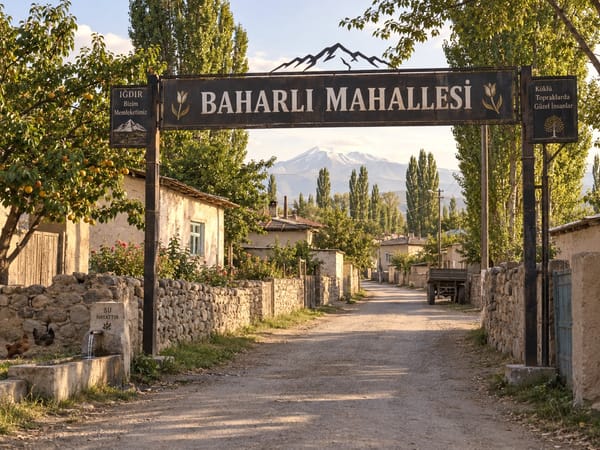
Somehow, one day Kinyas Hun gets engrossed in conversation with his friends, and his return home is delayed until midnight. He sets off towards Baharlı Neighborhood (November 14) in pitch darkness. He can barely see in front of him. "A flashlight is essential for moments like these!" he sighs to himself. As he passes Hacı Ömer Şark's factory and the Asri Hamam and approaches the triangle of Meşe Kerem's poplar grove, the late Blind Hacı's house of sorrow, and the slaughterhouse, his fear increases, but there is no other way home. He slows his steps, hoping that a local might come along and he could walk through this ominous triangle with them. However, neither anyone comes nor goes. He creates scary scenarios in his mind: "What if Blind Hacı appeared in front of me right now, killed me at the slaughterhouse, and buried me in Meşe Kerem's poplar grove..."
At that moment, a cyclist appears beside him. Kinyas Hun is happy. It's someone he knows. The man asks: "Brother, why are you so anxious?" Kinyas Hun replies: "I was thinking about the Bermuda Triangle. You know, planes disappear there for no reason. I am grateful to you for saving me from disappearing in the Devil's Triangle here."