The Hidden Chain of History
History's flow often appears as sudden leaps, but progress is actually the result of silent, gradual accumulation, with each stage preparing the next in an often unpredictable chain.

Dear Readers,
In the flow of history, developments often appear to us as sudden leaps. Great inventions, great discoveries, and new ideas that seem to emerge all at once... Yet, this appearance is misleading. In almost every field of human history, be it technology, science, philosophy, or social structure, progress is actually the result of a silent and gradual accumulation. It is impossible for one stage to emerge without the preceding one. What's more, it's interesting that while each of these stages prepares the direction of the future, what that future will be is often unforeseeable by anyone. The most striking example of this is seen in the development of the computer world. In the 1980s, engineers working on personal computers focused only on innovations for individual use. At that time, no one predicted that these machines would one day form the basis of global networks connecting billions of people, or even open the door to one of the greatest communication revolutions in human history. For the internet to be born, the personal computer first had to emerge, meaning a technical and intellectual foundation had to be established. Once this foundation was laid, a completely new world was born: the Internet. But the internet, in turn, prepared a new line of development. This time, social media networks emerged. Even the founder of Facebook could not have foreseen that a few lines of code he wrote in a Harvard dorm room would create a global transformation. But without personal computers and the internet, this transformation could not have occurred. A similar gradual progression is seen in the history of science. Isaac Newton's law of universal gravitation not only changed the understanding of physics of his time but also laid the foundation for future scientific revolutions. Einstein's theory of relativity is unthinkable without Newton. Newton's laws of motion laid the conceptual stones upon which Einstein's understanding of space-time was built. Darwin's theory of evolution is another example of this logic. Darwin was unaware of the existence of genes; Mendel's work remained unknown for many years. However, when Mendel's laws of genetics were discovered, Darwin's theory gained new meaning, and 20th-century biology was shaped by the complementarity of these two great thinkers. In other words, modern genetics could not have been born without Darwin; modern evolutionary theory could not have been born without Mendel. Social and cultural development is subject to the same law. Without the invention of writing, a legal order could not have been established. Because writing was not only the recording of symbols but also the safeguarding of social memory. Archives were born, and the consciousness of record-keeping developed. The record system, in turn, gave rise to tax regulations, the state mechanism, and the institutionalization of law. With the beginning of agriculture, people obtained a surplus of production. This surplus gave birth to cities; cities developed trade, and trade developed law and political structures. This chain, where one social form prepares the next, is one of the most fundamental laws of history. No one imagined the city-states that would emerge a thousand years later while plowing the field; but cities were a result made possible by agriculture. CUMULATIVE DEVELOPMENT AND EMERGENCE THEORY Two concepts stand out philosophically to explain this situation: cumulative development and emergence theory. Cumulative development states that every idea and every technological innovation arises based on the accumulations that preceded it. Emergence theory, on the other hand, points to a more interesting point: when a certain level of maturity is reached, and parts come together, a new whole emerges that could not have been foreseen before. This whole cannot be derived from the properties of the individual parts. Social media is like this; the engineers who wrote the protocols that formed the internet did not know that they were sowing the seeds of a global communication revolution. But when the structure matured, a new level spontaneously emerged. History is not a straight line guided by human will; but it is not entirely a game of chance either. The future always arises from the accumulations of the past. It is impossible for one stage to emerge without the completion of the other. Therefore, every major transformation carries behind it a long and often unnoticed period of preparation. Many developments that surprise us today are actually the natural result of yesterday's silent accumulations. THE UNFORESEEABLE CHAIN OF SOCIAL DEVELOPMENT Just as in technological and scientific progress, there is a similar gradual chain in the development of human societies. None of the concepts that seem perfectly natural to us today were designed or planned in the early periods of humanity. The cave dweller did not know that one day he would build cities. Communities that transitioned to village life could not foresee that the logical outcome of a village would be a city. However, with the beginning of agriculture, when a production surplus emerged, a more complex social organization became necessary to protect, distribute, store, and manage this surplus. Thus, cities were born from villages. When cities emerged, the need for defense grew; walls, guard units, and the first regular military structures were formed. This time, the existence of cities prepared a new stage. Families governing cities gained power, and over time, the concept of dynasty emerged. No urban community, while struggling with rival cities around it, imagined that one day it would reach the level of an empire. However, as cities grew, trade expanded, and the population increased, the political structure also expanded. This expansion gave birth to the era of empires. Great empires like Rome, Persia, China, and the Ottoman Empire were actually expanding rings of small accumulations composed of local communities over time.
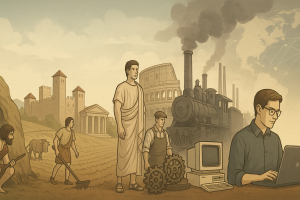
The development of humanity: From cave to artificial intelligence... Languages and ethnic identities were also shaped in this process. Languages, initially a means of communication for small groups, began to standardize with increasing urbanization. The emergence of administrative centers led to language transforming into a higher form of communication. Large-scale affiliations, which we call ethnic identities, also developed within these political structures. However, no one knew that tribal ties would later form the basis of national identity. Each stage of this transformation was a necessary consequence of the previous stage: without settled life, there could be no linguistic unity; without linguistic unity, no national identity; and without national identity, no modern state system. The modern political order in the form of nation-states is both the result and a new beginning of all these processes. When nation-states emerged, they also brought with them new types of social conflicts. In geographies where ethnic and political borders did not coincide, identity-based tensions became inevitable. Just as the urbanization of villages gave birth to empires, the dissolution of empires sowed the seeds of modern ethnic problems. No one foresaw the national identity debates that would emerge centuries later when they founded their village, but the process continued to flow towards that point. War technology also progressed parallel to this line of social development. Sticks and stones used by small tribes transformed into organized armies with the emergence of cities, and with the existence of these armies, into spears, armor, and walls. As empires grew, war tools also became more complex; a new era opened with the invention of gunpowder. The competition of modern nation-states, in turn, fueled the industrial age, and the industrial age fueled modern war technology. The origin of today's advanced weapons lies in the stone carved by cavemen thousands of years ago for hunting. The process followed a path that no one foresaw but was necessarily guided by accumulations. Social development is thus linked to the same law as technological development: each stage is both the product and the preparer of the preceding stage. This long line extending from the cave to the village, from the village to the city, from the city to the empire, and from there to the nation-state, is a chain that shapes both the identity and the destiny of humanity. The next stage cannot even be conceived before one stage is completed. But when each step is completed, the seeds of the next, even if unnoticed, have silently sprouted. CONCLUSION: THE FUTURE IS THE UNEXPECTED CHILD OF THE PAST History shows us this: predicting what the future will bring is almost impossible. Even the most sophisticated predictions are often merely estimates that repeat the conditions of their own time. Humans can at most take short-term steps using today's data. Neither scientists could see that the internet would give birth to social media, nor did the communities that founded villages imagine empires, nor did empires foresee the birth of nation-states. Each stage appears as an inevitable continuation of the one before it, but in reality, the outcome is never one hundred percent determined. The future is not a necessary consequence of the past; it is only an unexpected child that sprouts from it, whose form and direction can only be understood when it emerges. Therefore, it is impossible for us to know the future entirely. The only thing we can do is to take steps by carefully evaluating the information, opportunities, and conditions we have today. Every prediction is only a possibility; its realization is not guaranteed. The greatest transformations in history have repeatedly demonstrated this truth. The future always has the power to surprise us, and perhaps that is precisely what makes human history interesting.