Infinite Sound, Infinite Alphabet, Infinite Falsification
This essay explores the infinite possibilities of human sound and writing systems, critiquing a recent claim of a newly discovered Runic inscription in Turkey as a likely falsification.

Dear Readers!
I assume that many of you know a foreign language or are striving to learn one. There is a reality that troubles all of us when learning a language: we struggle to pronounce certain sounds, and even after years, or even living in the country where the language is spoken, we still feel uncomfortable producing these sounds that seem strange (!) to us.
Due to my curiosity about different languages, I frequently encountered such problems. For example, when I was learning English in high school and university in Turkey, there wasn't a single student who could successfully pronounce the "th" sound, which requires placing our tongue between our front teeth. I understood the seriousness of the matter even better when learning Arabic. As I learned more languages, I noticed these difficulties persisted, which piqued my interest in the subject, and I conducted research. The conclusions I reached were alarmingly profound.
CHESS, THE CHINESE GAME OF "GO," AND INFINITE SOUND
I don't want to overtax your minds. I will present my point by starting with a simple example. I assume all of you are familiar with the game of chess in some way. In chess, there are two players and 16 pieces for each player, making a total of 32 pieces. We might ask, how many different possibilities are there in a chess game? Mathematicians agree that calculations suggest this number could be between 10111 and 10123. For example, if I tell you that 105 means 100,000 (five zeros), you will have an idea of the magnitude of the number 10123.
Perhaps you still don't grasp the seriousness of the matter. In that case, let me state this: the total number of atoms in the known universe (all stars, galaxies, etc.) is estimated to be between 1078 and 1082. In short, the number of moves in a 32-piece chess game is 1042 times greater than the total number of atoms in the entire universe. This suggests that the number of moves in chess is almost INFINITE.
There is a game called GO, played by the Chinese with stones. If we consider that the number of moves in the game of GO is 10170, it means that the game of GO has 1047 times more moves than chess. This number also practically means INFINITE.
Why did I write all this? Human vocal cords are capable of producing around 500 vowels and consonants. If we consider that there are 10123 possibilities in a 32-piece chess game, it is impossible for mathematicians or computers to calculate this number for a 500-piece chess game.
This means that humans can produce an infinite number of different sounds. Indeed, because this is the case, hundreds of thousands of different languages have existed in the world so far, or billions of different languages may emerge in the future. Therefore, no one should fall into the absurd obsession of saying, "Our nation's language is the most beautiful."
INFINITE ALPHABET
Since English is currently the most popular language in the world, I want to continue my writing based on this language. There are 26 vowels and consonants in English. We can ask how many different words can be produced from 26 letters. With a simple mathematical calculation, we can see that this is 67,108,868. This means that no matter how much English develops, the number of words cannot exceed 67,108,868.
I hope an important point has caught your attention: humans can produce an infinite number of different sounds, but in written language, they are forced to express this with a limited number of words.
Throughout their historical development, humans, living in different regions and isolated from each other, defined objects and daily life by producing sounds that were not present in other groups. Since the number of objects and actions is limited, humans conveyed their thoughts by writing and carving them on paper, stone, etc., using alphabets and ideograms.
Currently, a few of the active alphabets in the world are:
- Latin
- Greek
- Cyrillic
- Armenian
- Korean
- Hebrew
- Arabic
- Braille (Alphabet for the Blind)
- Georgian
- Mongolian
(Note: To give an example, in the last 200 years, the Kurmanji language has been written with Arabic, Armenian, Cyrillic, and Latin alphabets. If desired, the Kurmanji language can be written with Korean, Georgian, or all other alphabets. There is no problem with that!)
SYLLABIC AND IDEOGRAMMATIC (SIGN INDICATING MEANING) ALPHABETS
In Japanese, three writing systems are used together: Hiragana, Katakana, and Kanji.
Hiragana and Katakana are not alphabets but are based on a syllabic system. Kanji is an ideogram, where each shape expresses a meaning. In short, the Japanese do not have an alphabet. That is, they did not need to develop an alphabet where each sound corresponds to a letter.
JAPANESE KATAKANA AND HIRAGANA WRITING SYSTEM
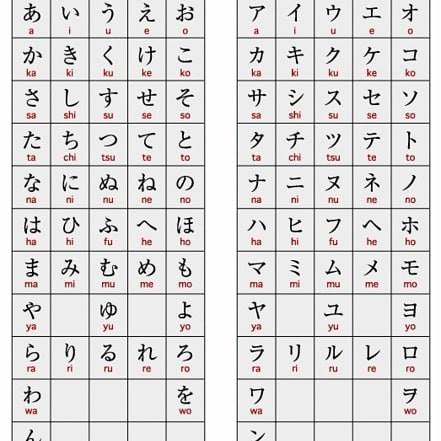
The syllabic and ideogrammatic system is a system that humanity used in its first transition to writing. For example, cuneiform writing was based on syllables, not letters. Each sign corresponds to a syllable.
CUNEIFORM WRITING

Since humans can produce a symbol for each syllable as they wish, this practically means that humans have the power to produce an infinite number of syllables, ideograms, or alphabets to put what they say into writing. Just as we have the ability to produce an infinite number of different sounds, it is possible for us to produce an infinite number of strange shapes or alphabets to express these sounds in written language.
EGYPTIAN HIEROGLYPHIC WRITING

Egyptian hieroglyphic writing consists of hundreds of symbols that can be easily distinguished from each other. Each sign represents a certain sound or object. This writing can be written from left to right, or right to left, or top to bottom. There are more than 700 signs in Egyptian hieroglyphs. Therefore, the literacy rate was low, because hieroglyphs were not an alphabetic writing system.
RUNIC WRITING

Germanic peoples invented Runic Writing before the Latin alphabet. The etymology of the word is derived from the root "rūnō," meaning something like "secret, mystery."
WHY DID I WRITE ALL THIS?

Runic inscription on stone, claimed to be found in Konya
On September 3rd, there was a news report in Cumhuriyet newspaper:
"Discovery in Konya to shed light on Turkish history: Inscription mentioning the name 'Turk' discovered
In Konya, at the excavation site of the ancient city of Savatra, an inscription with the phrase 'Turk' for the first time belonging to the early pre-Islamic Turkish history, written as 'Türkoğlu' in the Runic alphabet, was found. Excavation Head Assoc. Prof. Dr. İ. I. stated that the inscription, dating back to the 10th-11th centuries AD, is evidence of the Turkish presence in Anatolia before 1071. "The discovery of the Turkopol inscription is very important for us. Turkopol, in its Turkish equivalent, means Türkoğlu (Son of Turk). This is the first inscription of its kind found in Anatolia. In terms of its importance, we can say this; it is evidence showing the existence of Christianized Turks here in the period before 1071, before the banner of Islam was brought here by the Turks."
Up to this point, there seems to be no problem. The aim of the lecturer can be seen as an attempt to revive the Sun Language Theory of the 1930s or, inspired by this theory, to prove the existence of Turks in Anatolia since the earliest periods of history. Trying to glorify one ethnic group without any reason is another way of belittling all other ethnic groups. I would like to state that I do not find this approach consistent with scientific ethical values.
I want you to look carefully at the image above. None of the characters above are in the traditional Runic Alphabet. It is clear that this inscription was recently carved on stone, and a "New Runic Alphabet" has been discovered with fabricated characters.
I ask, why can a scientist be so simplistic? I assume it's to attract attention, to become famous.
The real reason that gave the lecturer this courage (!) should be sought in his invention of a "Runic Alphabet" by assuming that the possibility of "Infinite Sound" leads to the possibility of "Infinite Alphabet." In my opinion, such a fake discovery has cast a shadow on the prestige and scientific credibility of Selçuk University. What a shame! I hope the university sends an article refuting mine to my newspaper, and I will gladly publish it.