Five Fundamental Principles of a Modern Kurdish Party
This essay outlines five fundamental principles for a modern Kurdish party in Turkey, emphasizing a realistic vision, sociological inclusivity, peaceful engagement, national context, and a rejection of outdated ideologies.
MÜCAHİT ÖZDEN HUN
mucahithun@yahoo.com
If we set aside the silent period between 1930 and 1965, legal or illegal Kurdish parties have always existed in Turkey under various names, from past to present. Even now, parties such as HDP (Peoples' Democratic Party), HAK-PAR (Rights and Freedoms Party), PAK (Kurdistan Freedom Party), HÜDA-PAR (Free Cause Party), PSK (Kurdistan Socialist Party), Kurdistan Democratic Party-Turkey, Azadi Movement, Kurdistan Communist Party, etc., continue their activities.
Although the programs and statutes of each party contain similar expressions in many respects, it is possible to see that some have theses such as Greater Kurdistan (Pan-Kurdism), some Autonomy, some Federalism, etc., as their distant goals, and they diverge on this basis. Some consider Kurdistan a colony, some claim that feudal production relations still persist, and some pursue a policy that ties their hopes to the support and sympathy of external powers. We must also acknowledge the existence of many large and small illegal parties or terrorist organizations that, like the PKK, base their struggle on armed conflict.
Looking from 1965 to the present, we see that legal or illegal Kurdish parties have always repeated themselves in terms of program and statute, with the same rhetoric circling like a carousel. The main reason for this lies in the inability of all these parties to create a new vision in line with the conditions of the age, their entanglement in ideological structures and their imposition of these ideological molds on the people, as well as their insistence on either ignoring or failing to understand the diversity of the sociological structure in Turkish Kurdistan and their failure to grasp the reality of the nation-state.
FIVE FUNDAMENTAL PRINCIPLES
1. THE VISION OF A MODERN KURDISH PARTY MUST BE ACHIEVABLE
Vision is a roadmap and also an inspiring discourse that unites party members. Vision is not an expression that is changed every now and then. The biggest deficiency of Kurdish parties in Turkey is their inability to clearly articulate their VISION goals. The word VISION is confused with the word Mission. Mission means redefining the strategy pursued according to changing circumstances. For example, a farmer plans to sow seeds the next day. The next day, due to an unexpected all-day downpour, the farmer has to postpone his plan, i.e., change his mission. He spends his day engaging in another activity. The farmer's VISION, for example, might be to obtain twice the yield of the previous year. While mission is variable, VISION is permanent and guiding, like an inscription carved in granite.
To give an example from parties in Turkey, I would like to take HDP, as it is the largest party. HDP and its predecessor parties, which were established and closed down since the 1990s, have constantly changed their VISION statements. Initially, the expression "Greater Kurdistan," encompassing four parts of Kurdistan, was set as the VISION, but in later years, this VISION underwent change, the "Greater Kurdistan" vision was abandoned, only the independence of Turkish Kurdistan was targeted, then this goal was also abandoned, moving to Federal Kurdistan, and from there to Autonomy, and now to a difficult-to-understand expression. If we say that HDP is a party without a VISION, we would not be using a misleading statement. The same situation can be observed in other parties.
On the other hand, the VISION statement must have an "achievable" essence. Perhaps it might be possible to flatter the emotions of the masses with the expression "Greater Kurdistan," but setting such an unachievable goal as a VISION would be a serious obstacle to the party's goals and would mean wasting the energy and constructive power of the masses.
The VISION of a Kurdish Party to be established in Turkey must be determined in accordance with the historical and sociological reality of Republican Turkey. The VISION of parties in other parts of Kurdistan should not be copied; Kurdish parties in all four parts should determine their VISIONS based on the characteristics of the Nation-State they are in and conduct their struggles in accordance with the conditions of their respective countries.
The goal of a Modern Kurdish Party to be established in Turkey should be to gain the right to identity and mother tongue education for the Kurmanj and Zaza nations, to ensure the development of these languages parallel to Turkish, but to achieve this by accepting Turkish as the official language. Neither Kurmanj nor Zaza has the chance to achieve second official language status nationwide in the Republic of Turkey. Considering the sociological structure of Kurmanj and Zazas in Turkey (linguistic and sectarian differences), the establishment of INDEPENDENT, FEDERAL, and AUTONOMOUS structures in Turkish Kurdistan is impossible and meaningless. In Turkey, Kurds are dispersed throughout the country, intertwined with other peoples. In regions where Kurmanj and Zazas are concentrated, the establishment of universities in an educational sense can be targeted, and even some work can be done in terms of civil self-governance, and even, based on a certain percentage of the population, Kurmanj or Zaza can be accepted as a local official language alongside the official Turkish language in some regions, but the struggle for SELF-GOVERNANCE in a political and military sense means nothing more than wasting the time of Kurmanj and Zazas.
2. A MODERN KURDISH PARTY MUST VALUE LINGUISTICALLY KURMANJ AND ZAZA, AND RELIGIOUSLY SUNNI/YAZIDI/ALEVI DIFFERENCES
In a sociological sense, we must consider that there are five basic structures in Turkish Kurdistan:
- Kurmanj-Sunni
- Kurmanj-Alevi
- Zaza-Sunni
- Zaza-Alevi
- Yazidis
A Modern Kurdish Party cannot be established in Turkey by ignoring, denying, belittling this sociological reality, or even accusing those who express it of "dividing Kurdistan." It is impossible for parties that consider these five different sociological structures as a whole by calling them "KURD" on paper, without taking into account the sociological differences between them, to be successful. In a Modern Kurdish Party, religious and linguistic factors must be equally valued. The word "KURD" should be used to encompass all the above groups, not just as a reference to one of them.
There is another point I want to draw your attention to here: although Yazidis speak Kurmanj, they will probably prioritize their religious values and identity over Kurmanj. This is their natural right. A similar situation is experienced, for example, in South Azerbaijan, with Tabriz as its capital. The teaching of the Azerbaijani language is forbidden. Azeris living in this region prioritize the "Jafari" faith over ethnic and linguistic identity. Within the framework of the Nation-State, these preferences must be respected.
Socialist Kurdish Parties, because they disregard religious structures and beliefs, mostly base their structure on linguistic, i.e., Kurmanj-Zaza, divisions. We even know that there are language chauvinists who, with the idea of establishing "a single Kurdistan," argue that Zazas should learn Kurmanj instead of their own language. In a Modern Kurdish Party, the linguistic-religious balance must definitely be taken into account and be a part of its VISION.
3. A MODERN KURDISH PARTY MUST HAVE AN APPROACH OF HARMONY AND PEACE, NOT CONFLICT WITH OTHER PARTIES AND THE STATE
Unfortunately, a habit accumulated over years has caused a phenomenon to be perceived negatively in people's minds: "If a Kurdish Party wants to maintain its existence and increase its membership, it must keep its distance from other parties and always adopt an accusatory stance against the state." This understanding has continued since 1965. When the party's VISION is defined as "Independent Kurdistan" or "Federal Kurdistan," conflict with the fundamental values of the NATION-STATE structure will inevitably arise. These unnecessary conflicts and tensions have caused Kurmanj and Zazas to lose a great deal. If the reality of the Nation-State had been taken as a basis, today Zazas and Kurmanj would have had the chance to develop their own languages at a university level, alongside the official Turkish language.
The NATION-STATE structure established in Turkey in 1923 was founded by denying the identity and autonomy rights of Kurds, and Kurds responded to this injustice with rebellion and resistance, but they were not successful. In short, Kurds worldwide have not been able to establish their NATION-STATES anywhere. To retroactively blame someone for this, or even to go back in history and try to demand accountability for autonomy rights that were not granted by saying, "Atatürk granted autonomy rights to Kurds but then denied them," means not living in the SPIRIT OF THE TIMES. Even if it is against the interests of Kurmanj and Zazas in Turkey, there is now an established NATION-STATE structure. It is meaningless to go back and demand accountability. The correct method is to develop the religious and linguistic rights and secure the identity rights of Kurmanj and Zazas in the Constitution by struggling within the framework of the struggle for Democracy with other parties under existing conditions. TURKISH KURDS MUST END ARMED STRUGGLE AND NOW CONDEMN THIS METHOD. NEITHER A GREATER KURDISTAN CAN BE ESTABLISHED WITH THIS METHOD, NOR CAN THE MOST BASIC RIGHT, THE RIGHT TO EDUCATION IN THE MOTHER TONGUE, BE GAINED.
4. THE GAINS AND STRUGGLES OF KURDS (KURMANJ, SORAN, ZAZA, ETC.) LIVING IN THE FOUR PARTS (TURKEY, IRAQ, IRAN, SYRIA) SHOULD BE SEEN AS PART OF THE REALITY OF THAT COUNTRY.
One of the biggest mistakes of Kurdish Parties established in Turkey is that they are directly influenced by Kurdish Movements in other parts, or they force themselves to be influenced, or even organize as a continuation of them. For example, if Masoud Barzani declares an Independent Kurdistan in Northern Iraq, there is a prevailing understanding that Kurdish parties in Turkey should follow the same path. If Kurds (Kurmanj, Soran, Zaza, Goran, etc.) want to do themselves a favor, they should take into account the dynamics of the NATION-STATE reality they live in and develop appropriate strategies. The issue of establishing an Independent Kurdistan in Northern Iraq is a problem of the IRAQI Nation-State reality. As you know, today 250,000 Kurds live in Kazakhstan. Many were exiled by Stalin, and some migrated to Kazakhstan due to the Armenians occupying Red Kurdistan and exiling Kurds during the Armenia-Azerbaijan war. The Kurds living there are now part of the Nation-State structure of the Kazakh state. If the Kazakh state wishes, it can deny the rights of Kurds or even assimilate them, as Azerbaijan did. This issue should attract the attention of Kurdish parties in Turkey in terms of sister languages, but politically, expressions and rhetoric that interfere with the internal affairs of Kazakhstan or other countries should not be included in the party program. I would like to draw your attention to President Erdoğan's poem "ARAS" read on December 11. This poem essentially expresses the longing for the unification of North and South Azerbaijan. The Iranian state immediately reacted to this poem. It is right to do so. Because South Azerbaijan, with Tabriz as its capital, is part of the Iranian Nation-State. Azeris in Iran should seek their rights, such as education in their mother tongue, within the reality of the Iranian Nation-State.
5. A MODERN KURDISH PARTY SHOULD NOT USE THE WORD "SOCIALIST," AND THE USE OF THE WORDS "FEUDAL AND TRIBAL" SHOULD BE ABOLISHED. THE FEMINIST COMPLEX SHOULD BE ABANDONED.
The fundamental premise of Marxist doctrine is its acceptance of the existence of classes in society and its claim that societies progress by transforming from one mode of production to another through class struggles. The collapse of the Soviet Union proved this hypothesis wrong. In the 19th century, when Marx lived, savage capitalism emerged with all its injustices. Even children were forced to work 15 hours a day. To remedy these injustices, trade unions emerged, and Marx wrote to establish a humane and egalitarian society by organizing workers, i.e., proletarians, to take power from the bourgeoisie. Today, we understand that the socialist mode of production, as envisioned by Marx, is not superior to the capitalist mode of production. Increasing PRODUCTIVITY, which is more suitable for human nature, i.e., the existence of competition and a market economy, is superior to a stagnant, dull Socialist mode of production where there is no competition.
In this sense, a Modern Kurdish Party should be structured in accordance with the conditions of the latest stage of capitalism, where classes no longer exist, and should avoid classic "working class, bourgeois" expressions because these words no longer have meaning and value in real life.
Furthermore, the words "Feudal" and "Tribal" should not be used in a Modern Kurdish Party. Feudalism is a mode of production and was gradually relegated to the dustbin of history with the French Revolution. For years, within the Kurdish and Turkish left, the mode of production in Eastern and Southeastern Anatolia has been considered "Feudalism," and its social structure has been belittled as "Tribal." Tribalism is a sociological and social phenomenon that has existed since the beginning of humanity; it is not a mode of production. What a Modern Kurdish Party needs to do is to transform tribes into Civil Society organizations under the name of "Social Solidarity Associations," and to benefit from this sociological integrity in this sense. As a good example of this, the Metina, Celali, Bruki, and Redki social solidarity associations can be shown. I congratulate the founders of these associations. These are not reactionary and primitive structures. Within the vision of a Modern Kurdish Party, these social solidarity associations can transform into very important CIVIL SOCIETY organizations.
We know that some parties have established "women's rights" and "quota systems in terms of women's representation in politics." Feminism has now closed its era. "Co-chairmanship" structures are a manifestation of primitive feminism and a lack of self-confidence. Women's rights are now fully guaranteed in the Constitution and by legal measures. Let alone women's rights, we know that legal regulations for animal rights are even being implemented today. In the party to be established, the concept of "productivity" should be taken as the basis, rather than the balance between men and women.
CONCLUSION:
I believe that the establishment of a Modern Kurdish Party that adopts these five principles will contribute both to the Kurmanj/Zazas/Yazidis and to the Republic of Turkey establishing itself as a strong state in the region.
ORIGINAL IĞDIR ANECDOTES
(Dear readers! Those who read MISTO's story in my previous article expressed great sadness, and some even reproached me. To alleviate some of my friends' sorrow, and to relieve my own conscience, I present to you Iğdır anecdotes that have not been published anywhere else.)
NOTE: The anecdotes below reflect the reality of Iğdır during a certain period. We remember the mentioned personalities with mercy and respect.
FREE TEA
It's the mid-1970s. Iğdır is sharply divided into right and left. The mayor is the late Hüseyin Akbulut, a right-winger. The late Hamit Hun, a left-winger, owns a large apricot orchard. Hamit Hun believes the municipality unfairly demolished the back wall of his orchard and incorporated it into a newly opened road. Hamit Hun first tries to involve friends like Talat Tufan, but without success. Hüseyin Akbulut insists that the wall is within the municipality's boundaries. Hamit Hun wanted to hire a lawyer, but Attorney Muzaffer Öztekin, taking advantage of Hamit Hun's desperation, quoted such a sum that Hamit Hun's heart almost stopped.
As Hamit Hun walks in front of the municipality building, he mutters to himself:
"Well, I'll go and talk to the Mayor face-to-face! This is my right as a citizen! Why should I pay the lawyer a fortune?"
With this thought, Hamit Hun starts walking towards the entrance of the Municipality Building. In the political climate of that day, the officer at the door, seeing Hamit Hun, a CHP member, a leftist, and a "Communist," approaching the Municipality Building, becomes flustered and stops Hamit Hun in a harsh tone:
"What do you want?"
"I wanted to present a complaint to the Mayor!"
"Wait a minute! I'll be right back."
The officer rushes up the stairs, enters the Mayor's office, and breathlessly explains the situation:
"Mr. Mayor, Hamit Hun is at the door! He wants to see you. What should I tell this Communist?"
The Mayor immediately stands up and goes to the next room. "Let him in. Let him sit in my office. Stall him by saying 'The Mayor is busy.' After he drinks a few teas, he'll leave."
Hamit Hun sinks into the armchair in the Mayor's office. The officer makes an explanation:
"The Mayor has some work. He'll be down soon! Have some tea for now!"
Hamit Hun drinks the tea served to him in crystal glasses. Another tea arrives, but the Mayor is still nowhere to be seen. Hamit Hun also has nothing else to do. One tea, second tea, third tea, and then working hours are over. The officer enters, putting on a fake and sad expression:
"The Mayor was very busy. It wasn't meant to be today."
Hamit Hun politely gets up, stops by the bookstore, puts the evening newspapers under his arm, and returns home. The next morning, Hamit Hun sets off again to go to the Municipality. The late Hacı Cihangir Turan had just opened his pharmacy and was sitting on a stool. He calls out to Hamit Hun:
"Hamit, what's up? Where are you going so early in the morning?"
"Don't ask! Lady luck has smiled upon me! I found a place where I can sit all day and drink free tea. I also brought the newspapers I couldn't finish reading last night. If you want, you can visit me sometime!"
Hacı Cihangir Turan asks curiously;
"Where?"
"The Mayor's office!"
HÜSNÜ BİNGÖL'S PIPE
Hüsnü Bingöl, the General Inspector of National Security who terrorized Iğdır between 1932 and 1954, was fond of pipes. His friends, knowing this, would always bring a pipe as a gift when they visited. At that time, Hüsnü Bingöl was the number one target of the Soviet counter-espionage network. The Soviets tried every means to kill Hüsnü Bingöl.
Every day, after the midday heat subsided, Hüsnü Bingöl would go to the Municipality garden with his dog and enjoy chatting with acquaintances and friends. While sipping Turkish coffee, he would either smoke a nargile or place his pipe in his mouth and take deep, pleasurable puffs.
One day, Hüsnü Bingöl was sitting majestically, puffing on his pipe. One of his friends interjected:
"Sir, we hear that every guest brings you a new pipe as a gift, but you always use the same pipe. Why don't you use the others occasionally?"
Hüsnü Bingöl looked sternly:
"Tomorrow, I'll bring you one of those pipes. You use it for a day. If you don't die, then I'll use it!"
His friend, understanding the situation, stammered to finish his sentence:
"No, sir, what do you mean! This pipe really suits you."
THIS NEWSPAPER ISN'T WORKING
One day, the late Kinyas Hun, a staunch Galatasaray fan, was walking angrily. He had rolled up the newspaper in his hand, holding it in his right hand and hitting the palm of his left hand hard, while muttering loudly:
"It's time for a change! Yes, I have to now!"
Kinyas Hun's walking and talking to himself in this manner did not escape the attention of one of his admirers. He approached him:
"Kinyas Abi, what happened? Is there something bothering you?"
"Galatasaray has lost matches for two consecutive weeks. You know, I always follow sports news from Milliyet newspaper. From now on, I've decided to buy Hürriyet newspaper."
RUTTO YUSUF
Rutto Yusuf is Hüsnü Bingöl's most important intelligence agent in Iran. He has agents who carry information to Rutto Yusuf over a wide area, from Maku to Urmia, from Tabriz to Tehran. Rutto Yusuf also acts as if he is smuggling to conceal his identity as an intelligence agent.
One day, his path takes him to Tabriz. He sees incredibly beautiful porcelain plates. "If I sell these in Iğdır, I'll make good money," he thinks. He fills two saddlebags of his horse with porcelain plates and sets off for Iğdır. As luck would have it, almost all the porcelain plates are either broken or cracked by the time he reaches Iğdır. Rutto Yusuf is very angry. Suddenly, a brilliant idea comes to his mind. As he approaches Iğdır, he gallops his horse and comes to Hüsnü Bingöl's office.
"Sir, I have brought you important news! An Iranian agent has come to Iğdır to kill you!"
Hüsnü Bingöl nods meaningfully. Rutto Yusuf continues:
"All my porcelain plates broke when I galloped to deliver this urgent news to you on time."
"How much did you pay?"
"20 Tuman"
Hüsnü Bingöl enters his room. He takes the money from the drawer, goes out to the balcony, and hands Rutto Yusuf 30 Tuman. Rutto Yusuf is delighted and congratulates himself on his clever invention. Just as Rutto Yusuf is about to leave, Hüsnü Bingöl calls out from behind:
"I gave you the extra 10 Tuman for making up such a good lie!"
GÖDEKLİ VILLAGE
It's the 1940s. One day, two friends, an Azeri and a Kurd, set off from Gödekli village towards Iğdır. Of course, in those years, there were no motor vehicles, and horse-drawn carriages or phaetons were very rare. After walking for a while, an idea comes to the Azeri's mind: "If both of us walk, both of us will get tired. Let's do this! First, I'll ride on your back. Carry me for 500 steps. Then you ride on my back, and I'll carry you for 500 steps, so we both continue our journey resting."
This idea appeals to the Kurd. First, the Azeri rides on the Kurd's back. When 500 steps are completed, this time the Kurd rides on the Azeri's back. When another 500 steps are completed, the Azeri rides on the Kurd's back again. Then they take a short break. The Azeri confesses: "Before, when I walked this far, I used to get less tired. We are doing something wrong. If you want, let's correct our mistake. Let's go back to Gödekli village and set off towards Iğdır normally."
The Kurd immediately steps forward: "Kirve, riding on the back was your idea. You go back to Gödekli, come back here with normal steps. I'll wait for you here." The Azeri goes back to Gödekli, then returns towards Iğdır with normal steps. Soon he reaches the Kurd. "I corrected my mistake. Let's continue walking now." The Kurd, who carried the Azeri on his back twice, does not miss the opportunity: "There's an injustice! You carried me on your back once, I carried you twice! You need to carry me on your back for 500 steps too!" The Azeri agrees. The Kurd rides on his Azeri friend's back. The confused Azeri calls out: "Which way should I go now? To Gödekli or to Iğdır?" The Kurd replies with a grin: "Go whichever way you want! Just carry me on your back for 500 steps!"
NINO SEFER
(Nino Sefer, once an indispensable figure in our Iğdır, has been mentally ill since childhood. He spends most of his time wandering the streets of Iğdır or sleeping. He is scorned, stoned, but also loved enough to have a book written about him and is forever buried in our hearts.)
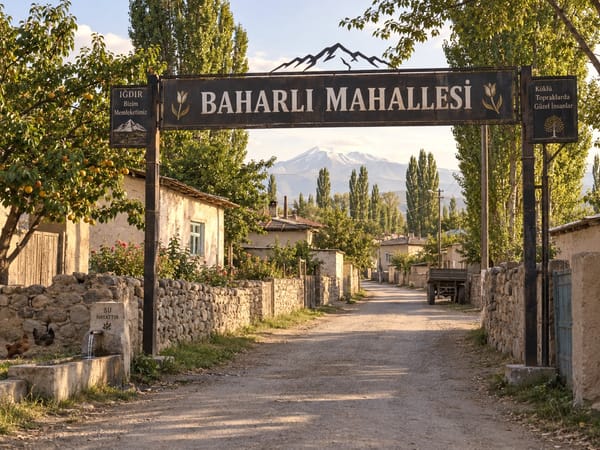
One day, Nino Sefer approaches a phaeton driver. "Take me to Baharlı Neighborhood!" The phaeton driver, who knows Nino Sefer well, is worried he won't get paid, but he also has a responsibility to serve a customer. Nino Sefer gets into the phaeton and settles into the seat. When the phaeton reaches Baharlı Neighborhood, Nino Sefer nudges the driver from behind: "Now let's go to Topçular Neighborhood!" Nino Sefer again sinks peacefully into his seat, greeting passersby as needed. The phaeton arrives at Topçular Neighborhood. Nino Sefer nudges the driver from behind again. "Let's return to the city center!" The driver, taking the command, heads towards the city center and stops at the phaeton station in front of the Municipality building. Nino Sefer gets out of the phaeton. He starts walking as if nothing happened. The phaeton driver calls out from behind: "Sefer brother, aren't you going to pay?" At these words, Nino Sefer suddenly starts breathing rapidly. He throws stones he took from his pocket at the phaeton driver, shouting: "You've been driving me around for two hours for nothing, and you still have the nerve to ask for money!"