The Triumph of Will: Yusuf Akgün (1)
This is the inspiring story of Yusuf Akgün, who, at the age of five, lost both arms in an electrical accident but overcame adversity to become a national athlete and a renowned painter, using his mouth to hold the brush.
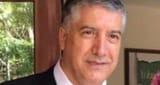
INTRODUCTION
Dear Readers:
Life sometimes delivers its harshest blows when we are most vulnerable. At just five years old, a child from a poor Kurdish family, struggling to survive, lost both arms in an electrical accident. It seemed his life story was over. Yet, within that small body lay a heart big enough never to abandon his dreams and a will strong enough to overcome any hardship. This child, who grew up in orphanages, became a beacon of inspiration not only for himself but for everyone seeking hope through his struggle against life's challenges. His determination in swimming made him a national athlete, and his passion and talent for art led him to become a renowned painter, holding the brush with his mouth. What you are about to read is a cautionary tale of how a person can be reborn under the most challenging circumstances.
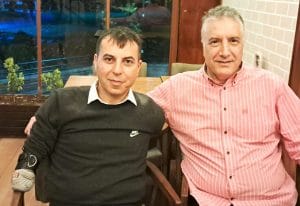
Yusuf Akgün and Mücahit Özden Hun
“LELÊ! LELÊ!”
The year is 1990… “Lelê! Lelê!” (Mother! Mother!) cried the 4-year-old child after his mother… “Min bibe ser pişta xwe!” (Take me on your back!) he pleaded. His mother was gathering brushwood in the open fields of Karakuyu village. She took Yusuf on her back, wrapping him tightly with her sash. Yusuf rested his head on his mother’s back. He continued to smell the flower he had picked.
***
Yusuf’s father, Yahya, had come from Aliköçek (Alibey) village and settled in Karakuyu, marrying a girl named Emine from Suveren village. Yahya was a member of the Gêloî tribe. Emine was from the Elyan tribe. Young Yahya did not yet have a house of his own. He was staying at his brother Şerif’s brother-in-law’s house.
There was a fountain in the middle of the village. Women would meet at the fountain, chat, and carry water for their homes in buckets. Young Yusuf’s greatest pleasure was going to the fountain on his mother’s back and eavesdropping on the women’s conversations. Years would pass, but he would never forget the women chatting and laughing in Kurdish.
***
Yusuf was born on October 10, 1986, as the first grandchild of the Akgün Family. His father, Yahya, had a three-wheeled vendor cart. Yahya would disappear during the day, work in Iğdır city center, and return home late at night.
There was no end to the feuds within the Gêloî tribe. Before marriage, young Yahya also had his own enemies. He always carried a pistol… He had a stern, quiet disposition. He didn't make friends with the villagers and often got into arguments... His father, Abdurrahman, was disturbed by his son's behavior. One day, he even said, "I will kill him with my own hands," grabbed a shovel, and hid behind the wall. His wife, Güvercin Hanım, saw this. She threw herself forward. Yahya escaped and fled. The shovel blow landed on Güvercin Hanım's back. Fortunately, there was no serious injury.
When the neighbors saw Abdurrahman, they would say, "Allah gave you Yahya as a punishment." Abdurrahman married Yahya to a girl named Emine from a neighboring village, hoping he might soften. Yusuf was the family's first child.
YEAR 2024… YUSUF AKGÜN NARRATES HIS LIFE
I was a child of 4-5 years old. You might think I received special attention because I was the family's first grandchild. This is not true! Everyone in the family had their share of duties and responsibilities. My mother was under an endless workload: milking sheep, making butter, cheese, yogurt, washing clothes, and preparing meals. My father had bought a piece of barren land between Karakuyu village and Iğdır and was engrossed in the dream of building a large farm… First, he set about building a stone house. He worked alone. He would dig the foundation, then tie ropes to try and build the wall straight. Sometimes, when he was in a good mood while making mortar with his trowel, he would talk to himself in a language I didn't understand. I would be curious and ask in Kurdish. I didn't know any language other than Kurdish anyway:
“Bavo, tu bi kîjan zimanî diaxivî?” (Father, what language are you speaking?)
He would laugh and say:
“Zimanê Lazî ye.” (It’s Laz language.)
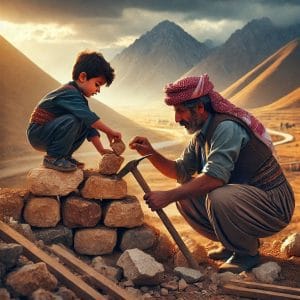
Young Yusuf helping his father build a wall
The surroundings of Karakuyu were full of black volcanic rocks and stones. My father had piled a heap of stones near the house to be built with a tractor. He often needed stones, and my father would take a sledgehammer and break them. He had small hammers to carve the stones. He shaped the stones with great care and enjoyed it. I would also take a trowel and try to fix the places my father had left unfinished, in my own childish way.
My father was skilled in stonework. He did it with an artistic flair, often singing Kurdish folk songs and working in a melancholic mood. My father's biggest problem was that small pieces of stone would occasionally get stuck in his eye. In such cases, he would stop working and wait for the pain in his eye to subside.
In later years, my father would make stonemasonry and house building his profession. My father built many houses in the village with his own hands. Even today, I remember my father breaking stones in his jeans and denim jacket. Over time, small stone fragments would damage my father's eyes, affecting his vision.
My father would wake up early every morning. He had a broken pencil. He would carefully place this pencil behind his ear and take notes for himself. He was a diligent person. He had taught himself to read and write.
He sold the first stone house he built to a neighbor. This time, he bought a larger piece of barren land. We were living in a tent. My father was building the stone house alone with all his might. We had a wheelbarrow. My father would put me in the wheelbarrow, and we would go towards the canal. He would fill the wheelbarrow with canal soil and try to reclaim the barren land where the house was being built. With great effort, he would plant saplings one by one, trying to establish the farm of his dreams. I can say that my father dedicated his life to that farm.
My father was very determined about me going to school. Even though I was five years old, he sent me to the village primary school. My classmates were 12-13 years old. I would set off early in the morning, regardless of snow or blizzard, and go to school. In those years, I didn't know Turkish. We spoke Kurdish at home and at school.
***
My main duty was to herd our sheep. I would gather 40-50 sheep in front of me, drive them upwards from Karakuyu, and head towards Suveren (Orgof) village. While the sheep grazed in the pasture, I would sit by the ant hills with great curiosity and watch their movements. Sometimes, with all my strength, I would overturn small stones and watch the insects scurrying around underneath. I never harmed them. Nor was I afraid… Sometimes I would gather with other child shepherds, set up a makeshift table, and share whatever provisions we had.
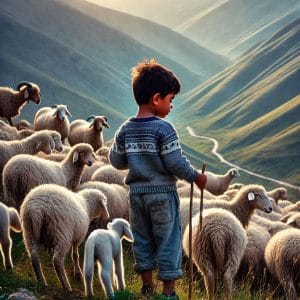
Yusuf herding sheep
My spirit of curiosity and exploration was far beyond my peers. Perhaps driven by a desire to always see new things, I would take my flock further and further each time. I would cross the Iğdır-Doğubayazıt road and head towards the slopes of Mount Ararat.
***
My family was semi-nomadic. In the summer months, we would go to the plateaus on the Kars side. On such days, our belongings would be loaded onto a truck, and we would set off towards the plateau. My father would bring the sheep to the plateau on foot, a journey of about a week. By the time my father arrived, we would have already set up the black tent.
Even at the plateau, I wouldn't stay still; I'd run around, exploring every nook and cranny. One day, a small stream had frozen over. I didn't want to miss this opportunity. I started walking and playing on the ice. It broke, and I fell into the water. They rescued me with difficulty. I still remember lying in bed with a fever that day.
At the plateau, I would lift stones with all my might and curiously watch the insects underneath. On such days, I was stung by scorpions many times, and my family would rush to my side in a panic.
Every day, my interests expanded further; I went to places I hadn't been before, trying to explore nature. My duty on the plateau was to graze the lambs. While the lambs played and grazed, I would get lost among the rocks, pick wild fruits, and dig the ground with a stick in my hand.
We had a dog. I would sneak bread from the table and secretly give it to him. He would get excited, wag his tail, and show his joy.
It was one such day again; I took the bread I had pilfered from the table and approached our dog. I threw the bread in front of him. Dogs from the neighboring tent attacked to snatch the bread. I grabbed a piece of stick from the ground and tried to chase these strange dogs away. The dogs left the bread and attacked me. One of them grabbed me by the back and tossed me around. Another came and tore my face. I was seriously injured by the time my father arrived. They immediately took me to the nearest hospital on horseback. I stayed in bed for days.
***
One day, I was herding the lambs again. My family warned me, "If you're going far, you must be with your uncle Ferdi or aunt Halime." I didn't listen to them. I took the lambs and went far away. On such a day, a group of armed men and women arrived (referring to the armed PKK groups in the mountains during those years. Mücahit). They wanted to take one of my lambs. I resisted. They liked my ownership of my lamb and my courage. "He's exactly the kind of child we want. He'd make a good fighter," they said, and took me and a few other shepherds with them. I stayed among the armed youths for about 20 days. My father found out where I was, came at night, and rescued me.
Sometimes, armed groups would send word, saying, "We will come at such and such an hour, prepare food packages for us." One day, as I was sitting in the black tent, playing by myself, an armed group appeared in the distance. My grandfather and all family members left me and hid behind the distant rocks. When the armed group came to the tent, they asked where my grandfather was. I pointed to the distant rocks. The armed group found my family members and beat them all. After they left, my grandfather came towards me angrily with his cane, and I ran away. The area was full of rocks… I hid behind a rock. I cried and cried… Then I fell asleep right there. They started looking for me. My uncle found me and brought me home. When similar incidents happened, my grandfather would angrily say, "Take this child away." My father then took me to Alıköçek (Alibey) village.
One day, my aunt Fatma came to visit. My aunt loved me. The village where my aunt lived was far away... When my aunt left, I followed her, crying. My aunt didn't even notice me. I crossed stones and rocks and went to the distant village. My aim was to stay with my aunt and have a good time. Since such situations happened frequently, I was forbidden to go to my aunt's.
***
My father had bought me a small watch. I loved my watch. The brides would milk the sheep and pour the milk into large buckets. My grandmother's job was to turn the handle of the cream separator. The cream separator was very important for nomads. With this method, the fat of the milk was separated from its other components. This was necessary for making butter. To be honest, turning the handle was tiring work.
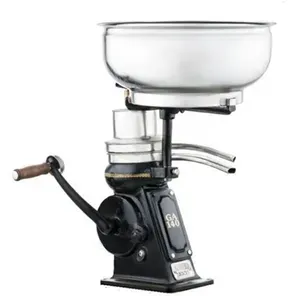
Hand-cranked cream separator used by nomads
One day, as my grandmother was turning the machine's handle with all her might, I used the glass of my watch to reflect a beam of light, seeping through the tent, into my grandmother's eyes. My grandmother didn't understand where the light was coming from. She kept changing her position, and I kept changing the direction of the watch glass, aiming for my grandmother's eyes. My grandmother suddenly noticed me. She grabbed a broom from the ground and chased after me. I ran away.
One day, I took matches from home and went out. In the garden, a threshing machine (a machine that separates grain from wheat ears) was working at full capacity in the distance. Villagers were lined up. Those whose turn came would fill sacks with the wheat grains coming out of the thresher and leave. On one side of the thresher, there was a pile of straw. I lit a match and set the straw pile on fire. Not only the straw but also the wheat piles caught fire. That year's harvest turned to ashes.
The villagers were furious. My grandfather had a half-balcony. They tied me there. On one hand, they poured cold water on me, and on the other, they beat me. I was five years old. I was screaming at the top of my lungs. My grandmother ran and rescued me from them.
***
One day, I was again at the head of the flock. They warned me not to go far. I did what I always did. I took the flock far away, towards the slopes of Mount Ararat. My mother had put tomatoes and cucumbers in my provisions… At one point, I opened my provisions and started eating. The goats rushed at the tomatoes and cucumbers. I couldn't overpower them. I started crying. I fell asleep. When I woke up, the flock was nowhere to be seen. A fear gripped me, wondering what I would do now. A dam passed near the village. I went and threw myself into the dam. The water carried away one of my shoes. I came home in that state. When they asked, "What happened? Where is the flock?" I said, "Two strangers beat me and forcibly took the flock." My father lit a cigarette out of sadness. He took a few deep breaths. He put his pistol in his belt and quickly left. After my father left, I told my mother the truth. I got a good beating.
Above Suveren village, there is a military zone. It was forbidden to enter these areas because armed groups were active. When my father approached the soldiers to inquire about the fate of the flock, they detained him. It turned out that when I fell asleep, the flock had entered the forbidden zone. The soldiers were angry at my father for entrusting the flock to a child. They checked my father's record. Seeing that it was not clean, they tortured him with electricity for a week.
One day, a military jeep stopped in front of our house. The back door opened. They threw my father out. My father's face was covered in wounds and bruises. They had pulled out his fingernails and half of his mustache.
My mother was angry with me. She told me to stay with my grandmother and not come home for a month. Whenever my mother prayed, she would loudly implore Allah: "What was my sin, that you gave me such a child?"
The villagers considered me crazy. My father would take me to hodjas and religious scholars. The hodjas would recite prayers and blow on me. I remember them tying amulets to my stomach and such.
***
Those were the years of intense armed clashes. In the evenings, the sound of bullets coming from Korhan echoed in the mountains. When day broke, everything calmed down, the fear of the night disappeared, and the normal hustle and bustle of life began.
When I took the flock near the military zone in Suveren village, I would offer the soldiers cigarettes I had pilfered from home, and in return, they would give me canned food. I would take the canned food to my mother. Since the villagers kept their children away from me, I was often alone at the head of the flock.
The Korhan plateau was closed for security reasons. Therefore, I could only take my flocks to places near Korhan. It was one such day again. The flock was spread out, grazing. I was wandering among the rocks. At that moment, I noticed a piece of sack under a huge rock. I tried to push the rock but couldn't. I convinced the other shepherds, and together we overturned the rock. What wasn't under it! Weapons, bullets, food supplies… It turned out to be a cache for armed groups. The shepherds spread the news to the villages. The villagers plundered everything in the cache. The armed groups asked and investigated who did it. When they said, "Yahya's son," my family became a target. One night, bullets rained down on our house. Our door was riddled with holes.
***
A sand quarry had opened a little above Suveren village. My shepherd friends were afraid to approach it. A little further away was the municipal dump. I collected whatever bottles and metal I could find there and approached a truck. I placed what I had under the wheel. We ran and hid behind a distant rock with my friends. When the truck moved, the tire burst, and the driver struggled to control the truck. The driver understood what we had done. He got out and opened fire on us with a pump-action shotgun. The angry shepherds blamed me for this situation and chased me all the way to the village. My father came to my aid.
***
My father did not get along well with my uncles who lived in Suveren village. In fact, he was right about this. When my mother's father passed away, a portion of land or property fell to my mother's share. My uncles would come to our house with cake and such, deceive my mother, and make her put her fingerprint on a paper. Thus, they had taken over my mother's inheritance rights.
***
One day, my uncle came to visit us. He had bullets in his hand. He asked me to hide them. With a child's mind, I put the bullets inside the tin stove. Soon after, my mother put brushwood on top of the bullets and lit a fire. First, we heard a bang. My uncle became suspicious, and when he learned where I had put the bullets, he shouted, "Run outside!" The bullets exploded one after another. We couldn't go inside out of fear. We waited outside in the cold for a long time. When we went inside, the stove was riddled with holes.
HIGH VOLTAGE LINE
The high-voltage lines connecting Iğdır, Aralık, Tuzluca, and Doğubayazıt stretched along the mountain slopes. These were the places where we child shepherds grazed our flocks.
One day, we were gathered with the other children again. Suddenly, I felt an urge to climb the high-voltage pole. I was 5 years old. I started climbing. I easily passed the iron-forked section that prevented us from climbing higher. There was a sign with a skull and crossbones, indicating danger. Something was written on it, but I didn't know how to read or write Turkish. I climbed and reached the top of the pole. From there, I could see very far. My curiosity pursued me. I approached the section with the wires. I grabbed the high-voltage line with my left hand. My hand felt as if it was stuck. To free my left hand, I tried to support it with my right hand this time. The only thing I remember at that moment was flying through the air.
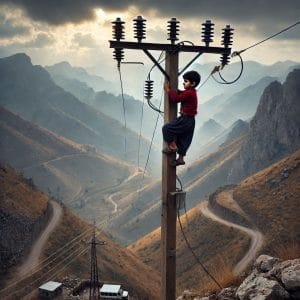
Yusuf climbing the high-voltage line
According to what they told me later, the high-voltage line had thrown me 40-50 meters away. I had severe burns and fractures on my body. Later, I would learn that the number of fractures was 27. Both my arms were also burned. The smell of burnt flesh bothered those who approached me.
They took me to Iğdır hospital. "There's nothing we can do. You brought the child for nothing. He'll die in a few hours," they said. My father wandered around me helplessly, muttering to himself.
This time, they put me in a red car and took me to Kars. They also said, "You brought him for nothing. There's nothing to be done." From there, they took me to Erzurum. Treatment began in Erzurum. They removed and discarded the pieces of clothing that had stuck to me due to the burns.
My poor father, psychologically devastated, wandered around me helplessly. I stayed in the hospital for three months. The doctors said that if they amputated my left leg, the child would have a chance to survive. Otherwise, it would become gangrenous. My father was not willing to do this. He argued and even fought with the doctor. They made an agreement with my uncle Şefik. At an opportune moment, they smuggled me out of the hospital's back door and brought me to Aliköçek village.
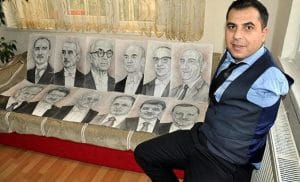
Portraits by Yusuf Akgün, holding the pen with his mouth
END OF PART ONE