CHP, the Kurdish Question, and the Search for Social Democracy in the New Century
This essay explores the historical relationship between the CHP and the Kurdish question, arguing that the party must overcome its state-centric reflexes to embrace a truly social democratic vision for all of Turkey.

Dear Readers,
Some issues exist that cannot be understood solely through security reports, electoral calculations, or bureaucratic concepts. This is because they are simultaneously a memory, a grievance, a sense of belonging, and a crisis of coexistence. The Kurdish issue in Turkey is precisely such an issue.
For many years, Turkey tried to understand the Kurdish problem only through the language of the state. Yet, the issue was sometimes the silence of a village, sometimes the quiet fear of an elderly mother waiting at a government office because she didn't speak Turkish, and sometimes the internalized anger of young people who felt they didn't belong to this country. One of the biggest problems of the Republic was this: for a long time, the state tried to define society rather than listen to it.
The Republican People's Party's (CHP) relationship with the Kurdish issue was also shaped within this historical background. For many years, the CHP was not merely a political party, but also the founding will of the republic and the carrying backbone of the state. For this reason, the party's approach to the Kurdish issue developed more through state reflexes than social democratic ones.
Between 1923 and 1950, the CHP was almost synonymous with the state. During this period, the Kurdish issue was addressed within the framework of security, centralization, nation-building, and public order. The party focused more on creating a common national identity than on understanding the multi-layered social structure of Anatolia. This approach might be understandable within the historical conditions of the time. However, the same process also laid the groundwork for grievances, distrust, and problems of belonging that would last for many years within Kurdish society.
The 1950 elections were not just a loss of power for the CHP, but the beginning of a historical confrontation. With İsmet İnönü's fall into opposition, the CHP was forced to truly engage with the people for the first time. Kasım Gülek's words years later, "We put on our sandals and went down to Anatolia," were in fact a great political confession. Because for the first time since its establishment, the CHP began to directly see the Anatolian countryside, poverty, exclusion, local identities, and the Kurdish issue.
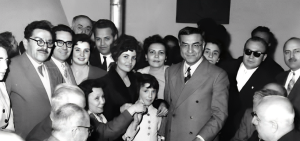
CHP General Secretary Kasım Gülek among the people. Kasım Gülek, one of the pioneers of the CHP's process of re-establishing contact with the people after 1950, represented the party's new face turning towards Anatolia.
**
In the 1960s, with the rise of the "Left of Center" idea championed by CHP General Secretary Bülent Ecevit, a new quest emerged within the CHP. As the discourse of social democracy strengthened, pressures arose to approach the Kurdish issue from a more democratic and social perspective. However, at the same time, the party's statist memory and security reflex continued to live on strongly. Thus, the CHP's historical dilemma became apparent: the founding reflex of the state, or a populist-social democratic transformation?
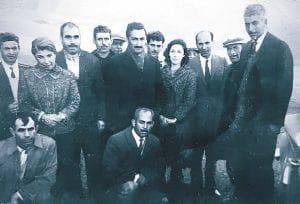
Year 1967. October. Iğdır. After Kasım Gülek, Bülent Ecevit travels through Anatolia step by step. Behice Boran (far left), CHP General Secretary Bülent Ecevit, Rahşan Ecevit, and CHP Iğdır District Chairman Mecit Hun (far right).
**
In fact, the CHP's fundamental dilemma regarding the Kurdish issue was not merely political. The party, on the one hand, carried the founding memory of the republic, while on the other hand, it tried to reach the universal conscience of social democracy. This is why the CHP, from time to time, turned into a historical party of conscience, caught between the state and society.
This dilemma was not fully resolved in the 1970s either. While the CHP tried to expand its discourse of labor, freedom, and democracy, it remained on a cautious line regarding the Kurdish issue, unable to transcend the limits of the system. This is because the Kurdish problem in Turkey was not only an identity issue but also a historical issue related to the very formation of the state.
When the CHP was re-established in 1992, Turkey was already at another historical threshold. However, what is noteworthy here is that the most courageous social democratic initiatives regarding the Kurdish issue had been prepared by the SHP (Social Democratic Populist Party) before the CHP was re-established for the second time. The SHP's Kurdish Reports were among the most comprehensive social democratic texts in Turkish politics at that time, covering topics such as cultural rights, democratization, strengthening local administrations, and the recognition of Kurdish identity.
These reports addressed the Kurdish issue not merely as a security problem, but as a problem of democracy, equal citizenship, and coexistence. For the first time in Turkey, a social democratic movement was trying to transcend the traditional security language of the state.
However, when the SHP and CHP merged, the new CHP that emerged largely relegated this democratic accumulation of the SHP to the background. Under Deniz Baykal's leadership, the CHP once again moved towards a more controlled, cautious, and state-centric line. Thus, the historical tension between the search for social democratic openness and the state reflex once again prevailed.
The new period of CHP leadership, however, produced another political impasse. Within the party, there was a strong concern that if a more democratic approach to the Kurdish issue were adopted, nationalist votes in the western provinces would be lost. As a result, instead of expanding its political presence in regions with a high Kurdish population, the CHP began to act through indirect alliances. The model developed under the name "urban consensus," while appearing pragmatic for short-term electoral calculations, prevented the CHP from developing a founding political vision encompassing all of Turkey in the long run.
The CHP must now recognize this: the period of nation-building in Turkey has largely been completed. The central reflexes of the Republic's founding years are not the same as today's social reality. The fundamental issue of the new century is no longer to suppress differences, but to establish a democratic common life with differences.
Therefore, the CHP's almost acceptance of its weakness in Kurdish provinces, its indirect perception of these regions as the natural domain of other political movements, and its insufficient expansion of its own political claim create a serious historical problem. Because effectively leaving certain geographies of a country to other parties, while appearing as a short-term pragmatic electoral strategy, ultimately weakens the idea of Turkey in the long run.
More importantly, there is a risk of an unstated mental division within this approach. Because the moment a social democratic party begins to see a part of Turkey only as the representation area of other political movements, it also begins to move away from the idea of the country's common political integrity.
Yet, true social democracy means being able to exist with the same political self-confidence in Hakkâri as in Edirne, in Diyarbakır as in İzmir, and in Van as in Ankara.
The historical duty of the CHP is not only to appeal to the modern-secular electorate in the west. It is also to directly reach the poor, the Kurds, the excluded, the rural youth, and the segments of society in the east who have felt outside the center for many years.
Because Turkey's democratic future cannot be built with a geographically and mentally fragmented political understanding, but with a new political courage that can bring together all the colors of the country under the same democratic roof.
One of the most important truths the CHP must now understand is this: the Kurdish issue is not only about security policies, but also about language, culture, belonging, and respect. A political language that cannot be established with people's mother tongue cannot build a true emotional bond with society.
Therefore, the CHP must learn to use Kurdish in provinces with a high Kurdish population not just at the level of a few symbolic words, but as a natural language of political communication and democratic representation. Because speaking the language of a people is not just asking for votes; it is recognizing their existence, their memory, and their human dignity.
Social democracy is a movement of political courage that does not fear the language of the people, but can speak it. If the CHP wants to be truly credible in the eyes of Kurdish voters, it must abandon a shy, hesitant, and defensive approach towards Kurdish.
The right to education in the mother tongue should be approached in the same way. This issue is not only pedagogical but also a matter of democratic equality. The CHP should be able to defend the issue of education in the mother tongue not by fearing, whispering, or indirectly mentioning it only during election periods, but as an open democratic right in line with the universal principles of social democracy.
Because for a social democratic movement, the demand of people to be educated in their own mother tongue is not a threat, but a natural consequence of democratic pluralism.
What Turkey needs in the new century is not a politics that fears the languages of society, but a new political maturity that can bring together all the languages of society within a common democratic belonging.
The resulting picture is this: the CHP has either retreated to a state reflex on the Kurdish issue or has adopted a passive balancing policy that leaves the field to other actors. However, social democracy grows not by abandoning certain regions to other parties, but by establishing direct contact with all segments of society.
Because what Turkey needs is not just an opposition that wins elections. What Turkey needs is a new democratic conscience that can overcome politics fueled by fears.
This is precisely the fundamental issue facing the CHP today. The party must restructure itself. A politics based solely on the secular-modern electorate in western Turkey and only on indirect alliances in the east is not sustainable. The CHP must transform the universal principles of social democracy into a real popular movement felt throughout Turkey's geography.
This new political language must be one that does not deny but does not divide, that recognizes identities but does not fragment society, that advocates for democratization but preserves common belonging, and that can build a new bridge of trust between the state and society.
Because the Kurdish issue in Turkey is not just an ethnic issue. It is also an issue of democracy, equal citizenship, representation, memory, and coexistence.
And if social democracy cannot touch all of Anatolia, it will not only lose elections; it will also lose its historical meaning.
The CHP will either transform into a new popular movement that carries all the colors of Turkey, or it will continue to shrink within the state reflexes of the past.
What Turkey needs in the new century is precisely this: a politics of courage, not fear; of confrontation, not denial; of the will to coexist, not anger.