Argentina's Two Universal Spirits: Che Guevara and Maradona
This essay explores the lives and legacies of two iconic Argentinians, Che Guevara and Diego Maradona, highlighting their shared revolutionary spirit and impact on global politics and culture.
(I dedicate this article to my nephew, Rabun Aksoy)
Argentina is a distant yet intriguing country. It is three and a half times the size of Turkey and has a population of 45 million. The majority of its inhabitants are of Spanish and Italian descent. Distant Argentina left its mark on the history of world revolution with two names: Che Guevara and Maradona. Che Guevara shook world politics by tapping into the rebellious spirit of youth. Maradona, through his football and unconventional interpretations, challenged imperialist and mafia powers much like Che Guevara. One started as a doctor, the other as a footballer, but both departed as universal revolutionaries.
PART ONE: DIEGO MARADONA
On November 25th, news agencies worldwide successively reported: Maradona is dead! I was writing on my laptop. I have a habit of glancing at the headlines of the WSJ (The Wall Street Journal) when my mind gets tired. When I read the news of Maradona's death, I first felt a slight tremor in my heart. On a day when the coronavirus plague was claiming hundreds of thousands of lives daily, and the number of those infected in my own circle of relatives was increasing every day, the news of Maradona's death initially seemed almost insignificant.
I looked out into the distance. My mind drifted to the past. It was 1986. I was watching the Argentina-England match in Paris, in a local establishment mostly frequented by Black people and Algerians. When Maradona's "Hand of God" goal came, Africans from formerly colonized countries, like me from an underdeveloped country, embraced each other with tears in our eyes. Our joy was so sincere and heartfelt that our hugs and kisses lasted so long that we missed seeing Maradona's "Goal of the Century," scored four minutes later after he dribbled past five English players. The wave of joy surged even higher. The Algerian owner was shouting: "All drinks are free today! Long live Maradona!" We all seemed to be crying with joy. Finally, we had won a victory against the imperialists.
As I reflected on these experiences, looking out at Tunalı Hilmi Avenue, I felt my heart tremble. If you wish, let's take a look at Maradona's life together. I hope this will help you understand me better.
HIS FAMILY AND CHILDHOOD

When Maradona turned 3, his cousin gave him a football as a gift. Maradona loved the ball so much that he slept with it and woke up with it. He was afraid someone would steal his ball.

When Maradona reached school age, everything suddenly changed. Maradona didn't care about his lessons and spent his time playing football in the garden. One day, his mother caught the ball and hid it. His mother wanted her son to study and become an accountant. Maradona fell into deep sadness. His mother couldn't bear to see her son like this and gave the ball back.

Every evening, his mother would shout:
"Diego! Diego! Where are you? Dinner's ready!"
Diego heard his mother's voice but paid no attention. He played with the ball in the garden like a cat playing with a toy mouse, trying to understand the secret of this simple yet miraculous round object.

His family was the poorest in the neighborhood. He was the fifth of eight children, five of whom were girls. He was born on October 30, 1960, in a shantytown called Lanús, south of the capital Buenos Aires. His family, a mix of Italian and indigenous heritage, had moved from Corrientes, 1000 km north of the capital, to Lanús, just south of Buenos Aires, to make a living. Lanús was a large shantytown. His family settled in the poorest neighborhood, Villa Fiorito. His father was a bricklayer and factory worker. His mother was a housewife.

Maradona started playing football at the age of 9. He quickly learned the rules of the game. The neighborhood team was called "Little Onion." He was the team captain. After winning 140 matches in a row, the "Little Onion" team gradually became famous.


Maradona's ball control, his ability to keep the ball at his feet for a long time, his perfect passes, and his leadership qualities quickly attracted attention. Spectators greeted with great cheers and applause as the short Maradona dribbled past much taller players with speed.
One day, a small newspaper published a headline: "A football star has been born who, despite his young age and short stature, devastates his opponents."
His father was a sacrificing and understanding man. He spent almost all the money he earned on Maradona's needs like shoes and clothes. For this, he worked long hours in the factory, wanting his son's dreams to come true. It was as if he had a premonition that his son would one day be the savior of Argentinian football. His father and mother went to watch all of Maradona's matches, sending their children the message, "We are proud of you!"
His father confessed: "I wanted Diego to succeed more than anyone. I polished his shoes with my own hands and showed my support by attending his matches. For a time, I harbored the wish that Diego would become a football star like Pelé. But when I saw Diego's talent, I had already forgotten about Pelé!"
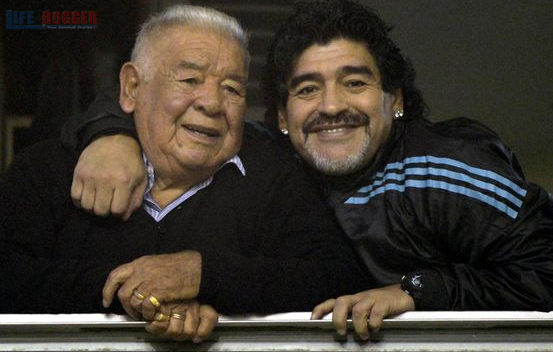
Maradona was often ill in his childhood. In later years, he fell into drug addiction from the neighborhood children. Despite this, in his father's eyes, Diego was a special child: "I was always proud of my son who ran from muddy streets to the top of the world."
The most important person in Maradona's life was undoubtedly his mother, Dalma. His mother was known by the nickname "Dona Tota" and always received special respect for being Maradona's mother. His father provided financial help to Maradona, but Maradona's soul was in the hands of his mother, Dona Tota.
His mother made great sacrifices for her children. It was not easy to feed eight children. Every time they sat down at the table, his mother would say, "My stomach hurts! Children, you continue eating." Maradona would learn at the age of 13 that his mother actually had no stomach ailment. His mother wanted her children to eat first because there wasn't enough food.
His mother made the greatest effort to save Maradona from the trap of drugs. Perhaps thanks to his mother's efforts, Maradona was able to play football for many years. His mother also tried to prevent Maradona from smoking and closely followed his private life. Maradona was so devoted to his mother that after matches, he would hug her and kiss her lips with affection. In a strictly Catholic country like Argentina, Maradona's behavior was not well-received by many. His mother passed away in 2011 due to kidney failure.

Maradona married his long-time girlfriend Claudia Villafañe on November 7, 1984. They had two daughters. Maradona divorced his wife after 15 years of marriage. He also confessed to having an illegitimate son in Italy. In 2013, he had another son with a different girlfriend.

Maradona lived as a drug addict between 1980 and 2004. He tried to get treatment in Cuba but did not achieve the desired results.
HIS EARLY CAREER
At the age of 10, Maradona was discovered by a talent scout and began playing amateur football for his neighborhood club, Estrella Roja. Shortly after, he moved to Los Cebollitas club, where he spent three seasons before joining the youth academy of Argentinos Juniors in Buenos Aires. At 12, he entertained spectators by juggling the ball during halftime.
On October 20, 1976, Maradona signed his first professional contract with Argentinos Juniors, ten days before his 16th birthday. After scoring 115 goals in 167 matches between 1976 and 1981, he transferred to Boca Juniors for 1 million pounds. Maradona, who transferred to Boca Juniors in the middle of the 1981 season, won his first league championship medal in 1982. Maradona was now a global star.
FALKLANDS WAR AND THE "HAND OF GOD"
The Falkland Islands are an archipelago in the South Atlantic Ocean, 480 km east of Patagonia (Argentina). They have an area of approximately 12,000 square kilometers. They are one of the United Kingdom's overseas territories. When Argentina also claimed sovereignty over the islands, war between the two countries became inevitable. Although Argentinian forces occupied the islands in 1982, the UK recaptured them two months later as a result of the Falklands War. This caused great disappointment in Argentina. There was deep animosity and a desire for revenge between the UK and Argentina.
VICTORY OF THE OPPRESSED PEOPLES AGAINST IMPERIALISM
It was under these circumstances that the 1986 Mexico World Cup matches began. Coincidentally, Argentina and England faced each other in the quarter-finals. The whole world held its breath, eagerly awaiting the match, as if it were to be an England-Argentina war. It was a struggle for honor for Argentina, a poor country that had been defeated in a just war against imperialist England.
The Argentina-England match was played on June 22, 1986, at the Azteca Stadium. The first half ended in a 0-0 draw. Six minutes after the start of the second half, in the 51st minute, the ball bounced into the air. Maradona and the English goalkeeper jumped at the same time, trying to control the ball. Maradona jumped up to the goalkeeper's hands, who was 20 cm taller than him, feigned a header, but sent the ball into the net with his left hand. The Tunisian referee awarded the goal. At that moment, life in Argentina stood still. It was as if revenge for the Falkland Islands had been taken. Life not only in Argentina but in all countries colonized by imperialism was filled with extraordinary joy.

Maradona knew he had scored the goal with his hand and that many of his teammates had seen it. When the ball hit the net, his teammates, thinking "this goal won't count anyway," started to walk away as if nothing had happened. Maradona called out to his friends: "Come and hug me! Otherwise, the referee will disallow the goal!"
Four minutes after the "Hand of God" goal, Maradona was on stage again. Maradona controlled the ball in midfield. He dribbled past four English players in front of him. He moved with such speed that he covered the 55-meter distance in 10 seconds and sent the ball into the net to the left of the goalkeeper. The scoreboard showed Argentina: 2, England: 0. The oppressed peoples of the world, who had gone wild just four minutes earlier, were swept up in a second wave of euphoria, almost losing themselves. Imperialism had been defeated! Long live the oppressed peoples!
The match ended with Argentina winning 2-1, and in the final match, Argentina defeated Germany to become world champions. The goal that went in after hitting his hand was called the Hand of God, and the goal he scored by taking the ball from midfield and dribbling past English players was called the Goal of the Century. A statue of him was erected in front of the Azteca Stadium.
VICTORY AGAINST THE ITALIAN MAFIA
Maradona transferred to Napoli. On July 5, 1984, upon his arrival in Naples, 75,000 fans welcomed Maradona at the San Paolo stadium. The people of Naples, who were quite poor compared to northern cities like Milan, believed their savior had arrived. Italian teams like Milan, Juventus, and Roma were under the control of the Italian mafia, and for years, the championship had been shared among these three teams. Soon, everything would change.

Maradona quickly became a fan favorite, and the team experienced its most successful period. Under Maradona's leadership, Napoli became league champions in the 1986/87 and 1989/90 seasons. They finished second in the league in the 1987/88 and 1988/89 seasons. They also won the Coppa Italia in 1987 (and were Coppa Italia runners-up in 1989), the UEFA Cup in 1989, and the Supercoppa Italiana in 1990. Maradona was the top scorer in Serie A in the 1987/88 season. These successes drove the Italian mafia crazy. Huge fortunes were slipping through their fingers. The poor people of Naples proudly celebrated every victory, shedding years of oppression. The mafia could no longer tolerate it. They forced Maradona into retirement by highlighting his drug use.
RETURN TO BOCA JUNIORS
Maradona returned to Boca Juniors in 1995 and played there for two years. Due to Maradona's legendary status among Boca Juniors fans, the entrance to La Bombonera stadium bears the inscription in Spanish: "Boca es mi religion, Maradona es mi dios, la Bombonera es mi iglesia" (Boca is my religion, Maradona is my god, La Bombonera is my church).
THE MAN WHO DEFIED THE POPE
Maradona, who grew up in a shantytown, developed a personality as a man of the people. In a meeting with Pope John Paul II at the Vatican in 1987, they clashed over wealth inequality. Maradona said, "I argued with him because I was in the Vatican and saw all those golden ceilings, and then I heard the Pope say that the Church was concerned about the welfare of poor children. 'Sell your ceiling, amigo (friend), then do something!'"

In September 2014, Maradona met Pope Francis in Rome and thanked Francis for inspiring him to return to religion years later; "We should all imitate Pope Francis. If each of us gives something to another, no one in the world will starve."
HIS FRIENDSHIP WITH CASTRO
Castro is undoubtedly one of the most important figures who resisted world imperialism. Maradona was a Castro admirer. When they first met in 1987, he gave his number 10 jersey to Castro, and Castro solidified this friendship by giving him his military uniform. Maradona, an admirer of the Cuban revolution, had a tattoo of Fidel on his leg and a tattoo of Che Guevara on his arm.

HIS DEATH
On November 2, 2020, Maradona was admitted to a hospital in La Plata for psychological reasons. A day later, he underwent emergency brain surgery. After a successful operation, he was discharged on November 12. Maradona, who was undergoing treatment at his home in Tigre after brain surgery, died of a heart attack on November 25, 2020. Just as it would happen to Che Guevara, an unknown person opened the coffin lid and took a photo with Maradona's body. This caused an uproar in Argentina. The funeral ceremony had to be postponed.

I remember Maradona, a symbol of the oppressed, the hopeless, and those who lost their joy of life, with mercy.
PART TWO: CHE GUEVARA

(Note: This world-famous photograph was taken in 1960 by Cuban photographer Alberto Korda, whose real name was Alberto Díaz Gutiérrez. In a short time, this photograph of Che gained great popularity, especially among the youth of the 1968 generation. The image, in a way, contained socialist ideology, the mysterious definition attributed to Che by the people, loyalty, and fear all at once. It soon became the emblem of the vanguard and leading force of the anti-capitalist movement. When was the photograph taken? The Castro Government had ordered weapons from Belgium. When the ship full of weapons and ammunition entered the Cuban port, it was sabotaged by counter-revolutionary forces, and the ship exploded with a huge blast. This caused the death of hundreds of people. Jean-Paul Sartre and Simone de Beauvoir from France also attended the funeral ceremony. Photographer Korda, on that day, secretly took a picture of Che on the podium.)
HIS FAMILY AND CHILDHOOD

Che Guevara was also Argentinian. Unlike the poor Maradona, he was born on June 14, 1928, into a middle-class family in Rosario, Argentina's third-largest city. His father, Ernesto Guevara Lynch, an engineer, was of Irish descent, while his mother, Celia de la Serna's family, had Irish and Spanish roots.

Che Guevara suffered an asthma attack when he was just two years old. Just as Maradona struggled with drug addiction throughout his life, Che Guevara would battle asthma attacks throughout his.
When Che Guevara was 3 years old, his family settled in the capital Buenos Aires, but as his asthma attacks worsened, his family decided to move to Cordoba on the advice of doctors. Asthma, which is difficult to treat, was closely related to climatic conditions. His family, known as politically liberal and open to the left, openly supported the Republicans in the Spanish Civil War. Although initially well-off economically, the family would begin to experience financial difficulties over time.
Despite his illness, Che Guevara had an active childhood. He was a very successful athlete and a dynamic rugby player. He had an aggressive and determined playing style. Che Guevara also learned to play chess from his father. Starting at the age of 12, Che began participating in local tournaments, and in his teenage years, he developed an interest in poetry and literature. Che Guevara, who particularly loved Pablo Neruda's poems, would maintain a good relationship with words throughout his life and would write poems himself.

Che Guevara, who read important writers from Jack London to Jules Verne, from Freud to Bertrand Russell to improve himself, was also interested in photography. He never left his camera, photographing people, places he saw, and archaeological sites. While receiving English education at school, Che Guevara also learned French from his mother and was a fan of the French poet Baudelaire.
CHE'S INTEREST IN POLITICS
When the Spanish Civil War began, Che was 8 years old. His uncle worked as a war correspondent. Whenever his uncle came to Argentina, he would recount in detail the struggle between revolutionaries and fascist forces in Spain. The news changed month by month, with reports like "such and such a city fell into the hands of the revolutionaries" or "such and such a city fell into the hands of the fascists." Che would hang small red flags on the map of Spain on the wall to represent the revolutionaries. When playing with children in the garden, he would make himself the leader of the Spanish revolutionary forces and play war games with the children. He would dig trenches and command his comrades, "Forward for the Republic!"
UNIVERSITY YEARS
In 1944, his family, who had moved back to Buenos Aires, was experiencing severe financial difficulties. The 16-year-old Che Guevara was in and out of small jobs. In 1948, Che Guevara began his education at the Faculty of Medicine at the University of Buenos Aires, and throughout his student years, he embarked on long journeys across Latin America. In his early years at the faculty, he traveled through the northern and western regions of Argentina, studying leprosy and other diseases in the forest villages there.
SOUTH AMERICA TOUR BY MOTORCYCLE
In 1951, when his old friend, biochemist Alberto Granado, suggested he take a year off from medical school for the South American trip they had been talking about for years, the duo soon set off from Alta Gracia on a 1939 Norton motorcycle they named "La Poderosa II" (The Mighty II). Spending a few weeks as volunteers at the San Pablo leper colony on the Amazon River in Peru, Granado and Che Guevara had the opportunity to get to know the peasants of Latin America intimately throughout their tour.

According to Che Guevara, the fact that Latin America was a complex structure composed of separate nations increased inequality between countries and led to a division of power. Therefore, Latin America should become a single body through a continent-wide strategy, and this inequality should be eliminated. Che Guevara, who began to dream of a united Ibero-America without borders and bound by a single culture, would find these ideas to be the starting point for his later revolutions. As soon as he returned to Argentina, Che Guevara, trying to finish his medical education as soon as possible to realize his dreams, graduated in 1953.
GUATEMALA YEARS
Che Guevara, who set off on July 7, 1953, to continue his travels in South and Central America from where he left off, had decided to work in a leper colony in Venezuela. First stopping in Peru, Che Guevara was arrested and sent to prison there due to a previously published study he had done on indigenous people. After serving his sentence, Che Guevara stayed in Ecuador for a few days, where he had the opportunity to make a historical acquaintance that would be one of the turning points in his life. After meeting a lawyer named Ricardo Rojo, he gave up on going to Venezuela. He headed to Guatemala with Rojo. At that time, President Jacobo Arbenz Guzmán, who was at the head of the government, was trying to carry out a social revolution, especially with land reform, but he was overthrown by a right-wing coup. Che Guevara then took refuge in the Argentinian embassy.
Guevara, who joined the ranks of the revolutionaries, was arrested and removed from the embassy building after a while. Che Guevara, who met many Cuban exiles and Fidel Castro's brother Raul Castro in Guatemala, went to Mexico when his stay in Guatemala became dangerous. The overthrow of the Arbenz Guzmán government by a CIA-backed coup strengthened Che Guevara's view that the United States was an imperialist power.
MEETING THE CASTRO BROTHERS
Meanwhile, Fidel Castro, released after his imprisonment in Cuba, had also arrived in Mexico, and Raul introduced Guevara to Fidel Castro on July 8, 1955.

Che Guevara, sharing the same ideas as Castro, concluded that he was a true revolutionary leader and joined the "26th of July Movement" formed to overthrow the Cuban dictator Batista. Although it was decided that he would serve as a doctor in the group, he also received military training along with the other members of the movement. Described as the most outstanding student by his instructor, Colonel Alberto Bayo, Che Guevara married his girlfriend Gadea, who came from Guatemala, on August 18, 1955, and a year later, on February 15, their daughter Hilda Beatriz was born.
LANDING IN CUBA

(NOTE: Granma is the name of the yacht used to transport Cuban Revolution fighters in 1956. Granma is the name of a 12-person, 18-meter long yacht built in 1943. It was purchased on October 10, 1956, for 50,000 Mexican pesos from an American retiree. Following the sale, 82 Cuban exiles boarded this yacht under the leadership of Fidel Castro, with the aim of launching a revolution against Fulgencio Batista. Among the other rebels on the yacht were Ernesto Che Guevara and Raúl Castro. On November 25, 1956, they set sail from the port of Tuxpan, Veracruz, Mexico, and landed on December 2 in what is now known as Granma Province.)

Che Guevara, who went to Cuba on the Granma ship that set sail from Veracruz on November 25, 1956, was attacked by Batista's soldiers as soon as he landed. In this conflict, Guevara had to abandon his medical supply bag to retrieve ammunition dropped by a fleeing soldier. Che Guevara etched that moment into his memory as the moment he transformed from a doctor to a warrior. After this incident, Che Guevara, who hid in the Sierra Maestra mountains, began to be seen as a leader among the rebels due to his courage in the guerrilla wars against the Batista regime and was called Comandante (Commander).
In December 1958, Che Guevara led the "Suicide Squad" that attacked Santa Clara, one of the most important events of the revolution. On February 7, 1959, Che Guevara was declared a "Cuban citizen by birth" by the victorious Fidel Castro government. Meanwhile, Che, who began divorce proceedings to officially end his marriage with Gadea, married Aleida March, also a member of the 26th of July Movement, on June 2, 1959.
He was appointed commander of La Cabaña prison for 6 months and, during his tenure, was responsible for the trial and execution of officials of the Batista regime, members of the BRAC secret service, alleged war criminals, and political opponents.

Che Guevara briefly served at the National Institute of Agrarian Reform, then was appointed president of the Central Bank of Cuba. Che helped revolutionary movements in other countries from Cuba, but all of them ended in failure. In 1960, he became Minister of Industry. Che Guevara, who was of great importance in the development of Cuban socialism, was one of the country's leading figures.
BAY OF PIGS INVASION
In 1961, during the Bay of Pigs Invasion, Che Guevara was placed in charge of a force in Pinar del Río province, the westernmost part of Cuba, by Castro's order, and repelled the invading military force there. Playing a key role in the Cuban Missile Crisis a year later, Che Guevara went to New York in 1964 to represent Cuba at the invitation of the United Nations. On December 17, he flew to Paris to embark on a three-month international tour.
During this trip, the leader visited the People's Republic of China, the United Arab Republic, Egypt, Algeria, Ghana, Guinea, Mali, Dahomey, Congo-Brazzaville, and Tanzania. On February 24, 1965, in Algeria, he delivered his speech at the "Second Afro-Asian Economic Solidarity Seminar," which would be his last appearance on the international stage.
CHE'S MYSTERIOUS DISAPPEARANCE
When Che Guevara returned to Cuba on March 14, he was met by Fidel and Raúl Castro in a simple ceremony at Havana airport. However, two weeks later, the leader withdrew from public life and completely disappeared. The mysterious disappearance of Che Guevara, Castro's right-hand man, remained unexplained for a long time. Different reasons were put forward. The relative failure of the industrialization project he advocated as Minister of Industry, his disagreements with Castro on economic issues, and Castro's discomfort with Che Guevara's power were some of them. The fact that Che Guevara did not explain the reason for his departure to Castro and left a letter written in a very simple style was also surprising for many.
Che Guevara's views were similar to those expressed by the Chinese Communist Party, and this had become a growing problem for Cuba, whose economy was becoming increasingly dependent on the Soviet Union. Western observers of Cuba pointed to Castro's forced acceptance of Soviet conditions and proposals, despite Che Guevara's opposition, as the reason for his disappearance. However, Che Guevara and Castro supported a united front that included both the Soviet Union and China. Che Guevara, who saw Khrushchev's approval of the withdrawal of missiles from Cuba without consulting Castro as a betrayal, stated that he viewed the Northern Hemisphere, led by the US in the west and the USSR in the east, as the exploiter of the Southern Hemisphere. During the Vietnam War, Che Guevara supported communist North Vietnam and encouraged the peoples of developing countries to arm themselves.

Question marks and speculations regarding Che Guevara's disappearance increased. Castro, in a statement on June 16, 1965, said that Che Guevara had acted without his knowledge and that he could not comment on his whereabouts. On October 3 of the same year, Castro announced an undated letter written to him by Che Guevara. In the letter, Che Guevara declared his commitment to the Cuban revolution but also his intention to leave Cuba to fight in foreign lands. Stating that other nations of the world were calling him to fight for revolution, Che Guevara also added in his letter that he had resigned from all his duties in the government, party, and army, and had renounced his Cuban citizenship.
In an interview with Castro on November 1, 1965, the Cuban leader denied rumors of Guevara's death and stated that he knew his whereabouts.
CHE GUEVARA AND AFRICA
Castro and Che Guevara had plans. On March 14, 1965, the two had agreed that Che Guevara would lead Cuba's first military operation in the region under the Sahara Desert (Algeria). According to a view that Castro would later confirm, Castro had persuaded Che Guevara to undertake this action because he believed that the conditions in Latin American countries were not yet suitable for the establishment of guerrilla nuclei. The then President of Algeria

Ahmed Ben Bella, on the other hand, stated that the situation prevailing in Africa seemed to have great revolutionary potential, which led Che to believe that Africa was the weak link of imperialism, and therefore he wanted to strive for Africa.

In the Cuban operation, which would be sustained by supporting the Patrice Lumumba-aligned Marxist Simba movement in Congo-Kinshasa, Che Guevara worked for a while with guerrilla leader Laurent-Désiré Kabila. Later, their alliance broke down because he did not trust Kabila enough. Che Guevara, who was 37 years old at the time, was a very experienced warrior despite not having formal military training. His asthma did not seem to bother Che Guevara much either.
Che Guevara, whose aim was to export the Cuban Revolution, began teaching communist ideology and guerrilla warfare to the local Simba fighters. However, South African mercenaries and Cuban exiles were in an alliance with the Congolese army, creating difficulties for Che Guevara. For this reason, he could not realize his revolutionary plan in Congo. Che Guevara attributed this to the incompetence of the indigenous Congolese forces and their internal friction.
Guevara, who considered staying in Congo and fighting alone, agreed to leave Congo after being persuaded by his comrades-in-arms and two officials sent by Castro. However, Che Guevara, who could not swallow his pride to return to Cuba because Castro had publicly announced the letter he wrote stating that he had severed all ties with Cuba to dedicate himself to revolutions in other parts of the world, hid for six months in Dar es Salaam, Prague, and the German Democratic Republic.
During this period, he wrote his memoirs about his Congo experience and also drafted two books, one on philosophy and the other on economics. Although Castro pressed Che Guevara to return to Cuba, Guevara accepted on the condition that his return would be temporary and his presence on the island would remain a secret. This was because he was preparing for a new revolution in Latin America.
BOLIVIAN MOUNTAINS AND CHE'S DEATH
Che Guevara was at the head of the guerrillas in Bolivia in 1967. Castro had requested that a piece of land be purchased by local Bolivian Communists for Che Guevara to use as a training ground. However, he did not achieve much success in forming a guerrilla army.
When Che Guevara and his soldiers first clashed with the Bolivian Army in 1967, the photographs they left behind proved that Che was in Bolivia. Upon seeing the photographs, Bolivian President René Barrientos ordered Che's immediate capture. Che Guevara, who achieved success against Bolivian forces with his army of about fifty men called the ELN, did not abandon his humanitarian qualities even in the midst of war, requesting medical aid for the wounded Bolivian soldiers they captured, but this proposal was rejected by the responsible Bolivian officer.


When the location of Guevara's guerrilla camp was reported to the Bolivian Special Operations Unit by an informant, the camp was surrounded on October 8. Guevara, captured while patrolling with Simeón Cuba Sarabia in the Quebrada del Yuro canyon, was forced to surrender after being wounded in the legs and having his weapon destroyed by a bullet. Che Guevara, whose pistol inexplicably had no magazine, reportedly said, according to the soldiers present at the time of his capture, "Don't shoot! I am Che Guevara, and I am worth more alive."
Barrientos, upon learning of Guevara's capture, ordered his execution. Guevara was taken to a school in the nearby village of La Higuera, spent the night there, and was killed the following afternoon. To give the impression that he died in combat and to ensure his face was recognizable, Che Guevara, who was killed by being shot repeatedly in the feet, had his body tightly bound to the landing gear of a helicopter and taken to nearby Vallegrande.

After his body was shown to the press in a bathtub, Che's hands were cut off by a military doctor, and the fate of his body remained unknown. There were speculations that he was buried, as well as claims that he was cremated.
The person who closely followed Che Guevara and his activities in Bolivia was a CIA agent named Félix Rodríguez. Rodríguez took Guevara's watch and other personal belongings and later showed them to journalists he interviewed. Some of these items are still exhibited at the CIA.
TRANSFER OF CHE'S GRAVE TO CUBA
Fidel Castro, who announced Guevara's death to all of Cuba on October 15, declared three days of national mourning in his country. In 1997, the bones remaining from Guevara's handless body were exhumed from under an airport runway, identified by DNA testing, and brought back to Cuba. On October 17, 1997, his remains, along with those of 6 soldiers who fought with him in the Bolivian campaign, were buried with a military ceremony in a specially prepared mausoleum in Santa Clara, where he carried out the Cuban Revolution.

THE CULT OF CHE AND THE WORLD YOUTH REVOLUTIONARY WAVE
After his death, Che Guevara became a symbol of socialist revolutionary movements worldwide. Che Guevara's photograph, taken by Alberto Korda, has been described as "the most famous photograph in the world and a symbol of the 20th century."
As images of Guevara's body circulated and the facts about his death were debated, the legend of Che began to spread. Demonstrations protesting Che's killing were held all over the world. Articles, eulogies, songs, and poems were written about his life and death. Latin American experts at the US State Department immediately recognized the significance of the death of "the most charismatic and successful revolutionary of all time," stating that Guevara would be idolized by communists and other left-leaning individuals as "the exemplary revolutionary who died heroically."
The credibility of these predictions steadily increased, especially with Guevara's emergence as a powerful symbol of rebellion and revolution in the student movements of May 1968. Left-wing activists noted Guevara's apparent indifference to fame, glory, and awards, and agreed with the idea that violence was necessary to instill socialist ideals. While the slogan "Che lives!" began to appear on walls in the Western bloc, Jean-Paul Sartre, one of the leading figures of the 1968 movements, described Guevara as "the most complete human being of our age," further supporting the excessive praise of Guevara.
CHE AND THE TURKISH YOUTH MOVEMENT

From 1968 onwards, Che Guevara's iconic image began to appear in revolutionary organizations, associations, and marches. Undoubtedly, Che Guevara's anti-imperialist stance and his dedication to world revolution deeply influenced young minds in Turkey.

Until 1975, the images of Che Guevara, prominently displayed in every march, were gradually replaced by posters of Mahir Çayan, who, interestingly, was made to resemble Che Guevara's iconic image.

QUOTES FROM CHE GUEVARA
“Be realistic, demand the impossible.”
“Stand tall and smile. Let them wonder why you're smiling.”
“No matter how different it may be; do not covet what is not yours, and no matter how simple it may be, never give up what is yours.”
“Keep talking behind my back. Because you're not big enough to stand in front of me.”
“Don't be afraid to lose; to win something, you must lose some things. And remember; you are defeated not when you lose, but when you give up.”
“He who fights may lose. He who does not fight has already lost.”
“The most important thing is to be able to feel any injustice committed against anyone, anywhere in the world, as if it had been committed against you. This is the most important quality of a revolutionary.”