World Mother Tongue Day and İhsan Aksoy
This article celebrates International Mother Tongue Day, highlighting the importance of mother tongues for cultural identity and education, and features a translation of Samed Behrengi's "The Little Black Fish" into Kurmanji by İhsan Aksoy, a pivotal work in Kurdish literature.

Dear Readers:
Happy Mother Tongue Day! Roja zimanê zikmakî pîroz be! "February 21st World Mother Tongue Day" was declared by UNESCO in 1999 and has been celebrated annually since 2000. The purpose of this day is to promote linguistic diversity and multilingualism, ensure the protection of mother tongues, and raise awareness about endangered languages. Today, more than 7,000 languages are spoken worldwide, but according to UNESCO, almost half of these languages are at risk of extinction. Undoubtedly, a mother tongue is one of the most important elements carrying a people's culture, identity, and history. Furthermore, it has been scientifically proven that children who receive education in their mother tongue achieve higher academic success. For this reason, UNESCO aims to facilitate individuals' learning processes by supporting education in their mother tongue. Languages are not merely tools of communication; they are also a part of cultural heritage and identity. The survival of languages is critical for societies to remain free and strong. Therefore, it is all our responsibility to keep our mother tongue alive and pass it on to new generations. Today, we know that the protection of the mother tongue is directly linked to human rights. In many countries, minority languages are still suppressed or do not have official status. One of these is Kurmanji, my mother tongue. WHY FEBRUARY 21ST? This date was chosen to commemorate five Bengali students who lost their lives in 1952 in Pakistan during protests for the recognition of the Bengali language as an official language. This event, which played an important role in Bangladesh's independence process, has become a symbol of the struggle for mother tongues. THE KURMANJI LANGUAGE IN TURKEY IN THE 1970s I first encountered written Kurmanji as a child, at the age of 9-10. The late Medet Serhat, when he came to Iğdır, brought with him M. Emin Bozarslan's children's book titled "ALFABE". He was a guest in our home. I took the alphabet book and eagerly turned its pages. On the colorful pages, there were pictures of fruits like apples and pears; and animals like donkeys, horses, and sheep. Below them were their Kurmanji equivalents. This alphabet stayed in our home for a few days.
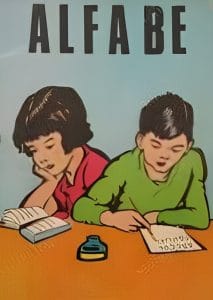
M. Emin Bozarslan's book "ALFABE" In 1976, Ehmedê Xanî's book "Mem û Zîn", translated by M. Emin Bozarslan, was published by Koral Yayınları. The left side of this book was in Kurmanji, and the right side was in Turkish. I bought a copy of this book and always kept it with me at Kabataş Erkek Lisesi, where I was a boarding student. Whenever I had the chance, I would read it, compare Turkish and Kurmanji words, and compile my own dictionary. In March or April of 1977, the famous Soviet Kurdish writer Ereb Şemo's book "Şivanê Kurmanca" was published as "Şivanê Kurd" by Özgürlük Yolu Yayınları. Although I had difficulty reading Kurmanji, I remember reading the book many times with great pleasure.


Also in June of the same year (1977), when İhsan Aksoy serialized the famous Iranian writer Samed Behrengi's children's story "The Little Black Fish" as "Masiyê Reş ê Piçûk" in the 25th issue of Özgürlük Yolu Magazine, the Kurmanji language in Turkey began to undergo a major transformation.



İhsan Aksoy's translation was published in issues 25, 26, and 27 of Özgürlük Yolu Magazine. *** Years passed. Looking back, I realize that İhsan Aksoy's translation was a turning point in the development of written Kurmanji. When İhsan Aksoy made this translation, the "M. Emin Bozarslan Alphabet," which was popular among Kurds in Turkey at that time, was being used. This alphabet differed in a few ways from the Celadet Bedirxan Alphabet, which has now become a standard. M. Emin Bozarslan used "ı" for the letter "i" in the Bedirxan Alphabet, and "i" for the letter "î" in the Bedirxan Alphabet. İhsan Aksoy also based his translation on the M. Emin Bozarslan Alphabet. While re-publishing İhsan Aksoy's 1977 translation of "Masiyê Reş ê Piçûk," I have harmonized the letters with the Bedirxan Alphabet. WHO IS İHSAN AKSOY?
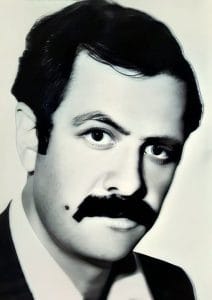
İhsan Aksoy, born in Ağrı in 1944, graduated from the Ankara Academy of Economic and Commercial Sciences. He served in the Workers' Party of Turkey (TİP) and the Revolutionary Eastern Cultural Hearths (DDKO). He was arrested during the March 12, 1971 military coup and imprisoned in Diyarbakır. He was released with the General Amnesty in 1974. He took on a role as a founder of the Socialist Party of Turkish Kurdistan (TKSP). His articles were published in Özgürlük Yolu magazine. In 1977, he married Ms. Süheyla, the daughter of Mecit Hun. In 1979, his son Rabun was born. In 1979, he left TKSP and led the Pêkanîn (Formation) Movement. In May 1980, he went to Germany via Iran and sought asylum in that country. In Frankfurt, he founded the Mala Gelê Kurd (Kurdish House) association with his friends, launched the newspaper Gazîya Welat (Call of the Homeland) in 1980, and the magazine Wekhevî (Equality) in 1981. In 1989, İhsan Aksoy opened the Ararat Restaurant in Darmstadt and returned to Turkey in February 2004. In Mersin, he published the magazine AÇILIM with his friends. İhsan Aksoy, who also participated in the establishment of TRT Şeş, underwent kidney transplant surgery in Germany in 2013. İhsan Aksoy published the books "The National Question and the National Question in Turkey" in Ankara in 1979 and "The Song of the Kurd" in Germany in 1985. His interview book with journalist and writer Enver Sezgin, "I'm Glad I Lived This Way," met readers in Istanbul in 2014. After his death, the book "ADAM," edited by Prof. Dr. Ahmet Özer and containing articles about him by his friends, was published. İhsan Aksoy, who passed away on October 24, 2017, from leukemia and kidney failure, was buried in the family cemetery in Darmstadt. WHO IS SAMED BEHRENGI?
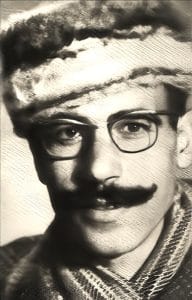
Samed Behrengi, a teacher and writer of Azerbaijani origin, was born in Tabriz on June 24, 1939. He studied at a teacher training school. He worked as a teacher in village schools. Meanwhile, he conducted research on Persian and Azerbaijani folk culture. He collected fairy tales and legends circulating in the vernacular and wrote children's stories. In his works, he emphasized feelings of justice and equality and taught resistance. In a sense, he paved the way for a rebellion against the Shah's regime. This situation disturbed certain circles. Samed Behrengi was found dead under suspicious circumstances in the Aras River at the age of 28 (August 31, 1967). The author's books have been translated into dozens of different languages. THE LITTLE BLACK FISH (Translation: İhsan Aksoy /June 1977) It was a winter night. The old fish had gathered her ten to twelve thousand children and grandchildren around her and was telling them a story: "Once upon a time, there was a little black fish. This little black fish lived with his mother in a small stream whose waters came from among the rocks. This little black fish always hoped that the moonlight would illuminate their place. He would say: 'At least, let it illuminate it just once.'"

"The old fish was telling a story" ** The little fish and his mother would swim in this water from morning till evening, and sometimes they would join other fish, going back and forth in this shallow water. The little black fish was his mother's darling. Among the tens of thousands of eggs his mother had laid, only he remained. Unfortunately, in these recent days, the little black fish had fallen into deep thought. He didn't even want to speak. The mother fish had noticed her child's unhappiness and felt very sorry for him. What was wrong with the little fish? Was he sick? Oh, if only the little fish would get well quickly, if only his illness would leave him quickly... The mother fish thought to herself. But the little black fish was not sick. He had another ailment. One day, early in the morning, before the sun had risen, the little black fish woke his mother: "Dear mother, if I may speak with you." His mother, half-asleep and unconscious, said: "What's your hurry, my dear son? We haven't even gone for our morning swim yet. We can talk later." "No, mother. I don't want these swims anymore. I want to leave this place." "What? You're leaving?" "Yes, mother. I want to leave quickly." "Where are you going so early this morning, my son?" The little black fish had made up his mind: "I want to see the end of this stream, mother," he said. "This question has been on my mind for months. I need to find out where this stream ends. Until today, I haven't found an answer to this question. I can't sleep at night. I always think about this. Mother, I have made up my mind, I will go and find out where the stream ends. I want to see and learn what is there and what is in other places." At these words, his mother laughed bitterly. She said, "My son, when I was as small as you, such thoughts came to my mind. But that stream has no beginning and no end. Everything you see is like that. This stream goes on and on, it never ends anywhere." When the little black fish heard these words, he said: "How can that be, dear mother? Everything has a beginning and an end. Like the day, the night, the month, the year, they all have an end." His mother angrily interrupted his question, saying: "Don't ask questions bigger than yourself! Now get up and let's go for a swim. Don't be stubborn!" The little black fish stood before his mother and said: "No, mother. I said I am tired of going back and forth in this stream. Besides, I want to see what else is in the world and what happens. Perhaps now you are doubting and saying, 'Who put such ideas into my little son's head?' Know this well, I have been thinking about these ideas for a long time, turning them over in my mind. But I also learned many things from other fish. That is, I thought a lot about those fish who cry about their situation, who see life as something empty. You know well that many fish are always dissatisfied, bored, grumbling. Is life just going back and forth in this narrow water from morning till evening, is that all? Are we to do this until we die? Or is there another life in this world? This is what I want to learn." His mother quickly and fearfully raised her voice: "Son, are you crazy? You keep saying 'universe, universe,' what is this? Your universe is this environment you live in! And life is what we live and experience." At that moment, a large fish swam by and came towards them. She said to the mother fish: "What's wrong, neighbor, why are you and your son arguing? It seems you have no intention of going for a swim this morning." The mother fish came out of her place with a complaint: "Oh," she said. "Why did I have to live to see these days? What a topsy-turvy world this is. But look, children the size of four fingers now want to show their mothers the way." "What?" "My little one, he has started saying he absolutely wants to go and see the world. He has been bothering me since morning. He asks questions bigger than himself." When the neighbor fish heard those words, she turned to the little black fish and frowned: "Son, look! Since when have you been among the wise and philosophers, eh? How is it that we haven't understood these things?" "Madam neighbor, I don't know why you're talking about the wise and philosophers. What I know is that this daily routine is suffocating me. I cannot live a life like this. I don't want to remain a dull fish years from now, to grow old and die." The neighbor fish, astonished, said: "What are you talking about?" His mother, tearfully, said: "It never occurred to me that my dear son would one day stand up to me and confront me. Surely, someone is putting these ideas into his head. If only I knew who it was!" The neighbor fish whispered into the mother fish's ear and said in a low voice: "But sister, why don't you think of the water snake?" "Ah, you reminded me well, neighbor," said the mother fish. "You're right. He always got close to my son. May God punish him!" When the little black fish heard these questions, he became very angry: "But mother," he said, "don't talk like that, he was my friend." His mother asked him mockingly: "Has anyone ever seen a fish and a water snake be friends?" The little black fish raised his voice: "I haven't heard of a fish and a water snake becoming enemies either. But I also haven't forgotten that you wanted to drown him." When the neighbor fish heard this, she said: "Now is not the time for this matter. That matter remained in the past." The little black fish stood before them: "You spoke of the past." This time the neighbor fish angrily said: "I wish we had killed him at that time, it would have been much better. Now we know well how he is harming his surroundings." The little black fish stood before them: "You spoke of the past." This time the neighbor fish angrily said: "I wish we had killed him at that time, it would have been much better. Now we know well how he is harming his surroundings." The little black fish said to her: "Since that is the case, you should kill me too. Because I also spread new ideas around me." The neighbor fish became very angry at this remark. She said: "Oh my! Do you think I'm talking about these things?" The other fish also noticed their conversation and approached them. The little fish's words also angered them. An old fish, in a sharp voice, joined the conversation: "Do you think we pity you?" Another fish said: "He needs to be taught a good lesson." When his mother heard those words, she cried out: "Go your way, don't bother my son!" "Look at me, Madam," said one of them. "Since you haven't raised your child well, you must also bear his punishment." "Until today, I didn't know who I was neighbors with. Believe me, I am very ashamed. Before we get into a worse situation, let's take him to the water snake." When all the fish attacked the little black fish to catch him, his little friends surrounded him and saved him from danger. His mother had covered her face with her hands and was crying. "Oh, what has happened to me! My son is slipping away. What will I do now?" The little black fish said to her: "Don't follow me, mother. If you're crying, cry for the situation of these old fish!" A fish shouted at him: "Don't talk back to us, get out!" Another fish said: "When you want to come back one day, then you'll see what happens to you." The third one called out to him: "These are youthful dreams, come on, don't go." The fourth one asked him: "What was missing for you here?" The fifth: "Leave him alone, my son. There is no other woman in the world." The sixth advised him: "If you come to your senses and stay here, one day you will understand all your mistakes." A seventh said: "We will remember you." His mother cried out and pleaded with him: "My son, don't go, what will happen! Don't you pity me?" The little black fish had nothing more to say to them. A few of his friends accompanied him to the spring. When he parted from them, he said: "Friends, farewell, don't forget me." "How can we forget you?" his friends said. "You opened our eyes. You taught us things we hadn't thought about until today. Stay happy. Our clever and fearless friend." Our little black fish plunged into the spring water and entered a small pond. At first, he was dizzy. Soon he came to his senses and began to swim as best he could. Until today, he had never seen such a large body of water in one place. And how many tadpoles there were in the pond. Thousands...
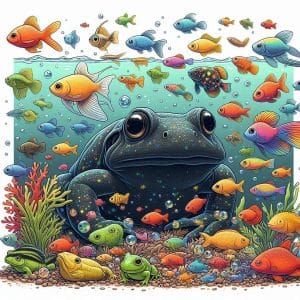
Frogs and fish ** When the tadpoles saw the little black fish, they said mockingly: "Look at this one!" and laughed at him. "Boy, what a strange creature you are!" The little black fish looked at them angrily: "Know yourselves and speak politely," he said. "My name is Little Black Fish. What are your names?" One of the tadpoles came forward and replied: "Our name is Tadpoles." Another: "We are of a very great and noble lineage," he said. The third: "There is no creature more beautiful than us on the face of the earth," he said. The fourth also stepped forward and said: "We are not shapeless and ugly like you." The little black fish, astonished by these words, said: "It never occurred to anyone that you would be so conceited," and shook his head. "But I will not dwell on this question, nor will I look at your flaws. I understand that you speak out of ignorance." At this, the tadpoles asked him: "So, you're saying we're stupid?" "Yes, you are stupid," said the little black fish. "If you weren't stupid, you would also know that there are many creatures in the world." At this, the tadpoles became angry, but they saw that the little black fish was not wrong; still, they resisted and said with a laugh: "You too will soon be tired of our questions. We swim and stop in this big world, in this pond, from morning till evening. We have seen no other creature besides our parents. Yes, there are also earthworms, but they don't need to be counted." The little black fish asked them: "If your whole life is spent in this small pond, how can you talk about the world? Have you ever been out of this pond?" The little frogs asked him curiously: "Are you saying there is a world beyond this pond?" At this question, the little black fish laughed: "How can there not be?" he said. "Wow!" "Did it never occur to you that there might be places beyond this pond where one could live?" said the little black fish. The tadpoles looked at him in astonishment for a moment. Then one of them asked: "So you're saying there are other places where one can live?" Another stepped forward: "Such a thing cannot be," he said. Another: "You've confused yourself," he said. In response to these words, what else could the little black fish say to them? It was best to leave those understanding creatures there and leave that place. He was about to leave when he suddenly wanted to see their mother and talk to her. He asked them: "Where is your mother?" Suddenly, a croaking sound was heard. A large frog, sitting on a rock around the pond, jumped into the water with a splash, swam, and came towards the little black fish. She said to him harshly: "Here we are, little prince, what is your wish?" The little black fish ignored the mother frog's anger and greeted her gently: "Good morning, dear madam." The mother frog said to him very angrily: "Why are you talking nonsense here? Do you think you can deceive the children? Listen to me! Look, I have reached this age, I know very well that the world is this pond. Now get out of here quickly, don't bother my children!" The little black fish had already disliked this frog. A creature either lives in water or out of water. But this frog lived both in water and out of water! No, she was not of good lineage. This is what the little black fish thought to himself. He said to himself: "This is a bad breed, a creature without lineage!" He turned and said to her: "Even if you live for a hundred years, you will remain stupid and ignorant, poor frog." When the mother frog heard these questions, she turned pale with anger. She pounced on the little black fish. But the little black fish darted away like an arrow. This small struggle stirred up the pond water. The mud and worms of the pond muddied the water. Now the stream was very wide. It twisted, turned, and flowed away. From a distance, at a height, it looked like a silver ribbon. A large rock had fallen into the stream and split it in two. On this rock, a lizard was comfortably stretched out, basking in the sun. Its eyes were on a crab. The crab was feeding itself on the mud of the stream under the water. At that moment, the crab was swallowing a small frog. The little black fish, who suddenly saw the crab in front of him, was very frightened. The crab looked at the little black fish with treacherous eyes. He said to him: "What a beautiful fish you are! Come to me, don't be afraid." "I have work to do," said the little black fish, "I want to travel the world. Forgive me, but I don't want my journey to end in your stomach." "Why are you so worried? What are you afraid of, little black fish?" "I am neither worried nor a coward," said the little black fish. "My tongue says what my eyes see and what my mind understands." The crab said mockingly: "Well, yes, but how do you see and understand that I want to eat you?" "Don't pretend to be ignorant for nothing," said the little black fish. "Now I understand," said the crab. "I guess you're talking about that frog. But frogs are my enemies. They consider themselves the only successful creatures in the world, and that's why I never give them a chance. I need to show them who rules the world. For this reason, you shouldn't be afraid of me. Come closer, don't be afraid, my dear."
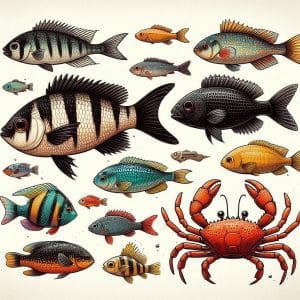
Crab and fish ** The crab was talking on one side and approaching the little black fish on the other. The little black fish said to himself: "Hypocritical, filthy bloodsucker!" But he laughed at the crab's approach. "What a pathetic creature you are," he said, laughing, "You still don't know how to walk like a gentleman, and you're saying that the world is in your hands. What do you know about whose hands the world is in!" With these words, the little black fish slowly pulled back. At that moment, the shadow of something fell on the water, a stone hit the crab's head and threw it into the mud. When the lizard saw this, it laughed so much that it almost burst and fell into the water. The crab could not get out of the mud. Who had thrown that stone? The little black fish saw a young shepherd by the stream. The shepherd had been watching the crab and the fish. At that moment, a flock of sheep and goats approached the stream. The sound they made echoed around. The little black fish watched the sheep and goats drink water and then swam to the lizard. He said to her: "Greetings to you, dear lizard! My name is Little Black Fish. I want to go to the end of this water. I believe you are a wise one, that's why I want to ask you a few things." "Come, ask whatever you want," said the lizard. "On the way, many people told me to protect myself from pelicans, predatory fish, and herons during my journey. Can you tell me what you know about them?" The lizard told him what she knew: "There are no herons or predatory fish in these parts. They live in the seas. But you might encounter pelicans around here. A pelican is a water bird. Protect yourself from it. It is a very cunning animal, never forget that. It also has a pouch under its beak." "A pouch for what?" asked the little black fish curiously. "The pouch you know," said the lizard. "It hangs like a large bag under its beak. It collects water in it. If it's just water, that's fine, but it also collects food." "I had never heard of it," said the little black fish. "There are so many things you haven't seen or heard of," said the lizard. "That pelican's pouch is like a trap. Fish fall into this trap and from there go into the pelican's stomach. That unfortunate creature often hides the fish it catches in its pouch for a while, it doesn't eat them right away; when it gets hungry, it throws some of those fish into its stomach." The little black fish asked her curiously: "Let's say a fish falls into its pouch, is there a way out or not?" "Yes, why not," said the lizard. "There is only one way to escape, you must tear the pouch." "Tear it?" "Since your journey is so long, you must learn how to save yourself from troubles and dangers." "Okay, but how?" "For this, I will give you a dagger. When you are in trouble, that dagger will help you." After these words, the lizard disappeared into a crack between the stones. Soon, she returned with a dagger.
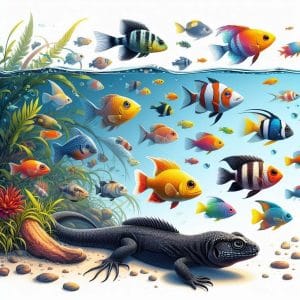
Lizard and fish ** The little black fish took the dagger: "Thank you very much, dear lizard," he said. "How kind you are..." "No need for thanks," said the lizard. "I have many thorns. When I am idle, I sit and make daggers from them for myself, and then I give them to wise fish like you." When the little black fish heard these words, he looked up, astonished: "Did fish pass this way before me?" The lizard replied: "Many, indeed many. Now they have become a large group there. They have all united and taken on the appearance and spirit of fishermen." The little black fish did not understand anything from this statement. He couldn't help himself and asked her: "Dear lizard, forgive me. I bothered you with many questions, don't mind my faults. But I have another question: How did these fish who united take on the appearance and spirit of fishermen?" The lizard laughed: "The fish joined hands, united, and pulled the fishermen's nets to the bottom of the sea." The lizard listened to the crack in the stone. "With your permission, little black fish," she said, "I must go, my children have woken up." She disappeared into the crack.

Fishermen and fish ** The little black fish, hesitant, left that place. He had wanted to talk to this dear lizard for a long time. Many questions went back and forth in his mind. Did this stream really end in the sea? They say there is a creature called a pelican that is very dangerous, and it also has a pouch under its beak. Is that creature very powerful? And why were the fish afraid of predatory fish? Why would one fish eat another fish? Would a creature ever eat another creature of its own kind? But why were those herons hostile to them? "How strange," said the little black fish to himself, "I have learned things since I left my mother." He swam forward on one side, and thought on the other. With every step, he saw new things and learned new things. Now, letting himself go down from the springs was a very easy event, and he was very happy about it. The sun's rays hitting his back gave him strength. Soon, he came across a gazelle on the bank of the stream. It seemed that the gazelle was afraid of something.
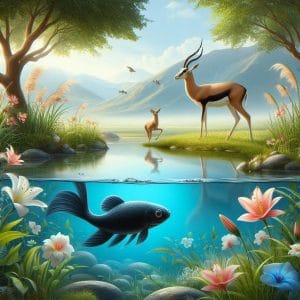
The little black fish and the gazelle ** The little black fish greeted her and said: "Beautiful gazelle, what is your hurry?" "Hunters are after me," said the gazelle. "Look, they wounded me." The little black fish did not see her wound. But when he saw the gazelle limping and staggering, he understood that she had told him the truth. He went a little further and came across a flock of partridges in a place. Soon, the calls of the partridges reached his ears. You would have thought they were laughing with raised voices. The smell of wild grass and the smell of water mingled in the air. After noon, the stream became very wide. It stretched and flowed through fields and trees. How much had the water of the stream increased? The little black fish swam happily in such abundant water. Suddenly, he came across a large group of fish. It was the first time he had encountered fish since leaving his mother. A few small fish surrounded him and asked him: "You are a stranger, aren't you?" He said: "Yes, I am a stranger, I come from far away." "Where are you going?" "I am going to the end of the stream." "Which stream are you talking about?" "This stream, this is where we are swimming." "We don't call it a stream, we call it a river," said the little fish. The little black fish fell into thought and remained silent. A small fish came towards him: "You know that a pelican is waiting for you nearby," he said. "Yes, I know about it." Another small fish asked him: "But do you also know about its big pouch?" "Yes, I know about that too," said the little black fish. Another small fish asked him, astonished: "Do you also know how dangerous that big pouch is?" "No, I don't know." The little fish went back and forth in fear. They said to him: "Still, you want to go your way, don't you?" "Yes, there's no choice," said the little black fish. "Whatever happens, I must go." Soon, among the smallest fish, there was an uproar that a fish like them, a little black one, had come, and he would swim to the end of the river and was not afraid of the pelican. Although a few small fish wanted to go with him, they later didn't dare. It became clear that they were afraid of their parents, but they didn't dare to say so. A few of the smallest fish said: "If it weren't for the pelican, we would gladly come with you, but that big pouch of hers makes our insides tremble." The river passed through a village. Women on the riverbank were washing clothes with much chatter and laughter. The little black fish listened to their conversation for a while, looked at the children, who were swimming in the water. Then he set off again. He swam and swam until it became dark. He felt sleepy and stretched out under a stone.

The little black fish and the moon ** When he opened his eyes in the middle of the night, he saw that the moonbeams illuminated the surface of the water like a mirror. You would have thought they had turned everything into silver. The little black fish loved the moon very much. Even when he was in his mother's house, on bright nights, he wanted so much to come out from under the moss-covered stone and talk to the moon. But unfortunately, as soon as he moved from his place, his mother would wake up, grab him by the tail, pull him back, tell him to sleep, and not let him talk to the moon. Now he was happy that his mother was not with him. The little black fish swam towards the moon. He said to her: "Good night, my dear moon." The moon replied: "Good night, little black fish. Well, what are you doing around here?" "I have set out to see the world," said the little black fish. "The world is so big that you cannot see all of it." "It doesn't matter, I will go as far as I can." The moon, realizing what would happen to her soon, said: "Oh, how I wished we could stay together until morning. But a black and ominous cloud is approaching me. Then my light will be hidden." "Dear moon, you don't know how much I love your rays. Always illuminate me," said the little black fish. "Dear little black fish," said the moon. "The truth is, this light is not mine. The sun lends me this light, and I illuminate the world with it." A little later, the moon continued: "Oh, little black fish, my sorrow is great." "What is your sorrow?" said the little black fish. "Perhaps you have heard, people have started to search for me." When the little black fish heard these words, you would have thought his tongue was tied. "But this... this... cannot be," he stammered. "I also said it cannot be like you, but once people have done something..." Before the moon could finish her sentence, a dark cloud came and blocked her. Everywhere became pitch black. In this pitch blackness, a great loneliness came over the little black fish. For a while, he looked at the darkness with fear and regret. Then, he slipped under the stone and tried to go back to sleep. Early in the morning, he woke up to the whispers of a few small fish around him. When the small fish saw him wake up, they all said together: "Good morning!" The little black fish recognized them. He replied to them: "Good morning! It seems you also want to come with me?" "Yes," said the smallest of them. "But we are still afraid."
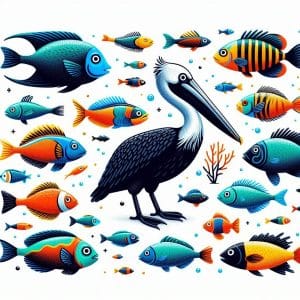
Pelican and fish ** Another small fish said: "Our hearts are never at ease because of the Pelican." At this, the little black fish said: "You only think. But thinking alone is not enough. We can set off. Then all your fears will flee. As they were preparing to set off, suddenly the water around them surged, splashing this way and that, and a black cloth fell over them. Their surroundings became darkness. Like night. There was no chance to escape or turn back. The little black fish then realized that they had all fallen into the Pelican's trap. To warn them, he said: "Friends, we have all fallen into the Pelican's pouch. But even here there are ways to escape." The little fish began to cry. "Oh, we can't escape from here. There is no hope left. It's all your fault. You led us astray. You ruined our comfort," they said. "The Pelican will swallow us all," they said, crying. Another small fish also whispered: "Our end has come," he said. At that moment, with a loud, rattling laugh, they were mixed up in the net. The Pelican was laughing. "Hohoy! What lovely little fish I have caught. I pity you. Believe me, I won't bother to swallow you, hohohoy!" The little fish pleaded and begged the Pelican and said: "Dear Pelican! We have always heard good things about you. Truly, if you are so kind-hearted, what if you open your lovely mouth and let us out? We will always pray for you, wish you well." When the Pelican heard these words: "Wait a minute, my dears, why are you in such a hurry?" she said with a laugh. "I won't swallow you quickly. Just take a breath. If you look at the bottom of the pouch, you will see how much food I still have in my pantry." Indeed, the bottom of the pouch was full of small and large fish. Still, the little fish did not stop begging: "Dear Pelican," they said. "We have done nothing wrong. We are innocent. This little black fish deceived us." The little black fish shouted at them: "Traitors! How can you consider this cunning and deceitful creature kind-hearted and ask for its help?" A small fish angrily replied: "Do you hear what you're saying? Look, you'll see, the dear Pelican will forgive us and give you a good punishment." A little later, the Pelican turned to them: "Yes," she said, "I will forgive you. But I have one condition!" The little fish quickly said: "What is it?" "What is your condition, dear Pelican? Tell us, we will fulfill it quickly, tell us quickly," they said and pleaded with her. The Pelican said: "That little black fish, who is so proud of himself, if you kill him, I will let you go." The little black fish pulled back. In a low voice: "Don't, don't believe her. That treacherous creature wants to turn us against each other." However, the little fish did not listen to these questions. The little black fish raised his voice: "Please wait a moment. I have something to say." But no one listened to him. You would have thought they had lost their minds. They were in distress and wanted to escape quickly. They attacked the little black fish. He pulled back. And shouted at them: "Cowards! You are all caught. You cannot do anything to me. Your strength does not reach me." But who was listening to him? "We will drown you, kill you! We want our freedom!" they said and went over him. "Are you crazy?" said the little black fish. He tried to protect himself from them. "Even if you drown me, you cannot escape from here. Don't be fooled by her words. She is lying!" "You are talking like that to save your life," said a small fish. "We are not your concern." "Wait! I have something to say," shouted the little black fish. "Listen to me! Now I will go down, to the dead fish, and lie there. I will pretend to be dead. You tell the Pelican that we have drowned and killed him. We will see if she lets you go or not. If you don't do as I say, I will kill all of you with this dagger in my hand, do you understand? Then I will tear the pouch and escape. You too from here..." "I'm scared," said the smallest fish and began to cry. At that moment, the little black fish said: "Why did you bring this suckling lamb with you?" and suddenly drew his dagger. The little fish saw that there was no other choice, they pretended to fight, the little black fish pretended to be killed in the fight and lay down at the bottom, among the dead fish. At that moment, the little fish called out to the creature: "Dear Pelican! I swear, we drowned and killed that proud little black fish." "Well done," said the Pelican, and burst into laughter. "Now I have a very good reward for you. I will swallow you alive so that you can do good deeds in my belly!" The little fish had not yet understood anything when they slipped down the Pelican's throat and disappeared. But our little black fish quickly drew his dagger, plunged it with all his might into the Pelican's pouch, and made a hole in it. He jumped out of this hole and fled. Behind him, he heard the Pelican's screams. The Pelican, furious, went mad, plunged her head into the water, but could not reach the little black fish.
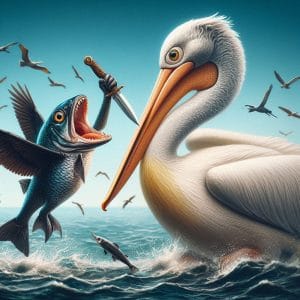
"The little black fish drew his dagger" ** The little black fish swam from morning till noon, never resting, and continued his journey. Mountains and plains were left behind him. The river flowed through a wide valley. From this side and that, small streams joined the river, increasing its water. The more the river's water increased, the happier the little black fish became. It was as if he could no longer see the bottom of the river. He swam to the right, he swam to the left, but it was useless; he could no longer see the riverbank. There was so much water around him that he was astonished. Whichever way he swam, he still saw endless waters. At that moment, a long creature like lightning came over him. It had a two-sided and sharp fin. The little black fish suddenly realized what it was. This was a predatory fish. The little black fish was very frightened, saying, "But now it will split me in two!" He came to his senses, swam towards the surface of the water like an arrow. He stopped for a while, then, to see the bottom of the sea, he plunged downwards. At that moment, he encountered hundreds, thousands of fish. "Friends," he said to them, "I am a stranger, I come from far away. Please tell me, where am I?" A fish who heard this question turned and called out to his friends: "Come on, a new one has joined us!" Then, he turned to the little black fish and said: "Dear friend, welcome to our sea." Another fish: "All streams and rivers end in the sea," he said. "But the end of some is muddy." The third fish, wholeheartedly, said: "You can join us whenever you want." The little black fish was very happy that he had finally reached the sea. "First, let me walk around a bit, see the surroundings, and then I'll come and join you, is that okay? When you unite and pull a fisherman's net together to the bottom of the sea, I would very much like to join you." "Your wish will come true soon," said a fish. "But as you said, you want to walk around and see the surroundings first. But protect yourself from the herons. These days, they fear no one. Every day, if they don't catch and swallow five or six of us, they don't leave us alone." The little black fish left his new friends and went towards the surface of the sea.
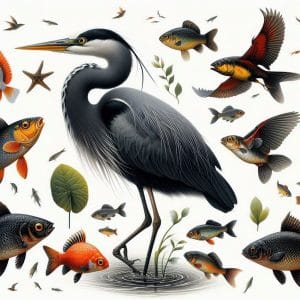
Heron and fish ** The sun was warming the surroundings. When its heat hit the little black fish's back, he was happy. He swam this way and that, talking to himself: "Yes, death may easily catch me. But I truly don't want to throw myself openly into death. Sooner or later, I will die. Death is not important. What is important is to influence people with my life and with my death." He had not yet finished speaking when a heron swooped down on him, caught him with its beak, and flew upwards. The little black fish struggled greatly in the beak but could not free himself. The creature held him tightly by the back. He breathed with difficulty. The little black fish thought to himself: "How long can a small fish stay out of water? I wish this bird would swallow me quickly so I could rest a little in its wet belly." He asked the creature: "Why don't you swallow me alive? You also know that I am one of those fish that spread poison after death..." The creature did not answer him. It said to itself: "Cunning one! You also want to deceive me. You want me to open my mouth and talk so you can escape, do you think I didn't understand that?" From a distance, darkness appeared. The ground was getting closer and closer. "If we reach the edge, my end has come," said the little black fish. He started again and spoke to the creature: "I understand," he said. "You are taking me to your children. But when we reach the edge, I will be dead. A dead person who spreads poison. Don't you pity me, at least pity your children." The creature thought: "I shouldn't feed this fish to my children. Whatever happens... It's better if I eat it myself. I'll catch other fish for my children." They flew silently for a while. The ground was now very close. The heron said to itself: "Perhaps it wants to deceive me? No, my dear. Who is this to deceive me?" The little black fish was shaking lifelessly in its beak. It hurried in fear. And cried out: "Hey, little one! I would have eaten you well. You're dead, what happened?" When it opened its beak for these questions, the little black fish freed himself and plunged into the sea water. The heron, very angry at the little black fish's trick, chased after him. The little fish, like lightning, fell into the water from the emptiness; he had missed the water very much, he opened and closed his mouth many times. Before he had even had enough water, the heron, with all its speed, pounced on him. It caught him again and simply swallowed him. Everything happened so quickly that the little black fish understood what had happened to him much later. Everywhere was dark. Everywhere was wet. His eyes slowly got used to this darkness. Suddenly, he saw a small fish in front of him. Its eyes were swollen from crying. This small fish was calling out to its mother without stopping. Our little black fish approached him: "Don't cry, little one," he said. "Crying and complaining are useless. Isn't it better to look for ways to escape than to suffer by yourself?" "You... Who are you? Don't... don't you see that... I... I can't escape anymore... mother... I can't... pull the fisherman's net... to the bottom of the sea with my friends... mother..." The little black fish shouted at him: "Stop crying. You have disgraced all the fish!" The little fish slowly stopped crying, gathered his wits. The little black fish said: "Listen to me carefully. I will kill this heron." "You will kill it?" said the little fish, astonished. "Yes. I will kill it so that all fish can be saved. But first of all, I will save you from here so that your shame is not cut short." The little fish looked at him suspiciously and said: "You are also considered dead now. How can you kill the heron?" The little black fish pulled out his dagger: "Aha, with this, I will tear its belly," he said. "Listen to me carefully. Now, as much as I can, I will throw myself from here to there and make the heron squirm. It will open its mouth to laugh, and then you will jump out, do you understand?" The little fish asked with worry and fear: "Okay, but what about you?" "Don't worry about me at all," said the little black fish. "Until I kill this monster, I will not come out." After these words, the little black fish threw himself this way and that, back and forth, inside the heron's belly. The little fish also waited at the creature's mouth, ready to jump out as soon as he saw a chance. Soon, the heron became ticklish and couldn't hold back, opened its beak, and began to laugh. The little fish jumped out of the beak and reached his freedom. Outside, he waited for the little black fish for a long time. But he did not come. Where was he, why didn't he come? Suddenly, a loud scream echoed around. It was the heron screaming. It was throwing itself around with screams and falling downwards. It hit the water with its heavy body. It struggled a few times and soon lay lifeless. The waves carried it away, it disappeared from sight, gone. However, from that day on, no one ever saw the little black fish again, and no news was received of him. The old fish had finished her story. She said to her nearly twelve thousand children and grandchildren: "My children, it's time to sleep now, go to bed." The children all shouted together: "Grandma! Grandma! What did the little fish do after he was saved, you didn't tell us?" "I'll tell you that tomorrow evening," said the old fish. "Now it's time to sleep. Good night." Twelve thousand little fish said good night and went to bed. Eleven thousand nine hundred and ninety-nine little fish, after saying good night, lay down in their nests and immediately fell asleep. The old fish also fell asleep. But sleep did not come to the eyes of a little red fish. He imagined the sea until morning and fell into deep thought. THE END NOTE: A BEAUTIFUL COMMENT ABOUT THE ARTICLE FROM ŞEVAL HUN'S PEN First of all, I would like to state that World Mother Tongue Day has great importance for us. The fact that you have frequently mentioned and included our mother tongue, Kurmanji (Kurmancî), in many of your articles and books over the years, and constantly kept it current, truly makes me proud. Unfortunately, as a society, we can get lost in small and insignificant details. However, the late İhsan Aksoy's book Masiyê Reş ê Piçûk (The Little Black Fish) is a very valuable work, and I was truly surprised when I learned this from you. I questioned myself, asking why the Kurdish community does not embrace such valuable writers and works. I thank you very much for enlightening and informing us with your work, effort, and endeavor. We, as children born Kurdish but living like Turks, are truly saddened that we have been disconnected from our mother tongue. How did my Little Black Fish story begin? It was the 1980s, and I was in the 3rd grade of primary school. During the summer holidays, I asked my father for a storybook. My father brought me "The Little Black Fish" book he had bought from Istanbul. When he first arrived, I couldn't find the book in his hand, he said, "Be patient, I'll bring it," and told me the book was inside a bale. I was so impatient! I waited for a few hours, my father was very tired, I kept asking for the book while kneeling beside him. My mother couldn't stand it, she said, "Leave your father alone, what do you want from the man, he's very tired." But I continued to wait sadly. My father finally went to the storage room, and I followed him. My father cut the middle of a bale with a knife and took out the book. At that moment, I was truly very happy. I immediately took the book and came home, went to my bed, and started reading. I fell asleep while reading the book. When I woke up, I couldn't find my book. I turned everything upside down, searched everywhere. My brother Mehmet came and said he had put the book under my pillow. At that moment, I was very happy again. From that day on, whenever I had the chance, I would take the book and gather the neighborhood children around me, reading it to them again and again. One day, our Azerbaijani neighbor, the late Aunt Asya, poked her head out the window: "Ay gij, can a fish even talk? Now İrehim (Rahim) Emin will bring that little black fish home, and we'll cook and eat it." When I heard this, I was very upset and ran home crying. My father was drinking tea on the balcony. When he heard what I told him, my father became very angry and called out to Aunt Asya: "It's a shame, neighbor, why are you making my daughter cry? That fish is not this fish!" Aunt Asya tried to smooth things over by saying, "Ay Hacı brother, I swear I was just joking." At that moment, I felt relieved, but I didn't eat fish for a long time. School started. On the first day, I took my book to school. Our teacher wasn't there, so the assistant principal Musa Atış came to our class instead. We were all very afraid of him. For us students, Musa Hodja was very cruel. He would punish children by pressing their ears with his fingernail. During recess, I gathered the children around me and started reading the book. Suddenly, Musa Atış stood over us, snatched the book from my hand, turned it over and over, and shouted, "Where did you find this Communist's book?" I started to cry. I was both very scared and my book had been taken away. At that time, of course, I didn't know what "Communist" meant. After school, Musa Atış took me to my father. He said to my father, "Why do you buy such books? These are not suitable for children." My father responded sharply to Musa Hodja, saying, "You are the one who is not suitable, but you have become a teacher. Give my daughter's book back!" Taking courage, I intervened: "Father, he called my book Communist. He took it from me," I said, crying. Hearing this, Musa Hodja was upset. My father gave me money and comforted me: "Don't cry, my daughter, go buy yourself something!" From that day on, I decided to live as a free "Little Black Fish." My dear husband, I am grateful to you and the late İhsan Aksoy. These values, these stories you have contributed to us, have become a part of our identity. With love