The Sin of Justice: Makbule Özer
The author reflects on the imprisonment of 83-year-old Makbule Özer for allegedly aiding a terrorist organization, drawing parallels to his mother's past experiences and questioning the justice system's approach to vulnerable individuals in conflict zones.

Dear Readers:
My mind was in turmoil when I heard the news report that 83-year-old Makbule Özer, living in Van’s Edremit district, had been imprisoned on charges of “aiding an illegal organization,” and memories of my mother resurfaced.
THE DOWRY CHEST
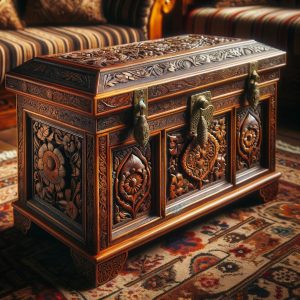
Dowry chest with walnut wood ornamentation
I don't know about now, but in my childhood, every house I visited invariably had a dowry chest. Dowry chests made of walnut wood were placed in an important corner of the house, and important items were arranged on top of them.
My mother also had a dowry chest. It was made of dark walnut wood. Its edges were embroidered and ornate. It stood in a corner of the bedroom, as if greeting those who entered with a noble posture. It aroused curiosity in those who looked at it, as if to say, "Oh, the things I contain..." This curiosity would later cause trouble for my mother.
A few times a year, my mother would carefully open her dowry chest, and we children would gather around it. What wouldn't emerge from the dowry chest gifted by my grandfather... Lace covers, elegant dresses my mother wore in her youth, fabrics, hand-knitted socks with a thousand patterns, prayer rugs brought as gifts from the Hajj, a huge photo album full of black and white pictures, jewelry boxes filled with diamonds and rubies, Süheyla's Ottoman princess-style dress, sewn for her to wear at the April 23rd ceremonies when she was a fifth-grader, and a thousand kinds of embroidered fabrics that I cannot recall now...
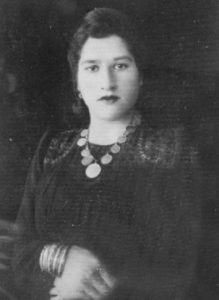
Naciye Hun, when she was newly married. My mother's dress and jewelry were in the dowry chest.
On January 5, 1978, Bülent Ecevit formed the 42nd government of the Republic of Turkey by transferring 11 deputies from the Justice Party, whose chairman was Süleyman Demirel. These were difficult years for Turkey. The right-left conflict had spread like a dangerous cancer cell to villages and neighborhoods, tearing Turkey apart from within.
In those years, Iğdır was a district of Kars. When right-left incidents intensified throughout Kars province, martial law was declared in 1977. Soldiers moved to ensure security in Kars and Iğdır.
Most of the leftists in Iğdır were Kurdish; most of the rightists were Azeri. The prominent leader of the Kurds, Iğdır CHP District Chairman Mecit Hun, was a target. They had to somehow apprehend Mecit Hun.
First Lieutenant Cebrail, serving under martial law, loyal to the instructions given to him, implemented a plot in the summer of 1977 to imprison Mecit Hun. Unfortunately for him, Mecit Hun was in Erzurum that evening; his son Ahmet, who was alone at home, was caught. Ahmet was arrested and sent to Erzurum Prison, on the grounds of a bag full of weapons and ammunition that the commando gendarmes, who raided the house, had themselves placed in a compartment above the stove under the shed in the garden. (I will leave the details of this incident for another article.)
A year passed. Ecevit was Prime Minister. Many of Mecit Hun's party friends were ministers. On such a day, a second plot was organized against Mecit Hun.
The gendarmes suddenly raided Baharlı Neighborhood (November 14). Houses began to be searched from the entrance to the neighborhood. In fact, the search of other houses was merely for show. The real target was Mecit Hun's house.
It was Mecit Hun's house's turn. Dozens of gendarmes stormed the house. They had been instructed: even the slightest element of crime would be taken into account.
Hundreds of books were scattered everywhere, but there were no banned publications. One gendarme even mistook the picture of the famous German philosopher Nietzsche on the cover of a book for Karl Marx and excitedly went to his commander. When Mecit Hun made the necessary explanation, the gendarme returned to his duty in disappointment.
This time, the gendarme entered Mecit Hun's bedroom. Items in the built-in wardrobe were thrown out, and the bed was turned upside down. At that moment, the gendarme's eyes fell upon the magnificent dowry chest standing in a corner.
"What kind of chest is this? What's inside?"
My mother replied:
"It's my dowry chest."
"Open it!"
My mother brought the key she had carefully kept and opened the chest. The gendarme soldier scattered the naphthalene-scented items he took from the chest and examined the jewelry boxes. He had to find a weapon!
Suddenly, his eyes caught sight of a switchblade knife, forgotten for years in a corner of the chest, from Atila's childhood. In the 1960s, this switchblade, carried in pockets by children imitating movies, would snap open with a spring when a button was pressed and automatically lock when folded.
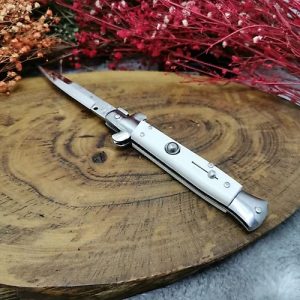
Switchblade knife
The gendarme took the knife, pressed the button, closed it, pressed the button again, the blade sprang out, and he closed it again. The gendarme shouted joyfully: "Commander, I found a weapon!"
The commander and gendarmes crowded into the room. The commander was happy. He turned to Mecit Hun:
"You're coming with us!"
Naciye Hun stepped forward:
"This chest belongs to me. I brought the key. You will take me!"
The commander insisted on taking Mecit Hun, but Naciye Hun insisted that he should take her. They were forced to put my mother in a military vehicle and take her to the Iğdır Gendarmerie Command. Naciye Hun spent the night in custody. The next day, she was arrested and placed in Iğdır Prison. The prisoners, hearing that Naciye Hun had been unjustly arrested, started a fire in protest. They resisted taking Naciye Hun into prison, but their efforts were unsuccessful. Naciye Hun spent 18 days in prison.
WOUNDED AHMET KESİP
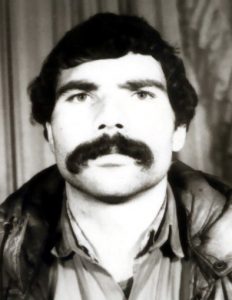
The name Ahmet Kesip came to the forefront of Turkey's agenda starting in the 1980s. Ahmet Kesip, a member of the Geloylu tribe, was from Karahacılı village, part of Aralık district. He rented a house with friends in Iğdır to attend middle and high school. He became acquainted with leftist ideology. When the September 12 military coup occurred, he started a resistance movement on Mount Ararat with a handful of friends.
On such a day, Ahmet Kesip was wounded in the shoulder during a clash with gendarmes on Mount Ararat. The bullet had pierced his shoulder. He tried to treat himself in village houses, but the wound became infected, and the pain intensified. One evening, he arrived at Mecit Hun's farm within the borders of Karakuyu village, accompanied by four friends. (This farm is known as 'qom' among the people.)
It was evening. Naciye Hun had milked 40-50 cows and retired to rest in the small, two-room, 20-square-meter house. She was alone in the house. For the past 10 years, her life had been spent on this farm, where there was no electricity, no refrigerator, no TV, and no running water, working day and night to educate her children. The shepherds had fed the cows in the barn and had retired to rest in their beds in a special section within the barn. The surroundings were silent.
***
Dear Readers:
I believe it was 2012. I was sitting with my mother at home in Ankara. Whenever I had the chance, I would confide in my mother, ask her questions about the past, and we would have a pleasant conversation.
It was a day I returned home tired. I was stretched out on the three-seater sofa, reading a book. My mother was sitting on the single armchair, playing with the remote control in her hand, watching TV, switching from one channel to another. She particularly enjoyed watching programs similar to "İbo Show." Sometimes, she wouldn't find a program to her liking, would get angry, turn off the TV, and retreat to her room.
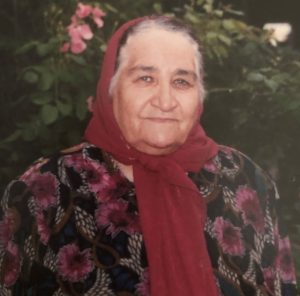
Naciye Hun
My mother was reticent about discussing the past. She wasn't eager. However, sometimes she would suddenly bring up a topic herself and explain it in detail. Most of the time, she caught me unprepared, so I didn't have a chance to record her voice.
My mother suddenly turned off the "İbo Show" program she was enjoying.
"Mücahit, I'm going to tell you something. You'll be the first to know."
I was curious. I sat up. I put the book aside and listened to my mother:
"It was the years when Kenan Evren staged the coup. I was alone in the house at Qom. Ahmet would occasionally stop by the farm in his Jeep and bring supplies for the house. We had two shepherds. I milked the cows and retired to the house. It was midnight. The door knocked. The shepherds wouldn't knock on the door; they would shout from a distance. It was also out of the question for Ahmet to come at midnight. A vague fear enveloped me. Who could it be? Besides, the dogs hadn't barked. When I opened the door, I saw five young men in front of me. They were armed from head to toe. One of them pointed his gun at me. At first, I thought they had come to harm me. After all, Mecit Hun had many enemies.
"What do you want? I am a lonely woman?"
The armed young man walking at the very back came up to me:
"Xatî (aunt), I am Ahmet Kesip. I am Qaso's son from Karahacılı village. You don't need to be afraid! We will be your guests tonight."
I had heard Ahmet Kesip's name but had never seen him before. Everyone knew his father, Qaso. I felt relieved when I learned he was Geloylu. The young men with him were from other cities and towns.
The young men quickly entered the room. They didn't want anyone to see them. One of them went up to the roof to stand guard.
They said they were hungry. I prepared some breakfast. At that moment, I noticed that Ahmet Kesip was wounded in the shoulder.
"Are you wounded?"
"Yes, I was wounded in the shoulder in a clash."
I boiled hot water and dressed the wound. His wound was deep. It had become infected because it hadn't been treated. I poured the herbal powders I used as medicine onto the wound and bandaged it. I knew this wouldn't do any good either.
Our shepherds were from Karakuyu village. They shouldn't have seen the young men who came to the house. In fact, this was also the armed young men's wish. I went to the barn, woke up the shepherds, told them to go home early in the morning, and that I was giving them a day off. The armed young men wanted me to go down to the city and bring the medicines they had written on a piece of paper. They also did not fail to warn me not to talk to anyone about this in the city.
Early in the morning, I walked from Qom to the Doğubayazıt-Iğdır highway. I waved at passing cars. A car took me to Iğdır city center. I went to the pharmacy of C.T., a family friend.
"Yesterday, one of our animals was wounded with a pitchfork. The wound is infected. I want you to give me tincture of iodine and bandages to treat the wound. Since such accidents happen frequently, I want you to give me plenty of these medicines. Please don't let Mecit know I came. I will pay my debt myself later."
C.T. gave me two bottles of tincture of iodine, oxygenated water, black ointment, and plenty of bandages.
I went to the terminal where minibuses departed hourly for Doğubayazıt. The minibus dropped me off opposite Qom. When I arrived home, the young men were hiding in the grass and barn area. They must have thought I might have informed the gendarmes.
After cleaning Ahmet Kesip's wound with oxygen, I applied tincture of iodine. I then applied black ointment and tightly bandaged it. Ahmet Kesip stayed in bed all day. I cooked and fed them. In the evening, this time I went up to the roof. The young men woke up early in the morning and set off towards Mount Ararat in the twilight."
CONCLUSION
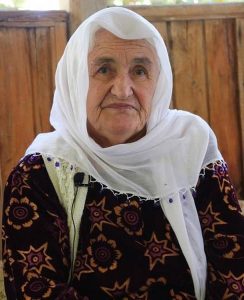
Makbule Özer
I would like to convey this message to our esteemed prosecutors and judges who sent Makbule Özer to prison:
We must accept a reality: the sociological fragmentation that emerged with the rise and strengthening of the PKK has affected the cities, towns, villages, and people of Eastern and Southeastern Anatolia as a whole. Young people who joined the PKK came from these villages and cities. In a sense, the PKK and the people of the region have experienced an intertwined cycle, where logic gave way to emotion, and the people, in general, were left helpless, and unfortunately, this emotional helplessness still continues.
Therefore, in my opinion, the arrest of 83-year-old Makbule Özer on charges of providing shelter to young people allegedly belonging to the PKK in her home raises serious concerns regarding fundamental principles of law and human rights.
While the necessity of the state's measures and security policies in combating terrorism is undeniable, the treatment of an elderly, defenseless woman in this manner pains the conscience of society. As in the example of my mother, Naciye Hun, women in the region do not consciously and willingly provide this support to armed youths; they act out of fear that their families will be harmed under threat. I ask: Which woman can find the courage to say no to armed young men who appear at her door in the middle of the night? Therefore, the arrest and imprisonment of 83-year-old Makbule Özer, living in an environment dominated by such difficult conditions, should be considered a violation of fundamental human rights.
This incident shows that Turkey's legal system and methods of combating terrorism need to be re-evaluated. A balanced approach between security and justice should be adopted, and particular sensitivity should be shown in protecting civilian, elderly, and defenseless individuals. Respect for human rights must be at the foundation of all legal and security policies.
It is a fact that the state must remain respectful of human rights while combating terrorism. Such situations, beyond being merely a legal problem, should also be addressed as a matter of SOCIAL CONSCIENCE. Makbule Özer's arrest reminds us that justice is not just a blind scale, but must also be in harmony with society's moral values.
I hope that the Makbule Özer incident will be a turning point for developing more just and humane approaches when similar situations are encountered in the future. As a society, we must not forget our responsibility to protect human dignity even in the most difficult times.