The Middle East, the Sword of Damocles, and Independent Kurdish States
This article explores the ongoing conflicts in the Middle East, the historical context of the Kurdish question, and the potential emergence of independent Kurdish states, viewed through the metaphor of the Sword of Damocles.

Dear Readers:
As I write this, Iran's missile attack on Israel, which the world has been eagerly awaiting, has not yet happened. Perhaps such an attack will never occur. As an anti-war advocate, my most sincere wish is, of course, that the parties reach a compromise at the negotiating table before this attack takes place.
However, real life does not proceed according to our wishes. The Russia-Ukraine war, which began on February 24, 2022, continues with full intensity before our eyes. According to estimates from US Think Tanks, Russia has suffered at least 400,000 dead and as many wounded in the war. Ukraine's losses are around 30,000... These are unbelievable, horrific figures.
While the Russia-Ukraine war continues, we are now facing a low-scale Middle East war that began with Hamas's attack on October 7, 2023. Again, according to estimates, nearly 40,000 Palestinians and close to 3,000 Israelis have lost their lives in the conflicts so far. Hopes for peace currently seem weak, even impossible.
THE MIDDLE EAST EQUATION
Since World War I, the Middle East has failed to achieve stable governance. Military coups and dictatorships have followed one after another. Seeds of hatred and animosity, ethnic and sectarian conflicts have been constantly kept alive. The Palestinian Question, which began with the establishment of the State of Israel in 1948, has continued unresolved to this day. Millions of people died or were wounded in the Iran-Iraq war, which lasted from 1980 to 1988.
With the First and Second Gulf Wars, the Middle East became, in a sense, an arena for the world powers to settle scores. The exact number of those who died in these wars is unknown. During Saddam's invasion of Kuwait, 300,000 people left their country. The Civil War that erupted in Syria on March 15, 2011, continues despite nearly a million dead and wounded. Israel's Six-Day War (1967), Yom Kippur War (1973), and Lebanon Wars (1982 and 2006) with neighboring countries have upset and continue to upset the balances in the region. The number of dead in the ongoing civil war in Yemen is close to 400,000. Egypt gained notoriety as a country of coups and never achieved stability.
All of this provides a brief insight into what kind of place the Middle East is.
AND THE KURDS
If the Kurds had been able to establish a state in the years following World War I, the balances in the Middle East might have progressed along a different path. Millions of Kurds in Turkey, Iraq, Iran, and Syria are currently the most important part of the Middle East equation. The biggest fear of Middle Eastern countries, including Turkey, is the emergence of a strong and independent Kurdish state, which would change regional balances.
This fear has always existed since World War I. During the Cold War, the CENTO defense organization, established between Turkey, Iraq, Iran, Pakistan, and the United Kingdom to balance or prevent Soviet influence in the Middle East, quickly changed its nature, transforming into an anti-Kurdish cooperation organization aimed at liquidating resistant Kurdish parties and organizations in their own countries through secret agreements between Turkey, Iraq, and Iran.
On September 25, 2017, the Kurdistan Regional Government of Iraq, led by Masoud Barzani, held an "Independence Referendum." 92.73% of voters said "Yes" to the independence proposal. Thereupon, Iraq-Iran-Turkey acted together, reviving the spirit of cooperation from the CENTO era. While the Iraqi Central Government took serious sanctions, the Turkish Armed Forces began exercises on the Iraqi border. Iran not only closed its border crossing but also closed its airspace to planes coming from the Kurdistan Regional Government and amassed troops on the border. Thus, the Kurds' desire for independence was stifled before it could be realized.
Now, Syria is also sought to be included in this tripartite cooperation. The reason for this is that the Kurdish population in Syria, which had been "sleeping and forgotten" for a century, has reached the stage of forming a state. Syrian Kurds, whose national identity was denied, deprived of citizenship rights, and even forbidden from being issued passports before the Civil War, have emerged as an undeniable independent force at the end of the prolonged and exhausting Civil War. While the establishment of a possible Kurdish state was expected elsewhere, this situation arising in Syria created a surprise and, in a sense, caused panic in the Middle Eastern countries with Kurdish populations. While tensions between Ankara and Damascus were at their peak, and even seemed impossible to repair with mutual personal "insults," the two countries now feel the need to put aside their disagreements and draw closer to each other to prevent a possible Kurdish formation in Syria.
THE SWORD OF DAMOCLES
The idiom "Sword of Damocles" finds its place mostly in political literature.
We all know the island of Sicily in southern Italy. In ancient Greek times, the Greeks established a colony in a region called "Syracuse" in the southeast of the island of Sicily. This small colony was ruled by a King named Dionysius. Damocles was a high-ranking official in the palace. Whenever Damocles was next to the King, he would flatter him, exclaiming that the King was truly fortunate as a man of unparalleled power and authority.
One day, the King suggested, "Since you want to be king so much, would you like to take on this role for a day?" Damocles gladly accepted the offer. Damocles sat comfortably on the throne in the hall adorned with embroidered carpets, filled with pleasant scents, and served by beautiful servants.
King Dionysius had made many enemies during his reign. He lived a magnificent life but carried the fear of being killed at any moment in his heart. He wanted Damocles to feel this fear in his heart, even if only for a day, while in splendor.
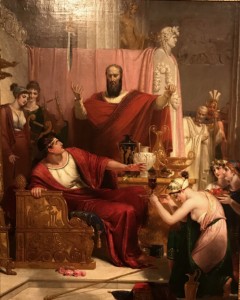
Damocles, sitting on the throne for a day, looks in fear at the sword hanging over his head.
King Dionysius had a huge sword hung over the throne where Damocles would sit, suspended by only a single horsehair. So much so that Damocles, sitting on the throne, could not relax for fear that the sword would fall on his head at any moment. The service was magnificent, but the fear of the sword falling on his head gnawed at his heart.
Damocles could not bear it, asked the King for permission, saying he could not endure living with such fear, even for a day. King Dionysius interjected: "From the outside, you envy my life, but my enemies' plans to kill me never leave me, just like the fear this sword creates in you."
Of course, the idiom "Sword of Damocles" is used in different meanings today.
The Kurds and the Kurdish Question hang over the Middle Eastern countries like the Sword of Damocles.
INDEPENDENT KURDISH STATES
Middle Eastern countries carry the fear of an independent Kurdish State being established one day in their minds and hearts, just like the "Sword of Damocles." However, this fear is deeper and more multi-dimensional than imagined.
Today, the Kurds have a fragmented structure in terms of language, sect, and culture. In the Kurdistan Autonomous Region of Northern Iraq, a single army has not yet been established. The Kurdistan Democratic Party (KDP), founded by Mullah Mustafa Barzani, has one army, and the Patriotic Union of Kurdistan (PUK), founded by Jalal Talabani, has another. Talabani's supporters predominantly use Sorani, while Barzani's supporters prefer Kurmanji. The sharp and irreconcilable line between the two sides became even clearer in the Kirkuk Governor elections held a few weeks ago. Therefore, it is not difficult to predict that both will emerge as separate states at the first opportunity.
If a regional war breaks out in the Middle East and lasts for years, just like the Russia-Ukraine war (or the Syrian Civil War), independent Kurdish states will undoubtedly fill the resulting political vacuum. All states in the region and international powers are aware of this fact.
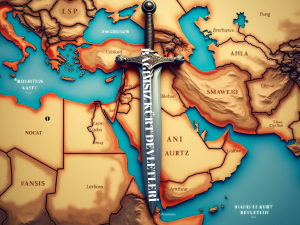
The fear of "Independent Kurdish States" hangs over the Middle East like the "Sword of Damocles."
The Palestinian Question is internationally recognized. 145 of the 194 UN members recognize Palestine as a state. Hamas's struggle is largely aimed at neutralizing Palestinian President Mahmoud Abbas. However, the situation of the Kurds is quite different. The political existence of the Kurds, whose population exceeds 60 million worldwide, has not been recognized or voiced by a single country in the United Nations.
Middle Eastern countries, which cannot tolerate a single independent Kurdish State, should not forget that in the political vacuum and chaos caused by a long-lasting and exhausting regional war, they could face half a dozen independent Kurdish States. The reason for this is the continuous and coordinated suppression of Kurdish identity rights.
The Republic of Turkey should know that it is making a big mistake by approaching its Kurdish citizens with an ambivalent attitude and the fear of the "Sword of Damocles." The right to education in the MOTHER TONGUE for Kurmanji and Zaza speakers should be implemented quickly by the state. It is a mistake to equate Kurmanji and Zazaki with minority languages such as Albanian, Bosnian, and Circassian. While today there are almost no villages in Turkey entirely composed of Bosnians, Albanians, or Circassians, this situation is different for Kurmanji and Zaza speakers. Kurmanji and Zaza speakers are endemic and historical peoples of Anatolia. Therefore, under the leadership of our state, a conference attended by all Kurdish Parties and Civil Society Organizations should discuss how education in the MOTHER TONGUE for Kurmanji and Zazaki can be implemented most quickly. It is a mistaken approach for our state to view the right to education in the MOTHER TONGUE, which is the most fundamental right of its own citizens, as the "Sword of Damocles."
Let alone education in the MOTHER TONGUE, the social hatred and delusion developed against Kurdish folk dances (halay) or the Red-Green-Yellow colors witnessed in Amedspor these days are harming the unity and integrity of our country.
The Kurdish Question should not be seen as the "Sword of Damocles." The Kurds are one of the most ancient peoples of the Middle East, prioritizing brotherhood, unity, and loyalty.
Mücahit Özden Hun 14 August 2024 Time: 20:00