Black, White, and Gray: Hüsnü Bingöl – Part 4
This installment of the series delves into the life of Rutto Yusuf, a legendary figure in Iğdır and one of Hüsnü Bingöl's most trusted agents, alongside other anecdotes from Hüsnü Bingöl's time in Iğdır.

A HERO IN HÜSNÜ BİNGÖL'S SHADOW: RUTTO YUSUF
One of Hüsnü Bingöl's most trusted and active agents among the Kurds, perhaps even the foremost, was Yusuf Çakmaz. Also known as "Rutto Yusuf" or simply "Rutto," Yusuf Çakmaz is an Iğdır legend.
INTRODUCTION
Four borders kiss on Mount Ararat. Iran, Turkey, Armenia, and Nakhchivan can be woven together like a sweater in an old woman's hands, traversable from one end to the other in a day on horseback. Iranian territory begins with the Helikan tribe. Villages are side by side, intertwined. Blood ties are the most valid passport. Rutto, from the Helikan tribe, carries this passport in his blood.
His early youth is spent on horseback. He shuttles between Iran and Turkey, earning a living from the strong presence of his tribe; his saddlebag is filled with rabbit-blood Iranian tea and plates with Süreyya motifs. Hüsnü Bingöl's prison becomes a lesson for him. The generous and wealthy people of Iğdır do not begrudge Rutto Yusuf a meal. He takes on all sorts of jobs. He matures through life, sometimes dabbling in politics, sometimes a voluntary extra in every important event. Rutto Yusuf is a unique hero embedded in the heart of Iğdır.
THE HELIKAN TRIBE
In the late 1920s, the Mount Ararat Rebellion continued with full force, and the rebel forces received their greatest logistical support from the Helikan tribe, settled on the Iranian border. The wounded were treated there, and provisions and weapons were delivered to the rebels via the Helikan tribe. Knowing this, the Turkish Government put diplomatic pressure on Iran, demanding the removal of the Helikan tribe from the region. Consequently, Iranian forces attacked the Helikan tribe. The tribal leader, Halit Ağa, finding himself in a difficult situation, requested asylum from the Turkish Government. The Turkish Government, delighted to be rid of this trouble, opened its borders to the Helikan tribe, consisting of approximately 500 households, and settled them in 12 villages in Dil Ucu, which had been vacated due to the Brukan tribe's move to Van. However, since these villages were close to Mount Ararat, and thus to the rebels, the tribe was quickly transferred to villages near Tuzluca. The Helikan tribe, which spent the winter in villages vacated by Armenians in Tuzluca, was exiled to Western Anatolia in the spring of 1931. They were settled in districts of Aydın province, especially around Söke, with a few households per village. They were forbidden to leave the villages. The tribal chief Halit Bey was exiled to Thrace, where he passed away.
THE HELIKAN TRIBE IN TURKEY
Rutto Yusuf recounts his life:
“I was born in Iran in 1923. I have been living in Iğdır since I was seven. I am illiterate. I am married, a father of ten children, four of whom are boys. Before going into the details of my life story, I must summarize some historical events and highlight the characteristics of an era. Because the fate of my family and my tribe developed in relation to these events, and they were primarily affected by them. My family belongs to the Helikan tribe. Our original settlement was the village of Akgöl, in the Makü district of Iran. I was also born in this village.
During the Zilan Valley events (June 1930), some of the rebels crossed the border and entered Iran as refugees, taking refuge with the Helikan tribe, whom they considered close. When Turkey issued an ultimatum to Iran, demanding the return of the refugees, the Iranian government used its influence on our tribal leader, Halit Ağa, to have the refugees returned to Turkey, but Halit Ağa flatly refused this request.
Then, shortly after this event, the Mount Ararat Rebellion dispersed (September 1930), and a second wave of refugees, including the rebellion's leadership (Halis Öztürk, Ferzende Bey, İbrahim Ağa, etc.), crossed the border and took refuge with Halit Ağa and Musa Ağa, the leader of the Sakan tribe.
As the Iranian government continued its attacks and intimidation operations relentlessly and decisively, Halit Ağa was forced to contact Salih Pasha, asking for his help. Salih Pasha set only one condition for help: the leaders of the Mount Ararat Rebellion would surrender with their weapons. Salih Pasha promised that no one would be arrested and that they could reside wherever they wished.
When Halit Ağa made this proposal, İbrahim Ağa (Bıro Heskê Teli) strongly objected, declaring that he would not surrender to Romê Reş (the Turkish Government) at any cost. Halit Ağa, unable to achieve the desired outcome, could no longer withstand the increasing Iranian pressure, contacted Salih Pasha again, and asked for his help in allowing his tribe to cross into Turkey as refugees. Once an agreement was reached, our tribe took refuge in Turkey. Salih Pasha allowed our tribe to shelter in the abandoned villages near Tuzluca that winter (1930). In the spring, families were dispersed by ships from Trabzon to western provinces such as Söke, Aydın, Lüleburgaz, and İzmir.
My father had died a martyr in a conflict with Iranian government forces. I grew up an orphan, an only child. My mother's family was from the village of Kellehemo (Germeşof) in Iğdır. When we came to Turkey as refugees, my uncles secretly smuggled us out of the camp and took us to their village.
I was a frail child, six or seven years old, with my milk teeth fallen out. I stayed with my uncles in Kellehemo for two years. When my mother married someone from the Motanlı tribe, we moved to the center of Iğdır. My stepfather was a good man but poor. My mother tried to support us by working. When this was not enough, from the age of 9-10, I realized I had to fend for myself and learned to survive by doing small jobs.
“THE ORIGIN OF THE NICKNAME “RUTTO”
A boy named Mısto from Zor village – he was 3-4 years older than me – used to stay at our house. Both of us had nothing but our white shirts that reached our knees. Half-naked, we would wander around all day, trying to make a living by stealing small things or working.
Because we wandered around the streets and neighborhood half-naked like this, the neighborhood people eventually gave Mısto the nickname “rût” or “rutto,” which means “naked” in Kurdish. Since I wandered with Mısto, I also got a share of this nickname. From that day on, everyone knew me as “Rutto Yusuf.”
THE GOOD PEOPLE OF MY CHILDHOOD
Since I was 9-10 years old, I wandered aimlessly through the streets of Iğdır, taking every job opportunity that came my way. The Azeris were the first to take me in and put a few pennies in my pocket.
The Tezel brothers, Hasan and Cafer, would call me and send me home with various items. Their mother, Güvercin Hanım, was a loyal and kind woman. Knowing my mother's poverty, she would help me, asking me to warm myself by the stove in winter and filling my pockets with vegetables and fruits she gathered from the garden in summer. Hasan Tezel had a tailor shop. Every day I would pass by there, clean up, take my allowance, and leave.
One of the good people who extended a helping hand to me was Hacı Nağdali Parlar. Every time he saw me, he would generously reach into his pocket and give me my allowance. Hacı Nağdali Parlar was one of Iğdır's important merchants, like Abdürrezak Güneş. He was rich and also generous. I understood how much Hacı Nağdali Parlar loved people because of an incident:
During the Kaça-Kaç years (1919), 5-10 Azeri families lost their Turkish citizenship records while traveling to and from Iran, and their citizenship rights were endangered. The government gathered these families and sent them back to Iran. The people, leaving with heavy hearts, escaped and returned, insisting, "We were born here, the state should accept us again." No one stood up for them. Hacı Nağdali Parlar extended a helping hand. On one hand, he provided financial aid, and on the other, he hired a lawyer and filed a lawsuit for their citizenship rights.
Another wealthy, respected, and charitable Azeri merchant in Iğdır was Bağır Aras. I always remember him with the gray horse he rode. He would come to the city center on his gray horse, dismount at the Söğütlü cafes, lightly flick the horse's flank with his hand, and give a command:
"Go home, my boy!"
And the horse, as if understanding, would trot off towards home.
The Azeri merchants who helped me the longest were Nağı Odoğlu and his son Abbas Odoğlu. I grazed their animals in the meadows for 6-7 years. Nağı Odoğlu had two sons named Bekir and Abbas, and three daughters named Fahriye, Süheyla, and Ayten. Fahriye was married to her cousin Recep. There was also a gentleman from Karxunlu named "Beyaz Kerim" who never left their house. But I must confess that Abbas Odoğlu was the most perfect person I had ever seen. He would honor even an orphan and poor child like me and treat them humanely. I always felt happy and proud by his side.
Among the Kurdish merchants who extended a helping hand was Musa Turan (uncle of Cihangir Turan), who was a draper. Also, Naci Güneş, Abdürrezak Güneş, and Kerem Güneş were people who loved the poor. Besides Azeris and Kurds, there were also merchants of Bitlis and Laz origin in the city center. Reşit Keki, İsmail Şefkatli, Cevdet Ergin, Mehmet Kakioğlu, and Fazıl Kalafat are a few of the important names that come to mind.
MEETING HÜSNÜ BİNGÖL
Hüsnü Bingöl would place his hat on his head in his unique way, wearing culotte boots, with two miniature poodles by his side, walking slowly down the street, his eyes carefully scanning his surroundings. He would settle at one of the tables in the municipal garden, drink his tea and coffee, and after a brief chat with friends, return home.
Among Hüsnü Bey's close friends, I can name Temır Bey from the Şöllü family, Ahmet Armağan from the Brukan tribe, Hacı Abdullah, and Hacı Abdülhadi.
In those years, smuggled goods like plates and tea entered Turkey from the Iranian border. Most of the villages along the border belonged to the Helikan tribe. I had kinship ties with most of the smugglers. I would sometimes load smuggled goods into my horse's saddlebag and market them from village to village. Naci Güneş, being extremely fond of eating and drinking, would occasionally buy smuggled tea from me.
It must have been 1945. One day, the police caught me in the city center and brought me before Hüsnü Bingöl. I couldn't understand what was happening. Hüsnü Bingöl spoke in a calm tone:
"You and a few of your friends are going back and forth to Russia as agents for Naci Güneş."
I was shocked. It was true that I had illegally crossed the Iranian border, but I had not engaged in espionage for Naci Güneş or anyone else. They quickly threw me into the surveillance house next to Hüsnü Bingöl's home. In one room, Naci Güneş was alone. In another room were Xottê and Kişmiş Xur, whom I knew well and who were accused of the same crime.
ESCAPE FROM PRISON
For a few days, I couldn't think due to the shock of the event. Perhaps because I was unjustly accused, I carried a deep sense of sadness and rebellion within me.
With our hands cuffed, we began counting our days within four walls. One day, I decided to myself: "No matter what, I will escape from here!"
My poor mother would visit me every day, tearfully handing me small items she brought. One day, I instructed my mother:
"Lêlê (mother), tomorrow evening, bring the bayonet from home and throw it through the window of the surveillance house that faces the street!"
The next evening, I eagerly awaited my mother's arrival. I leaned my head against the window, watching people pass by on the street. Finally, my mother appeared in the distance! As she approached the window, pretending to talk to me, she handed me the bayonet she had hidden under her çarşaf, along with food and other items. The guard was pacing without suspecting anything. As soon as my mother left, the three detainees sat down and made an escape plan.
It was summer, and scorching heat prevailed. When the midday heat set in, we carried a few buckets of water to our room, pretending to cool off. We made sounds as if we were showering, but our real task was to wet the mud-brick wall and make a hole with the bayonet!
In a few days, we managed to make a small hole in the wall, but I had a feeling that if we all escaped together, our chances of being caught were high. I decided to change my escape plan.
It was very early in the morning. I asked the guard to take me to the toilet. The toilet was a small wooden shack next to the high garden wall. As soon as we reached the toilet, with my hands still cuffed, I threw myself over the wall into the adjacent garden and started running. By the time the soldier ran to the front door and reached the garden, I was already out of sight...
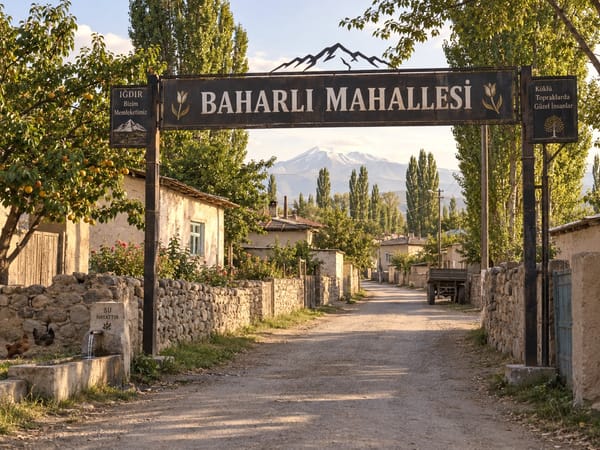
In the early morning, without being seen by anyone, I crossed İdirmava from end to end and went to a place near the Asri Hamam. Nearby, there was a two-story, ruined, Armenian-built building. I was eager to hide there. After glancing inside, I changed my mind, thinking I would find a safer place, and slipped through the gardens in Baharlı Neighborhood, running towards unfamiliar houses.
A group of houses appeared before me. As I wondered, "Where can I hide?" my eyes caught sight of a hay bale on the roof of one house. "A perfect place to hide!" I said to myself. Without startling the dogs, I quietly climbed onto the roof and disappeared among the haystacks.
There was a rusty nail on the wooden beams of the roof. With a laborious effort, I managed to open the handcuffs on my hands.
The midday sun was scorching everything. Hunger, fear, and the oppressive heat had taken hold of me, and I remained half-faint among the haystacks.
In the afternoon, hoping to find food, I emerged from my hiding place. There was a huge mulberry tree next to the house. I gathered the crushed mulberries that had fallen onto the roof and ate them with appetite.
The evening coolness filled the air. I poked my head out from among the haystacks, watching people come and go. A little further on, Eşref Başaran, whom I knew well, was walking with a group of friends on the dusty road, coming towards the roof where I had been perched all day. When Eşref Başaran entered the house, I was surprised. I muttered to myself: "Wow! What luck! Of all places, I found Eşref Başaran's roof!!" Eşref Başaran was the leader of the Karapapaks in Baharlı Neighborhood. Since he was one of Hüsnü Bingöl's favorite people, it would be difficult for them to guess that I was hiding on his roof.
In the garden, a large table was set under the trees. Eşref Başaran, with his friends, surrounded the table, munching with appetite. The smell of food and lion's milk (raki) reached my nose, making me give in. Trying to control myself, I listened to their conversation. In those years, Eşref Başaran was the President of the Cotton Sales Cooperative. The word "cooperative" was frequently repeated, conversations grew heated and turned into arguments, and soon after, glasses clinked amidst laughter.
Towards midnight, I jumped from the roof and disappeared. I didn't have proper clothes on. In this state, it would be impossible for me to leave the city. I couldn't go home either. The police must have calculated that I would come and set a trap. As I writhed in despair, Mehmet Gülten came to mind. Thinking he might help, I went to his house.
Like many people, Mehmet Gülten would spread his bed on the roof and sleep there during the summer months because it was cool. I approached the wall and threw a small stone onto Mehmet Gülten's bed. He woke up in fear, shouting, "Who's there?"
"Mehmet, speak softly! It's Rutto!" I whispered. Mehmet Gülten came down, pulled me aside, and spoke anxiously: "Rutto, all the police and gendarmerie are after you!"
After I had a good meal, I asked him to go to our house and bring my clothes. Later, we decided that this would not be a cautious move and gave up on it. Tomorrow, at an opportune time, Mehmet Gülten would go to my mother, take my clothes, and keep them for me in his shop, and I would send my trusted friend to pick up my clothes.
A day later, everything went as planned; my clothes were on me, ready, and I was impatiently waiting for midnight.
CAUGHT AGAIN!
Passing through an area near Halfeli village, I began to climb the Zor mountains. My aim was to reach Kellehemo, my uncles' village, and hide there. Since the houses were in the yayla (summer pasture), the village was completely empty. Continuing my walk, I reached the obaya (nomadic camp) above the village.
There was an unusual silence in the zoma. No one was in sight. I tried to understand the situation from a shepherd I encountered. The shepherd said: "Some of the oba people have left to attend a wedding in Doğubayazıt. Some have taken their scythes and gone to harvest wheat and hay. That's why the village is completely empty!"
I was exhausted from hunger. I threw myself into one of the goat-hair tents, went to the kitchen section we call kulin, and filled my stomach. As fatigue also overwhelmed me, I fell asleep in a corner of the tent.
Towards noon, someone woke me up by beating me with a stick. When I opened my eyes in fear, I saw that it was a person named Hesene Derviş. It turned out the tent was his! A few months ago in Iğdır, at a gambling party, I had not only taken all the money from Hesene Derviş but also given him a good beating. Now, fate had brought me full circle and put me to sleep in his tent!
Hesene Derviş was aware that I was wanted by the police. With his helpers, he tied me up thoroughly. He was on horseback, and I was on foot, and we set off. He held one end of the rope that bound my body tightly in his hand. We set off towards Iğdır.
As we passed through Halfeli village, Emin Güneş from the Torun family and a few of his relatives hurled insults at Hesene Derviş and insisted that he release me. Everyone had heard that I was wanted in connection with Naci Güneş. I hoped to myself:
"The Toruns (Güneş Family) will surely rescue me from Hesene Derviş's hands, no matter what." However, Hesene Derviş was so determined and insistent on delivering me to Hüsnü Bingöl himself that no one could press him further. After all, Hüsnü Bingöl could also cause trouble for them!
As we approached Iğdır, I pleaded with Hesene Derviş: "Please, at least tell Hüsnü Bey that I surrendered to you willingly so that my punishment might be lightened!" Hesene Derviş did not answer, merely smiling under his mustache.
He handed me over to the nearby gendarmerie station. News of my capture spread rapidly through the town. My mother, tearing her hair out, entered the station in a distraught state. Her eyes were bloodshot from crying. Due to the justified rumor among the people that "Hüsnü Bey will surely execute Rutto!", my mother wanted to spend time with her only son before he died. She looked at me with desperate eyes.
The station commander, Nuri Başçavuş, was a good man. He tried to comfort my mother and give her hope, convincing her that everything would be alright. However, he couldn't stop my mother from sitting in a corner and crying silently.
Towards evening, the gendarmes took me before them and led me to Hüsnü Bingöl's house. Hesene Derviş also came, walking at the very back of the procession with the air of a hero.
The soldiers took me and Hesene Derviş into a room and asked us to wait at attention. Soon after, Hüsnü Bingöl entered. He fixed his eyes on me. Turning to Hesene Derviş, he asked:
"How did you catch Rutto?"
"He was fleeing towards the mountains, I went after him and caught him by force. He didn't want to surrender!"
In anger, I cursed Hesene Derviş:
"You disloyal wretch! I came to your house, ate your food, and then asked you to 'hand me over to Hüsnü Bey.' You agreed! Now you're changing your statement!"
Hüsnü Bingöl came up to me and slapped me hard across the face. "You cannot curse in my presence!" he shouted. After sending Hesene Derviş away, he advised me:
"You acted very thoughtlessly. What if the gendarmes had shot and killed you, or something worse had happened to you? Then I would have suffered pangs of conscience. Don't try to escape again, alright?"
Hüsnü Bingöl took me by the arm and led me out of the room, handing me over to Sergeant Haydar. The sergeant must have been severely reprimanded for what had happened, because as soon as he saw me, he started punching me. Hüsnü Bingöl, hearing the commotion, snapped at the sergeant: "From now on, Rutto is not to be touched, not even a flick, or I won't be responsible!"
This time they took me to a room with an Armenian. They bound my hands and feet with a 64 kg chain and left. The Armenian knew a little Kurdish. He tried to advise me as best he could, saying, "Rutto, control your tongue! Don't talk too much!"
A few weeks passed. As I evaluated the events, my love and respect for Hüsnü Bingöl had grown. He did not treat people unfairly; he acted as his duty commanded.
My helpless mother would also go to Hüsnü Bingöl's house every day, helping his wife with housework, trying to gain the family's trust. Whenever she found an opportunity, she would tenderly and longingly hand me the liver stew and yogurt she had brought, wiping her tears with her dress and moving away from me. I would sit with the Armenian, who had no one, and eagerly eat what my mother had brought.
FREEDOM
I was held under surveillance for 55 days. One evening, the gendarmes took me to Hüsnü Bingöl's room. My mother stood in a corner with innocent eyes, her two hands clasped, silently looking at me. Hüsnü Bingöl spoke Kurdish well. He first spoke to my mother in Kurdish:
"Ew kure te ye. Teslimi te dikim!" (Here is your son. I am handing him over to you!)
Then he spoke in Turkish:
"I have one condition. Rutto will not say a single word about what happened here to anyone, otherwise, I will throw him back in the cell, alright? Go and immediately bring Enver Usta, who works at the municipality, to open the chains!"
My mother, with joy on her face, left the room. Soon after, I was freed from the chains and returned home with my mother. That day, I truly felt very happy. The good thing was that from that day on, everyone became wary of me.
A rumor had spread that "Hüsnü Bey released Rutto because he loved him very much." In fact, once when the police threw me into custody, Hüsnü Bingöl sent word and had me released. This news also did not escape people's attention. I was now a privileged Rutto who had won Hüsnü Bingöl's love and protection!
YEARS AS AN AGENT
Rutto is an active and intelligent young man. In a short time, he becomes the master of the streets. He speaks Azeri perfectly with Azeris and Kurdish perfectly with Kurds. He is perhaps the only person in Iğdır who speaks three languages (Azeri, Kurdish, Turkish) with such speed and perfection. For this reason, he gets the chance to enter and exit everywhere. With the money he saves, he buys a horse. He loads large saddlebags onto his horse and sets off for Iran. This is how his smuggling life begins.
In those years, Hüsnü Bingöl's biggest problem was to dismantle the Communist and Shiite espionage network, which he saw as a major threat to Turkey. For this reason, he tried to establish pressure and control over Soviet refugees, whom he considered harmful to the Republic of Turkey, and over people of the Ja'fari sect, whom he suspected of being Iranian agents.
Rutto makes a deal with Hüsnü Bingöl. Rutto will convey what is happening among the people to Hüsnü Bingöl, and Hüsnü Bingöl will turn a blind eye to Rutto's smuggling.
Rutto is very happy. He curls his mustache upwards like Hüsnü Bingöl, in a crescent shape, and mingles with the people. Whenever he got into trouble with the police or gendarmerie, he would whisper the magic words 'Hüsnü Bingöl' into their ears, and they would keep their distance from Rutto as if their hands had touched fire.
Thus, the Rutto legend was born in Iğdır. Over time, so many anecdotes were attributed to Rutto that it became impossible to distinguish between fact and fiction. One known fact is that Rutto's personality was indispensable during Hüsnü Bingöl's era.
HE WOULDN'T BREAK MY WORD
Rutto possesses a devilish intelligence. One day, he gives the smuggled goods he brought from Iran to a Kurdish itinerant vendor (peddler) whom he convinced to work with him, and sends the man to Kurdish nomadic camps. The itinerant vendor appears before the tribal leader in each camp:
"Sir, I brought you a gift from Iran. Choose what you like and take it!"
The Ağa is very pleased and calls his wives. Everyone chooses something they like. The peddler visits all the nomadic camps one by one in this way, showering the ağas with gifts.
A few weeks pass. Rutto mounts his horse and knocks on the doors of the ağas to whom the peddler distributed gifts:
"I'm very sorry. I have bad news for you. A peddler selling smuggled goods was caught while wandering in the mountains. Hüsnü Bingöl interrogated him. The man confessed everything. I was there too. Under pressure, he told everything about selling smuggled goods to you and so on. The man is currently in custody! He will be executed soon. Hüsnü Bingöl thinks that you also benefited from this. Your names are on the blacklist. Soon Hüsnü Bingöl will call you. But you know Hüsnü Bingöl wouldn't break my word. I can prevent this, but whatever you feel in your heart..."
The panicked ağas pay the requested fee without hesitation. Rutto collects his tribute from all the ağas in this way and returns to Iğdır. When his money runs out, he mounts his horse again, goes to the ağas, and makes a new request:
"As I promised, I did my best, and I prevented Hüsnü Bingöl from calling and interrogating you. However, Hüsnü Bingöl's poodle fell ill, and he must be very upset, because the blacklist suddenly came to his mind. He gave an order; he will interrogate all of you one by one. But you know Hüsnü Bingöl wouldn't break my word. I can prevent this, but whatever you feel in your heart..."
YOU DANCED BEAUTIFULLY AT THE WEDDING
At one point, Hüsnü Bingöl began to doubt Rutto's loyalty as an agent. He sent another agent after Rutto to Iran. The agent followed Rutto and even witnessed him dancing the halay at a wedding. He returned to Iğdır and summarized what he had seen in Iran to Hüsnü Bingöl.
When Rutto returned from Iran, Hüsnü Bingöl asked Rutto for a report. Rutto recounted many things but omitted the wedding. Hüsnü Bingöl smiled slightly:
"Mashallah, you were dancing the halay very beautifully at the wedding!"
Rutto couldn't figure out how Hüsnü Bingöl had obtained this information, but from that day on, he made it a habit to tell Hüsnü Bingöl everything as it was.
HÜSNÜ BİNGÖL'S PRICE
One day, Hüsnü Bingöl wanted to know how valuable he was to Iranian intelligence. He assigned Rutto to find this out. Rutto went to Iran. He found a way to have a friend he worked with contact Iranian intelligence agents and negotiate the reward he would receive if he killed Hüsnü Bingöl.
Rutto returned a week later. He appeared before Hüsnü Bingöl in his study:
"Uncle Bey! Good news! The Iranians are offering 5000 sheep and one kilo of gold to kill you."
Hüsnü Bingöl smiled slightly:
"What are you waiting for, Rutto! Draw your pistol, shoot me!"
Rutto gave an unexpected answer:
"Hüsnü Beg! Hüsnü Beg! Your worth cannot be measured in gold and sheep!"
THE CIRCUMCISION HUNT
Hüsnü Bingöl received a tip that Armenian agents, well-versed in the region, would infiltrate Iğdır from Soviet Russia. He summoned his civilian agents who served him in the villages and city center. Rutto was among them:
"We can only overcome this danger in one way: check if everyone you find suspicious is circumcised!"
Rutto sat on the road at the entrance of a village near the border, checking for any unfamiliar person coming or going.
A horseman appeared. Rutto was seeing the man for the first time. He blocked his path. The horseman stopped.
Rutto:
"Please, get down!"
The man dismounted his horse.
"Do you have a cigarette?"
The man offered his tobacco pouch. As Rutto slowly rolled a cigarette, he subtly observed the man's demeanor, trying to make sense of him. Not convinced, he asked:
"Are you circumcised?"
"Of course! Why do you ask?"
"The dogs in our village, as soon as they smell an uncircumcised person, bark with all their might, the sheep flocks get scared and run away, the shepherds shout at each other, and the village is turned upside down."
The man:
"No need to worry! Let me show you!"
The man took it out and showed his penis. He was circumcised.
Rutto, uncomfortable seeing someone else's genitals, complained:
"Alright, we get it, you're circumcised. Why are you waving it around like you're going to stick it in my mouth!"
THE INNKEEPER IN MAKÜ
Iranian agents did not suspect Rutto; in fact, they dismissed him as an ordinary smuggler. Rutto, fearless, mingled with the people, filled his saddlebags with smuggled goods, and after staying in Makü for a few days, headed back to Iğdır. One such day, after his routine shopping, he retired to an inn to rest. The innkeeper was also an agent of Hüsnü Bingöl, but neither of them knew this. When the innkeeper learned that Rutto was from Iğdır, he approached him:
"There's a tyrant named Hüsnü Bingöl in Iğdır. Be careful!"
Rutto, to avoid suspicion, confirmed the man's words:
"Indeed, what a tyrant! He doesn't let anyone breathe."
An Iranian agent, hearing this conversation, came over to them:
"That tyrant is causing us a lot of harm. The Shah will give a large sum of money to whoever kills Hüsnü Bingöl."
The innkeeper and Rutto declared their willingness to undertake this task. Whoever killed him first would receive the reward.
The innkeeper and Rutto, unaware of each other's intentions, set off at full speed towards Iğdır.
Rutto appeared before Hüsnü Bingöl, excitedly informing him of the danger awaiting him:
"An innkeeper of such and such height, with such and such appearance, of such and such age, has been assigned by Iranian agents to kill you."
Hüsnü Bingöl smiled in his characteristic sweet-and-sour way. He called his assistant Durak, asking him to bring in the guest waiting in the other room. Rutto was speechless when he saw the innkeeper. The innkeeper was no less surprised. Once their astonishment subsided, Hüsnü Bingöl reproached Rutto:
"If the innkeeper had really come to kill me, he would have succeeded because you were late!"
Rutto was at a loss for words:
"Don't worry, Uncle Bey! I would have gone and killed him in Makü to avenge you."
EXCERPTS FROM HÜSNÜ BİNGÖL'S IĞDIR PERIOD
İSMAİL AĞIRKAYA RECOUNTS:
"Hüsnü Bingöl was an extremely honest man who loved his country and nation. He had no interest in money. He had adopted patriotism as his principle. He was a rare figure who was never spoken ill of. My elder brother, Hacı Ekber, had an unpleasant incident involving Hüsnü Bingöl.
One day, my elder brother was chatting with strangers in one of Iğdır's coffeehouses. When a foreigner from Kars spoke ill of Hüsnü Bingöl, my elder brother, for no reason, joined the conversation, encouraged the man, and spoke of Hüsnü Bingöl's evils (!). Hüsnü Bingöl had ears everywhere. When this situation was reported to him, he summoned my elder brother to warn him:
"I know your father and your family very well. Why are you getting involved in such things? If I asked you to prove one of the things you said, you couldn't."
My elder brother's face turned pale with fear. Hüsnü Bingöl, this time softening his voice, gently patted my elder brother's back. After reassuring him, he sent him home."
AYDIN AKGÜN RECOUNTS:
"A group of 17 high school and middle school students from prominent Iğdır families, we went to listen to a singer named Garibe performing at the municipal open-air theater. Paşa Turan, Hüseyin Çınar, İbrahim Güzelsoy, Halil Ulusoy, Cemalettin Güneş, Kâmil Taner, Timur Toksöz are a few of the names I remember...
We sat in the front row, enjoying the songs. Towards the end of the program, Kâmil Taner wrote a song request on a piece of paper and handed it to the artist. A police officer named Şevket and a watchman named Salih came up to us and tried to remove us from the hall, saying, "You are disturbing the order of the saz (musical performance)." We resisted at first, but they took us to the police station. For no reason, they started kicking us. Unable to endure the humiliation, the 17 young people united, surrounded the police officer and watchman, and gave them a good beating. We took their weapons and left.
We knew we had committed a serious crime. I fled to Melekli village; Hüseyin Çınar to Küllük village; Timur Toksöz to Aralık, and the others to villages and hamlets they found close. For days, we lived miserably in the countryside, escaping the gendarmerie's pursuit. When our situation became tragic, prominent figures like Abdürrezak Güneş and Resul Taner went to Hüsnü Bingöl and asked for help. We were pardoned. We received a one-day prison sentence for resisting security forces, but it was converted into a fine of "one lira." However, when they caught Kâmil Taner, they showed him little leniency. They interrogated and beat him as the "ringleader."
HACI SAFİYE (KAKİOĞLU) ALAGÖZ RECOUNTS:
"My father, Mehmet Kakioğlu, used to travel to cities and districts in the eastern region, collecting copper. One day, his path led him to Hınıs. After settling his affairs, he was invited to a friend's house. My father, who was quite the flirt, sat in the garden and, with binoculars in hand, spied on the girls washing carpets by the spring. He saw and liked my mother that way. Hüsnü Bingöl was serving as an officer in Hınıs at that time.
At my mother's wedding ceremony, my father and Hüsnü Bingöl met and became friends. Soon after, when Hüsnü Bingöl also married the daughter of Mehmet (Güner) Ağa, a Karapapak from Hınıs, the two families became relatives, in a way.
Hüsnü Bingöl was among those invited to my mother and father's wedding dinner (1926). An interesting incident happened to him during the meal.
Hüsnü Bingöl, hearing that Fazıl Ağa's son Mehmet Kakioğlu was getting married, took his place at the guest table in his sparkling navy blue suit. That day, the famous Bitlis region dish, meatballs filled with melted butter, was served to the guests. Hüsnü Bingöl, unaware that there was liquid butter inside the meatball, bit into it with appetite, and the butter, gushing like a fountain, covered his jacket from top to bottom. Since the stain could not be cleaned, Hüsnü Bingöl went to the tailor the next day and had a second jacket made from the same fabric.
Hüsnü Bingöl was a family friend. He especially loved my mother. The two families would often gather, eating and drinking together. When he was ill, he would always send a few soldiers to my mother:
"Our commander is ill! He wants food!"
Hüsnü Bingöl was passionate about my mother's cooking. On such days, my mother would make yogurt soup with raw denden (wheat) and send crispy sweets, fresh from the iron molds, in a basket. In return, whenever my mother needed help, whether it was chopping wood or carrying groceries from the market, she would ask Hüsnü Bingöl for assistance. A few soldiers would carry the supplies home with daşkalar (horse-drawn carts) and help my mother.
One day, Hüsnü Bingöl handed my mother a valuable rosary that had been given to him as a gift:
"Zinnet Hanım! I don't pray. Take this rosary, and when you pray, pray for its owner!"
HÜSNÜ BİNGÖL'S LOVE FOR CHILDREN
Hacı Safiye (Kakioğlu) Alagöz recounts:
"Hüsnü Bingöl loved Atila, Mecit Hun's son, very much. When Mecit Hun first married, he settled in Şeyh Xano's house, and Atila was born there. Hüsnü Bingöl's daughters, Şükran and Müjgan, who were next-door neighbors, would come and take Atila from the house and bring him to Hüsnü Bingöl.
My elder sister Naciye, Mecit Hun's wife, had given me the task of bringing Atila back. One day, I went to Hüsnü Bingöl's house to bring Atila. When I entered the house, I encountered an unforgettable scene. Hüsnü Bingöl had his hands in the air, bouncing Atila, who was 1-2 years old. Atila was naked from the waist down.
Suddenly, the child, unable to control himself, urinated in a downpour on Hüsnü Bingöl's chest. Hüsnü Bingöl held the mischievous child in the air, moving him away from himself, and in a calm tone:
"Şükran, my daughter! Bring a cloth, the boy's urine touched my chest!"
Various kinds of Turkish delight and chocolates would arrive at Hüsnü Bingöl's house. The packages would remain stacked, unopened. When Atila came, he would grab one of them and run out. Hüsnü Bingöl would jokingly call out:
"Hey! You're taking our share too, come on, let's eat it together!"
They would open the package together, he would only take one, and Atila would quickly grab the rest, run, and leave.
Şeyh Xano's house and Hüsnü Bingöl's house overlooked the same garden. The rooms of one could easily be seen from the window of the other.
In one of the rooms, a hanging cradle was set up from the ceiling. When my elder sister Naciye was busy with housework, she would put Atila in the cradle and return to her work.
One day, Hüsnü Bingöl saw Atila fall from the cradle through the window. He ran, slippers on his feet. He scolded my elder sister Naciye for her carelessness. He took Atila in his arms, claiming him:
"I'm not giving my son back to you anymore!"
HÜSNÜ BİNGÖL'S DUNGEON
Hacı Safiye Alagöz recounts:
"The place referred to as Hüsnü Bey's dungeon was a single-room roof directly opposite his house, with a small window. What I remember as a child was two Russians brought in one day. One was young, with straight, neatly combed hair, and the other was old. Hüsnü Bingöl spoke to them in Russian or Armenian.
The prisoners, with their feet chained, would be brought out in front of the dungeon in the evenings and allowed to sunbathe.
One day, my mother asked Hüsnü Bingöl at a family gathering:
"Hüsnü Bey, what are you doing to these men? Are you beating them?"
"When necessary, of course! They don't talk, what else can we do!"
HERİZ HANIM
Hacı Safiye Alagöz recounts:
"There was a woman from Erzurum named Heriz. Her husband's name was Mikail. Hüsnü Bingöl regularly sent him to Russia for espionage. Knowing the danger of his mission, the man one day made a will to his wife:
"Wife! If I don't return, wait seven years! After that, you have the right to marry."
Indeed, the feared came to pass. The man set off for Russia for the fourth time and never returned. Our neighbor Heriz Hanım waited with her two sons for her husband to return.
Fazıl Baykal, who was married, fell in love with Heriz Hanım. He proposed marriage but received a "No!" in response.
One night, Fazıl Baykal secretly came to Heriz Hanım's house and tapped on the window. When Heriz Hanım screamed in fear, neighbors rushed to help.
In the morning, Heriz Hanım came to my father and asked for advice regarding Fazıl Bey's marriage proposal. When my father approved, Heriz Hanım became Fazıl Baykal's second wife.
MAHMUT ALAR RECOUNTS
Note: The Kızılbaşoğlu tribe supported the Mount Ararat Rebellion. When the rebellion was defeated in 1930, the tribe moved to Iran.
"After the Mount Ararat Rebellion dispersed, our tribe moved to Iran. Iranian security forces met us at the border. They subjected each tribe to forced settlement in a certain region. Thus, our exile life within Iran began.
I completed my first year in Evoğlu district, and my second year in the Tabriz region. I entered my 11th year in the village of Hiceş in Zanjan province.
Zanjan was an Azeri region. As you know, childhood memories are important. After a long time of 55 years, I went back to Hiçeş village. I had an uncle who lived and died there for many years. I wanted to visit his grave and commemorate his spiritual presence.
I got out of the car in front of the coffeehouse in the middle of the village. Everything in the village had changed! I introduced myself to the elderly people there:
"Are you perhaps a relative of Ketxuda (Village Headman) Ali Bey? He was a good man. He had two sons named İbrahim and Mahmut."
"That Mahmut is me!" I said. We embraced and caught up. With my Azeri friends, I went to the cemetery, recited Fatiha for the souls of those buried there and my relatives, and then left.
In 1941, when I was 11 years old, the Russians occupied Zanjan province and northern Iran. The British, I believe, also came from the south and joined forces with the Russians. A new political authority was formed in the region. Thus, the forced settlement decision made by the Iranian government regarding us also lost its validity.
We loaded our belongings onto donkeys and set off towards the Makü region. After a journey of exactly 28 days, we settled in the town of İrint, which remained within the borders of Iranian Kurdistan. Şeyh Abdülkadir, one of the leaders of the Mount Ararat Rebellion, also resided there.
In 1945, the Mahabad Kurdish Republic was established, with Muhammed Qazi as president and Molla Mustafa Barzani as Chief of General Staff. Şeyh Abdülkadir was appointed regional governor responsible for the administration of the Celali and Milan Tribes.
In 1946, a magnificent ceremony was prepared in the town of İrnit for the anniversary of the Mahabad Kurdish Republic's establishment. Like everyone else, I was armed from head to toe. I was walking around with my ammunition belt on my shoulder. On the day of the ceremony, the sound of drums and zurnas filled the air. They said İhsan Nuri Pasha had come from Tehran! We eagerly went to meet him. He was a medium-height, dark-skinned, and plump man. He was wearing civilian clothes. İhsan Nuri Pasha returned to Tehran after the ceremony.
In 1947, when the Russian forces withdrew, the Mahabad Kurdish Republic could not survive. On February 8, the Republic disintegrated. In the middle of winter, I went with Şeyh Hasan to Ağugöl, the region of the Helikan tribe. We stayed there until spring.
Meanwhile, we were in contact with Hüsnü Bingöl, the MAH (National Intelligence Organization) Regional Chief of Iğdır. We were waiting for permission to cross back into Turkey. One day, the requested permission arrived. The Sakan and Kızılbaşoğlu tribes came together to Düjüj hill at the foot of Little Mount Ararat. We stayed there for 40 days.
When the permission order arrived, we were disappointed. Only 9 people were allowed! The rest of us, full of regret, returned to our place in Iran. 4 days later, another message came from Hüsnü Bingöl:
"I got permission for 40 more families from Ankara. Come gradually, combining 4-5 families!"
70-80 families entered Turkey. But the majority of our tribe remained in Iran and completely gave up on coming to Turkey.
They kept us in quarantine for 40 days near Aralık. Since we had lost our Turkish citizenship rights, legal papers were drawn up for us as asylum seekers, and we were settled in Hasanhan village, attached to Aralık.
However, as a twist of fate, a Kurdish tribe that had once been attacked and plundered by the Kızılbaşoğlu tribe began to attack and harass us. They came from Taşburun, scattering our belongings and threatening us.
One day, Hüsnü Bingöl called my father to him;
"Ali Bey, the state won't, but the Kurds will ruin you! For this reason, I wrote to the government for the transfer of your tribe to Central Anatolia."
In 1947, we were sent to the Felahiye sub-district of Kayseri. After staying there for two years, we moved to the provincial center. Necmettin Tunç, the Tunceli Deputy, took an interest in our problem. He called the Prime Minister of the time, Hasan Saka:
"A state has no right to take away people's freedom to live and be citizens wherever they wish. We have condemned 486 people from the Kızılbaşoğlu tribe to exile. Please do what is necessary to correct this mistake!"
In May 1949, by a decision of the Council of Ministers, we regained our citizenship rights and returned to Iğdır. However, since the prohibited zone continued, we were prevented from returning to our ancestral villages before the rebellion.
The Mount Ararat Rebellion region was forbidden to Kurds but open to Azeris. The District Governor of Iğdır, Ertuğrul Kürkçü, wanted to settle us in Çimen, near Halfeli village. Çimen was a popular spot for the tribes in the region. In spring and autumn, they used Çimen as a temporary resting place during their migrations to and from the yayla. When my father refused the offer, Hasanhan village, which was still abandoned at the time, was allocated to us. The village population gradually increased with the arrival of the Helikan and Keleşkan tribes.
In 1950, when the prohibited zone was lifted, my father, without being eager for the title deed offered to him, returned to his ancestral village of Karabağ (Gödekli). Of the 40-50 Kızılbaşoğlu families, only our family went to Gödekli. Over 40 households loyal to Yusuf Ağa, son of the old leader Hesene Tozo, settled in Axura (Yenidoğan) village.
Axura is a very old settlement. During the Russian administration, a historical road starting from the city of Ani in Kars passed below Axur, reached Korhan, and from there, passing through the Little Ararat forest, reached the city of Dambat in Iran! Traces of this historical road are still visible.
THE NACİ GÜNEŞ INCIDENT
The years 1945-46 were difficult for Iğdır. Soviet Russia, the victor of World War II, demanded Kars, Ardahan, and Iğdır back. There was fear that the Soviet army would occupy Iğdır at any moment. The wealthy of the district and some of the populace, weary of wars, abandoned Iğdır. This was the second Kaça-Kaç (the first Kaça-Kaç occurred in 1919).
By 1945, the respected Kurdish tribal leaders of Iğdır, Ali Mirze Bey (Yiğit), Ahmed Şemo (Hun), and Kerem Bey (Güneş), were no longer alive.
Between 1945 and 1955, the most respected names among the Iğdır Kurdish tribes were Abdürrezak and Naci Bey, brothers of Kerem Bey.
Abdürrezak Güneş is a mature, prudent leader who takes state affairs seriously, and is measured and cautious in his views and actions. Naci Güneş is fond of freedom, pleasure, and revelry, and is a pleasant conversationalist.
As espionage activities increased, Hüsnü Bingöl wanted to further strengthen his authority over the people. There was one family among the Kurds that resisted this: the aristocratic Güneş family.
Hüsnü Bingöl sought an excuse to bring the family to heel. Knowing that a sudden, unjust attack would cause outrage among the Kurds, he acted patiently.
The Güneş family, aware that they were under close surveillance, was careful around Hüsnü Bingöl. Except for one person: Naci Güneş.
One day, Hüsnü Bingöl was walking slowly and carefully on a muddy road, his stern and serious gaze fixed on the crowd.
At that moment, a horseman appeared in the distance. He was galloping on the muddy road. Hüsnü Bingöl barely managed to throw himself in front of a shop to protect himself from both the horse and the mud.
The horseman was Naci Güneş. As the horse passed close to Hüsnü Bingöl, Naci Güneş did two things at once: he violently brought his whip down on the horse's flank and shouted:
"Keftar (old dotard)! I keep trying, but I can't get you to behave."
It is unknown whether Naci Güneş's words were aimed at the horse or Hüsnü Bingöl, but the general opinion among the people was that these words targeted Hüsnü Bingöl.
Naci Güneş's behavior was not approved by the public. Hüsnü Bingöl thought he had found a good opportunity. If he targeted Naci Güneş, the public would think he deserved it. But how would Naci Güneş be tricked? Hüsnü Bingöl had friends and agents who had gained experience and expertise in this matter.
Naci Güneş loved his drinking table. Especially when raki was on the table, Naci Güneş knew almost no limits in alcohol consumption.
His elder brother Abdürrezak Güneş had repeatedly reproached and warned him, "Don't drink that cursed stuff!" but to no avail!
Hüsnü Bingöl based his scenario on the drinking table.
One day, Naci Güneş again chatted with his friends (!) at the table until the middle of the night. It was time to go home. Naci Bey was dead drunk, struggling even to stand up. A phaeton was called. His friends (!) put Naci Bey in the phaeton, and together they traveled into the darkness.
After a long journey, the phaeton arrived at the Markara (Alican) Bridge, the Turkey-Soviet Union border crossing. Naci Güneş thought he was approaching home. The phaeton, as planned, crossed the forbidden military zone and came right next to the bridge. Naci Güneş was taken out of the phaeton. His friends (!) took his arm for a while, and they walked together. The lights on the bridge were shown to Naci Güneş:
"Here we are home! Now we're leaving."
Naci Güneş was left all alone. As he staggered towards the Markara Bridge, the Gendarmerie blocked his path and handed him over to Hüsnü Bingöl on suspicion of being a spy. Hüsnü Bingöl had Naci Güneş thrown into jail.
When this news was conveyed, Abdürrezak Güneş was preparing for breakfast at his home in İdirmava. After learning the details of the news, these words came out of his mouth:
"How many times did I tell Naci not to drink that cursed raki! If only you had drunk something else! If only you had drunk vodka, if only you had drunk wine!"
Naci Güneş, after being imprisoned for 5-6 months in Hüsnü Bingöl's special cell, was sent to Erzurum. He remained in Erzurum prison for 3 years. He was released with an amnesty issued by the DP in the early 1950s.
AZİZ GÜNEY RECOUNTS
"To increase the incriminating evidence against Naci Güneş, a photomontage supposedly showing Naci Bey talking to a Russian officer in Russia was added to the file. Naci Güneş was imprisoned in Erzurum military prison.
In April 1948, I was discharged from reserve officer duty and came to Erzurum by train. I was going to stay there for a few days. I knew Naci Güneş was in military prison. I knew him and always showed him respect. That's why I really wanted to visit him.
In Erzurum, I accidentally ran into a relative of his. He told me, "They absolutely don't let anyone see him!" Despite this, I had a package of pastries made and went to the Kars gate, where the military prison was located. I introduced myself to the duty officer. As a newly discharged second lieutenant, I said I had a request and asked for permission for a short visit to a prisoner who was my relative.
"It is absolutely forbidden to meet this prisoner! But since you are a soldier, I am giving you special permission!"
They had thrown Naci Bey into a basement. I spoke through the window and asked how he was doing. Naci Bey stayed in this prison for 3-4 years until the DP amnesty."
TURGUT SUNGAR RECOUNTS
Note: Naci Güneş was married to Turgut Sungar's elder sister, Hikmet Hanım.
"My brother-in-law, Naci Güneş, was a light-hearted person who enjoyed eating and drinking. He would consume a small amount of alcohol with meals, but he never lost control because of it, nor did he show any signs of aggression or belligerence.
Naci Güneş and my elder sister Hikmet had a son and a daughter, but both died in infancy. In later years, they were unable to have children.
Naci Güneş had received primary education during the Russian administration. I remember they introduced a very old building in the Zor plateau as "Şkol," which means "school" in Russian. Naci Güneş probably received his education in this school.
Naci Güneş was arrested in 1947 on charges of espionage and imprisoned. He spent 2.5-3 years in Erzurum prison. When I did my military service in 1948, Naci Güneş was imprisoned in Erzurum Prison. Naci Güneş, who was acquitted in 1950, had personally told me an anecdote about that difficult period:
"They locked me in a dark room. It was pitch black inside. There wasn't even a single ray of light. Slowly, I lost my sense of time. Half an hour and half a day seemed to make no difference to me anymore. I don't know how much time passed, but one day the doors opened, and they brought me out into the light. My first question to the officer next to me was, 'What time is it? What year is it?' When the officer said, 'You've been in this cell for six months,' I was astonished. My surprise increased even more when I saw that the room I was in was a secret compartment in the attic of a mosque, as I was taken out of the cell without my eyes being covered."
Naci Bey's trial on suspicion of "espionage" seemed absurd. Because Naci Bey neither needed money for such a venture nor possessed a temperament to undertake such a dangerous mission. Many times, my mother would affectionately scold Naci Bey, saying, "Damn you! Even your shepherd speaks better Turkish than you." Indeed, Naci Bey was a pleasure-loving person who lived in his own world, far from being able to express himself. One felt like saying, "Espionage where, and he where."
I was working in Tosya. One night, I had a confused dream about Iğdır, my family, and Naci Bey. I have limited superstitions. Curious, I grabbed the phone. When I asked Cemalettin Güneş, "How is my brother-in-law?", I received the answer, "Your brother-in-law passed away" (1972). Naci Bey died of cancer."
I OWE MY LIFE TO HÜSNÜ BİNGÖL
Note: Turgut Sungar's father, Bekir Sıtkı Sungar, served as a Major in Kâzım Karabekir Pasha's army. He came and settled in Iğdır. His elder sister, Hikmet Hanım, married Naci Güneş, a notable from Iğdır. His father passed away in 1937. He became an orphan at a young age.
Turgut Sungar continues to recount:
"It was 1949-50. I had just returned from military service. Every day, I would get dressed and go out, meet up with my friends, and have a good time. One day, as I was aimlessly wandering the street, Hüsnü Bingöl saw me. He called me over. He was sitting in the coffeehouse in the municipal garden, sipping his coffee. I went up to him and respectfully said, "Yes, Uncle Bey!" He made me sit next to him and ordered tea:
"My son, you've finished your military service, but I see you're just wandering around aimlessly. Why aren't you working? If you want, I can talk to the Ziraat Bank manager and arrange a job for you," he said. I replied with courtesy and respect:
"As you deem fit, Uncle Bey!"
A few days later, the Ziraat Bank manager called me. We sat and talked. The manager suggested, "For now, there are no positions in Iğdır. If you want, work temporarily at the Agricultural Credit Cooperative in Taşburun. Then you can come to Iğdır." I immediately accepted the job offered.
I owe my career to Hüsnü Bingöl. I embarked on my professional life through his encouragement and initiative. Hüsnü Bingöl's behavior was commendable. Especially, the repercussions of the unpleasant incident between my brother-in-law Naci Bey and Hüsnü Bingöl were still ongoing. Despite all these negativities, Hüsnü Bingöl, with surprising courage and maturity, did not hesitate to extend a helping hand to me.
Even years later, I appreciate Hüsnü Bingöl's noble behavior as a debt of gratitude towards him."
ŞEYH HASAN BARBAROS RECOUNTS
"Since Hüsnü Bingöl's mother was from the Şeyh family, he would address my father as 'Uncle.' There was an unshakable bond of trust and friendship between them. They would often meet and chat. The only person Hüsnü Bingöl openly clashed with from the tribe was Naci Güneş. My father, not believing the espionage charges attributed to Naci Güneş, made great efforts hoping to dissuade Hüsnü Bingöl from this case.
In a conversation, I asked my father:
"Father, how can it be that you believe Hüsnü Bingöl is a very just person, and yet you say he unjustly arrested Naci Güneş?"
"My son, Naci Güneş was acting like a bully and undermining Hüsnü Bingöl's authority."
YAŞAR AYDIN RECOUNTS
Hüsnü Bey was a seemingly dictatorial figure who acted with the broad powers granted by the state. He could judge and punish anyone he wished without a court order.
Our houses were neighbors. When the neighborhood children played in the street, with Hüsnü Bingöl's arrival, we all would stand at attention, holding our heads high in a rigid posture. He would ask, as if inspecting a squad of soldiers:
"How are you, children!"
"Thank you, sir!"
"Are you well?"
"We kiss your hands!"
He would pass by us with stern and heavy steps. His poodles would run behind him.
(TO BE CONTINUED)