Violence and Political Hypnosis
This essay explores the phenomenon of "political hypnosis," where individuals and societies develop an unconditional loyalty to despotic leaders, drawing parallels between historical figures like Tamerlane and modern figures like the Unabomber.
Dear Readers!
Putin's attack on Ukraine continues with all its savagery. Civilians are in mortal danger, not knowing where to go. Millions of families have been torn apart, separated from their villages, towns, cities, and loved ones.
History is full of examples of violence and war. Do you know who profits from such massacres and who etches their name into history? History forgets the millions of civilians who die and suffer; instead, it immortalizes the notorious princes of savagery in our memory: Tamerlane, Hassan-i Sabbah, Hitler, Stalin, Mussolini, Saddam Hussein, Pol Pot... and now Putin.
Humankind has a serious and fundamental weakness: it is the syndrome of unconditional loyalty, admiration, respect, and obedience to murderers, serial killers, despotic rulers, and despotic politicians. It is impossible to summarize this situation in a few sentences. Individuals, organizations, communities, or peoples who fall into this trap are as if "hypnotized" and never feel the need to question themselves. In fact, they consider it a sacred duty to follow the despots they worship unconditionally, like "idolaters," without questioning themselves.
When these despots die or are caught and imprisoned, life seems to end for the millions who followed them unconditionally; many cannot bear the void left by the "despot idol" and even attempt suicide.
INTRODUCTION
Humankind has lived with this syndrome for thousands of years. Thousands of despotic politicians and statesmen have carried out ruthless massacres and genocides. The strange thing is that even when these despots, who left an "immortal" impression, died, people did not want to believe in their death. Only after many years passed did people awaken from a deep sleep, from hypnosis, and question themselves in astonishment:
"What happened to me? How could I admire such a murderer, a selfish deceiver, a despotic ruler? How could I unconditionally obey his commands? I had tied all my hope, even my life, to him. Why did I feel empty and alone when he died? Why didn't I have the chance to question myself at the time?"
They couldn't, because they were under the deep influence of a "political or social hypnosis." This reality was also hidden in the history of humankind. Despots who understood and could use the secret of this "hypnosis" never missed this opportunity; they established their own orders and built their empires of fear with ostentatious poses over "martyrs" and heads.
STOCKHOLM SYNDROME
The "killer or despot hypnosis" was first questioned scientifically in 1973. The following incident occurred:
It was a quiet day in Stockholm, the capital of Sweden. Someone wanted to rob a bank. The police surrounded the bank. The robber, realizing he couldn't escape, took a young woman hostage for six days. Negotiations lasted a long time. During this process, the woman became emotionally attached to, and even fell in love with, her captor. When the robber surrendered to the police and was sent to prison, the woman not only defended the robber but also left her fiancé, eagerly awaiting the robber's release from prison to marry him.
This incident particularly caught the attention of psychiatrist Nils Bejerot. Research in this direction continued, deepened, and gained a historical dimension.
Let's first examine an incident that occurred in America, and then apply the reality of the "hypnosis syndrome" to history and the political history of Turkey.
THEODORE KACZYNSKI (Ted Kaczynski)

There has always been a state preferred by immigrant peoples in America. For example, Chinese and Japanese preferred California. This is why the famous "Chinatown" was established in San Francisco. Similarly, during World War II, especially after the Japanese attack on Pearl Harbor, the US Government, fearing or suspecting that Japanese American citizens in California would spy, placed them in internment camps without any reason. (During World War II, not only Hitler but also the US implemented internment camps, causing great suffering to its own Japanese citizens. Unfortunately, this reality is not widely known!)

Chicago is the city preferred by Polish immigrants. A Polish family named Kaczynski settled in Chicago. They had two sons named Theodore John (Ted) and David.
Ted was born on May 22, 1942. His parents earned their living as laborers. Ted started elementary school. In 1949, his brother David was born. In 1952, the family moved to Evergreen Park, Illinois. Ten-year-old Ted started middle school in this city. As was customary, he took an intelligence test during school registration, and his IQ was determined to be 167. Ted was treated as a gifted, even "genius," child according to IQ standards and skipped a grade.
Both Ted and his brother David were quite intelligent for their age. Their parents did everything they could to ensure their children received a good education. Ted was extraordinarily intelligent but also very introverted. Ted's greatest passion was mathematics. He would spend hours trying to solve advanced mathematical problems.
In high school, he was placed in a higher grade. His self-confidence in mathematics was so high that Ted would prepare and teach the lessons. He graduated at 15. Ted was nominated for a National Merit Scholarship by the school. At 16, he enrolled at Harvard University on a scholarship.
Ted studied mathematics at Harvard. He graduated in 1962. He earned his master's and doctoral degrees in mathematics at the University of Michigan. In 1967, he started working at the University of Berkeley in California as the youngest Assistant Professor. He did not enjoy teaching, and one day, with a sudden and unexpected decision, he resigned from his position.
LIFE IN MONTANA
Ted returned to his family. For two years, he worked with his father and brother in a foam rubber factory in Lombard, Illinois. In August 1971, he was fired by his brother for writing derogatory things about a female supervisor.
Ted left his family and returned to Montana. Montana is in the northern US, on the Canadian border. It is about half the size of Turkey. The population of such a large state is only about 1 million. In short, it is like a state where almost no one lives. In the middle of the state, there is a town called Lincoln, with a few hundred inhabitants. Ted built a one-door, one-window, one-room cabin for himself in the forest near this town. He began to live in harmony with the wild nature. He had no electricity or water. In a sense, he built a life for himself in the wild. In the early years, he would go to the town of Lincoln, work odd jobs, and meet his needs.

Ted was devoted to the theory of anarchism. He hated all social authorities, including his family. "I have the right to live as I wish. I don't have to account to anyone. I don't have to put my intelligence at anyone's service."
Ted quickly learned to hunt and identify non-poisonous plants, just like primitive people. He bought an old bicycle. He would cycle to and from town. Whenever he had the chance, he would visit the town library, taking care to read books in their original languages.
And one day, Ted's peace with nature was disturbed. His hatred for human authority sharpened. The reason for this was that real estate agents were putting up for sale places near Ted's cabin for industrial projects. Ted decided to raise the flag of rebellion within himself against factories that devour humanity like monsters, against industry, against universities that train personnel for them, in short, against all the values we boast about as "civilization." Alone, he declared war on American capitalists and the professors who served them. His goal was to trigger a world revolution.
How would he wage this war alone and instill fear in the hearts of "despicable" capitalists? As he pondered these things in his wooden cabin, illuminated by candlelight, a brilliant idea came to him, and he jumped out of bed, shouting: "Sabotage! Yes, I will make their lives hell with sabotages."

While reading books on sociology and political philosophy with great interest, he also thought about how to carry out his sabotages. Let's not forget, Ted was a genius by US standards. He had extraordinary intelligence. He had already proven this. Even today, only 5-10 people in the US can understand the "Boundary Equations Theory" he worked on for his mathematics doctorate.
UNABOMBER
In 1978, Ted decided to begin his sabotages. Companies developing modern technology, professors providing brainpower to them, and airlines, which only the wealthy could fly in those years, were his first targets.
Ted named his small wooden cabin "Freedom Club," symbolizing it with the letters "FC." He carefully carved the "FC" sign onto the bombs he prepared for sabotage. Just in case the device didn't explode or was captured, he took care not to leave fingerprints and resorted to some tricks to mislead the world-famous FBI police organization. For example, when he bought something from a store to use in bomb-making, he protected the area where the shop owner's fingerprints were and wiped away his own.
Ted took action, sending his first package bomb in May 1978 to a professor working as a visiting professor at the University of Illinois in Chicago. The professor opened the letter delivered with the bomb package. He couldn't make sense of what was written. He notified the police. As the police opened the package, the bomb exploded, and a police officer was injured.
In short, between 1978 and 1995, Ted sent a series of package bombs to individuals and organizations in the US that he believed were developing modern technology and destroying nature, causing the deaths of three people and injuries to 23.
Let's take a look at who the package bombs were sent to and when:
- May 25, 1978 Northwestern University A police officer is injured
- May 9, 1979 Northwestern University Minor injury
- November 15, 1979 American Airlines 12 passengers poisoned by smoke
- June 1980 United Airlines A passenger's body burned
- October 1981 University of Utah No injuries
- May 5, 1982 Vanderbilt University One person severely burned
- June 2, 1982 University of Berkeley A professor burned and injured
- May 1985 University of Berkeley A professor burned and injured
- June 1985 Auburn University No injuries
- November 1985 University of Michigan Three people deafened, body burned
- December 1985 Computer Store Owner Death
- February 1987 Computer Store Owner Left arm crippled
- June 1993 Professor of Genetics Loses fingers
- June 1993 Yale University Loses right hand and eye
- December 1994 CEO Death
- April 1995 CEO Death
Between 1978 and 1995, Ted caused the deaths of three people and injuries to 23.
The FBI formed a special group to catch Ted. This group, of course, did not know who Ted was. Because he preferred to bomb universities and airlines, he was given the code name UNABOMBER, an abbreviation of "University-Airlines-Bomber." Now, the Unabomber (Ted) was wanted everywhere.
In 1995, Ted, believing he had taught the "capitalists" and their "servant" professors a lesson for 17 years, planned to end his actions. He sat down and wrote a long manifesto, sending it in 1995 to the two most famous newspapers in the US, The New York Times and The Washington Post. His condition was: "If you publish my manifesto, titled Industrial Society and Its Future, in your newspapers, I will cease my actions."

The newspaper managements contacted the FBI. Ted's condition was accepted. The FBI's goal was to catch Ted through some clues in the published manifesto. The manifesto was published on the front page of both newspapers.
I was in the US during those years. I remember reading the long manifesto several times with great attention. I must confess that in those years, I inexplicably harbored a secret admiration for the Unabomber. He was a hero (!) who had outsmarted the world-famous FBI for 17 years and waged war against enemies of nature. He had created a "political hypnosis" over a significant segment of society. Even a professor who was injured in the arm by a bomb sent by Ted expressed his sympathy, saying, "Maybe he's right."
One of those who carefully read Ted's manifesto published in the newspapers was his brother, David. David remembered reading some writing patterns and expressions in the manifesto somewhere before, and suddenly his brother Ted, with whom he had corresponded years ago, came to mind. He went up to the attic, took out old letters, and compared Ted's writing style with the manifesto. Yes, the manifesto was written by Ted. Oh my God! What to do now! Moreover, the FBI had promised a $1 million reward for catching the Unabomber.
David discussed the situation with his wife. For the sake of humanity, he agreed to give this information to the FBI. The police caught Ted red-handed in his cabin in Montana. David distributed the reward he received to the families of Ted's bombing victims. According to FBI estimates, the cost of Ted's bombing activities to society was over $50 million.

Ted was arrested in 1996. In 1998, he accepted the charges and reached a settlement with the court. Ted was sentenced to life imprisonment without the possibility of parole. Ted is currently serving his sentence in a North Carolina prison. He has millions of admirers worldwide because he established "political hypnosis" over them. He has made it a habit to reply to letters he receives in his own handwriting.
As you can see, violence and death create "political hypnosis," influencing humanity. This is an interesting syndrome of attachment that humanity has developed towards violence and murderers. Every day, Ted receives marriage proposals from very wealthy young women, adding to his pleasure.
Now let's choose a random "Political Hypnosis" character from history:
TAMERLANE

Tamerlane was one of the most ruthless killers in history. In his youth, he commanded a cavalry unit of a few hundred men. He entered the service of a Mongol leader and captured the city of Samarkand. He married a woman descended from Genghis Khan. Tamerlane quickly ruled over a vast geographical area from Damascus to Delhi. First, he destroyed the Golden Horde. He conquered Iran and Mesopotamia. He invaded Russia, Georgia, India, Syria, and the Ottoman Empire. He took thousands of women as slaves with him.
In Baghdad, he had 90,000 civilians beheaded. He built towers from their skulls. When he besieged Sivas, he promised not to shed civilian blood, but he buried 3,000 prisoners alive. He told his assistants with a laugh: "As you can see, I kept my word, I did not shed blood."

Tamerlane's terror and ruthlessness spread rapidly. Cities surrendered voluntarily. He was supposedly a Muslim, but he inflicted the most suffering on his Muslim brethren. This ruthless dictator created "political hypnosis." He protected artists, his aim being to use them to propagate his "political hypnosis."

He was now 70 years old. He prepared an army of 200,000 with the aim of conquering China, 5000 km away. It was winter. The cold was freezing. He advanced with his army to the city of Otrar in Kazakhstan. He caught a cold. Treatments were ineffective. His death was near. Before taking his last breath, he gathered his family members around him, forbidding them to cry after his death.
One evening, around 8 o'clock, he died in his sickbed. The China campaign was canceled. The army returned to Samarkand. His body was placed in a steel coffin. On top of it was placed the world's largest jade stone, 182 cm long. An inscription was carved on the stone: "This is the resting place of the glorious and merciful ruler, the greatest sultan, the most powerful warrior, Timur, Conqueror of the World."
Timur was born in Uzbekistan. He was a member of a Mongol tribe named Barlas. He spoke Uzbek. (Some Turkish historians, based on this, consider Timur to be Turkish. This is not true! Timur was Mongol.)
Timur, who started out as a sheep thief and highway bandit, was buried as an emperor whose name made the world tremble. Because he was wounded in the leg in a conflict, he was given the nickname Tamerlane, meaning "Timur the Lame."
Tamerlane's tomb was first opened in June 1941 by Soviet archaeologist Mikhail Gerasimov, on Stalin's orders.

The people of Samarkand believed that "if Tamerlane's tomb is opened, a great disaster will befall us." When the massive jade stone was removed, there was an inscription on the steel coffin: "Whoever opens my tomb, a more terrible invader than me will appear." Within two days of the tomb's opening, Hitler launched Operation Barbarossa, the largest military operation in the world, against the Soviet Union, and millions of people died.
CONCLUSION
There is a direct relationship between violence, death, massacre, genocide, and "Political Hypnosis." The more a person is responsible for deaths, the more they create a "Political or Social Hypnosis" effect on those around them. This is why, for example, all Mafia leaders engage in "executions and deaths" to create "Social Hypnosis" among their followers and secure their loyalty.
Despotic rulers, aware of this, constantly encourage and keep violence and deaths alive, thus embedding their names as "emperors of fear" in the hearts and minds of their followers. When they are caught or die, their followers, and even those who suffered from their tyranny, throw themselves to the ground in grief, set themselves on fire, and even commit suicide. Then they turn the commemoration of these ruthless dictators' birth or death anniversaries into a hypnotic ritual. They even take pride in being secretly admired and loved by such a leader, and feel "safe" by taking refuge in the name of this dictator. Oh, poor humanity!
The Turkish and Kurdish people will not easily find peace until they get rid of or nullify the dictatorial political leaders and rulers who create "Political Hypnosis" over the masses with the violence they apply and the massacres they commit.
ANECDOTE… ANECDOTE… ANECDOTE… ANECDOTE…
LOAN MONEY
Hamit Hun, though he doesn’t like it very much, one day does not break the heart of a Terekeme friend named Behman, he lends a significant amount of money for a week. Time passes, but Hamit Hun still hasn’t got his loan back. Besides, Behman looks like he’s disappeared. He asks and investigates, but no one has seen Behman for a while.
Hamit Hun caught in the crunch. He is supposed to send money to his son, who is studying at university in Ankara, but he cannot do so because he cannot get the money he lent.
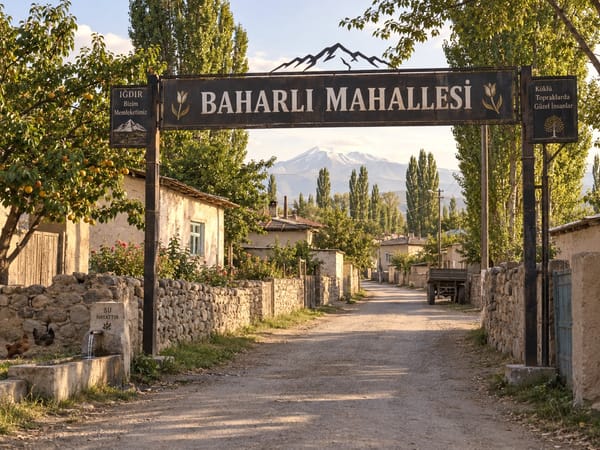
On an autumn day, Hamit Hun, as usual, walks from the city center to his home in Baharlı District. When he walks down the dirt road, suddenly a strong wind blows from all around and smothers everytihg with the dust. Dry leaves fly through the air, even cotton fibers flutters around from the gin factories it passes by, cling to its clothes, face, eyes etc.
Hamit Hun, with one hand, he presses firmly on his fedora so that it does not fly, and with another hand he resists the wind, which, as if, wants to throw away his overcoat.
The wind gets stronger and stronger. It becomes hard even to breath. In this way, Hamit Hun barely was making his way home.
Behman, who has been hiding for months to avoid being seen by Hamit Hun, decides to take a tour of the city, thinking, “Hamit Hun does not go out in such weather anyway.”
As Hamit Hun barely moves step by step, he sees a silhouette coming towards him. When the silhouette gets even closer, Hamit Hun, to his surprise, recognizes the figure: He is Behman!! Hamit Hun becomes very happy. Of course, Behman is deeply sorry because he screwed up.
Hamit Hun barely screams in the high winds:
“Behman, when are you going to give my money back?”
Behman cunningly try to play deaf, as if he misunderstood the question because of the strong wind, gives an irrelevant answer:
“You’re right, Mr. Hamit, this wind is going to hurt the cotton fields a lot!”
“I’m not saying that! When are you going to pay back my loan?”
Behman pretends again:
“Yes, yes! Hopefully it rains. So we get rid of this dust scourge!”
“You don’t hear me well! Come a little closer and I’ll tell you in your ear!”
“That’s what I think! There will be a drought this year!”
Hamit Hun understands Behman’s cunning answers and says to himself:
“He understands the opposite of what I say, so let him say him the opposite. So, he might understand me straight.”
“Behman, you’re a con man!”
Behman’s face becomes serious, he is immediately pushes forward:
“I’m not a con man!”
He takes out his wallet, repays the debt, then quickly walks away.
Hamit Hun, talks to himself:
“Now I got it! In the life, when you lend money, you have to talk ‘Politely and nicely’, but when you want your money back, you have to talk ‘Roughly and badly'”