The Spirituality of Muharram
This essay explores the spiritual significance of Muharram, sharing anecdotes from an esteemed religious scholar on compassion, resilience, and the problematic custom of offering food at condolence gatherings.

The month of Muharram is a sacred month. Today is the tenth day of Muharram. May the Ashura day be blessed for my fellow Iğdır citizens and all my Ja'fari brethren who experience feelings of mourning and sorrow deep in their hearts.
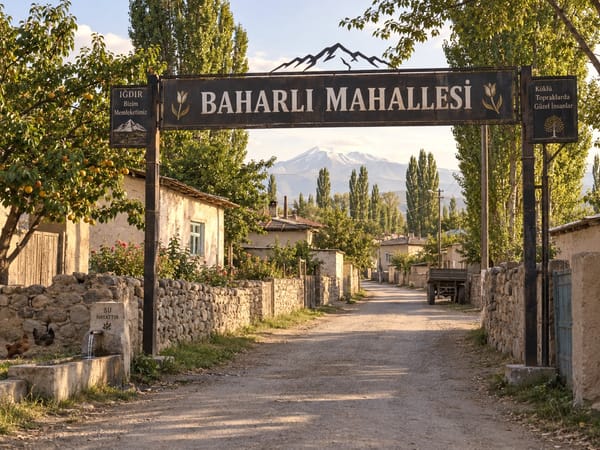
On this sacred and faith-filled day, I had the chance to sit side-by-side with my esteemed elder, Abdülmecit Hodja (Aydın), the Imam of Eski Baharlı Mahallesi (November 14) Mosque, in the condolence tent for my late mother, Naciye Hun. I was deeply impressed by his wisdom and spiritually rich conversations. Whenever he found a moment between the comings and goings of the congregation, he would tell instructive stories. I want to share a few of these anecdotes, full of wisdom and insight, that he told me during these days when our Iğdır is shrouded in spiritual mourning. But first, it would be an honor for me to introduce this esteemed elder to you, however briefly.
Abdülmecit Hodja was born in 1949 in the village of Ortaköy in Kağızman. At a young age, he received his first religious and spiritual education from his late grandfather, Hüseyin Aydın. When his grandfather passed away, he continued to study with his late father, Ömer Aydın, who was also a religious scholar, and thus, at a young age, he stepped into the spiritual and intellectual riches of this world. He is a primary school graduate. He showed his will and determination, completing middle school, high school, and the Faculty of Theology through external studies. He served as an imam in various villages. Wherever he went, he earned not only his livelihood but also the spiritual hearts of the people. It was a source of pride for me that such exceptional individuals live on the soil of Iğdır. I leave you with the beautiful and meaningful anecdotes told by Abdülmecit Hodja:
THE CATS OF THAT TIME
I was serving as an imam in the village of Taraş. I had gone to ask for a girl's hand in marriage. I sat with the homeowner, and we delved into a religious conversation. To emphasize that Islam is a religion of mercy and tolerance, I recounted an event from the time of our Prophet Muhammad (peace be upon him).
“One of the Companions was very fond of cats. For this reason, the Prophet Muhammad (PBUH) gave this Companion the nickname Abu Hurayra, meaning 'father of kittens.' Abu Hurayra loved cats so much that one day, to avoid waking his cat that had fallen asleep on the edge of his garment, he chose to gently cut off the edge of his garment and get up.”
The homeowner listened carefully to the anecdote I told. He nodded his head meaningfully. We sat down to eat together. There was a piece of bone on the table. A cat suddenly jumped onto the table, snatched the bone, and darted away. The homeowner got up with the same speed, grabbed a stick, and angrily threw it at the cat. The stick hit the poor cat squarely, and the cat tumbled a few times. The homeowner then returned to the table and continued eating as if nothing had happened. I was bewildered by this situation. I couldn't hold back and said what was on my heart:
“Just now, I gave an example of a cat to illustrate the tolerance of the Prophet Muhammad's (PBUH) time, and instead of learning from what I said, you mercilessly threw a stick at the poor cat.”
As soon as the homeowner swallowed the mouthful of food, he continued speaking:
“Hodja, the cats of the Prophet Muhammad's (PBUH) time had manners and discipline. The cats of today are very impudent!”
DELEGUR (FEMALE WOLF)
One day, I was teaching in a madrasah. Suddenly, shouts and cries from outside shook the earth and sky. I ran to the window, thinking a murder must have been committed. I asked what was happening: “Tonight, a female wolf attacked Bekir’s flock, killing 50 and severely injuring another 50. The shouts and cries are because of this.”
I went to Bekir to console him. There were tears in his eyes and a feeling of revenge in his heart: “I swear to God that I will find and kill this female wolf. Otherwise, this life will be a prison for me.”
I thought he was talking nonsense. How would he find that female wolf in these mountains? I tried to console him, but it was in vain. As a friend, I didn't want to leave him alone. I took a single-shot hunting rifle. Bekir came with an automatic weapon, referred to as a “five-shot,” and a scope. Together, we headed to the mountains. As we walked, I tried to persuade and dissuade Bekir:
“How will we find this female wolf in these mountains?”
Bekir, without looking at me, insisted in an angry and determined tone:
“We will find her!”
We wandered in the mountains for a day or two, hungry and thirsty. It was towards the evening of the third day. As soon as Bekir saw some movement in the distance, he immediately hid. I also lay down behind a rock. He gestured for me to be silent. He took the scope, looked carefully. It was indeed the female wolf! A sparkle of joy appeared on his face. “She has three cubs with her!” he muttered to himself. He handed me the scope. I looked carefully. The female wolf, with a black sheep alive in front of her, entered a narrow passage with her cubs and brought it to an enclosed area. To prevent the sheep from escaping, she lay down in front of the passage, stuck out her tongue about an inch, and while catching her breath, watched her cubs trying to kill the sheep inside. The cubs didn't know how to kill the sheep. The female wolf would get up every now and then, go to the sheep, grab it by the throat, show her cubs how to kill the sheep, then lie down again in front of the passage, letting her tongue hang out and catching her breath as she watched her cubs. We could see everything happening clearly from above. Finally, the cubs, as their mother had taught them, grabbed the sheep by the throat and strangled it, then tore it apart and began to eat.”
“What are you waiting for? Now's the time, let's open fire!” I whispered softly.
Bekir, who had been consumed by thoughts of revenge for three days, shaking his head in negation. A tear rolled from his eye. He stood up. He slung his rifle over his shoulder, the scope around his neck, and began to walk downhill. He was heavy-hearted, but he uttered words I will never forget:
“If we humans had taught our children the struggle for survival like this female wolf, there would not be so much cruelty and brutality in the world. The female wolf, with great effort, brought the sheep to train her cubs. Could we humans take such trouble to raise our own children?”
As I followed Bekir, I pondered his virtuous and wise words and admired his behavior. When we reached the village, as a religious scholar, I gathered the villagers in the mosque and addressed them:
“Bekir lost his flock, he is a victim. Each household will give a few sheep according to their means.”
The villagers loved me. In a short time, Bekir again had a flock of a hundred sheep. I thought to myself: God never abandons those who show virtue and excellence, He finds a solution to their troubles.”
PART II
TEA, WATER, AND FOOD SERVICE IN CONDOLENCE TENTS
In the condolence tent for my late mother, Naciye Hun, I sat side-by-side with my esteemed Hodja Abdülmecit Aydın, benefiting from and being impressed by his wise and insightful words. One point caught my attention: Hodja Abdülmecit drank neither the water nor the tea placed before him. He politely refused the food offered. I asked out of curiosity. A bitter smile appeared on his face. “I do not find it right for such services to be provided in condolence tents.” I asked why. He told me an incident that had happened to him:
“The mother of a young man I knew had passed away. The young man was unemployed and poor. With the help of family friends and relatives, he buried his mother. When he returned home, a crowd was waiting for him. People sat on chairs, expecting to be served as if they were guests. But as I said, the young man was poor. He didn't even have tea to offer. The crowd came again on the second day. I was sitting at the table, reciting Fatiha, and greeting the arrivals. A whisper circulated among the crowd: ‘Is there no tea and food service?’ This remark must have reached the young man's ears, as he took it as a matter of pride. He borrowed money from loan sharks. On the third day, he offered plenty of tea and food to the crowd. After some time, the crowd stopped coming. The young man was left alone. This time, another fear filled him: How would he pay back the debt he had taken? In those years, interest rates were high. When the loan sharks added their own interest, the interest accrued in a month exceeded the principal.
The young man had no means to pay either the principal or the interest. He couldn't sleep due to his distress. The loan sharks constantly pressured him, threatened him, and demanded the repayment of the principal with interest. The young man had neither a friend to turn to nor any property to sell. One day, he took a rope, hung it from a tree in the garden, and committed suicide. When I heard this news, my heart ached. In a way, I became disgusted with the long-standing tradition of ‘condolence meals.’ Besides, there is no such verse in the Holy Quran! From that day on, wherever I went, I adopted a firm stance on the issue of ‘condolence meals.’ Over time, a considerable public opinion was formed! That's why I do not accept anything offered.”
When Abdülmecit Hodja recounted this grave incident, my heart ached. Just think: A relative, someone you love, passes away, and while you wander half-dead with a heart full of grief, you are also concerned about how to serve tea and food to the friends and relatives who will come. If you don't have money or means, you are left in the middle, ashamed and dejected.
If I had heard what Abdülmecit Hodja said earlier, I would not have served water, tea, or food at my late mother's condolence table. Here, in the presence of the public, I want to apologize, at least on my own behalf, to the friends who initiated a social solidarity movement to abolish meals in condolence tents.