Two Sad Stories from Mücahit Hun
This article presents two poignant tales: "The Legend of Golden Isa," a story of a young man's desperate quest to heal his disabled brother, and "The Azerbaijani Jockey," a memoir of a jockey's life, loss, and enduring love for horses.
THE LEGEND OF GOLDEN ISA
NOTE: The story you are about to read is true. But over the years, hundreds of versions have been told, changing as they spread by word of mouth. Thus, a legend was born. What matters is not whether the details of this legend are true or not, but the legend itself. Happy reading!
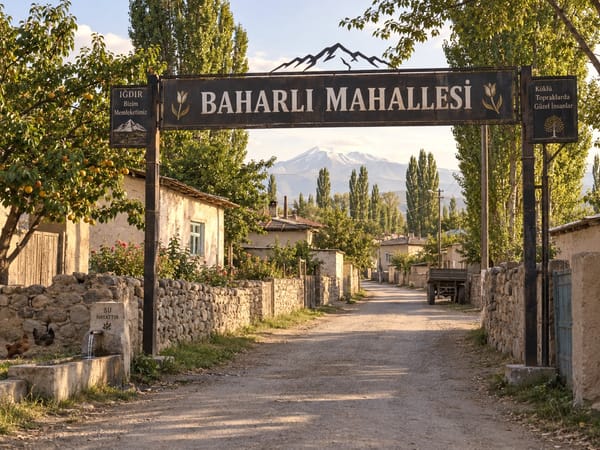
Once upon a time, where Mount Ararat met the Iğdır plain, by the Karasu stream, there was a village named Adetli. In this small village lived a young man named Isa. His family was quite poor. Like all Kurdish tribes, his tribe was semi-nomadic. They would go to the highlands in May and return to their village in autumn as the weather grew cold. This had always been the case since Isa's childhood. Since there was no school in the village, Isa spent his days looking after animals and herding from an early age.
He had many siblings. One of them was crippled from the waist down since birth. He couldn't walk. He could only crawl with the strength of his two hands. Isa was his brother's greatest helper. Whenever his brother needed something, he would call out to Isa and ask for help. Isa, with a heart full of love and compassion, would carry his beloved brother on his back and help him go to the toilet. Sometimes he would carry his brother far away, wanting him to see everything. On such days, his disabled brother couldn't sleep, constantly repeating, "Isa, tomorrow you'll take me to the deep valley where the sheep graze, won't you?" His greatest fear was that Isa would forget his promise. But Isa was not like that. He was bound to his brother with an indescribable, deep love and compassion. He felt responsible for the injustice his brother suffered and harbored a hidden hatred for the injustice and cruelty of nature and people.
Isa would meet his brother's heart-wrenching words with a smile, comfort him, and reassure him: "Of course! I'll take you to the deep valley (neval). I'll gather shilan fruit for you. There are wild apples there too. We'll eat them together and have a good time." Isa would immediately add: "You'll see, one day I'll earn a lot of money. I'll take you to Ankara and have you operated on. You'll be able to walk, even run, like everyone else." His brother would be even happier at this news, praying in his own way for Isa to become rich.
Time passed, Isa grew up, and it was time for his military service. As Isa left the village, his disabled brother burst into sobs. He felt as if he had been abandoned to death. Isa kissed his brother's forehead, trying to comfort him, "Look, you'll see, everything will pass quickly! My military service will end soon, and I'll come back." As Isa said goodbye to his family and moved away from the village, a sadness fell over him, and he couldn't hold back his tears. He was angry at the injustice of life. But he also knew he was helpless!
Isa completed his military service in a distant province. He learned to read and write a little. His Turkish became more fluent. He completed his service without taking leave and returned to his village. More than 1.5 years had passed, but nothing had changed in the village. He only found his disabled brother a little older. They embraced each other with longing. His disabled brother spoke as if pleading, "Isa, don't leave me alone again!"
But the reality of life is bitter. Isa knew he had to earn money. One morning, he carried his disabled brother on his back and took him to the Karasu stream. He talked about his military memories, how the officer's wife, for whom he carried wood, flirted with him. These conversations pleased his disabled brother, who burst into fits of laughter, making strange sounds.
Isa suddenly became serious, took his brother's hand: "You know I promised you. I'll earn money and heal you. It's impossible to earn money in the village. I have to go to big cities, work, and save money. I'll leave you alone again." Before Isa could finish his sentence, his disabled brother began to cry silently and with sobs. His tears fell into the Karasu stream, mixed with the water, and drifted away.
With the help of an acquaintance, Isa found a job on a farm near Ankara. He still worked as a shepherd, but occasionally had the chance to go to Ankara. He would wander the city, mingle with the crowds, but no matter what he did, his disabled brother never left his mind. One day, shyly and hesitantly, he went to a doctor, explained his brother's condition, and asked about the cost of such an operation. The doctor quoted a high figure: "It would cost at least 10 million! Because three or four operations might be needed with two-year intervals." (In the early 1980s, 1 dollar was 100 TL)
Isa returned to the farm. He calculated his salary. He would have to work for at least 30 years to save that much money! He fell into despair. One morning, he went to his boss, made up a lie, and said he had to return to his village. He asked for the money he had earned over six months. His boss was stingy and paid him less than he was due. Isa's hatred for the rich and the wealthy grew even stronger. He left the farm and set off for Iğdır.
He arrived at the Ankara Bus Terminal. He bought his bus ticket and settled into his seat. He felt a deep unease and sadness. An old man sat next to him. Isa was respectful and did his best to make the old man comfortable. The bus started moving. A conversation in Kurdish began between them. In the middle of the conversation, Isa inexplicably turned his eyes out the window, staring blankly into the distance. Isa's unease did not escape the old man's notice, and he questioned Isa. The journey was long. Isa slowly, but in a sad tone, summarized his life without rushing. The old man was lost in thought. He felt pity for this young man whose heart was wounded because he couldn't help his disabled brother.
"Isa, I'm going to tell you a secret, but no one must know!"
The old man leaned his mouth to Isa's ear and whispered. Isa interjected occasionally, "I know Mount Ararat step by step, it's our highland pasture." After the old man finished speaking, he reached into his wallet. He took out a coin, the size of an iron coin, yellow in color, slightly concave, with uneven edges, hidden in a corner of his worn and torn leather wallet.
"This is the gold I was talking about!"
Isa took the gold coin in his hand, turned it over and over, a thousand thoughts coming to his mind.
"How much would you sell this coin to me for?"
"I won't sell it! It's a keepsake. I don't know its value either."
Isa reached for his wallet.
"I have 150,000 TL in my wallet. Would 100,000 be enough?"
The old man looked into Isa's eyes. The desperate young man from before was gone, replaced by a hopeful one. He didn't know what was going through this young man's mind, but it was clear he wanted this money very much. They agreed on 100,000 TL.
When the bus arrived in Erzurum, Isa respectfully kissed the old man's hand. "I've changed my mind about going to Iğdır. I'll stay in Erzurum for a few days!"
As Isa walked the streets of Erzurum, he thought about what the old man had whispered in his ear. He entered the jewelers' street. He randomly walked into a jeweler's shop. He asked for the price of the gold coin in his hand. The jeweler took the coin, turned it over, and asked curiously: "Do you have many of these?" Isa remained silent. Knowing human weakness and vulnerability in the face of money, he said nothing. Isa's silence excited the jeweler even more: "This is an old coin!"
Isa, in the manner of a shy (!) and ignorant (!) villager, asked:
"I want to know the price! I have many of these!"
The jeweler asked Isa to sit down. He ran out of the shop. He returned with an old man with a white beard. The old man took the Byzantine coin in his hand. He bit it with his teeth. He took out a catalog from the safe. He compared it with the coin pictures there. He was sure it was a rare coin. The jeweler and the old man spoke quietly. Both were excited. Isa watched everything with great attention, while also pretending to be an ignorant villager and sipping his tea.
The white-bearded man: "It's an old coin! Made of bronze. If it were gold, its value would be much higher."
The old man on the bus had said it was gold. Clearly, the jeweler was trying to deceive him.
The white-bearded man approached Isa:
"I'll give you 1 million for one of these coins. How many do you have?"
Isa used his intelligence. He wanted to leave the impression of an ignorant and naive villager on the jeweler:
"I am a shepherd. While grazing sheep on Mount Ararat with my friend, we found a chest full of these coins in a cave. There were other things inside too. We didn't want to sell them in Iğdır because Iğdır is a small place. If our relatives, especially the aga, found out, they would take everything from us. That's why I came to Erzurum."
The white-bearded man couldn't sit still.
"Let's do this! Don't go to another jeweler. I'll give you 10 million in advance. You go back to Iğdır. I'll come to Iğdır in a week. How will I find you?"
"There's the Şimşek Hotel in Iğdır. You can stay there. I'll come and find you. Is that okay?"
The white-bearded man didn't want to return the Byzantine coin. Isa objected:
"My partner is a very troublesome person. If he doesn't see the coin, he'll think I sold it for a very high price and gave him little money. Let the coin stay with me so my partner's trust in me doesn't diminish."
The white-bearded man found the suggestion reasonable. He pressed 10 million liras and the Byzantine gold into Isa's hand. Both parted ways in a very happy mood.
Isa walked away from the jewelers' bazaar. It wouldn't be right for him to be seen there again. He checked into a hotel. He lay on his bed and smoked for a long time. He fell into deep thought: "So bronze and gold look alike!" he sighed. Another idea came to his mind. He left the hotel. There were other jewelers under the mosque. He found a toy shop. He bought a plastic bear. He went to the jeweler:
"I have a request for you. I want you to make a bronze bear similar to this plastic bear. In our region, it's believed that a bronze bear brings good luck."
The jeweler pursed his lips: "We can do it, but it will be very expensive!"
"How much?"
"It will cost 2 million!"
Isa bargained. They agreed on 1.5 million. Isa immediately paid half a million as an advance.
"When will it be ready?"
"By tomorrow morning!"
The next day, Isa, with the bronze bear beside him, boarded the Iğdır bus, dreaming one dream after another.
When he arrived in the village, his disabled brother was the happiest.
"Did you bring the money for the operation?"
"Almost! I'll take you to Ankara soon."
Towards evening, Isa went to the house of his most trusted friend, with whom he had grown up. Of course, he didn't tell him everything that had happened. He couldn't fully trust anyone. Money was like a devil that tempted people! He only said that if he did what he asked, he would earn a lot of money. He gave him 1 million liras.
"This is just the beginning! No one will know. Even if you're tortured, you won't tell! Promise?"
"Promise!"
A week passed. The white-bearded jeweler must have arrived in Iğdır. Isa went to the Şimşek Hotel. As he had hoped, the white-bearded man had arrived.
Isa, pretending to be very careful, whispered into the white-bearded man's ear:
"Not here! Let's go up to your room!"
Once alone in the room, Isa briefly explained to the white-bearded man:
"My partner and I counted. There are 150 of these coins. Also, there were some bear-like objects. I brought one with me."
Isa merely showed the head of the bronze bear, carefully wrapped in cloth pieces and hidden inside his jacket, from a distance. Then, he hastily re-wrapped it in cloth and placed it back in his bosom:
"There are exactly twelve of these bears, from large to small! I brought the smallest one."
The white-bearded man was convinced that this too was gold and had antique value.
They began to bargain. At one point, Isa made a suggestion:
"My partner is a shepherd. He doesn't know the value of such things very well. You give me 50 million, and I'll cut my partner out of the deal. I'll bring you 150 gold coins and 12 bear pieces. Then we'll make our deal. What do you say?"
The jeweler liked this suggestion. He had 60 million liras on him. He handed 50 million to Isa without batting an eyelid. Before Isa left, he strongly advised him:
"Wait for news from me! Tomorrow I'll get everything and bring it here. But I want my money upfront."
After Isa left the hotel, the white-bearded man called Erzurum and asked his son to bring money.
As Isa returned to the village by horse-drawn carriage, he had 50 million liras and the bronze-gold bear in his pocket. In the evening, he went to his friend's house. His friend was single. He lived alone. This gave Isa confidence. He entrusted most of the money to his friend and instructed him: "Tomorrow I'm going to Adana via Doğubayazıt!"
After a long journey, Isa arrived in Adana. Meanwhile, the jeweler from Erzurum, tired of waiting for Isa at the Şimşek Hotel, realized he had been deceived and returned to Erzurum. He knew neither Isa's name nor his village. He couldn't go to the police either, because he would get into trouble for smuggling historical artifacts.
Isa toured Adana. He conned four people: one hotel owner, two jewelers, and one gas station owner. He put five million advance from each into his pocket. He had a small notebook he carefully carried in his pocket. With difficulty, he wrote down the names of his customers and noted which day they would be in Iğdır. He gave his customers appointments at the Şimşek Hotel, two weeks apart. Each time, he didn't forget to add that he had 150 Byzantine coins and 12 gold bears of various sizes, emphasizing it strongly. "We will make our deal and delivery in Iğdır. So come with enough money!"
First came the hotel owner from Adana. Isa took 100 million and sent him back from Iğdır empty-handed. In the same way, he took 100 million from the other guests from Adana and sent them back empty-handed.
One evening, they sat at his friend's house and began counting the money. Isa got tired of counting money and gave up. He smoked his cigarette and fell into deep dreams. Meanwhile, he had unknowingly increased his cigarette consumption and was frequenting bars and drinking alcohol. There were cases of beer bottles in a corner of the room.
Isa advised his friend, who was excitedly counting the money. "Don't keep the money at home, put it in an iron chest, and place it at the base of a rock far from the village. It's enough for you to know its location! You never know, they might catch me and torture me, and I might have to reveal its location."
Suddenly, he announced his new decision: "Tomorrow I'm going to Trabzon!"
He went to Trabzon via Doğubayazıt. Isa had now mastered his role. He wore ragged clothes, gave himself the air of an innocent and ignorant villager, and spoke as someone who didn't know the value of the Byzantine coin in his hand. In a short time, he conned two dairy owners, a restaurant owner, and a bus company owner. He gave them appointments at the Şimşek Hotel, two weeks apart. He returned to Iğdır.
Everything was going as he wished. Without making a mistake, he extorted a fortune from the people of Trabzon who came to the Şimşek Hotel and sent them back empty-handed. The bus operator from Trabzon was shrewd. When Isa left the hotel, he asked who Isa was. The young man at the reception said, "I don't know him very well, but he lives in Adetli village."
When Isa didn't return, the bus operator from Trabzon inquired and tried to gather information about Isa, who lived in Adetli village. When he even dared to tell some people that he had fallen into a treasure trap and lost a lot of money, the word spread in Iğdır. Soon, the people of Iğdır began to follow Isa. The wealthiest among them would grab Isa by the arm and pull him aside, saying, "Isa, our fathers are friends. Why are you selling the treasure to foreigners? I'll give you the same money, sell it to me!"
Isa would almost forcibly take the money put in his pocket and return to the village. When he came to Iğdır, he would make up a thousand lies, saying his partner wasn't satisfied with the price, extorting more money, and then heading back to the village. Another day, a rich Azerbaijani would corner Isa, saying, "Isa, we are kinsmen! Whatever others offer, I'm ready to give double," and forcibly stuff millions into Isa's pocket.
Isa had become very wealthy, but he had also fallen into a bad habit: smoking and alcohol.
The hotels and inns in Iğdır were overflowing with people who had returned hoping to either catch Isa and persuade him or get their money back. Isa no longer came down to Iğdır; he hid in a secluded house in the village, waiting for the hopes of the people he had defrauded to fade and for them to disperse. However, this wait lasted a long time. Isa had pushed his cigarette and alcohol consumption to its limit. He had five million dollars! He was the richest man in Iğdır, but only he knew it.
One morning, Isa woke up coughing deeply. There was blood in his phlegm. He didn't suspect anything. But when the bleeding continued for a week, Isa rented a private car and went to Erzurum. He had laryngeal cancer, but it had metastasized to his lungs. His death was near.
A respected person from Iğdır, who heard that Isa was in Erzurum and knew his family very well, went to visit him. Isa was lying in bed, half-dead. His compatriot, who knew about Isa's frauds, was not after any money or gold. He asked curiously:
"Who gave you this idea?"
Isa opened his half-closed eyes, smiled bitterly:
"One day I was returning from Ankara to Iğdır by bus. An old man sat next to me. He was from Doğubayazıt. He told me a story. Since I am on my deathbed, I see no harm in telling you what that old man told me.
According to the old man, his father had participated in the Mount Ararat rebellion. It was the last days of the rebellion. Towards evening, planes were bombing everywhere. His father threw himself behind a rock. A bomb exploded nearby. My father suddenly fell into a pit. The pit was 3-4 meters deep. Since the area was swarming with soldiers, my father sat silently in the pit, waiting for dawn. In the morning, from the light filtering in, my father realized that the pit was a cave. He slowly went deeper into the cave. When it got dark, he lit his lighter. He saw a huge chest. He opened the lid of the dusty chest. It was full of gold coins and gold bears. My father filled his pockets with gold coins, and with great difficulty, he climbed out of the hole. He pushed a rock to close the hole. Hiding, he reached Iran.
He stayed in Maku for a while. He put the gold coins in a bag and hid them under his arm. One day, he went to Tabriz. As he passed a jeweler's shop, he took out one of the gold coins and showed it to the jeweler. The jeweler, realizing the value of the antique coin, asked how many there were. My father was very naive. He took out the bag he was hiding under his arm and emptied the coins onto the table. The jeweler closed the door from behind so no one would see. They started counting. There were exactly one hundred and fifty-one coins. The jeweler took a pen and paper and made calculations. It amounted to a large sum of money:
"I don't have that much money! I need to go to the bank. I'll pay tomorrow!"
As my father put the money back into the bag, the jeweler intervened, warning him kindly as if to protect him from danger:
"Don't carry so much gold with you! Let it stay with us! The location of our shop is well known."
My father took one of the coins and put it in his pocket.
"Then I'll come and get the money for 150 coins from you tomorrow!"
My father went to the jeweler's shop the next day. It was closed. He didn't suspect anything. He went the next day. The shop was closed again. My father went to the shop every day for a week but found it closed. He asked the neighboring jewelers out of curiosity and was very saddened by the answer he received:
"They moved to Tehran!"
My father realized he had been deceived and returned to Maku, full of regret, with one coin in his pocket. Before he passed away, he told me what had happened: "Take this coin and keep it safe! It didn't do me any good, maybe it will do you some good!" he said.
The old man whispered all this into my ear on the bus. I had been working on a farm in Ankara for six months. I gave 100,000 liras and bought this coin. I had a bronze bear made by a jeweler in Erzurum. You know the rest better than I do."
Isa spoke with difficulty, his breath catching occasionally, as if he were about to faint. His friend, who had listened carefully to the entire story, received the news of Isa's death when he came to the hospital the next day. He was a generous man. He took Isa's body and brought it to Adetli village. Isa was buried silently. His disabled brother cried the most:
"Isa, you died without operating on me!"
Isa's siblings knew that the collected money was with Isa's trusted friend. They asked for half of the money. The man denied it: "Isa used to hide the money in a place I didn't know. I don't know anything!"
Isa's brother went to the gendarmerie and told them what had happened. These were the years of the September 12th Military Coup. A commando vehicle came to the village, caught Isa's trusted friend, and took him away.
When the man denied the accusations, he was severely tortured. They tied his feet upside down and hung him from the ceiling, beating him continuously with sticks. The man screamed and groaned but did not reveal where he had hidden the iron chest containing the money. Finally, they gave up the interrogation.
The man returned to the village, limping for months. One day, when he felt better, he filled a sack with the money and fled via Doğubayazıt to an unknown city in Western Anatolia. Years later, it was heard that he had become a real estate mogul, but it was too late to hold him accountable!
THE AZERBAIJANI JOCKEY
In 1973 (I was 15 years old), we had a patisserie directly opposite what is now the Iğdır Municipality Building. Some summers, I wouldn't go to the highlands; I'd stay in Iğdır, either helping out at the patisserie or sitting on the not-so-comfortable seat of a Lombardini brand Italian harvester, enveloped in the smell of gasoline and heat, mowing endless meadows. In the summer of 1973, my brother Ahmet took over the hay mowing. It was left to me to manage the patisserie.
We had an employee named Latif. He was short but agile. He never stood still. He would walk around with a white cloth, taking orders, serving customers, and making lemonade, ice cream, or rice pudding when he had free time. When the unbearable heat filled the air around noon, he would take a bucket, draw water from the stream passing in front of the patisserie, and water the surroundings. Soon, a pleasant coolness would fill the air, preventing the dust raised by the phaetons and daşkas (horse-drawn carriages) passing in front of the patisserie.
Next to our patisserie was a coffeehouse. Every morning, an old uncle would sit alone at a table in the front part of the coffeehouse, resting his chin on his cane, staring into the distance, his eyes lost in thought. Latif whispered in my ear at one point:
"Watch out! Soon, when a phaeton or daşka passes, the old man will angrily strike his cane on the ground, shake his head, and show his discomfort."
Inevitably, curiosity got the better of me. In those years, there were only a few taxis in Iğdır. Everywhere was full of phaetons and daşkas. The phaeton drivers would line up in a single row in front of the municipality, sheltering under the huge elm trees, waiting for customers.
I saw a phaeton approaching. I was watching both the phaeton and the old uncle. Just as Latif had said, as the phaeton passed directly in front of the patisserie, the old uncle angrily struck his cane on the concrete ground, mumbled something, then calmed down and fixed his gaze into the distance again.
One day, the old uncle was sitting at a table near the entrance of our patisserie. The air was stifling and hot. I placed a glass of lemonade on the old uncle's table. He looked at me with surprised eyes:
"Oh, son! There's been a mistake. I didn't ask for lemonade. Besides, I don't have any money!"
"Emmi (Uncle)! I'm treating you to the lemonade. I won't take any money."
"You're Mecit Bey's son, aren't you?"
"Yes," I said, and sat on the empty chair next to him. He was complaining about the heat. He lived in a village close to Iğdır center. He walked this road every day.
I was a curious young man.
"Emmi, forgive me, why do you get angry when a phaeton or daşka passes?"
Emmi smiled. His eyes sparkled.
"This is a very long story. Do you want to hear it?"
"Of course!"
"Then listen carefully to me! I haven't told anyone what happened to me. You seem like a good young man. Your father also did a lot for me."
He took a sip of his lemonade. In those years, I kept a diary. I had an older brother figure named Temel Ural, whom I valued greatly. He would tell anecdotes and jokes, and I would write down what he told me in my notebook.
I quickly fetched my notebook and pen. Emmi began to speak:
"I was born in Develi village, on the other side of the Aras, within today's Armenian borders. I had two brothers and two sisters. My father worked as a groom in a stud farm in Moscow. He earned good money. He couldn't come to the village often, but he sent plenty of money. I hadn't seen my father for many years. One day, my father showed up. I was 13 years old. When my father returned to Moscow, he took me with him. He wanted me to learn the profession of a groom: 'There's a lot of money in this, you'll be comfortable!' he said.
After a long journey, we arrived in Moscow. We reached a huge farm near Moscow by car. It belonged to a rich Russian. He raised racehorses. My father took me to his boss. He was a kind and cheerful man. He said a few words that pleased me.
My father lived in a small hut next to the stable. He brought a bed for me. We started living together.
Perhaps you don't know, but horse races are held with purebred or half-bred horses. In those years, flat races were held in Moscow. They were races with big prizes. There was a lot of interest in horse racing. Rich Russians would fill the hippodrome and bet large sums of money.
The very first morning after we arrived, my father woke me up early, and we went to the stud farm together. Each horse had a Russian name. There were Arabian, English, and Shetland pony breeds in the stud farm. The most popular horse in the stud farm was a purebred Arabian horse. Its name was Molniya. It meant "Lightning" in Russian. My father was a good groom. It was as if he understood the language of his horses. He slowly taught me what to do. My father never wanted the horses to be hit even once. When the horses were stubborn, my father would talk to them and plead with them to give up their stubbornness.
A horse is an extremely obedient animal to its owner. If its owner wishes, it gallops at full speed, if it wants, it walks slowly, if it wants, it stops. In all situations, it tries to please its owner. If necessary, it would exert all its effort for its beloved owner, even at the cost of exhausting itself, regardless of its fatigue.
Horses have different gaits. Their Russian names are in my memory, but in Turkish, names like "tırıs" (trot), "rahvan" (amble), "eşkin" (canter), "dörtnal" (gallop) are used. The gait changes from horse to horse. What interested me most were the foals. Mares are pregnant for eleven months and give birth to one foal. The foal is born with its eyes open, and after a few minutes, it struggles to its feet and begins to follow its mother.
Riding and racehorses have long, slender legs. Horses have a habit of envying each other. That's why they want to run faster and get ahead in a race by envying each other. The Arabian horse is a very durable and excellent racehorse. The English horse is also a good riding and racehorse, even longer-legged than the Arabian horse.
Horses come in various colors: Yağız (black), al (reddish-brown), white, doru (bay), kır (roan), boz (grey)..."
Emmi spoke slowly, in a low voice. I made him repeat words I didn't understand. His mind went back and forth between Turkish and Russian names.
Emmi suddenly changed the subject:
"Let me tell you a little about what grooms do. The duty of grooms is to ensure the horses are fed and cleaned. All horse care is their responsibility. They clean the stables, groom the horses, saddle them, and prepare their water and feed. It is also their duty to take racehorses for long walks in the morning and evening."
Emmi asked for another lemonade. The weather was hot. I also got a lemonade. Emmi was talking about subjects I knew nothing about:
"The riders who race horses at the hippodrome are called jockeys. Jockeys must be under 30 years old. A good jockey must be patient and show their love to the horses, otherwise, the horses will not obey their commands and will abandon them halfway."
One day, an important race was to take place. We started preparing the Arabian horse Molniya for the race. This task was given to me because Molniya loved me; when she saw me, she would neigh with joy and shake her mane. Sometimes she would playfully nudge me with her head.
It was 1912. Finally, the race day arrived. The Tsar and his family would also be present at the race. We took Molniya to the hippodrome with great care and attention. Other racehorses and jockeys were also milling around. Our jockey mounted Molniya, but Molniya was not very pleased. She showed her displeasure. The jockey tried to soothe and calm her, but he wasn't getting the desired result. The boss was not very happy with this situation. He called my father over. They talked about something, looking at me. My father gestured to me. I ran to them. My father, in a timid tone, said, "Son, can you ride Molniya as a jockey?" I was very excited. We had little time. I was small and slender. The jockey's uniform fit me perfectly. They explained the rules. I already knew many things. When I went next to Molniya, she shook her head with joy.
The starting time had come. I mounted Molniya, and an attendant pulled the reins and positioned us behind the starting gate. When the referee raised the barrier with a lever, the race began. Molniya galloped off. She swiftly slipped between two horses and caught up with the leading horse, leaving it behind too. I could hear the shouts rising from the hippodrome. Molniya was running at an incredible speed. I glanced left and right but couldn't see any rivals near me.
That day, I finished the race first. My father and the boss embraced me with joy. The boss received a large sum of money. He was a generous man. He almost stuffed half of the money into my father's pocket. I walked around proudly, leading Molniya by her reins. Suddenly, a crowd surrounded me. My name appeared in the newspapers. I was very proud when the boss showed me my picture in the newspaper.
From that day on, I became famous as Moscow's best jockey. My father was proud of me, and every now and then, he would affectionately place his hands on my head and kiss my forehead.
Several years passed like this. One day, my father suddenly fell ill. He had a heart attack. Despite all interventions, he passed away before my eyes. We buried him in the Moscow cemetery. When the 1917 revolution happened, horse racing ended. I asked the boss for permission to return home. I hadn't seen my mother and siblings for years.
When I arrived in Develi village, everyone was very saddened by the news of my father's death. My family mourned for days. I thought everything would return to normal after the Russian Revolution and planned to go back to Moscow. Then, ethnic war broke out in the region. Villages were emptied, and people fled in droves. My mother and siblings set off towards Ganja.
My conscience wouldn't allow me to leave the house. "You go! I'll follow and catch up with you," I convinced them. But I was wrong! Armenian forces had blocked the roads. With great difficulty, hiding during the day and traveling at night, I went to Nakhchivan. I stayed there for a few years. Then I heard that Iranian Azerbaijan was safe. I stayed there for a few years too. When I heard that Iğdır had been emptied of Armenians, I came and settled in my current house. I took various jobs. Those were difficult days! I got married. When my wife died with her child during childbirth, I never married again. I lived alone and still live alone. I worked as a shepherd for many years. I grew old, but thanks to my neighbors, there's always a piece of bread on my table. From that day to this, I haven't heard any news from my family who went towards Ganja."
Emmi's facial expression changed. It was clear that his heart was full of longing and yearning. I repeated my question: "Emmi, why do you angrily strike your cane on the ground when a phaeton passes?"
Emmi smiled slightly: "The phaeton drivers, the daşka drivers, torment the horses with whips. Whenever I see them cracking their whips, my heart aches, and out of my love for horses, I get angry and strike my cane on the ground."
From that day on, a silent but respectful friendship began between us. Most of the time, I would have a packet of cookies prepared for him to take home and place it on his table. He would accept what was given with honor and pride, and never failed to offer his blessings. That autumn, I started at Kabataş High School. When I came to Iğdır during the semester break, I received the news of old Emmi's passing. May God have mercy on him!