Grave Visits and Metaphysics
The author reflects on his visits to Iğdır, the unchanging nature of Mount Ararat, and the profound metaphysical questions prompted by grave visits, contrasting them with the philosophical ideas of Politzer and Kant.

Dear Readers!
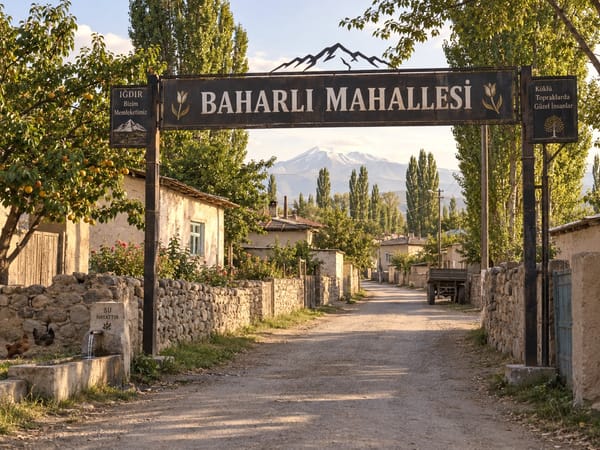
I spent five days, from March 24-29, in Iğdır, the land where I was born. Iğdır is my true homeland and my love.
Mount Ararat was covered in snow, pure white. It seemed impatient, as if saying, "Spring is late this year! I wish the warm weather would start so I could shed this burden of snow."

Years have passed. I have changed. Once a skinny, frail, tall child, I grew up, traveled countries, and returned to Iğdır with graying hair. But Mount Ararat is always the same, always the same… Suddenly, two important figures, one Kurd and one Azeri, came to mind: Eleşref Bey and Kerim Yaycılı.
Eleşref Bey
(From the narration of the late Hacı Evliya Yiğit. Source: Iğdır Sevdası book)
“Eleşref Bey was a very cultured and knowledgeable Kurdish General. Every word he spoke carried a deep meaning and a philosophical message:
One day, as he was passing near Çarsale Hill, close to the village of Kellehemo (Nişankaya), on horseback, he pulled on his horse's reins, looked thoughtfully at Çarsale Hill, and sighed, muttering:
‘Oh, Çarsale Hill, when I was a small child on my mother's back, you were still Çarsale Hill, now I am old and weak, but you are still the same Çarsale, the same Çarsale…’

Kerim Yaycılı
(From the narration of the late Hamza Aygün. Source: Iğdır Sevdası book)
“Poet and man of letters, Kerim Yaycılı, son of Hacı Abdullah Efendi of the Alhan family, was born in 1913 in the village of Yaycı, Iğdır. His childhood was spent amidst the suffering and pain of the First World War. These painful scenes from the past fueled his love for serving his country as an officer, and Kerim Yaycılı, who always graduated first in his class in the military middle and high schools he attended, was discharged in 1931 due to a lung ailment caused by his intense work and weak constitution.
During his convalescence (change of air) which lasted until 1934, he served as a teacher in primary schools in Karaköse (Ağrı), Karakoyunlu district, and Erzurum. In the same year, after graduating from the literature department of Erzurum High School, he was called up for reserve officer service. After being discharged in 1937, he came to Ankara and enrolled in the Turkish Language and Literature department of the Faculty of Language, History, and Geography.
Because Kerim Yaycılı was born and raised in Iğdır, he had endless love and respect for it and its citizens. The Aras River and Mount Ararat were his sources of inspiration.
Despite spending 36 years of his 66-year life sick and unable to walk, Kerim Yaycılı never lost his will to live, connecting to life with a great determination and willpower that few are blessed with.
I met Kerim Yaycılı on March 21, 1962. He had a wide circle of acquaintances at the State Opera and Theatre where he worked. All the artists held deep love and respect for him. His room, where he stayed alone and did not go out, was never empty, always filled with visitors.
When he had to scold someone, to avoid hurting anyone's feelings, he would add great softness and a smile to his words, soothing the heart of the other person.
Kerim Bey passed away on the evening of Friday, July 13, 1979, due to a heart attack. His funeral was held on Monday, July 16, at 3 PM at the Ankara Küçük Tiyatro with the participation of State Theatre artists, friends, and fellow townspeople. After the ceremony, his relatives took him to Iğdır, where he was laid to rest.
I wish God's mercy upon Kerim Bey, a good man and, above all, a good national poet. I cannot pass without presenting his poem 'Araslı Kız' (Girl from Aras) which he wrote for Iğdır.”
Araslı Kız (Girl from Aras)
White clouds cover Ararat’s peak
Azeri girls listen to Aras’s joyful sound
How endearing Iğdır is with its spring
Girl from Aras, adorn your hair, your breast with roses.
Songs spread from arbors to the plain
Come, Aras, let’s gaze at Iğdır to our fill
Today even the winds imitate your lament
Tell me, Aras, to which land do your arms reach
My heart still aches as I wander this shore
I saw her one day, girls going to the field
Under her white veil, her lips were crimson red
I didn’t ask anyone, whose daughter was that girl?
As the flag’s star sparkled in her eyes
I fell in love right there with that joyful Azeri girl
There was a lover’s tremor in her sweet voice
In the fragrant shade of the oleaster trees
Last summer’s memory then struck my soul
In her voice was the burning longing of our love
Whenever sheep and lambs spread across these fields
I await Nowruz, hoping to see her
I searched like Majnun on the mountain slopes
They said she was washing her hair in the Aras
Oh, if only I could hear her joyful voice again
If only I could taste her kiss before I die
I would say, even if no one is my beloved in Heaven
I have only one love in both worlds
WHAT IS METAPHYSICS?
The Turkish equivalent of the word "metaphysics" means "beyond physics / beyond nature." The word "physics" here, in a sense, refers to the real world we live in (i.e., worldly). When we think this way, the word "metaphysics" carries within itself the message of "the unknown or the world we do not know." Metaphysical questions have always existed throughout human history and will continue to exist. Let's take a look at a few metaphysical questions if you like:
- What is the meaning of life?
- What is our place in the universe?
- What is consciousness?
- Does the world really exist?
- Do we have free will?
- Does God exist?
- What is man? Why do we live?
GRAVE VISITS
Human beings do not want to confront metaphysical questions out of the blue, because they carry within them a feeling as if they will live forever, and they are afraid of facing disappointment. They lose their relatives, loved ones, and friends one by one, but still believe that they will not die. Whenever they see a cemetery or step into one, metaphysical questions rush into their minds, they question existence and nothingness, they become afraid, they cannot make sense of life, they want to take refuge somewhere, they want assurance that they will live and never die. But these efforts are in vain…
Every time I go to Iğdır, I always visit the Karakuyu Village cemetery and the Iğdır Asri (Narınçoğlu) cemetery, remembering my loved ones with deep sadness. Yesterday (March 29), when I went to visit graves with my wife Şeval, metaphysical questions rushed into my mind even more intensely this time.
MY INTRODUCTION TO METAPHYSICAL THEORY
Interestingly, I first encountered metaphysical theory when I read the book Principles of Philosophy by the famous French philosopher George Politzer, who disparaged and even dismissed the concept of "metaphysics." For socialists, philosophers like Aristotle, Hume, Berkeley, Hegel (if we set aside the definition of dialectics), and Kant were excluded and ignored as if they had committed great sins. In my university years, if Hume or Kant had accidentally fallen into our hands, they would undoubtedly have been judged and lynched for "betraying" (!) "Dialectical Materialism."
WHO IS GEORGE POLITZER?
In the 1970s, among socialist students and intellectuals in Turkey, the name George Politzer commanded as much respect as Marx and Lenin. I can even say with ease that those who had not read George Politzer's book Principles of Philosophy were silently excommunicated and ostracized. Perhaps for this reason, when the September 12, 1980 Military Coup occurred, the first book to be banned was Principles of Philosophy.
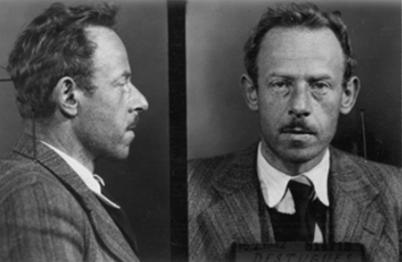
George Politzer was born on May 3, 1903, in Oradea, a city now within Romania, to a Hungarian Jewish family. He was exiled at the age of 17 for his involvement in activist actions, settling first in Vienna and then in Paris. He joined the French Communist Party (PCF). He took on the "Dialectical Materialism" courses at the Paris Workers' University, which was founded by this party.
During the Nazi occupation of France (1940), he served in Paris on behalf of the PCF. In February 1942, Politzer was arrested along with his wife Mai, who was also a resistance fighter and communist. On March 20, 1942, the Nazis subjected Politzer to severe torture. Politzer was executed by firing squad on May 23, 1942. His wife Mai was sent to the Auschwitz concentration camp, where she died in March 1943.
His book Principles of Philosophy, prepared based on notes taken by his students, was published posthumously in 1945 and gained widespread support, especially among socialist youth and intellectuals.
KANT'S TORMENT

Years passed. It was sometime towards the end of 1991. The Soviet Union had collapsed, and a large portion of the world's socialist intellectuals were experiencing deep disappointment. On such a day, I read a critical article about the famous German philosopher Immanuel Kant's book "Critique of Pure Reason" in the weekly Literature/Philosophy supplement of Le Monde newspaper. I was impressed. I bought the book, whose French title is "Critique de la Raison Pure." I started reading it!
Oh my God! An impossible book to understand! I read the same sentence repeatedly but couldn't make any sense of it. Yet, George Politzer's Principles of Philosophy was written in clear, lucid language. Marx's and Lenin's works were also understandable with a little effort. But understanding Kant was impossible! I'm not kidding, it was impossible!
I became stubborn! I carried the book with me for a month. Even though I didn't understand it, I read it from beginning to end several times. I noted down unfamiliar words. I was finishing the book, but if someone had asked me at that moment, "What was it about?" I wouldn't have been able to utter a single sentence. As I read Kant repeatedly, I would better understand how simple, understandable, and reader-friendly all other books were written.
I discovered Kant's secret to myself, in a miraculous way. All other philosophers had followed a similar path: their aim was to explain and clarify the chaotic questions that humanity constantly questioned, such as State, Religion, Death, Life, Universe, Ethics, Consciousness, etc., within a framework of order. In other words, they followed a path from Chaos to Order.
However, Kant proceeded in the opposite direction. He preferred a three-stage approach: from values we know and accept as undeniably true, to Chaos, and then from Chaos back to Order. In doing so, he proved that when our seemingly simple and ordinary "Values" are questioned, they actually lead to "Chaos." And he said: "Since understandable things lead us to Chaos when questioned; then there is an order within Chaos itself."
Kant's approach was a revolution in Metaphysical Theory. The questions that frightened and intimidated people became understandable with Kant's approach, creating peace and tranquility in one's inner world.
Kant discovers a paradox inherent in humanity: when human knowledge about the universe is limited, the number of unknowns in a philosophical sense is also limited. As human knowledge develops, the number of unknowns also increases. In short, humanity will never fully understand the universe. According to Kant, humanity can only partially overcome this paradox through "thought experiments."
WHO IS KANT?
Kant, considered the father of critical philosophy, was born in Königsberg, East Prussia (today Kaliningrad, part of the Russian Federation). He never left the city of Königsberg throughout his life. He began his higher education at the Faculty of Theology at Königsberg University. After receiving his habilitation, he taught social sciences at the university. He died in Königsberg on February 12, 1804.
Kant had a peculiar personality. For example, he always went for his morning walks at the same time. So much so that his neighbors would set their clocks by Kant. He always followed the same route on his walks, even walking with the same number of steps. He suffered from headaches, specifically migraines.
Albert Einstein confessed: "If I had not read Kant's Critique of Pure Reason, I would not have been able to conduct thought experiments or develop the Special Theory of Relativity."
I must confess that after understanding Kant, my grave visits acquired a more peaceful and harmonious essence.
ANECDOTE… ANECDOTE… ANECDOTE… ANECDOTE…
HOUSE OF CONDOLENCES
One day, Hamit Hun receives news of the death of the wife of a dear friend, who lives in a village in Iğdır, half of whose population is Kurdish and half Azeri. His friend's wife had been ill for a long time. He takes a religious teacher (Hodja) with him and goes to offer condolences. In accordance with Kurdish traditions, they load a sack of sugar into a taxi and set off.
The taxi enters the village. Hamit Hun does not know where his friend's house is. His eye catches sight of a condolence tent a little further away. He is happy to have found the house effortlessly.
The taxi stops in front of the condolence tent. Hamit Hun and the Hodja get out of the taxi with sad expressions. The driver takes a sack of sugar from the trunk and places it next to the tent. A few young men greet Hamit Hun and the Hodja. Hamit Hun, with a sad expression, says, "My condolences!" and then enters the tent with the Hodja.
The congregation is eating heartily. Hamit Hun and the Hodja find a place among the congregation and sit down. Food is immediately served to them. Both begin to eat with pleasure.
The Hodja repeatedly leans towards Hamit Hun's ear and whispers in an insistent tone:
"It's best if I recite some Quran now!"
"Wait a minute, Hodja! No one will hear you over the sound of spoons!"
At one point, Hamit Hun lifts his head from his meal and looks around. There seem to be no familiar faces. He finds it strange. He asks the person next to him:
"Whose condolence is this?"
"Condolence?!"
"Isn't this a house of condolences?"
"No! Our Meshedi Yakup won the mukhtar (village head) election! He's giving a celebration meal."
Hamit Hun leans towards the Hodja's ear and whispers in Kurdish:
"Em niha rabin! Şikir ji Xwedê re em têr bûne. Bila em kîsê şekir xilas bikin!"
(Let's get up now immediately! Thank God we're full. Let's at least save our sack of sugar!)
ENGLISH ANECDOTE… ENGLISH ANECDOTE…
HOUSE OF CONDOLENCES
One day, Hamit Hun receives the news of the death of the wife of a dear friend, who lives in a village populated with half Kurds and half Azeris. The poor wife has been sick for a while.
He asks a religious teacher (Hodja) to accompany him. In accordance with Kurdish tradition, he buys a sack of sugar, loads it into the trunk of a taxi and sets off.
The taxi enters the village. Hamit Hun does not know where his friend’s house is. A little further away, he sees a big tent, in which, the condolences have been exchanged. He feels relaxed to find the house effortlessly. The taxi stops in front of the condolences tent.
Hamit Hun and Hodja get out of the taxi with a sad countenance. The driver takes out the bag of sugar and puts it next to the tent.
A few young men greet Hamit Hun and Hodja. Hamit Hun offers his condolences and walks in the tent, followed by Hodja. The villagers have been gathered around a big table and were eating happily. Hamit Hun and Hodja find a place and sit among them. Meals are served immediately. They both start eating with pleasure. Hodja, once a while, leans towards Hamit Hun’s ear and whispers with an insistant voice:
“I’d better read some Quran now!”
“Wait a minute! No one will hear you because of the noise of spoons!”
At one point, Hamit Hun lifts his head from the table and looks around. To his surprise, there were no familiar face. He finds it weird. He asks the person next to him:
“Whose condolences is this?”
“Condolences!!”
“Isn’t this a condolences tent?”
“No! Meshedi Yakup has won the election for Mukhtar (village head). He offers a celebration lunch.”
Hamit Hun leans towards the Hodja’s ear and whispers in Kurdish:
“Em niha rabin. Şikir ji Xwedê re em têr bûne. Bila em kîsê şekir xilas bikin!”
(Let’s get up now immediately. Thanks God we’re full. Let’s at least save our sack of sugar!)