The Shepherd from Melekli
A journey to Balık Lake reveals the harsh realities of rural life, including blood feuds and environmental concerns, through encounters with local shepherds.

We set off for Ağrı Airport. There were four of us in the car.
Ahmet Ertuğrul, the grandson of Abdurrahman Bey, brother of Numan Efendi, who held important positions between 1920-30 as Iğdır's first temporary district governor, first director of the National Property and Land Registry Office, and first attorney, was in the driver's seat. Beside him was my esteemed compatriot Asım Keser, who serves as an Advisor at the Ministry of Culture and Tourism; my wife Şeval and I were in the back seat.
As we passed Doğubayazıt and headed towards Ağrı, we made a sudden decision to pay our respects to Balık Lake and continue our journey via Taşlıçay. After all, we had plenty of time for our flight!
We drove through villages. We hadn't reached Balık Lake yet. On a hill, I saw dilapidated and abandoned houses. It was clear that it had once been a village. Ahmet began to speak:
“In this village (Çalıxa), people from the same tribe once lived in peace. One day, an incident broke out, and the village was divided into two. The killings never ended. The village ceased to be a habitable place, and they all migrated to the West together. Since that day, no one has returned.”
Seeing the abandoned houses with collapsed roofs on the hill, I felt a heaviness in my heart. I knew well how the scourge of "blood feuds" gnawed at and destroyed the souls of Kurdish people, and how it exhausted and consumed villages and tribes. We left the ruined village behind and continued our journey towards Balık Lake.
The air was freezing cold. Due to the rains that had continued for several days, the soil and asphalt mixed road had turned into a lake in some places and a swamp in others. Soon, Balık Lake appeared with its blue silhouette among the lush green hills.
Balık Lake, with an altitude of 2241 meters, is one of Turkey's highest lakes. Its deepest point is around 37 meters. It is a source of drinking water for Doğubayazıt district and surrounding villages. It is fed by streams from the mountains, springs on the shore, and groundwater. Its surroundings are covered with reeds. It is 60 km from Doğubayazıt and 26 km from Taşlıçay.
There was a large building on the shore of the lake. They said it served as a hotel and restaurant in the summer months. There was no one around. Later, I would learn that a tall man, who was the owner of the hotel, was alone in front of the building, busy doing something.
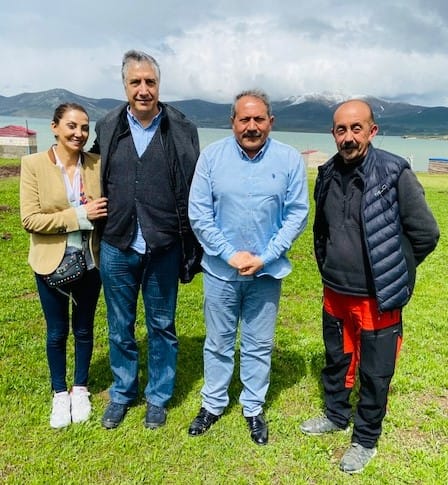
On the Shore of Balık Lake
We got out of the car and greeted each other. Soon, a second villager joined us. They listed their complaints and concerns. Doğubayazıt's drinking water was supplied from Balık Lake. As the district's population increased, a second pipe was installed, and the lake's water level was dropping every year. The villager stated his opinion decisively:
“In 3-4 years, Balık Lake will dry up and disappear!”
According to what they said, trout in the lake had also come to an end. They had haphazardly thrown different species of fish into the lake for them to breed and multiply, and these fish had consumed the trout as food and wiped them out.
We set off again. This time, we started to move on a road mixed with soil and grass. The road sometimes turned into a swamp and sometimes stretched out as lush green grass. As we climbed the hills, the snowy mountains and the blue of the lake stretched out before us as an unforgettable view.
Leaving the lake behind and traveling through mountains and hills, this time we encountered a huge flock of sheep scattered on both sides of the road in a vast plain. The animals were spread out across the plain at intervals, both grazing and moving in the same direction. We got out of the car to take pictures of this pastoral scene.
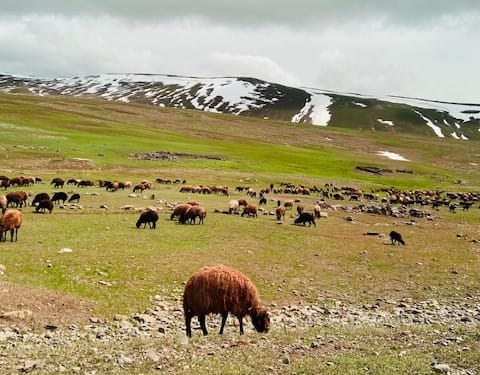
The freezing cold cut at one's face like a knife. Three shepherds approached us. We greeted each other. There was no need for words to understand the difficulty of shepherding in such cold. Out of curiosity, I asked where they were from. Two were Kurdish, and one was Azeri. The shepherding ability of Kurds and their resilience to the harshness of the mountains was a known fact.
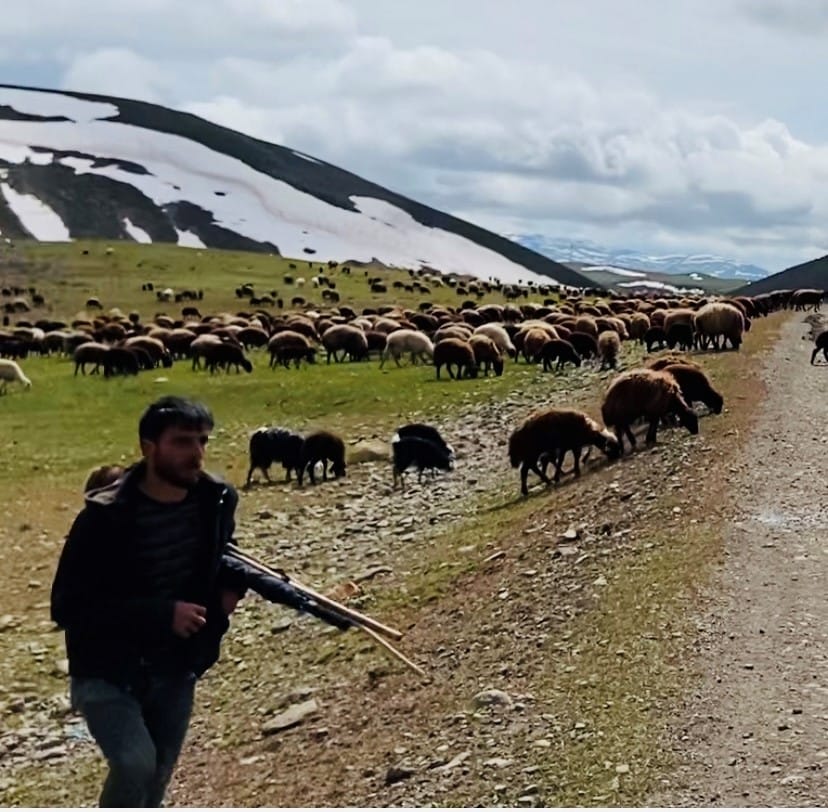
I asked the Azeri shepherd where he was from.
“I am from the village (township) of Melekli in Iğdır.”
(Melekli is a township connected to Iğdır. It has a population of around 3500.)
Seeing a compatriot here, shepherding in the freezing cold, moved me. His face and cheeks were red, even purple, due to the icy cold.
“Which family are you from?”
“I am from the Artantaş family.”
“Is Yücel Artantaş your relative?”
“We are cousins. Our families fell out because of a blood feud. After that day, we never saw each other again. I earn my living by shepherding in distant places.”
He spoke hopelessly, pointing to the flock of sheep:
“Animal husbandry is dead now! It's over!”
It saddened me to see that the scourge of "blood feuds" had also alienated my Azeri compatriots from life and scattered them far from their own land.
As we continued our journey, I became lost in the greenery and hills, trying to understand this sociological phenomenon: how the souls of Kurds and Azeris united in brotherhood in pain, sorrow, and poverty; but in wealth and prosperity, their souls, on the contrary, detached and drifted apart, becoming strangers to each other.