Globalization / The End of the Information Age and Iğdır
The author reflects on Iğdır's missed opportunities for development and argues for local and regional integration to seize its current third chance.

Dear Readers:
In this short article, I want to draw the attention of my dear fellow citizens of Iğdır to an important point. In my previous writings, I had stated that our Iğdır unfortunately missed significant opportunities in the past, got bogged down in the turning points it encountered, and failed to make a huge, HISTORIC breakthrough. I would like to briefly recall these historical turning points:
- In the 1930s, the wealthiest merchants of Eastern Anatolia flocked to Iğdır to trade with the Soviet Union via the Margara Bridge (Alican Bridge). Reşit Keki, İsmail Şefkatli, Halef Boran, Zeki Keki, Cevdet Ergin (father of artist Erol Evgin) are just a few names that come to mind. Of course, Iğdır also had its local wealthy families: Hüseyin Yaycı, Nağı Odoğlu, the Parlar brothers (Hacı Nağdali and Gulem Parlar), Meşe Haydar Yüksel, Resul Taner, Bağır Aras, the Çöllü, Şöllü, and Tezel families, and among the Kurds, the Güneş Family (Abdurrezak Bey), Ahmed Şemo, and others were important families and personalities who held capital accumulation in the 1930s. Because the local merchants of Iğdır and the foreign merchants coming from outside could not unite and create synergy, Iğdır contented itself with a "passive" mission, serving only as a bonded warehouse, storage facility, and temporary accommodation for animals. The money earned left Iğdır. In those years, if Iğdır had been able to convert the money earned into investments, it would be one of Turkey's most popular cities today. Visionary businessmen like Nağı Odoğlu established canning factories in the 1930s; their products won first prize at the İzmir Fair, and canned goods were exported to Europe. They planted the largest vineyards and orchards in Eastern Anatolia with their own hands, but they could never quite break the spell. Otherwise, our Iğdır could have transformed into a center with massive canning factories, meeting Turkey's pickle, jam, and tomato paste needs as early as 1930.
- Our Iğdır seized its second important opportunity in the 1950s. Two important industrial products, cotton and sugar beet, offered Iğdır a chance to leap forward. Consider that cotton and sugar beet were grown only in Iğdır in Eastern Anatolia. Sugar factories were established in Erzurum, Kars, and Ağrı to process the sugar beet grown in Iğdır, but the establishment of such a factory in Iğdır never came onto the agenda, or the voices advocating for it remained weak. Similarly, cotton was grown only in Iğdır in Eastern Anatolia. The establishment of textile factories to process this cotton locally never came onto the agenda. Iğdır cotton was sent to provinces like Kayseri, Adana, and İzmir, and sold off cheaply. The task assigned to Iğdır was limited to the establishment of ginning factories that separated the cotton fiber from its seeds; in other words, it was merely the heavy lifting.
At this stage, I would like to ask you an important question: Why did Iğdır fail to establish textile and sugar factories? The answer to the question is very clear and equally painful: BECAUSE OF CONFLICT BETWEEN FACTIONS.
In the 1950s, Iğdır lost its political balance, pushed aside its city's vision, and instead of making factional politicians kneel, it unfortunately knelt before them in a fragmented structure. If textile and sugar factories had been established in Iğdır in those years, our Iğdır would have become an important center in Turkey for textile and sugar derivatives, i.e., the clothing industry, chocolate, and confectionery. Furthermore, it could have transitioned to modern animal husbandry by establishing livestock farms with sugar beet pulp and cotton seeds. This was the second major opportunity our Iğdır missed. If Iğdır had succeeded in these endeavors in those years, it could undoubtedly have become a brand in dairy products as well.
- Our Iğdır became a province on June 3, 1992. As a result, many investments were compulsorily made by the state. These investments were made not only in Iğdır but in all centers that became "provinces." They did not arise as a result of Iğdır's internal dynamics. When Iğdır became a "province," it received considerable migration from surrounding provinces and districts. As a result, the construction sector made a move, but we must know that the construction sector provides employment as long as it is active, but it does not contribute to the development of a city. The construction sector in Iğdır has now reached saturation point, and house prices are competing with Ankara. The establishment of a university in Iğdır also emerged as a compulsory consequence of its becoming a province. Iğdır is still far from being a province that develops with its own internal dynamics. It does not own a brand in any field. Since 1992, there has been only one issue on Iğdır's agenda: Will the Kurds or the Azeris take the parliamentary seats and the municipality? Unfortunately, our politicians lack vision. They act with concerns about votes and factionalism. They may consider this an injustice done to them, but the facts are in this direction. The best thing our politicians do is to use their connections to employ those they see as close to them. In doing so, unfortunately, factionalism and vote calculations play an important role.
Our esteemed businessmen have started to invest capital in Iğdır in recent years. I hope that the logistics company established by Mr. İshak Yaycılı will soon become one of Turkey's most important logistics centers. Similarly, I believe that Mr. Selçuk Turan, who established modern barns in Bayraktutan village and is trying to create a sector unique to Iğdır by bringing purebred cows from as far as Argentina, will bring new vitality to our Iğdır in the animal husbandry sector. Also, the efforts of Mr. Ziya Yiğit, owner of HAS Dairy, who focuses on dairy products, should not be overlooked. I consider the unique character of the innovations Mr. Tacettin Şimşek has brought to the construction sector a chance for Iğdır. We appreciate the multifaceted efforts of Mr. Cantürk Alagöz, owner of Alagöz Holding. I especially wish for the continuation of his determined stance in creating a common spirit above factions and sects in Iğdır by establishing Iğdır FK.
With the establishment of our university, Iğdır is in the process of making a leap forward in the education sector. The opening of KEY College and Bahçeşehir College branches in Iğdır, in addition to our university with a capacity of 12,000 students, and the diversification of education, should be seen as both a new opening and a new challenge for Iğdır.
Our Iğdır is going through the THIRD opportunity presented to it by history. Will these independent explosions in industry, trade, energy, construction, animal husbandry, logistics, education, sports, and other fields unite and turn into a volcano, or will each of them burn out and turn to ash in its own fire? To answer this question, we need to review the concepts of GLOBALIZATION AND THE INFORMATION AGE that I used in the title.
Dear Readers:
GLOBALIZATION, which emerged with the collapse of the Soviet Union in 1990, has now run its course and lost its importance. In today's world, where the Internet has entered every home, both globalization and the information age have ended. Those who benefited from the phenomenon of globalization have happily drawn a line over this definition and are pursuing a new quest. The name of this new phenomenon and quest, which has not yet knocked on Turkey's door, is LOCAL AND REGIONAL integration. Our Iğdır must seize these two phenomena without delay and make a difference. Just as a conductor is needed for the performance of a good orchestral piece – otherwise, there will be cacophony, i.e., polyphony – our Iğdır must achieve LOCAL AND REGIONAL integration as soon as possible, by uniting all its forces, under the leadership of a strong social will.
WHAT IS LOCAL AND REGIONAL INTEGRATION?
Let's consider Iğdır FK (Football Club), which Mr. Cantürk Alagöz has taken over and reshaped. If the people of Iğdır, regardless of being Kurd-Azeri, Sunni-Ja'fari, are curious about Iğdır FK's matches and feel happy every time it wins, only then can Iğdır FK advance to the 2nd League. No matter how well-intentioned the president is, no matter the quality of the players, if there is no local integration, if hearts like that of the late Fatih Aksoy from Çarpala village are not beating with excitement, Iğdır FK will "give up" at some point. This is just a simple and understandable example.
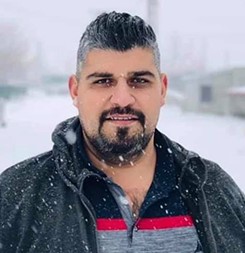
We commemorate the late Fatih Aksoy, a lover of Iğdır FK, with mercy.
You can apply the same mindset to logistics, animal husbandry, construction, education, and other sectors. If we want Mr. Selçuk Turan to succeed in the animal husbandry sector and add value to Iğdır, we must appreciate his efforts and offer our social support.
This deficiency is most felt in the field of EDUCATION. My fellow citizens of Iğdır are still not integrated with the university, which has 12,000 students. The understanding that views the university merely as an institution that grants diplomas unfortunately persists. I want you to know that we are missing a great opportunity with an understanding that sees the university's problems as "the state's problem." An Iğdır integrated with its university will be able to seize its third opportunity.
Our university must become a brand in certain areas. For example, software, information technologies, logistics applications, agriculture, and tourism are a few names that come to mind. As our university integrates with local values, it will determine its own roadmap and structure itself to gain expertise in specific areas.
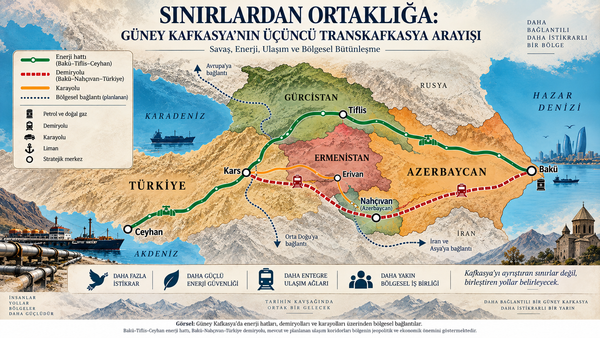
By the word "local," I mean Iğdır and its surrounding provinces and districts; by the word "regional," I mean our border neighbors Armenia, Nakhchivan (Azerbaijan), and Iran.
Iğdır is a province of geopolitical importance. Therefore, in addition to English, the university should have philology departments where Kurmanji, Azerbaijani, Armenian, Persian, and Russian are taught intensively. Cooperation with regional universities should be developed.
Our Iğdır must take the big step of ensuring local and regional integration with an approach that transcends factions and sects, without falling into the mistakes it made in the 1930s and 50s. It should base its vision and plan not on elections held every five years, but by prioritizing the growth of the values it already possesses. Let's not forget that every company and every investment established in Iğdır is ours; every faculty and every educational institution is ours; every football team and every sports event is ours. As we embrace them, they will grow, and thus our Iğdır will usher in a brand new era.
It is time to push aside the feeling of "alienation" that continues openly or secretly between factions and sects, and to integrate with the private and public legal entities that invest with great effort, seeing their problems as our own and taking action; otherwise, our Iğdır will miss its THIRD TRAIN as well.
Sincerely,