Kemalist Left, Kemalist Right
This essay explores the emergence of "Kemalist Left" and "Kemalist Right" factions in Turkish politics, arguing that these new alignments transcend traditional party lines and pose a potential threat of fascism.

KEMALIST LEFT, KEMALIST RIGHT
Dear readers!
The plan to write this article had been in the back of my mind for some time, but events of the past week accelerated the process. For the past year, and especially since the July 15, 2016 coup attempt, I have observed an increasing number of parties and individuals on both the right and left wings taking refuge behind the name of Mustafa Kemal Atatürk, using his name to create a facade for their own "left or right" ideologies. I questioned myself for a while as to why this need has arisen now. A significant group of writers, like Yılmaz Özdil, have long since turned this into a lucrative business, filling their pockets by writing books about Mustafa Kemal. This segment is growing, and a new political balance is leaving its mark on Turkey.
Forget all legal and illegal parties for now! Disregard all illegal parties you can think of, as well as legal parties like Ak Parti, CHP, MHP, İYİ PARTİ, HDP, TKP. Two distinct currents are increasingly emerging: Kemalist Leftists and Kemalist Rightists. I need to make a clarification: Kemalist Leftists are stagnant and quiet. In previous years, they would have had a political approach that would first draw Kemalism towards a Social Democratic line, then to Socialism, and finally to Communism. Let's not forget that the 1971 coup was essentially planned as a "Leftist" coup, backed by figures like Doğan Avcıoğlu and İlhan Selçuk, but it was prevented at the last minute. But now, let alone Communism or Socialism, even Social Democratic thought is barely surviving. In short, Kemalist leftists currently give the impression of being innocent, unassuming, and harmless.
As for Kemalist Rightists, the situation is very different! They are like rubber. If you pull them a little, a conservative structure emerges. If you pull a little more, it becomes nationalist; pull a little further, and it becomes ultra-nationalist; and finally, a "Fascist" structure, with all its institutions, rears its head and takes over the state.
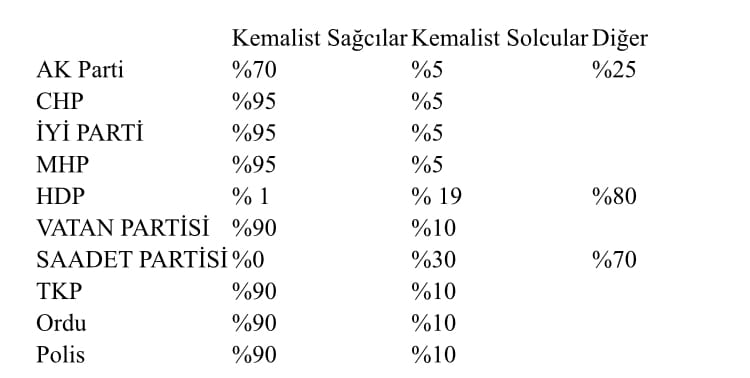
Please do not ask me where I got these figures. This is my personal prediction. In fact, every sensible reader can more or less see that this is the case. The only difference is that I am the first to put this observation and classification into writing and share it with the public.
I can anticipate the reactions of many of my readers. I respect your anger, even your curses, but politics in our country is now irreversibly clustering around two views: Kemalist rightists and Kemalist leftists.
Of course, none of these views put forward in the name of Mustafa Kemal have anything to do with Mustafa Kemal's original worldview. The only point on which we can criticize Mustafa Kemal is his implementation of repression and control within the country through the Independence Tribunals to establish the nation-state structure. He did this not only to the Kurmanj and Zaza but also to his closest friends, such as Kazım Karabekir Pasha. We even know that he died estranged from İsmet İnönü. The surprising thing is that İnönü, who accused Mustafa Kemal of harshness and being a dictator, adopted an even harsher stance against his rivals when he was President between 1945 and 1950. All these groups oppressed by İnönü gathered in the Democrat Party (DP), and when the DP came to power in 1950, they wanted to hang İnönü, using the lie of the "Boraltan Bridge" as an excuse, but they abandoned this attempt because the balances within the army were in İnönü's favor. However, in later years, especially after the 1957 elections, they almost made it impossible for İnönü to leave his home.
I want to tell two anecdotes about the persecution İnönü experienced between 1957 and 1960. The late Kars Deputy Osman Yeltekin told me these. I published the first anecdote in Iğdır Sevdası, but I kept the second in the archive due to lack of space:
The late Osman Yeltekin recounts: "The DP government launched a nationwide campaign to block and ban İsmet Pasha from traveling. The government mobilized its affiliated civil and administrative officials to harass the Pasha everywhere and prevent him from making political propaganda. I endured these attacks alongside the Pasha on many of these trips.
We received news that the Pasha's convoy was not allowed to pass through the district of İncesu to return to Ankara, and therefore he was stranded in the provincial center of Kayseri. A group of party deputies set off for Kayseri to help the Pasha. However, the scene awaiting us was not very pleasant. The Mayor, Governor, and gendarmerie regiment commander joined forces to disrespect the Pasha and us to the point of insult, threatening hotels and restaurants not to accept us. Finally, the Pasha settled in the provincial chairman's house. We, too, tried to provide security by standing guard around the house. In the morning, party members from the province and districts hosted a breakfast in honor of the Pasha and the 40 deputies present. As we were enjoying our breakfast, the provincial chairman entered.
He had a woman and a little girl with him. The provincial chairman said, "Pasha, the wife and daughter of the gendarmerie regiment commander who blocked your way yesterday have come to kiss your hand." The woman respectfully approached the Pasha and kissed his hand.
"Pasha, rest assured, I am very upset by my husband's behavior towards you. I didn't let him into bed last night," she said. The Pasha smiled at the woman and, as if to comfort her, said:
"Your husband is merely following orders. He carried out the command given to him. Now, my request to you is to go home and apologize to your husband."
The late Osman Yeltekin told another anecdote: Again, he was on a country tour with İnönü. Their entry into a district of Uşak province was blocked by the instigation of DP members. The Pasha waited a bit, thinking that the soldiers and police would intervene. But no one came or went. There was no food or water left in the convoy. Osman Yeltekin went down to the gardens and returned half an hour later with grapes stuffed inside his shirt. He placed them on the hood of the Pasha's car. Of course, there was no water. The Pasha took a grape, tasted it:
"Very sweet! Please, whoever wants some, take it!"
Osman Yeltekin sighed as he ate the grapes:
"Pasha, I wish the people here were sweet and the grapes were bitter."
İnönü was witty:
"If that were the case, we wouldn't be able to eat these grapes now."
They laughed.
Do you know why I told these two anecdotes? If conservatism (DP) is pulled a little, nationalism comes; if it's pulled a little more, ultra-nationalism comes; and if it's pulled even further, fascism comes.
Mustafa Kemal did not have a "fascist" mentality. He showed some interest in the idea of Turan but did not take it seriously. In 1931, he expelled a significant figure like Mehmet Emin Resulzade, the first President of the Azerbaijani State founded in 1918, from Turkey. He valued and prioritized universal and contemporary values. He was in favor of democracy and the competition of different parties. He took a step towards a multi-party system in 1930. When he sensed the possibility of the caliphate and monarchist supporters winning the elections, he canceled them. He was right. He had miscalculated that the loyalty to the institutions of the caliphate and monarchy, due to a 500-year imperial legacy, would not end in a few years, but when he realized his mistake, he had to backtrack. His decision was correct.
Now, let's turn to Turkey's political future: When we look at the picture, we clearly see that there is a hidden force connecting members of different parties, regardless of their party affiliation: Independent of the party's name, voters are drawing closer to each other with either a Kemalist Rightist or Kemalist Leftist ideology.
Currently, Kemalist rightist thought predominates. Some forces might want to turn this into an opportunity, hoping that they will have Kemalist rightist supporters, or civilian support, in every party. I feel like I can hear the footsteps of this. What frightens me is that such a movement, starting with an innocent right-wing view, could rapidly slide into Fascism.