Fratricide / Patricide
This essay explores the historical and sociological dimensions of fratricide and patricide, from ancient myths and Ottoman history to a fictionalized account of a family tragedy in Iğdır, concluding with anecdotes about a powerful intelligence official.

(NOTE: I would like to remind you that the words "Fratricide" is used for "killing a brother" and "Patricide" for "killing a father" in Latin, and these terms are used in sociological research.)
"FRATRICIDE / PATRICIDE / FILICIDE" FROM HISTORY TO THE PRESENT
In the media and political world, the term Fratricide is already used in a political sense. For example: the Korean War (South-North), the past Vietnam War (North-South), etc., can be given as examples. We should even consider the East-West German rivalry during the Cold War within this definition.
Sometimes, "fratricide" type events can occur not at the state level but within a specific region. For example, the fratricidal war between Barzani and Talabani in Iraqi Kurdistan between 1994-1997 can be cited. In this civil war, thousands of people died, and on one occasion, Barzani supporters executed 450 Talabani supporters in one fell swoop. The events in Kirkuk proved to us once again that the effects of this civil war and the distrust between the two brotherly groups secretly continue even today.
Sometimes, events can also occur within large tribes descended from the same father. There are many examples of this. Unfortunately, this tradition still continues.
We can generally categorize the definition of "Fratricide" under the following headings:
- A brother killing or having a brother killed
- A brother killing or having a father killed
- A father killing or having a son killed
Among these, perhaps the most interesting to you is a father killing or having his own child killed. I would like to present an example from the time of the Ottoman Empire:

Taking advantage of Sultan Süleyman's campaigns in Europe, the Safavids attacked the Eastern Anatolia region. Sultan Süleyman set out on a campaign against Safavid Shah Tahmasp I at an opportune time in the summer of 1553. Before setting out, Sultan Süleyman ordered his son, Şehzade Mustafa, who was in Amasya, to prepare an army and meet him in Ereğli. Sultan Süleyman had information that Şehzade Mustafa was plotting a rebellion against him and was seriously disturbed by this betrayal, planning to neutralize Şehzade Mustafa under the pretext of this campaign.
Şehzade Mustafa arrived at his father's camp on October 6, 1553, and prepared to enter the tent to kiss his hand. He dismounted his horse and handed the stirrup to his assistant. He surrendered his sword and cutting tools to the guards. He appeared before his father. Sultan Süleyman held an arrow in his hand. He pointed the sharp tip of the arrow at the Şehzade. The Şehzade respectfully greeted his father but received an unexpected reply: "Ah, you dog! You dare to greet me without shame?"

At a nod from the Sultan, three mute executioners pounced on Şehzade Mustafa, trying to strangle him with a rope. The Şehzade was strong. He was almost about to escape their grasp, but in the end, he succumbed to the executioners, strangled to death before his father's eyes.
In the Ottoman Empire, until the 17th century, there was no rule of succession, meaning how sovereignty would pass from father to son. When the Sultan died, the şehzades (princes) would rebel to seize power, even with the support of enemy states if necessary, and the country faced the danger of division due to these fratricidal wars among the şehzades. Tired of these events repeating every time, the Ottoman Empire, during the time of Fatih Sultan Mehmet, issued a Kanunname (law code) that allowed the şehzade who seized power to kill his brothers in order to protect the state (devlet-i aliyye).

CAIN KILLING ABEL
Cain and Abel are the first two sons of Adam and Eve. Cain envies his brother Abel for many reasons, but especially for the large number of animals Abel possesses. One day, Cain succumbs to jealousy and kills his brother. As you can see, humanity encountered the definition of "Fratricide" at a very early stage.
Dear readers!
As you can see, fratricide has continued from the past to the present. However, I would like to draw your attention to one particular point. It is necessary to distinguish "political fratricide," which I exemplified above, from fratricide occurring within a family living a quiet life.
Would you allow me to give you a test?
- Have you physically killed a sibling?
- Have you physically attacked a sibling with the intention of killing them?
- Did you remain silent even though you knew your sibling would be killed by others?
- Did you kill your sibling IN YOUR MIND? That is, did you kill your sibling in your imagination?
- Did you harbor such HATRED and VENGEANCE towards your sibling that it amounted to wanting to kill them?
- Did you envy your sibling to the point of wishing them dead? Did you wish for them to be harmed and fall into distress?
- Did you plan to kill your sibling?
If you answer YES to one or more of the items listed above, you are also a FRATRICIDE. Let's see if you can find the courage to admit this reality to yourself.
I must also add that deaths occurring among members of tribes descended from the same father also fall under the definition of FRATRICIDE.
My sociological research indicates that the society where Fratricide (Jealousy) is most intensely experienced within families worldwide is among KURDS (Kurmanji / Sorani / Zaza, etc.).
There are many reasons for fratricide. The most striking is inheritance disputes. I must remind my reader of this fact: just as the disease of DEPRESSION has a hidden contagious effect on other family members in addition to its familial and cultural causes, we must not forget that the phenomenon of FRATRICIDE is nourished by the cultural values of the society in which it occurs and is contagious.
Now it's time to tell you a true story... I want to take you back in a time tunnel, not too far, but to the year 1944 (or 1945), when World War II was in full swing.
SILO'S STORY
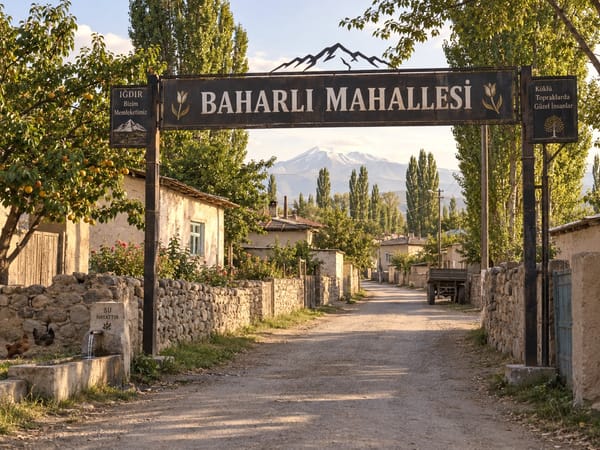
The year must have been 1944. One day, a brutality occurred in a mountain village of Tuzluca, inhabited by Kurdish tribes. A quarrel began between two married brothers over a piece of land inherited after their father's death. Since the boundaries of the land were crooked, a dispute arose between the two brothers every time they tried to divide it. For a piece of land not exceeding ten square meters, half of which was stony, the two brothers would curse each other whenever they met on the land, and one would destroy the boundary drawn by the other with stones. Over time, a deep enmity developed between the two brothers. One day, they got into a fistfight. One of the brothers threw a huge stone at the other, whose skull collapsed, and he collapsed to the ground, struggling for a few minutes. He died.
Since the land was on the mountainside far from the village, the killer thought no one had seen what happened. He dragged his dead brother's body towards the valley and placed it in the middle of a huge rock split in two on the side of a valley. He covered it with large and small stones. He walked away from the scene as if nothing had happened, swinging his arms.
The killer had been married for a few years. He had a three-year-old son named Sılo. As usual, he calmly went to the barn, fed the animals as if nothing had happened, and went to bed earlier than usual. But he had forgotten something: a young girl collecting rose hips (şilan) on a distant tree had seen everything when he killed his brother.
The killer woke up in the morning as usual. He quietly fed and watered the sheep. He began to repair the garden wall. It was towards evening. A gendarmerie patrol appeared on the mountainside. He thought it had nothing to do with him and continued to build the wall. The gendarmes, accompanied by the little girl, took the killer to the scene. When the girl told everything she saw, the fratricide had to confess what had happened. The gendarmes took the killer away. After a few hearings, he received a life sentence.
His wife, widowed at a young age, did not wait long after hearing the news of his life sentence. A few months later, she ran away with someone and disappeared. Three-year-old Sılo was left alone. His uncle took him under his care.
Time passed. Sılo grew into a young man of 14-15. He was a talented shepherd. The richest man in the village entrusted his sheep to Sılo. Sılo, with his four dogs, would herd 300 sheep on the mountainsides every day, bringing them back to the village towards evening.
One day, Sılo leaned his back against a rock and gazed at the encampment and the distant mountains. He thought of his mother and father. He wanted to remember both of them, but like a broken film strip, some scenes appeared in his mind and then quickly disappeared. His dogs lay on the ground beside him, eyes closed, breathing in short gasps. Sılo also fell asleep without realizing it.
When he opened his eyes, he saw that it was dark and panicked. He quickly gathered the flock, herding them towards the village as if running. The owner was not pleased with Sılo's delay and negligence. He slapped him hard across the face. Although Sılo had grown up an orphan, he was a proud boy. After the sheep were milked, he found an opportunity, took his oak stick, and left the village. He had no intention of returning to this ominous village. One of the loyal dogs followed Sılo for a long time, but Sılo repeatedly turned back and threw stones at the dog, telling it to go back.
Sılo walked all night. He had long since overcome the feeling of fear. Towards morning, he reached a large village. The girls at the spring laughed as they looked at Sılo. Sılo asked the girls for water, saying he was hungry from walking all night. One girl ran and brought bread and cheese. Sılo thanked the girls and lay down in a green area a little further away. He fell into a deep sleep. Towards evening, he heard two men arguing loudly. Sılo leaned his back against a rock, not wanting to be seen. What he heard was astonishing:
"I love Berivan, I will abduct her!"
"I love Berivan too. Even if you are my brother, I will not let you abduct Berivan."
This verbal altercation soon turned into a fistfight. Then sticks began to speak. The larger of the brothers pinned the other brother to the ground, pressing his fingers on his throat, and the younger brother soon suffocated to death. Sılo was disturbed by witnessing the event firsthand. The older brother carried his dead brother on his back and climbed towards the top of the mountain. Darkness had fallen. Sılo found an opportunity and left. He had no intention of telling anyone what he had seen. Knowing that his father was also a fratricide, he quickly tried to forget the matter.
Sılo first arrived in Tuzluca. He looked for work. He didn't speak Turkish. A Kurd advised him to go to Iğdır to find a job. Sılo set off for Iğdır. Iğdır was a larger, more bustling district. He approached one of the flour mills. He watched the workers loading sacks of flour onto a truck. A well-dressed gentleman in a tie approached him and asked, "Do you want to work?" Seeing that Sılo couldn't answer, he asked in Kurmanji this time: "Tu dixwazî bixebitî?" Sılo nodded, meaning 'Yes'.
Sılo was never idle at the factory; he would finish one job and move on to others, constantly shifting between tasks. Gradually, he developed an interest in machines. Sometimes, he would learn to repair broken belts using his own ingenuity. The factory owner assigned Sılo as an apprentice to the head foreman. Sılo worked in the factory's machine department until he went into the military. Fortunately, World War II had ended, and the four-year military service was reduced to two years. He served as a driver and became skilled in car repair. After his discharge, he returned to Iğdır. He opened a small workshop for car and tractor repair. As the number of tractors in Iğdır increased each year, his business grew. He also paid attention to matters of the heart and, when the opportunity arose, married a Kurdish girl. One day, he received a telegram from Sinop prison. His father had died and was buried in Sinop. Sılo would never have the chance to see his runaway mother again.
One day, he learned that his wife was pregnant. He prayed to God for a daughter. His wife gave birth. Twin sons were born. Sılo, who had grown up with the fear and hatred of fratricide, did not interpret this situation as a good omen.
Time passed, and the two boys grew into young men. Although they were twins, there was a difference in their characters. One was obedient and quiet, always listening to his father, while the other was disobedient and rebellious. Sılo sometimes had to use violence to discipline this son. He even once tied him to a poplar tree and left him hungry for a few days. Instead of being disciplined, the child became even more aggressive, even defiant and disobedient towards his father. While his father and brother worked in the workshop, he spent his time carousing.
One evening, as the family sat down for dinner, his father praised his hardworking, obedient son, saying he would become a very successful master in the future. The other brother angrily left the table, roamed the streets of Iğdır, smoking a cigarette while planning revenge on both his brother and his father.
One day, Sılo went to Erzurum to buy materials. The jealous brother saw this as an opportunity. He went to the workshop. His brother was repairing a corner of a car. He lay on a small wheeled creeper, his head under the car. A hydraulic jack had one side of the car lifted. The jealous brother approached the car and released the jack. The side of the car collapsed onto his brother's head.
The killer brother quickly left the scene as if nothing had happened. While he was drinking tea at the coffeehouse, a neighbor's child brought him the news of his brother's death. Without waiting for his father, who had gone to Erzurum, he hastily buried his brother. The grieving father received the news of his son's death upon arriving in Iğdır. From his other son's demeanor, he knew it was a planned murder, but he had no proof.
Sılo's mother-in-law had passed away in Adana. These were the days he was sending his wife to Adana by bus. He was left alone at home with his fratricidal son. Sılo, bent over with grief from his deceased son, was unable to work. While he was sleeping, his fratricidal son intended to strangle his father. He approached his deeply sleeping father. He pressed his strong fingers on his father's throat. Sılo struggled not to die, but he knew that with each passing second, he was bidding farewell to this life. After a few struggles, he succumbed to the cruel force of his son, who harbored hatred and resentment, and was strangled to death. At midnight, his son carried his father on his shoulders, quietly entered a neighbor's garden, and hung his father from an apricot tree branch as if he had committed suicide.
In the morning, he woke up to the shouts and cries of the neighbors. As if he knew nothing, he went to his hanging father, embraced him, shedding fake tears. One of the neighbors commented: "The poor man had fallen into depression after his son was crushed under the car. He couldn't bear the pain and committed suicide."
***
HÜSNÜ BİNGÖL ANECDOTES

(Who is Hüsnü Bingöl? The powers of National Security Inspector Hüsnü Bingöl were not limited to merely receiving information, like those of a current MIT director. All state resources and means were at his command. He interpreted and evaluated the information he obtained as he wished. He would apprehend those he deemed guilty through civilian and military personnel, have them detained, personally conduct the necessary investigations and interrogations in the prison in his garden, and refer those whose guilt was established to the military court in Erzurum. In short, Hüsnü Bingöl was a state official who combined the duties of intelligence inspector, political prosecutor, and interrogation judge, and whose power and influence were felt in Eastern Anatolia and even throughout Turkey. He had no official connection with the district's administrative and judicial authorities.)
JOLI, WHERE ARE YOU?
National Security Inspector Hüsnü Bingöl had a poodle named "Joli." (The pronunciation of the French word "Jolly," meaning "pleasant, sweet," is "Joli.")
As was his habit, Hüsnü Bingöl, in his boots and elegant attire, would stride down the main street of the city, where shopkeepers were busy, every afternoon. With his sparkling eyes, he would discreetly survey the shopkeepers who greeted him with fearful respect in front of their shops, and then slowly make his way towards the Municipality garden. On such days, Joli, being a mischievous dog, would run after his master, sometimes entering shops he liked and sniffing everything inside. When he heard his master's call of "Joli," he would forget everything and quickly run towards Hüsnü Bingöl.
It was one such day. Hüsnü Bingöl was walking majestically in the middle of the street. The shopkeepers were outside, as if ready for inspection, waiting for him. On this particular day, Joli was mischievous again. Since the shop owner was outside, showing off for Hüsnü Bingöl, Joli slipped into the shop without his owner noticing. He spent his time sniffing everything he came across.
Hüsnü Bingöl looked behind him but couldn't see Joli. Knowing he was being mischievous again, he shouted at the top of his voice, "Joli! Come here quickly!" The shopkeepers around were so frightened by this sound that they didn't even hear the word "Joli." They all ran towards Hüsnü Bingöl and, in a sycophantic chorus, exclaimed, "Yes, sir!" At that moment, Joli also arrived and was circling his master's feet. Hüsnü Bingöl said, "Go back to your work! I was just calling my dog!"
PASSION FOR THE PIPE
Hüsnü Bingöl suffered a heart attack in the autumn of 1954. The district doctor, Necdet Koçak, gave him an injection and forbade him from smoking a pipe or cigarettes. After the doctor left, his two daughters surrounded their father, pleading with tears in their voices: "Father, promise! You won't smoke a pipe again!" Hüsnü Bingöl, recovering from his heart attack, nodded in agreement, meaning "Yes!" "Just let me carry the empty pipe in my mouth!" His children found this request reasonable.
A few months passed. One day, his eldest daughter entered her father's study, and what did she see! Hüsnü Bingöl had returned to his old habit, and smoke was billowing from the pipe in his hand like a stovepipe. The daughter approached her father: "Father, you promised! You would never use tobacco again!" Hüsnü Bingöl looked at the pipe in his hand in astonishment and confessed: "My dear daughter, I don't remember how this tobacco got into the cigar!"
Hüsnü Bingöl succumbed to a second heart attack a few months later and passed away.
DAVOLNA
Iğdır bordered Soviet Russia. Soviet agents of Armenian, Azerbaijani, Russian, etc., origin frequently infiltrated Turkey, established contacts, and then returned. Occasionally, Russian-origin agents were caught, so Hüsnü Bingöl had taken an interest in learning Russian to interrogate them himself.
One day, a Russian agent was caught. Hüsnü Bingöl threw the agent into the dungeon to interrogate him. Meanwhile, a good idea came to his mind. He summoned the Russian agent to his presence and asked the agent to converse with him in Russian, using his broken Russian. Day by day, Hüsnü Bingöl improved his Russian. One day, emboldened by this "friendship," the Russian agent spoke in a harsh and inappropriate tone: "You unjustly threw me into the dungeon. You must release me immediately!"
Hüsnü Bingöl lit his pipe, flipped through the Russian-Turkish dictionary in his hand, and found the Russian equivalent of the word "Enough." He called the soldiers on duty and ordered: "Put this agent on the bastinado. Beat him thoroughly until he shouts 'Davolna, davolna!'"
CONDOLENCE SPIES
While Hüsnü Bingöl was smoking his nargile in the Municipality Garden, a soldier ran up and whispered something in his ear. Hüsnü Bingöl threw the nargile hose and walked quickly towards the car. As the car drove off, the soldier spoke in a tearful voice: "Everything was fine this morning. She suddenly passed away."
When Hüsnü Bingöl arrived home, his daughters and friends surrounded him, their cries shaking the heavens and the earth. The leading figures of the district and religious scholars, hearing of the death of Hüsnü Bingöl's wife, also flocked to the house. A corner of the garden was covered with a curtain, the deceased was washed with prayers in accordance with religious rites, and buried in the Military Cemetery with a semi-official protocol. Today, the place to the left of Hüsnü Bingöl's grave, which has neither a tombstone nor a grave height, is the grave of Hüsnü Bingöl's wife.
While the crying and deep mourning continued at home, Hüsnü Bingöl called Rutto to him: "Rutto, Soviet agents, having learned of our situation, will take advantage of it and enter Turkey these days. Warn all our agents along the border, and have them do night duty. Be careful!" Rutto, saying "As you command, Hüsnü Bey!" spurred his horse and rode away at a gallop. He informed all local agents from Tuzluca to the very tip of the border. Hüsnü Bingöl was right: that night, six Soviet agents were caught.
Three more months passed. This time, a false rumor was spread in such a way that Soviet agents would hear it: supposedly, Hüsnü Bingöl's beloved sister had died in Ağrı. And Hüsnü Bingöl had hastily gone to Ağrı!
Rutto again mounted his horse and warned the civilian agents. That night, four more Soviet agents were caught red-handed. Three more months passed, and another rumor spread. Supposedly, Hüsnü Bingöl's beloved aunt had died in Erzurum.
When this news was conveyed to the leader of the Soviet counter-espionage network, he is rumored to have said to himself: "Hüsnü Bingöl plans to bring about my end by killing his entire family. From now on, even if I see Hüsnü Bingöl dead with my own eyes, I will not believe it!"
IS THAT EVEN A JOB?
One day, Hüsnü Bingöl's path led him to Doğubayazıt. After conducting the necessary meetings, he did not want to return to Iğdır without seeing his classmate, the Brigade Commander. The two friends fell into conversation. The Brigadier General, curious, asked:
"Hüsnü Bey, what exactly is your duty?"
"To catch agents infiltrating from the border!"
The Pasha smirked and, somewhat belittling Hüsnü Bey, said:
"Oh! So your job is very easy! I'm dealing with the troubles of 3500 soldiers here."
Hüsnü Bey was disturbed by the implied statement. As he did in such moments, he lit his pipe, and after taking the first puff, began to speak:
"Pasha, listen to me carefully now! In the most intense days of World War II, in the early months of 1942, German and American agents warned their heads of state about the atomic bomb. But there was a problem: who would build the first atomic bomb? Undoubtedly, whoever used this bomb first would win the war.
The Americans arrested two German agents who had infiltrated America to gather information. Moreover, one of these agents was directly involved in the project. This time, America sent agents to Germany. Enriched uranium and heavy water were needed to build the atomic bomb. The Germans had succeeded in obtaining enriched uranium and had moved the factory to the Telemark region in southern Norway to meet their heavy water needs. In a sense, the Germans were slightly ahead of the Americans. The American agents quickly learned that the Germans were preparing the atomic bomb in the Telemark region and contacted Ronneberg, a resistance leader who was organizing resistance against the Germans in Norway, to blow up the facility. In 1943, Ronneberg and his assistants carried out a secret operation on the heavily guarded NorskHydro plant and blew up the facility. Pasha, as you can see, if it weren't for the agents, Hitler would have gotten the atomic bomb, and you and I would have turned to ashes like the tobacco in my pipe within that atomic bomb."