The Black Death
This article discusses the historical Black Death pandemic, drawing parallels with the current coronavirus outbreak and emphasizing the importance of global solidarity and adherence to quarantine measures.

Dear readers,
As we enter the Nowruz/Newroz holiday, no one is smiling. This is true for the entire world. A hidden fear gnaws at everyone from within, and together we are moving towards a future whose end is unknown. On such a day, I would not want to write an article that would further darken your mood. But we must face the facts. We must be prepared for all possibilities, and in the struggle for life against the coronavirus pandemic (a worldwide epidemic) that knows no age, race, or religion, we must develop a common sense of solidarity and empathy. For example, if someone who hates Americans or Russians rejoices because more people have died from the pandemic there, it means that their own heart and humanity have died. These are days for all humanity to show solidarity. Let our beloved Nowruz/Newroz holiday carry this spirit to all people. In the meantime, I would like to remind you that the Nowruz/Newroz holiday has been declared a spiritual common heritage of humanity by UNESCO. Despite this bad news, I wish all humanity a happy Nowruz/Newroz holiday and hope that the ideal of solidarity and living together will come to life in the spirit of all humanity.
Based on current data, many more people will undoubtedly die due to the coronavirus pandemic, which we will certainly face for more than a year, but ultimately humanity will emerge victorious. But first, I want to take you back in time to more severe pandemics that occurred once upon a time, and inform you about the Black Death (Black Plague), one of the greatest tragic events in human history. I want you to know that every 300-400 years, an unstoppable pandemic emerges before humanity, spreading rapidly everywhere as if to wipe humanity from the face of the earth. Let us not forget that in every epidemic in history, people have died, but ultimately humanity has won. Here, by the word "humanity," I want you to know that I mean solidarity and the rapid sharing of treatments. The head of the German company that developed the fastest vaccine against the coronavirus currently affecting the world states: "Our goal is to find the vaccine as soon as possible and share it with all humanity." These words are proof that our "humanity" side has not died despite all wars and differences, and that humanity carries a common and hidden spirit of solidarity within itself.
THE PLAGUE EPIDEMIC IN THE MIDDLE AGES
This plague epidemic, also known as the Black Death, ravaged the then-known world, meaning Europe and Asia (America had not yet been discovered), for four years between 1347 and 1351. The epidemic first began in China and Central Asia and was carried to Europe in 1347 when the Mongol army, besieging a Genoese trading post in Crimea, catapulted plague-ridden corpses into the city. A bacterium named Yersinia Pestis caused this disease. Nearly 200 million people died worldwide during the epidemic. In those years, the world population was around 450 million. In other words, almost half of humanity had been wiped out. The plague did not discriminate between rich and poor; it brought everyone to their knees. Some Italian nobles and aristocrats boasted, "Such a disease does not affect a noble like me," but they soon contracted the plague and died. Similarly, in the city of Qom in Iran, some Ayatollahs, assuming that God had exempted them from the coronavirus, carelessly visited those infected with the disease, but most of them contracted the coronavirus and died or are still on their deathbeds.
As you know, in the Middle Ages, the Roman Catholic Church ruled all of Europe. They planned the famous Crusades and could direct the people as they wished. In those years, world trade was in the hands of the Italians. Since there were no cars, airplanes, or trains, sea transport was important. The largest ports in Europe, Genoa and Venice, were in Italy. Goods transported from the Far East were carried into Europe by Genoese and Venetian merchants.
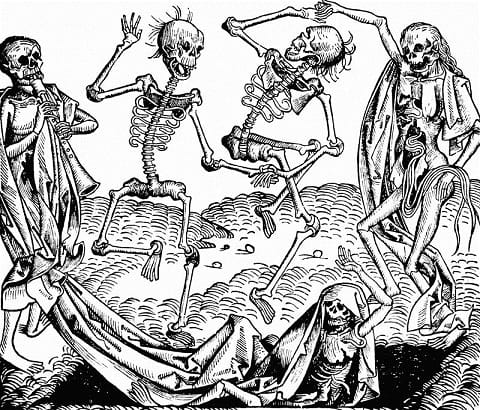
The image you see above was a motif that could be seen everywhere in the Middle Ages. People had become accustomed to death and wanted to depict themselves dancing with death.
The Roman Catholic Church, like the Ayatollahs in Iran, thought they were immune and exempt. But when the Chief Cardinal and several archbishops died from the epidemic, panic seized the Church. They needed to find a culprit. A list of culprits was quickly prepared and posted on walls in the streets: Jews, Muslims, beggars, Roma, lepers, and foreigners were to be killed on sight. Indeed, the people believed this. They abandoned the fight against the disease and began massacres. They had killed everyone on the list, but the plague still raged.
The Flagellants, also known as the Brotherhood of the Cross, emerged, believing that by atoning for their sins, the disease would disappear, and for this, they whipped themselves with whips and chains. They believed they had a sacred mission to stop the plague and prevent harm to the world. These groups, consisting of hundreds of people, would visit villages and cities in clothes with red crosses on their backs, trying to boost public morale. We owe all these details and events to the book Decameron, written by Giovanni Boccaccio in 1353.
Because of subcutaneous bleeding during the plague, the skin turned black, and thus this pandemic was popularly named "Black Death." According to the Italian writer, during the plague epidemic, swellings filled with blood and pus occurred, especially in the groin. Very deep pits were dug to bury the dead; those who died that day were thrown into the pit, lightly covered with soil, and those who died the next day were thrown into the same pit, on top of those who had died the day before. In some pits, up to 15,000 corpses were buried. Excavations in later years showed that the graves had 20-30 layers. The sky was filled with flocks of vultures because of the corpses. Sometimes corpses were loaded onto boats and burned at sea. Cities struck by the plague became dead cities. No work, no religious ceremonies could be performed, and the streets were filled with rotting corpses torn apart by animals.
A bacterium named Yersinia Pestis lives in rats. It does not harm rats. We also have thousands of types of bacteria in our bodies right now, but they are benign. However, Yersinia Pestis was a deadly bacterium for humans. When fleas, which feed on the blood of rats, sought refuge in humans due to the death of rats as the weather cooled, this bacterium was also transmitted to humans. As you know, there is a proverb: "Rats abandon a sinking ship first." In those years, ships, the only means of transport, were full of rats. Ships carried these rats to Europe. The plague epidemic, starting from port cities, slowly moved north. It left death and suffering everywhere it went. There was a short period of about 20 days between a flea biting a human and death occurring.
Pilgrims, ignoring the plague epidemic, set off for Mecca with the thought, "God will protect us." In 1349, almost all the pilgrims died in a plague epidemic that broke out in the city, and those who could escape took refuge in the city of Baghdad. This time, the streets of Baghdad, which was the most magnificent city in the world in those years, began to fill with corpses. Thereupon, the Caliph issued a fatwa: "Those who die of the plague are martyrs; they will go to Paradise." Thus, people began to compete to contract the plague. Some intelligent scholars opposed this fatwa and ensured that the people left Baghdad, thus ensuring the continuation of the lineage.
As I mentioned before, in the plague disease, swellings occurred in the neck, armpits, and groin, and the skin turned black. In those years, experts devoted to medical science somehow burst these swellings and developed a method to treat patients, albeit slowly. However, since no one dared to approach plague victims and the number of experts was small, it was not possible to develop an effective treatment method. Other symptoms of the plague were fever and vomiting blood.
The French King also blamed the planets for the plague epidemic. Supposedly, such a disaster occurred on Earth because three planets aligned on the same straight line. He believed that as the planets moved away from each other, the plague epidemic would also disappear, but he himself contracted the plague and died before seeing this opportunity.
The cause of the plague was a bacterium. If humankind had discovered antibiotics in those years, they could have treated the plague very easily. But let's not forget that the coronavirus disease is caused by a virus, not a bacterium. Antibiotics have no effect.
When the plague appeared, the rich fled to their country houses, while the poor lived their fate intertwined with the disease. Before the rich returned to the city, their houses were disinfected with incense, fumigated with sulfur, and then a poor person was placed in the house to ensure safety. If that person died, the return home was postponed. For this reason, the plague was called "the disease of beggars, the plague of the poor."
As time passed, they decided that the most correct solution was quarantine. From the 14th century onwards, quarantine was applied to ships and places where the disease was observed. The word quarantine is derived from the Italian word "quaranta giorni," meaning 40 days. Ships were isolated in special ports, and passengers were detained in the port for 40 days. In cities where the plague was seen, black flags were hung on bell towers to warn travelers who would come there. Plague victims were driven out of settlements, and even killed. Gatherings where people came together in groups, such as carnivals, fairs, and church services, were prohibited. Thanks to quarantine and these measures, it was possible to control the plague.
Therefore, I wish my dear readers health and well-being, hoping that they will adhere to the QUARANTINE rules and that we will overcome these difficult days together in a spirit of solidarity.