Two Sister Republics
This essay explores the intertwined histories of the short-lived Azerbaijan National Government and the Mahabad Kurdish Republic, both established in 1946 on Iranian soil, and their significance for the author's hometown of Iğdır.
Dear Readers:
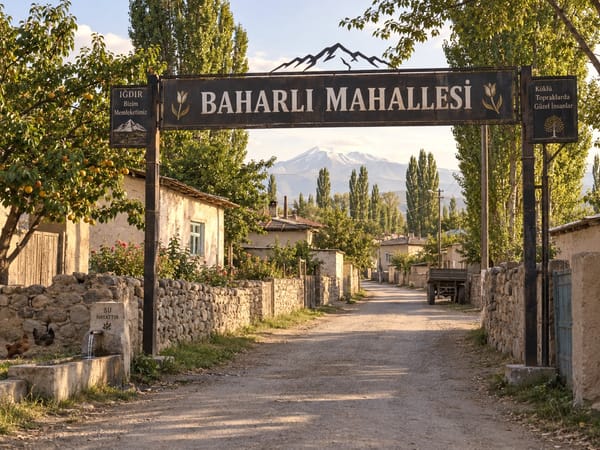
I was born in Iğdır. Iğdır is not part of the Anatolian geography but rather the South Caucasus. This is true not only geographically but also in terms of language, culture, value systems, and way of life. I, too, was rooted and grew up amidst the social and cultural values of Iğdır.
Our neighbors were, without exception, either Azeri or Terekeme (Kara Papak). I befriended them, played with them, fell out and made up, played football, and rolled around in dusty streets for games of marbles and knuckle-bones. With our slingshots, we aimed at crows perched high on poplar trees, ready to descend on the fields at the first opportunity. Although I never danced at weddings, I was always present. The melody of the accordion, played by skilled hands, always stirred my heartstrings.
Given this, the history of Azeris, Kurds, and Terekemes (South Caucasus) has always been an area of interest for me.
INTRODUCTION
Around this time of year, in November and December, I remember and feel saddened by the anniversary of the establishment and subsequent collapse of two sister republics within a single year. These republics were the Azerbaijan National Government and the Mahabad Kurdish Republic, both founded on what is now Iranian territory. The capital of the Azerbaijan National Government was Tabriz; the capital of the Mahabad Kurdish Republic was Mahabad.
Just beyond Iğdır lies South Azerbaijan, and a little further, Iranian Kurdistan. Therefore, the existence and fate of these two sister republics, established in these regions, have greatly interested me, even if they might not be of interest to someone from Istanbul, Ankara, Trabzon, or Diyarbakır. This interest in the fate of neighboring peoples has always been with me, from my early youth to my time abroad.
What I find strange is this: Azeri and Kurdish intellectuals from Iğdır are unaware of the history of these two sister republics established right next to them. Yet, as you will see when you read my article, Iğdır once served, in a sense, as a bridge for these two republics.
A DIPLOMAT NAMED WILLIAM EAGLETON
In my first year of university, I came across a book. Published by Komkar Publications (December 1976), its title was: The Kurdish Republic of Mahabad. Author: William Eagleton.


First, let me give you a brief introduction to the author: Born in 1926, Eagleton was an American diplomat who served as an ambassador in Middle Eastern countries. He was a graduate of Yale University. He began his career at the State Department. Eagleton served at the American Consulate in Tabriz between 1959 and 1961. In 1961, he wrote the book “The Kurdish Republic of 1946 / The Mahabad Kurdish Republic.” In 2003, Eagleton served as the US special advisor for Northern Iraq. He was known for his fascination with Kurdish carpets and kilims. Eagleton passed away in 2011.
It must have caught your attention: The Mahabad Kurdish Republic was founded in 1946 and ceased to exist in the same year; an American diplomat wrote a book about this republic in 1961; and as if that weren't enough, this book only reached Turkish readers in 1976.
Eagleton wrote his book in English. An Arab journalist translated the book into Arabic. Mamosteyê Mezin (Great Teacher) Mehmet Emin Bozarslan then translated it from Arabic into Turkish. Well done, esteemed Teacher!
Given such neglect for the Mahabad Kurdish Republic, were there any books written about the Azerbaijan National Government, established around the same time?
Answer: No!
The Turkish Historical Society bothered to publish a book titled "Azerbaijan National Government (1945-1946)" by Sonay Ünal in 2019; that is, 73 years later, Turkish readers learned about the existence of a short-lived but independent Azerbaijan National Government with Tabriz as its capital! I answer with a single sentence: Shame on them!
I would particularly like to ask why some Iğdır intellectuals, who exhibit an extraordinary talent for all kinds of distortion, did not want to undertake a book study about the Azerbaijan National Government, which was a real and lived reality and a turning point in Azerbaijani history, instead of striving to "create what does not exist." For some reason, even in newspaper columns, there is no courage to acknowledge the existence of this republic. A strange situation!
REZA SHAH PAHLAVI

The name "Reza Shah Pahlavi" is not unfamiliar to the people of Iğdır. Reza Shah Pahlavi embarked on a 27-day journey to Turkey in June 1934 (June 10 - July 7, 1934). He spent one night in Iğdır at the home of Ali Rıza Ataman (a Member of Parliament in the First Assembly). He reached Istanbul by ship via Trabzon. He was hosted in Ankara, Eskişehir, Kayseri, and Izmir.

Reza Shah Pahlavi, with British support, overthrew the Qajar dynasty in 1921 and gained control in Iran from 1925 onwards. He was influenced by Atatürk's reforms, and a closeness developed between them. Reza Shah intended to free young people from the clothing styles of the ulema (mullahs) and from madrasahs, and to establish a modern education system. Furthermore, during the Mount Ararat Rebellion (1930), Turkey and Iran cooperated. With minor border adjustments, the Mount Ararat Rebellion, which troubled both countries, was suppressed. One purpose of the visit was to sign a protocol that would secure the new border.
Reza Shah Pahlavi returned to his country. He founded Tehran University (1934). He liberalized clothing styles. Reza Shah Pahlavi's most significant change was renaming his country. From the 6th century BC until 1935, the country was known either as the Persian Empire or Ajamistan. Sometimes the word Fars was also used.
In 1935, Reza Shah winked at Nazi Germany, the new rising power in Europe, against the British, who dominated the world in those years and, in a sense, arbitrarily exploited the oil fields in his own country. The Nazis had made the superiority of the "Aryan" race the center of their political propaganda. On Nowruz (March 21) in 1935, Reza Shah Pahlavi declared the country's name to the world as "Iran," meaning "Aryans." In this way, he implicitly announced his alliance with Germany.
WORLD WAR II AND IRAN
On June 22, 1941, Hitler launched the military operation codenamed "Barbarossa" against the Soviet Union. The Soviet Union could not hold its ground against the rapidly advancing German armies and retreated. The Soviet Union urgently needed aid in weapons, ammunition, and food. Turkey, fearing Hitler's wrath, did not allow the passage of weapons through the Bosphorus. Even if it had, the Black Sea ports were already occupied by the Germans.
The Allied forces began searching for an alternative route. The most reasonable solution was for the Allied forces (especially Britain) to occupy southern Iran via the Persian Gulf, while simultaneously the Soviet Union would occupy the northern region of Iran (South Azerbaijan and the Mahabad Kurdish Region), meeting with Britain to form a bridge.

The Soviet Union and Britain asked Reza Shah Pahlavi for help with the project. The pro-German Reza Shah Pahlavi rejected the proposal; however, unable to withstand the pressure, he abdicated on September 16, 1941, and his son, Mohammad Reza Pahlavi, became the Shah of Iran.

When Soviet troops arrived from the north and the British from the south, meeting in the city of Kermanshah, this news was conveyed to Churchill. He lit a cigar with pleasure in the presence of his friends, exclaiming "To the Bridge to Victory!" and took a deep puff from his cigar. Iran was now in the hands of the Allies.
Shah Mohammad Reza Pahlavi was now a puppet. The famous Tehran Conference of the Allies was held in Tehran despite Hitler's intense anger. Of the three leaders, only Stalin visited the Shah and inquired about his well-being.
As Stalin was going alone to the reception given by the Shah, Foreign Minister Molotov tried to stop him: "Sir, what are you doing? The Shah should come to you!" Stalin replied with a laugh: "I am not going to the Shah, I am going for oil." Stalin achieved his goal. After the war, he made an oil agreement with the Shah. Based on this, he withdrew Soviet troops from Mahabad and South Azerbaijan. Soon after, the Shah's army destroyed both republics.

ESTABLISHMENT OF THE AZERBAIJAN NATIONAL GOVERNMENT AND THE MAHABAD KURDISH REPUBLIC
World War II ended on September 2, 1945. The territories of South Azerbaijan, with Tabriz as its capital, and Kurdistan up to the Mahabad region, were occupied by the Soviet Union. Mir Jafar Baghirov, General Secretary of the Baku-based Soviet Azerbaijan Communist Party, made a proposal to Stalin. The first stage was to unite South Azerbaijan with North Azerbaijan, and the second stage was to ensure that independent Azerbaijan joined the Soviet Union. Stalin was receptive to the proposal.

(Baghirov was born in Kuban in 1896. He served as General Secretary of the Soviet Azerbaijan Communist Party from 1933-53. After Stalin's death (1953), he was arrested. In 1956, he was executed by firing squad on the grounds of being a Stalin supporter.)
AZERBAIJAN NATIONAL GOVERNMENT AND MIR JAFAR PISHEVARI

Mir Jafar Pishevari was born in 1892 in the Halhal province of South Azerbaijan to a poor family. He was the General Chairman of the Azerbaijan Democratic Party. In 1905, he went to Baku. He adopted Marxist thought. He worked as a teacher for many years. His articles were published in various newspapers. In 1924, Reza Shah Pahlavi imprisoned a group of 50 socialists (interestingly, in 1959, the DP government also arbitrarily rounded up 50 Kurdish students and intellectuals). Pishevari was among them. Pishevari, like TIP leader Mehmet Ali Aybar, advocated for a socialism that would take into account the specific characteristics of the country. He was arrested in 1930 and imprisoned for 11 years. In 1941, he was released under an amnesty when British and Soviet forces entered Iran.
In July 1945, Pishevari secretly met with Baghirov in Baku, and upon his return, he founded the Azerbaijan Democratic Party. On September 13, 1945, he declared the Azerbaijan National Government. Since Pishevari had no intention of angering Iran and Turkey, he did not include Ministries of Foreign Affairs, Foreign Trade, and Defense in the cabinet list, as if he were only demanding autonomy. However, he secretly contacted Baghirov to discuss the unification of the two Azerbaijans. The government made important decisions:
- Education would be conducted in the Azerbaijani language.
- Land would be distributed to peasants.
- A Tabriz bank would be established.
- Tabriz radio would be opened.
- A state theater would be opened.
- A national library would be opened.

Borders of the Mahabad Kurdish Republic and the Azerbaijan National Government (Note: Iranian Kurdistan is not limited to the Mahabad Kurdish region. The Republic was established in the Kurdish region occupied by the Soviets.)
Soon, an undesirable situation developed. The Tehran Government and the Soviet Union signed an oil agreement. The Soviet Union promised to withdraw its troops from South Azerbaijan and Kurdistan. On March 24, 1946, when the Soviet Union withdrew its troops from Iran, the Tabriz-based Azerbaijan National Government and the Mahabad-based Mahabad Kurdish Republic were left alone.
Pishevari, left alone, convened the Assembly. He stated that they had three alternatives:
- To annex (join) Turkey,
- To declare independence,
- To remain within Iran if the above two conditions were not met.
A delegation was sent to Ankara, but the delegation was kept waiting in Ankara for 3 months, and their request for a meeting was rejected. The delegation returned to Tabriz empty-handed. Soon after, the Shah's army entered Tabriz on December 12, 1946, ending the Azerbaijan National Government. Pishevari fled to Baku. The Iranian army carried out a massacre, killing tens of thousands of people. Pishevari died in a suspicious car accident in Moscow in 1947.
MAHABAD KURDISH REPUBLIC AND QAZI MUHAMMAD
(There are three immortal leaders in Kurdish political history: Saladin Ayyubi, Mullah Mustafa Barzani, and Qazi Muhammad. All three fearlessly carried the spirit of humanism, peace, justice, and struggle for their people to the highest degree, inspiring respect even in the hearts of their enemies.)
Qazi Muhammad was born in Mahabad in 1900. His father, Qazi Ali, was a well-known figure in Mahabad and also a Qadi (judge).

In his childhood, Qazi Muhammad received religious education at the madrasah known as "Kutabxane." He also expanded his knowledge by taking lessons from his father.
While serving as the Director of Endowments in Mahabad, he was appointed Qadi in his father's place upon his father's death.
When the Soviet Union supported the establishment of two states, the Azerbaijan Republic and the Mahabad Kurdish Republic, in the occupied region, Qazi Muhammad declared the Mahabad Kurdish Republic on January 22, 1946, in Çarçıra Square, before a massive crowd. Twenty days later, on February 11, 1946, he convened the Kurdistan National Assembly (KMM) and formed a government.

From the Iraqi Kurdistan region, Sheikh Ahmed Barzani and his brother Mullah Mustafa Barzani also participated in the establishment of the Mahabad Kurdish Republic with their Peshmerga. Mullah Mustafa Barzani became the Chief of Staff.

SHEIKH ABDULKADIR (KOTAN)

Sheikh Abdulkadir (Kotan) is not an ordinary name. In the 1920s, he was undoubtedly the most prominent leader of the Sakan Tribe on both the Turkish and Iranian sides. In the final stage of the Iğdır Civil War, in October 1920, Sheikh Abdulkadir, with his affiliated Celali Hamidiye Regiment, participated in the siege of Iğdır, and as stated in Mecit Hun's Pamukova newspaper, he was responsible for the Kültepe-Yarmalar line.
Sheikh Abdulkadir actively participated in the Mount Ararat Rebellion in 1929, overshadowing İhsan Nuri Pasha and Bıro Heski Telli to become the leader of the rebellion. When the rebellion was suppressed, he crossed into Iran and settled in Maku. When the Mahabad Kurdish Republic was established, Qazi Muhammad appointed Sheikh Abdulkadir as the commander of the Celali tribal forces around Maku. In the military parade held in Mahabad, the most magnificent cavalry unit belonged to Sheikh Abdulkadir. Sheikh Abdulkadir passed away in Iran in 1947.

The government took on the organization of press and broadcasting. The publication of the Kurdistan magazine, which began on January 10, 1946, continued, and it was also decided to publish an official newspaper named Kurdistan.
The Kurdistan National Assembly made new decisions regarding education. A law making primary education compulsory was enacted. Financial and clothing aid was provided to children from poor families, and textbooks were distributed free of charge. The Assembly, which attached importance to cultural activities, published the poetry books of two Kurdish poets, Hejar and Hêmen. Kurdish schools were established, and education in Kurdish began. Two new magazines, Hawar and Hilale, were published. On March 10, Mahabad Radio began broadcasting with a transmitter station sent by the Soviets.
THE FALL OF THE MAHABAD KURDISH REPUBLIC
The Soviet Union withdrew from Iran on May 9. On December 17, the Iranian army occupied Mahabad. The Mahabad Kurdish Republic collapsed. On March 31, 1947, President Qazi Muhammad, Prime Minister Hacı Baba Sheikh, and Defense Minister Muhammad Hussein Khan Seyfi Qazi were hanged and executed in Çarçıra Square, where the Republic had been declared.
QAZI MUHAMMAD'S ARREST, DEFENSE, AND EXECUTION
Kiyomers Salih, an Iranian official who witnessed the collapse of the Azerbaijan and Mahabad Republics, wrote:
“(…) After the charges were read, Qazi Muhammad began his defense. Qazi Muhammad was very vigorous during his defense. He answered questions calmly and respectfully.
When Qazi Muhammad tacitly rejected the court's accusations, the judge shouted at Qazi Muhammad in a very harsh tone. Because of this, Qazi also became very angry and, speaking in Persian, said to the Judge:
“You are slandering! You are infidels and do not recognize God, you do not believe in the book and the reckoning of the afterlife, and you have no trace of reason or courage. Why do you attribute all these lies and slanders to us? If you are speaking the truth, prove it with a document!”
Because these words were shameful among Persians, the presiding judge was very angry at Qazi's words, and holding his head in his hands, he said to Qazi:
“Kurdan seg sifet! (Kurds are dog-faced!)”
However, the judge's angry words did not affect Qazi Muhammad at all, and he calmly replied to the presiding judge:
“You are the dog, the dishonorable, the shameless, and the immoral, for you recognize no limits against the people and against the laws. You are the immoral one! Ultimately, you can only execute the decision given by the immoral one before you, and nothing more is in your power. I believe I am innocent, and I have long been ready to die on this path. I am dying for the freedom of my nation, and I am honored by this honorable death. I see this as a mercy from God for myself.”
Qazi Muhammad concluded his words in this manner and announced his decision not to speak further or answer any questions from the court. Qazi swore not to answer and said:
“Let this ignorant man make as many mistakes as he wants!”
The presiding judge then adjourned the session for Qazi's anger and reaction to subside, for him to reconsider his decision, and to answer the questions. When the court resumed, much effort was made for Qazi Muhammad to answer the questions of the presiding judge, Colonel Nikuzad, but Qazi Muhammad replied:
“The decision for my execution has been made. The promise and message (Peyman) I gave to my nation is that I will live with my nation and die for it. How can I now abandon the promise I made and the oath I took to my nation! Therefore, all the immorality stems from the presiding judge, the Colonel. I will not answer that man's questions; if there is someone else, let them ask the questions!”
When it became clear that Qazi Muhammad would not speak, the court panel, helpless, had to replace Colonel Nikuzad with Colonel Recep Eta, who was also the presiding judge.
All questions were asked again, starting from the first. Qazi Muhammad again rejected all the questions he had previously rejected.
In response to the question, "Why did you sign an oil trade agreement with the Russian State without the approval and decision of the central government?", Qazi Muhammad laughed and said:
“What oil did we have to trade with! What oil wells and companies did we have! If you want to accuse us cunningly, then make accusations and slanders that have some truth to them. It seems you see the water of the river flowing through the city of Mahabad as oil. Truly, you accuse us very unconsciously; none of your accusations against us have any basis. Similarly, in the answer to the other question, it was supposedly claimed that Qazi Muhammad wanted to bring foreigners into Iran and leave a part of Iranian territory under their administration, for example, Mullah Mustafa BARZANI!”
Qazi Muhammad, as in the trial three months earlier, answered this question again, saying:
“Mullah Mustafa BARZANI was not and is not a foreigner who came to Kurdistan; no one brought him. Kurdistan is the home of every Kurd. Circumstances required it, and he moved from one part of his home to another.”
Colonel Eta repeated the questions one by one, and Qazi Muhammad again rejected all the accusations as before. Meanwhile, Colonel Nikuzad took out a piece of cloth from his bag, yellow, red, and green, with a hammer and sickle emblem on it, showed it to Qazi Muhammad, and said:
“Is this not your entire government, flag, and organization?”
(The Colonel spat on the flag and trampled it under his feet.)
In response to the Colonel's behavior, Qazi Muhammad said:
“Firstly; the flag you showed is definitely not the flag of Kurdistan, because our flag does not have a hammer and sickle emblem on it. Secondly; this behavior is an indication of your foolishness and unconsciousness. Know very well that your hand will never reach the flag of Kurdistan to insult it. A day will come when that flag will be hoisted and wave over the courthouse where I am currently being tried. I entrusted the flag of Kurdistan to Mullah Mustafa BARZANI. On his shoulders, this flag is carried from one mountain to another, from one city to another, from one country to another, until one day it is hoisted and waves over all the mountains and lands of Kurdistan. Know very well that that day will come.”
The Colonel made a request to Qazi Muhammad:
“Although this matter is outside the scope and duty of the court, can you tell us about some of the characteristics of Mullah Mustafa BARZANI?”
Qazi Muhammad:
“Forget Mullah Mustafa BARZANI! You yourself said, Mullah Mustafa is a foreigner. It is outside the scope and duty of the court.”
But the Colonel requested him again.
Qazi Muhammad:
“If I speak about Mustafa Barzani as a whole, you might think that my Kurdish side is prevailing.”
Colonel Eta:
“In this court, it has become clear to me that everything you say and will say comes from the depths of your heart and you speak with conviction.”
Qazi Muhammad:
“I cannot tell you all the characteristics of Mullah Mustafa BARZANI, and you can in no way fully know BARZANI. Because you view him as an enemy, even if I tell you, you will in no way want to appreciate these valuable and good qualities, his stance and practice, of your enemy.”
The judge again requested Qazi Muhammad to introduce BARZANI to them as much as he knew.
Qazi Muhammad:
“Neither I nor anyone else can introduce Barzani to you as he is; I ask you to stop asking this question.”
But the court panel again requested him to speak about Mustafa BARZANI.
Qazi Muhammad:
“Very well, I will tell you about Mullah Mustafa BARZANI in just a few sentences; in history, however many heroic, brave, resistant, honorable, humanist, free, fearless, and far-sighted great personalities there have been, BARZANI is one of them. Just as there is truth, honesty, and loyalty in the Muslim nation that believes in God and religion, in the leader of the Islamic religion, all these qualities are also present in BARZANI. As Saadi said: "Believe it or not, or be pleased or not."
Everyone in the courtroom was pleased by these sincere and heartfelt words of Qazi Muhammad. Undoubtedly, it was clear that these laudatory qualities he described about BARZANI were neither for BARZANI's sake nor for the court panel's...
Presiding Judge Eta asked Qazi Muhammad:
“As far as we know, there is no one in this country as calm and self-controlled as you, why were you so angry with Colonel Nikuzad?”
Qazi Muhammad:
“I will not give anyone the opportunity to insult the honor of this nation for which I am currently being tried with the death penalty. How can I accept such a cowardly act that would insult and belittle my nation right now? I can only say this: I will not give an opportunity to a vile and cowardly person who would insult the Kurdish nation. If you are not knowledgeable and civilized enough to accept this, how can I tolerate your disrespect? As Saadi said: "To die and be martyred for my nation!" What I asked of God has been accepted. I hope to go before Almighty God, the Forgiver, with a clear conscience.”
At the end of the court session, a new charge was added to the list of accusations against Qazi Muhammad; it was alleged that he had recited poetry to the republic's cadres and a group of officers, and they had taken this poetry as their guide. However, Qazi replied, "This is the first time I'm hearing this poem from you."
I have attended many military court and public square court hearings, but I have never seen a person as courageous, brave, and fearless as Qazi Muhammad. He showed no fear in court; he answered questions as if he were at a festival or celebration, and he spoke with great courage.
When Colonel Nikuzad uttered words that insulted the Kurdish people and Qazi Muhammad, Qazi Muhammad responded to him very sharply:
“Those before us knew you very well. May God bless the poet who said (……………),” and he recited a very philosophical and profound Persian poem that revealed the soul and roots of the Persians and Shias.
I wanted to learn and write down who that poem belonged to, but since it was court time, there was no opportunity to repeat the poem. And after reciting the poem, Qazi said:
“They introduced you to us like this.”
Colonel Eta again asked Qazi Muhammad:
“After Mullah Mustafa BARZANI left here, what kind of relationship did he have with you? If he did, when and how did it happen?”
Qazi Muhammad:
“We had a relationship until BARZANI reached the Shino and Nixede region, but after he left there, our relationship was cut off, and I haven't heard from him since.”
The judge asked again:
“When you had a relationship with Mullah Mustafa BARZANI, what kind of plans did Mullah Mustafa prepare to save you?”
Qazi Muhammad:
“Mullah Mustafa BARZANI very much wanted me to go with him. Before I was arrested, he said: 'I cannot claim to be innocent (against the Iranian state).'
Mullah Mustafa BARZANI painted a true and accurate picture of you Persians for me; he made me understand who and what you are.”
Colonel Eta asked:
“Can you show us and describe what that picture was like and what it was?”
Qazi Muhammad:
“Truly, BARZANI knew you better than anyone else… BARZANI told me this:
“No people or nation is like the Persians; when the Persians have power and strength, you will not find anyone more cruel, ruthless, and conscienceless than them, and when they are under subjugation, no one knows better how to appear supplicant and oppressed to the ruler than they do. When they have power, they do whatever they can, and when they are under subjugation, they do whatever is necessary to survive. Therefore, you should not expect the Persians to treat you kindly because you are innocent.”
Colonel Eta asked again:
“Are you not regretting not going with BARZANI?”
Qazi Muhammad:
“If my Almighty God does not prevent this kind of death, I have no regrets. Because I have promised the Kurdish nation that I will live with them and die with them. I know that if I had gone and not fallen into your hands, you would have killed many people from Mahabad and the Kurdish nation to take revenge on me. That is why I am at peace. Firstly, I will be killed innocently. Secondly, because I have kept my promise, I hope to be a beloved person in the eyes of God and the Kurdish nation, in this world and the hereafter.”
Colonel Eta asked:
“When you were arrested, did BARZANI, who was in the vicinity of Mahabad, have a plan to save you?”
Qazi Muhammad:
“Yes, BARZANI sent me a message and said that he could send many Peshmerga any night, no matter what, and rescue me from prison. Mullah Mustafa's goal was to rescue me from prison before I was killed.”
Colonel Eta:
“Why didn't the plan work?”
Qazi Muhammad:
“I myself did not want it.”
Colonel Eta:
“Why? Why didn't you want to be saved?”
Qazi Muhammad:
“For several reasons…”
Colonel Eta:
“What were those reasons?”
Qazi Muhammad:
“Firstly, it was the promise and agreement I made to my nation. Secondly, it was to prevent more bloodshed, especially since I am saddened by death and killing in my life.”
Colonel Eta:
“What was the truth? Were you sad for yourself, for the Barzanis, or for our officers?”
Qazi Muhammad:
“Believe in God, I am neither sad for myself nor for your officers… I am sad for the Kurds and the young people of Barzani. If it weren't for this, I had made my decision and knew that I would be killed in any case.”
Colonel Eta:
“Can you tell us why you are so sad for the Barzanis?”
Qazi Muhammad:
“Because Mullah Mustafa and the Barzanis are the future hope of the Kurdish nation. I entrusted the flag of Kurdistan to them, and they will protect that flag. The flag of Kurdistan will remain with them until its day comes. That flag is not the flag that Colonel Nikuzad spat on and trampled under his feet. My hope from God is that that flag will be hoisted and wave over this house where I am now being tried and over all the mountains of Kurdistan by the hands of the Barzani forces.”
Colonel Eta:
“Last question: Truly, did you not go yourself, or did BARZANI not want to take you with him?”
Qazi Muhammad:
“It seems you don't believe what I've said so far.”
Colonel Eta:
“I want you to tell me the truth.”
Qazi Muhammad:
“Colonel! Come to your senses, don't insult me too! Why do you ask me for the truth? Is what I'm saying not true? My father and ancestors lived in these lands, where else should I go but Kurdistan! I am not so fond of life as to abandon my country and nation and flee!”
Colonel Eta quickly apologized, so that Qazi Muhammad would not get angry again as before and insult him like Nikuzad, and said that his intention was not to insult Qazi Muhammad, but that it was just a slip of the tongue. And then he added:
“I really want you to answer this question too. If you love your homeland and nation so much, why do you allow foreigners to come into the country and serve as officers for your nation?”
Qazi Muhammad:
“You repeat this statement a lot, it seems your aim is to refer to the British and Russian Forces?”
Colonel Eta:
“No, my aim is to refer to Mullah Mustafa Barzani.”
Qazi Muhammad (smiling):
“I answered this question of yours a while ago, there is no need to repeat it. I told you, Mullah Mustafa BARZANI is a Kurd and Kurdistan is the home of every Kurd, and BARZANI is like a person moving from one room of his house to another, every person has the right to sit anywhere in their house and property. And know well that I myself did not want to go, if it were not so, I had several cars at my disposal. I could have left Iranian territory with one of these cars at any moment and time. I knew the outcome of my actions very well and I knew you very well. As BARZANI said, no people or nation is like the Persians, when the Persians have power and strength, you will not find anyone more cruel, ruthless, and conscienceless, as insulting and skull-headed as them. And when they are under subjugation, no one knows better how to supplicate the ruler and present themselves as helpless and oppressed.”
Qazi Muhammad's trial ended in this way.
The decision to execute the Qazis in ÇARÇIRA Square, located in the center of Mahabad city, was made in Tehran, to intimidate the Kurdish people and encourage the Iranian soldiers.
When the court panel arrived in Mahabad, the military command evacuated the houses around ÇARÇIRA Square, under the pretext of deploying soldiers to ensure the city's security.
The house in the square where the Qazis were taken had three doors; one door opened to the square; the second to the opposite direction of the square; and the third door opened to the small courtyard of the house.
The truck carrying Qazi Muhammad was ordered to go towards the square. When the truck stopped at the door of the house in Çarçıra, Qazi Muhammad asked:
“Why are you taking me down here?”
The soldier replied:
“Your departure to Tehran will be organized from here, and the remaining few questions will be asked to you here.”
Qazi Muhammad got out of the car. When he entered the house, he saw Colonel Nikuzad, a Kurdish imam, and several armed officers. At the same time, there was a large table in the room with a Holy Quran on it. The chief medical officer who came from Tehran to Mahabad was also there.
There he understood that the trip to Tehran was a lie. They had brought them to ÇARÇIRA Square under this pretext.
Judge Colonel Nikuzad began to read the court's verdict and said to Qazi:
“This verdict must be carried out now. If you have a will, say it or write it!”
Qazi Muhammad quickly went to the table and began to write his will. But he appeared tired. After writing a few pages, he called out to the Mahabad imam and requested:
“Come and write what I will say!”
Qazi Muhammad spoke and dictated very clearly. "Write this!" he said, detailing his wishes. "I donate such and such a place, such and such land, for the benefit of Kurdish children in the future; for the construction of schools, hospitals, and mosques. Form your unity and integrity for the Kurdish people and love each other," he advised.
After the will was written, he began to pray. All of this took 2.5 hours. The judge seemed very distressed during this time, wanting to return to Tehran as soon as possible. After Qazi Muhammad wrote his will, performed his prayers, and conveyed his wishes to God, he asked the authorities for permission to write a will and some advice to the Kurdish people, and the judge granted that permission.
He was given the pen and paper he requested, and he asked the imam to write down what he would say, in a way that Judge Colonel Nikuzad and everyone else present could hear and understand.
Qazi:
“Mullah, write everything I tell you.”
Mullah: “My dear, what should I write? I don't write in the way you speak (Kurdish), the judge needs to give permission for me to write in Kurdish.”
Qazi Muhammad replied angrily:
“Who is the judge? What is it to him whether he gives me permission or not? I am telling you.”
The imam said: “My dear, forgive me, I don't know how to write in Kurdish.”
Qazi Muhammad (angrily) said:
“This is another misfortune of the Kurdish nation.”
(Qazi Muhammad wrote his own advice; he ended it with this sentence)
I hope you listen to these counsels and, with God's help, defeat your enemy. As Saadi said:
“Miradî ma nesîhet bud ve goftim. Hewalit ba xuda kerdîm ve reftîm.”
(Our wish was to advise, I did. I entrusted myself to God and left.)
After the servant of the nation and country, Qazi Muhammad, finished writing his will, he said to the judge:
“If you want to listen, I will read it to you!”
Judge: “No need!”
Qazi Muhammad:
“Good! Since execution is not approved in Islamic Law, when you kill me, kill me by firing squad!”
The judge did not accept Qazi Muhammad's request, because according to the court's decision, they had to be hanged.
Qazi Muhammad:
“I will pray and fulfill my duties before death.”
Permission was granted for his requests.
Before going to the gallows, Qazi Muhammad turned towards the Qibla, raised both hands in the air, and loudly conveyed his wishes to God:
“Oh God! You are my witness that I spared no effort and had no worries in serving this nation. Oh God! You are my witness that I have done everything in my power in Your path. Oh God! In this world and in the hereafter, take revenge on the oppressors for the oppressed, as far as I know, it has always been this way. Oh God, who is aware of everything, save all oppressed nations, including the Kurdish nation, from the yoke of oppressors.”
The act of conveying his wishes and crying out to God lasted approximately 20 minutes. I was asking the Kurdish imam present in the court for the Persian meaning of these things that Qazi Muhammad said in Kurdish.
After all these stages, they took Qazi Muhammad to the gallows to carry out the execution. Two minutes after the noose was placed around his neck, Qazi Muhammad passed away. It was four in the morning.”
BROTHERHOOD AGREEMENT SIGNED BETWEEN THE AZERBAIJAN NATIONAL GOVERNMENT AND THE MAHABAD KURDISH REPUBLIC
(It has become fashionable in recent years! The State of Azerbaijan and the Republic of Turkey are referred to with the slogan, TWO STATES, ONE NATION. Everyone knows that behind this slogan lies oil and natural gas! Azerbaijan has still not officially recognized the Turkish Republic of Northern Cyprus. For many years, it used Karabakh as an excuse for this behavior, but even after the Karabakh Victory, it has not taken the necessary step. In such a sensitive period, where discussions continue about which oil fields in the Eastern Mediterranean belong to whom, the official recognition of the Turkish Republic of Northern Cyprus by other countries is of serious importance. Azerbaijan also lifted the visa requirement between the two countries reluctantly and unwillingly. However, when we look at historical facts, we see that true and unconditional brotherhood was established between the Azerbaijan National Government and the Mahabad Kurdish Republic.)
On May 3, 1946, an agreement was signed between the Mahabad Kurdish Republic and the Azerbaijan National Government. According to this:
- Representatives of each party would be sent to each other's territories;
- Kurdish administration representatives would be present in Azerbaijani territories where Kurds were in the majority, and representatives among Azeris would be present in Kurdish territories where Azeris were in the majority;
- The two governments would form a Joint Economic Committee to deal with economic issues;
- Mutual military assistance would be provided when necessary;
- All negotiations with the Iranian government would be conducted after obtaining the approval of both governments;
- The Azerbaijani government undertook to take the necessary measures to organize initiatives in the field of education for the Kurds living in its territories. The Kurdish government, for its part, promised to carry out the same initiatives for Azerbaijanis living in the territories of Iranian Kurdistan;
- Anyone attempting to disrupt the historical friendship and cooperation between the two peoples or extending their hand to their national unity, whoever they may be, will be punished by both peoples.


ATTENTION: I would like you to note that both flags bear the same colors. This is an expression of the bond of brotherhood between the two Republics.
MOLLAH MUSTAFA BARZANI'S LONG MARCH AND IĞDIR

The Barzani Tribe, which participated in the establishment of the Mahabad Kurdish Republic, returned to Barzan in Northern Iraq in April 1947. The Iraqi government arrested and imprisoned Sheikh Ahmed Barzani. At the same time, four officers from the Iraqi army were executed on charges of collaboration. Mullah Mustafa Barzani realized that the people and the Peshmerga were facing a great massacre.
With the vision and courage of a military genius, Mullah Mustafa Barzani, just like Mao Zedong's 100,000-strong, 370-day, 12,500 km Long March to avoid annihilation by Chiang Kai-shek's army in 1934, embarked on a 52-day march towards the Soviet Union on May 22, 1947, with 560 Peshmerga, following the Turkish and Iranian borders, entering Turkish territory at times and Iranian territory at others. On June 18, 1947, he reached the Aras River on the Soviet border. During the march, clashes occurred with Iraqi, Iranian, and Turkish soldiers. Mullah Mustafa Barzani finally crossed the Aras and sought refuge in the Soviet Union with his Peshmerga.
During the long march, Barzani and his Peshmerga aimed to reach the Aras by passing through a region close to Iğdır. For days, the Peshmerga were tired, hungry, and thirsty from the march.
I will leave the rest to Halit Güneş, the son of the late Süphan Güneş:
“Barzani's forces, surrounded on all sides, were stranded around Mount Ararat for 20 days. Information that they needed food and money reached Iğdır center. My father Süphan Güneş, who ran a restaurant in those years, became aware of the situation. Those were the days when Hüsnü Bingöl ruled with an iron fist. My father went to Halife İbrahim Güneş and explained the situation. At that time, Mecit Hun was also in Iğdır for military leave. Since the Geloylu tribe was settled on Mount Ararat, Halife İbrahim specifically wanted Mecit Hun to be at the meeting. The three of them secretly collected provisions and money among Kurdish notables and delivered them to Barzani.”
PART TWO: APPENDICES
DISTORTION AGAIN… DISTORTION AGAIN… WE ARE TIRED! WE ARE TIRED!
Dear Readers:
Contrary to what many believe, I am not someone who spends all day following other people's Facebook, Twitter, Instagram accounts. Social Media is certainly important, but my ongoing book projects and research prevent me from doing so. Luckily, my wife Şeval is a social media expert. She gladly takes on these tasks. Believe me, I have never once logged into my Twitter and Instagram accounts. Şeval also monitors my Facebook account, but I write the posts myself.
Şeval recently asked me to read an article she came across on Facebook. I won't mention his name, but an Azeri intellectual or young person from Iğdır, whom I love and admire, introduces the tomb of Gulicevher Ağa in Kolikent Cemetery as a Seljuk artifact and makes similar claims.
While I exposed the "Hasan Onbaşı" distortion in my previous article, and the issue is still fresh, now someone else engaging in distortion truly saddens me!
Gulicevher (Gulî Cewher) Ağa and his son General Ali Eşref (Eleşref) Bey are two important figures who led the Caucasian Kurds (including my tribe) in the 19th century. Gulicevher Ağa passed away in 1877 and was buried in Kolikent Cemetery. His son, General Ali Eşref Bey, had a tomb built for his father. When Ali Eşref Bey passed away, he was buried in a grave next to the tomb. So, this tomb is not from the Seljuks 700-800 years ago. Secondly, and most importantly, the tomb is not empty. In that tomb lies Gulicevher Ağa, the great leader of all Caucasian Kurds.
A BROTHERLY SUGGESTION TO AZERI YOUTH AND INTELLECTUALS
My dear compatriots! I love you. Whether you love me or not neither makes me happy nor sad. What matters is that the land we live on becomes a city of peace. Let's admit it, the clothes of chauvinism and sectarianism that have been forced upon us for years are now too tight. It is imperative that we embrace the future of our Iğdır with a different vision, a different understanding. Let's stay away from those who resort to chauvinism and sectarianism for politics. Let's no longer wear this cheap, outdated, second-hand clothing; let's tear it off and throw it away. Now, the future of our children converges on a single goal, and our children continue to struggle with the same problems. Let's not think small! If we think big, Iğdır will open all its richness and heart to us. The land of Iğdır is upset with its people. The fault is ours! It is time to make peace with Iğdır and with ourselves. Thank you.
If my young compatriot who published the article had read my book IĞDIR SEVDASI, published in 2002, he would not have made the mistake he did.

(Also included in IĞDIR SEVDASI in the following text)
Gurci Selçuk Narrates: (First Edition, Second Volume, Page 351)
“Eleşref Bey is the son of Gulicehar Ağa. Eleşref Bey had no children. If you go to the cemetery near Kolikent village today, there is a large tomb there. That belongs to Gulicehar Ağa. Right next to it is a ground grave. That belongs to Eleşref Bey.
Once, I went to visit the cemetery with my mother Fattê (Gurci Selçuk used to call his mother Fattê, like all the household members).
Eleşref Bey's tombstone had fallen; a second stone was needed to set it upright again. I took a stone from his father Gulicehar Ağa's tomb, saying aloud: "Gulicehar Ağa, forgive me. Your son took care of you, built a tomb, but he had no son to take care of his grave. Allow me to place this stone on his son's grave."
My mother must have been emotional, for she sat down and cried.
Gulicehar Ağa's son Eyüp Pasha had fallen out with the Russian government and sought refuge with the Ottoman State. The Ottoman Government gave him seven villages in the Eleşkirt region. Eyüp Pasha's daughter Horê Hanım married my uncle Hacı İsa. Eleşref Bey served in the Russian army with the rank of general. He married five times but had no children.”
AZERI-TURKISH DICTIONARY
In my childhood, I was friends with Alaattin, the son of the late Kelba İbrahim (Bayat) uncle, who came from Alıkızıl (Yukarı Topraklı) village in Aralık district and was our neighbor. His daughters were also very close with my sisters. My friendship with Alaattin continued uninterrupted until I went to high school in Istanbul. The use of Azeri words was natural for me and a part of daily life. For this reason, I wanted to share with you the Azeri words from those years, both to commemorate my friendship with Alaattin Bayat and to strengthen Kurdish-Azeri brotherhood.
I would like to insert an anecdote here: I was a first-year student at Kabataş Erkek Lisesi. Our literature and composition teacher was Recep Usta. It was the first composition exam. Our teacher wrote a proverb on the blackboard and asked us to write a composition based on it.
A few days later, our teacher entered the classroom with a bundle of papers under his arm. He placed the composition exam papers on the table. There was a mocking expression on his face. For some reason, he spoke without taking his eyes off me: "Some of your friends use dialects and local words. They won't get a good grade from me!"
Our teacher took the chalk and wrote three words: Kartol, yallı gitmek, badımcan. The teacher continued: "Tell me! What do these words mean?" There was no sound from the class. I knew what they meant, but I wasn't quite sure about their Turkish equivalents. Since I made similar mistakes in every composition exam, it was impossible for me to get a grade higher than 4 (out of 10), and despite being one of the best in the class, I failed composition. What saddened me was not just failing, but having to travel from Iğdır to Istanbul and back in the heat of July to take a make-up exam for one subject. In those years, the bus journey took more than two days, and smoking was allowed, which badly affected my asthma, which I suffered from due to tuberculosis in my childhood.
I didn't know how to prepare for the exam in July. My uncle Fetullah Kakioğlu and Enver Aytekin, the owner of Sosyal Yayınlar, were close friends because they had been detained together in the 23s Incident involving Kurdish intellectuals in 1963. My uncle took me to Enver Bey. After cursing my composition teacher profusely, he asked Enver Bey, who lived immersed in literature:
“Mücahit, how should he prepare for the exam?”
Enver Bey, puffing on his ever-present pipe, ordered his assistant:
“Package all the works of Ömer Seyfettin and Sait Faik Abasıyanık, and also all the issues of Ayna magazine containing Şevket Rado's articles!”
That summer, I was both mowing hay and reading these books with great pleasure. When I set off for Istanbul to take the exam, the Cyprus Peace Operation had begun. My journey passed amidst excited conversations. I had finally passed the exam.
| AZERİCE | TÜRKÇE |
| Acışmaq | Gocunmak (To feel offended) |
| Açar | Anahtar (Key) |
| Aftafa | İbrik (Ewer) |
| Ağ | Beyaz (White) |
| Akuşka | Pencere (Window) |
| Alça | Erik (Plum) |
| Aparmaq | Götürmek (To take away) |
| Arxayın | Güvenli (Safe, secure) |
| Arxayın olmaq | Emin olmak (To be sure) |
| Astana | Balkona çıkmadan kapı önündeki çıkıntı (Threshold, projection in front of the door before going out to the balcony) |
| Ata | Baba (Father) |
| Axırıncı | Son (Last) |
| Axtarmaq | Aramak (To search) |
| Axund | Din hocası (Religious teacher) |
| Azad | Özgür (Free) |
| Badımcan / Pamidor / Tomat | Domates (Tomato) |
| Balaca | Ufak (Small) |
| Basdırmaq | Gömmek (To bury) |
| Başa salmaq | Anlatmak (To explain) |
| Berk | Sert (Hard, tough) |
| Berkitmek | Sağlamlaştırmak (To strengthen) |
| Bes | Yeter (Enough) |
| Beyneva | Zavallı (Poor, pathetic) |
| Bığ | Bıyık (Moustache) |
| Biabır etmek | Rezil etmek (To disgrace) |
| Bibi | Hala (Paternal aunt) |
| Birbaşa | Doğrudan (Directly) |
| Bulaq | Pınar (Spring, fountain) |
| Camış | Manda (Buffalo) |
| Cığal | Oyun bozan (Spoilsport) |
| Cırıq | Yırtık (Torn) |
| Cummaq | Suya dalmak (To dive into water) |
| Cüce | Tavuk (Chicken) |
| Cüt | Çift (Pair) |
| Çapıt | Bez (Cloth) |
| Çatmaq | Ulaşmak (To reach) |
| Çatmaq | Yetmek (To suffice) |
| Çaynik | Çaydanlık (Teapot) |
| Çeçele barmağı | Serçe parmağı (Little finger) |
| Çıra | Lamba (Lamp) |
| Çimmek | Yıkanmak (To wash oneself) |
| Çiyin | Omuz (Shoulder) |
| Çömçe | Kepçe (Ladle) |
| Çörek | Ekmek (Bread) |
| Dal | Arka (Back) |
| Dalan | Antre (Entrance hall) |
| Darıxmaq | Sıkılmak (To be bored) |
| Daşka | At arabası (Horse cart) |
| Dayaz | Derin değil; sığ (Not deep; shallow) |
| Deyesen | Galiba (Perhaps, probably) |
| Dığır | Kısa boylu (Short-statured) |
| Dimdik | Gaga (Beak) |
| Dincelmek | Dinlenmek (To rest) |
| Dolanmaq | Geçinmek (To make a living) |
| Dünen | Dün (Yesterday) |
| Düyü | Pirinç (Rice) |
| Düz (Düz deyirsen!) | Doğru (Right, correct) |
| Elcek | Eldiven (Glove) |
| Ele bil | Sanki (As if) |
| Erzinde | Sırasında (During) |
| Evezini çıxartma | Mukabele (Retaliation) |
| Eyleş! | Dur! (Stop!) |
| Eyleşmek | Oturmak (To sit) |
| Eynek | Gözlük (Glasses) |
| Eyvan | Tandır damı (Tandoor shed) |
| Fehle | Amele (Laborer) |
| Fikirleşmek | Düşünmek (To think) |
| Fit olmak | Ödeşmek (To settle accounts) |
| Garışka | Karınca (Ant) |
| Gatıx | Yoğurt (Yogurt) |
| Gede | Erkek çocuk (Boy) |
| Gic / Ahmak | Enayi (Fool, idiot) |
| Gic elemek | Usandırmak (To bore, to annoy) |
| Göbelek | Mantar (Mushroom) |
| Göçek / Geşeng | Güzel (Beautiful) |
| Günorta | Öğle (Noon) |
| Güzgü | Ayna (Mirror) |
| Helelik | Şimdilik (For now) |
| Hemişe | Her zaman (Always) |
| Herdenbir | Ara sıra (Occasionally) |
| Heresi | Her biri (Each one) |
| Heyat | Avlu (Courtyard) |
| Hıyar | Salatalık (Cucumber) |
| Hol | Topaç (Spinning top) |
| Hövsele | Sabır (Patience) |
| Hövseleden çıxmaq | Zıvanadan çıkmak (To lose one's temper) |
| Hunduşga | Hindi (Turkey) |
| Hündür | Uzun boylu (Tall) |
| İl | Yıl, sene (Year) |
| İlan | Yılan (Snake) |
| İskan | Bardak (Glass) |
| İsti | Sıcak (Hot) |
| İti | Keskin (Sharp) |
| İtirmek | Kaybetmek (To lose) |
| Kaç gün qabax | Geçen gün (The other day) |
| Kap | Tabak (Plate) |
| Kartof | Patates (Potato) |
| Kerenti | Tırpan (Scythe) |
| Kerki | Keser (Adze) |
| Kerti | Bayat (Stale) |
| Kişi | Adam, erkek (Man) |
| Kovun | Kavun (Melon) |
| Köhne | Bayat (Stale) |
| Köhne | Eski (Old) |
| Kömek | Yardım (Help) |
| Köynek | Gömlek (Shirt) |
| Küçe | Sokak (Street) |
| Künçüt | Susam (Sesame) |
| Mahnı | Şarkı; türkü (Song; folk song) |
| Mat qalmaq | Şaşırıp kalmak (To be astonished) |
| Meke | Mısır (Corn) |
| Mellim | Öğretmen (Teacher) |
| Mığmığa | Sivrisinek (Mosquito) |
| Mıh | Çivi (Nail) |
| Milçek | Sinek (Fly) |
| Moruq | Yaşlı (Old person) |
| Möhkem | Sağlam (Strong, sturdy) |
| Mürebbe | Reçel (Jam) |
| Nağıl | Masal (Fairy tale) |
| Nahar | Öğle yemeği (Lunch) |
| Nece | Nasıl (How) |
| Neçe? | Kaç? (How many?) |
| Neve | Torun (Grandchild) |
| Noğul | Şekerleme (Candy) |
| Oğurlamaq | Çalmak (To steal) |
| Otağ | Oda (Room) |
| Oxşamaq | Benzemek (To resemble) |
| Ötürmek | Uğurlamak (To see off) |
| Paltar / libas | Giysi (Clothing) |
| Parç | Maşarpa (Pitcher) |
| Payız | Sonbahar (Autumn) |
| Pazı | Şeker pancarı (Sugar beet) |
| Pışka | Kibrit (Match) |
| Pille | Basamak (Step) |
| Pilleken | Merdiven (Stairs) |
| Puç olmaq | Boşa gitmek (To go to waste) |
| Pul xırdalamaq | Para bozdurmak (To break money) |
| Qabaq | Önce (Before) |
| Qada | Dert, sıkıntı (Trouble, difficulty) |
| Qadağan | Yasak (Forbidden) |
| Qanfet | Şeker (Sugar) |
| Qaydaya salmak | Düzenlemek (To arrange) |
| Qayğanaq | Sahanda yumurta (Fried eggs) |
| Qayırmaq (Ne qayırırsan?) | Yapmak (To do, to make) |
| Qayıtmaq | Dönmek (To return) |
| Qaytarmaq | İade etmek (To return, to give back) |
| Qeşeng | Güzel (Beautiful) |
| Qıcqırmaq | Ekşimek (To sour) |
| Qıraq | Kenar (Edge) |
| Qışqırmaq | Bağırmak (To shout) |
| Qızıl | Altın (Gold) |
| Qohum | Akraba (Relative) |
| Qonaq | Misafir (Guest) |
| Qöy | Mavi (Blue) |
| Quldur | Serseri (Vagabond) |
| Qurtarmaq (Film qurtardı!) | Bitmek (To finish) |
| Sancımak | Ağırmak (To ache) |
| Seher | Sabah (Morning) |
| Selqeli | Derli toplu (Tidy) |
| Sımışka | Ay çekirdeği (Sunflower seed) |
| Sındırmaq | Kırmak (To break) |
| Sümük | Kemik (Bone) |
| Şaxta | Şiddetli soğuk (Severe cold) |
| Şetele | Felaket (Disaster) |
| Şille | Tokat (Slap) |
| Şirinyat | Tatlı (Sweet) |
| Tapşırmak | Havale etmek (To entrust) |
| Tele | Tuzak (Trap) |
| Teles | Acele (Hurry) |
| Tırıklı | İshal (Diarrhea) |
| Tike | Parça (Piece) |
| Tula | Köpek yavrusu (Puppy) |
| Tuman | Külot (Underpants) |
| Tülkü | Tilki (Fox) |
| Uca | Yüksek yer (High place) |
| Udmaq | Kazanmak (To win) |
| Uduzmaq | Kaybetmek (To lose) |
| Ulduz | Yıldız (Star) |
| Xala | Teyze (Maternal aunt) |
| Xesis | Cimri (Stingy) |
| Xırda | Küçük (Small) |
| Xörek | Yemek (Food) |
| Yada gelmek | Hatırlanmak (To be remembered) |
| Yaddaş | Bellek (Memory) |
| Yadına salmaq | Hatırlamak (To remember) |
| Yallı | Halay (Folk dance) |
| Yaxşı | İyi (Good) |
| Yay | Yaz (Summer) |
| Yaylık | Başörtüsü (Headscarf) |
| Yeke | Büyük (Big) |
| Yel | Rüzgar (Wind) |
| Yemiş | Meyve (Fruit) |
| Yumaq | Yıkamak (To wash) |
| Yuxu | Rüya (Dream) |
| Yüngül | Hafif (Light) |
| Zarafat | Şaka (Joke) |
| Zehlesi getmek | Nefret etmek (To hate) |
| Zekge | Bilye, aşık kemiği oyunlarındaki en önemli taş (Marble, the most important stone in knuckle-bone games) |
| Zibil | Çöp (Garbage) |
| Zirzemi | Bodrum (Basement) |