Iğdır and the Mount Ararat Rebellion – Part 8
This part of the series details the murders of Numan Efendi and İshak Bey, exploring the complex inter-ethnic tensions and political dynamics in Iğdır following the Mount Ararat Rebellion.

THE MURDER OF THE CENTURY IN IĞDIR: THE NUMAN EFENDİ AND İSHAK BEY INCIDENT
THE MURDER OF NUMAN EFENDİ
As Iğdır began to revive from the ruins left by a horrific civil war between 1918 and 1920, the Mount Ararat Rebellion (1926-1930) erupted nearby. This rebellion deeply affected the lives and lifestyles of all Kurds living in the region, sometimes flaring up and gaining momentum, at other times continuing its existence silently but powerfully. By the end of September 1930, the Mount Ararat Rebellion was defeated. Mount Ararat and its surrounding villages were declared a forbidden zone. Tribes that supported the rebellion sought refuge in Iran. Tribes whose villages were within the forbidden zone but who had not sided with the rebellion found other settlements. Iğdır was completely exhausted by the Mount Ararat Rebellion, which followed the civil war. While the Azeri population suffered massacres during the civil war, Kurdish civilians endured hardship during the Mount Ararat Rebellion. As the two peoples sharing the same land dreamed of building a new life together, two consecutive murders this time seriously pitted the Azeri and Kurdish populations against each other. This also marks the first Azeri-Kurdish tension in Iğdır's history.
The first of these murders was that of Numan Efendi. I had written a brief introductory piece about Numan Efendi's life in a previous article. For the sake of the article's integrity, I must remind my readers about Numan Efendi once again:
WHO IS NUMAN EFENDİ?
At the end of the 19th century, the Gêloî tribe lived dispersed between Tsarist Russia and the Ottoman Empire. Within the Ottoman borders, in the Bayezid Province, there was a significant Gêloî population affiliated with the late Hacı Ali Yiğit, Davo Ağa, Eli Bey, and Newo Ağa. However, the true backbone of the Gêloî tribe consisted of those residing in Iğdır and its surrounding villages under Tsarist Russian rule. From 1914 onwards, Ahmed Şemo became the leader of the entire Gêloî tribe.
There was once a tradition in the Gêloî tribe. If someone had 12 sons, they were obliged to dedicate one child to a madrasa. When Gelo had 12 sons, he sent his son Ceco to the madrasa in Bayezid Province. Ceco received a rigorous religious education. His son Yusuf followed in his father's footsteps. He became famous in the region under the name Hoca Yusuf. He had a son in Erciş, where he was assigned, and named him Numan (1885). Numan was a diligent student. He continued his schooling as a boarder at Erzurum High School (1903). After passing the Mülkiye (Faculty of Political Science) exam, he settled in Istanbul. He became closely involved with the Kurdish Teavun ve Terakki Cemiyeti (Kurdish Aid and Progress Society), founded in 1908. However, he soon returned to Bayezid Province, taking on the role of deputy governor. Numan Efendi, who spoke seven languages, is recorded in official documents as "Numan Feridun Es," "Numan bin Yusuf," or "Numan Dündarzade." He was the Governor of Bayezid when World War I began. He was captured by the Russians and exiled to Siberia (1915-1919). Numan Efendi, who was married to a woman from the Bayezid gentry, lost his seven children—four sons and three daughters—and his wife to Armenian komitacıs (militants) in the same year.
Numan Efendi, who escaped from Siberian exile, became the Deputy Governor of Bayezid in 1920. When Iğdır was incorporated into the borders of the Grand National Assembly on November 14, 1920, he was sent to Iğdır as a temporary district governor. From day one, Numan Efendi earned the respect and affection of the tribes in the region. He developed a special bond of friendship with Ahmed Şemo, the leader of the Gêloî tribe, and Kerem Bey. Meanwhile, he took on the Iğdır representation of Azadi (Freedom), a secret Kurdish organization chaired by Colonel Cibranlı Halit Bey, who was serving in Erzurum.
The late Aziz Güney recounts:
"Hacı İsa Bey, son of Ali Mirze Bey, once told me this incident: 'I was going to Erzurum for some business. Numan Efendi, who was then the Director of Land Registry in Iğdır, gave me a secret letter to deliver to Cibranlı Halit Bey. I hid this letter in my underwear, against all dangers.
Upon arriving in Erzurum, I presented myself to Cibranlı Halit Bey, who was serving in the Army. 'I have a letter for you from Numan Efendi.'
He took me into his private room and closed the door. Then, as if he had guessed where I had hidden the letter, he pointed to the next room and said, 'Go and get the letter!' His foresight and sensitive demeanor deeply impressed me.
After taking the letter, he looked at me: 'Numan Efendi is unique in Kurdistan. Take care of him!'
Shortly after this incident, Cibranlı Halit Bey was arrested and executed.
***
In 1923, when the permanent district governor arrived, he continued his duty as the Director of Land Registry, deputizing for the district governor when necessary. In 1926, with the law on the exile of Ağa and Beys, he was exiled to Bursa.
The exile unfolded as follows: One day, Numan Efendi went to visit the district governor, whom he held in high regard. Since the district governor was on inspection, he was asked to wait in his office. Numan Efendi saw a document on the desk marked "Top Secret." Curious, he read the document. It contained an order for the immediate and sudden arrest of eleven Kurdish and Azeri notables. Numan Efendi saw his own name on the list. He panicked. He immediately went home. The first thing that came to his mind was to send a message to Ahmed Şemo, whose name he had seen on the list. While preparing for his escape, he also penned a letter to be delivered to Ahmed Şemo:
"Your name and Ali Mirze Bey's name are on the list of those to be arrested. Ali Mirze Bey should go to Iran, but you, by no means, go to Iran! Hide for a while in Kırrê (on the slopes of Mount Ararat). Gendarmerie Commander Captain Nuri, whom I know from my years as district governor, is a close friend of mine. It is impossible for him to help any of you now, but after things calm down, give him the second letter I sent you; it will be helpful. I hope I will also go to Mount Ararat."
As Numan Efendi pondered how to deliver the letter, Hesene Tozo, a notable from Kızılbaşoğlu who had decided to settle in Iğdır city center, came to his house. Numan Efendi quickly summarized the situation:
"Inform Ali Mirze Bey and Ali Mahmut Bey that soldiers will soon come to arrest them. They should flee to Iran. And give these letters to Ahmed Şemo!"
Soon after, the gendarmerie cornered and arrested Numan Efendi at his home, exiling him to Bursa. In Bursa, he married Melahat Hanım, of Albanian origin. Melahat Hanım had a daughter named Semiha. The state did not leave Numan Efendi alone this time. It broke up his home in Bursa and exiled him to Balıkesir. Numan Efendi found a way to escape from Balıkesir, and after a long journey on foot, he reached the rebels on Mount Ararat. He felt safe and at peace. When the Governor of Bayezid, Lord İbrahim (the word 'Lord' was used in those years to mean 'Mr.' under the influence of French culture), learned that Numan Efendi was on Mount Ararat, they sent a letter to Numan Efendi with the help of the PTT Director. Their aim was to persuade Numan Efendi to surrender. Numan Efendi replied to this letter in his own style:
To Lord İbrahim Bey, Governor of Bayezid:
Dear Sir:
I received your letter dated February 21, 1928, sent through Mam (code name) from the village of Gelê. I have forwarded the letter and telegram sent to Mehmet Bey. He will be here within two days. If he writes a reply, I will deliver it to you.
You write that you are making efforts for my surrender and pardon. I assume your conscience compelled you to make these efforts, and you were insistent in this regard. However, I do not recall making any application for either my surrender or my pardon.
In my opinion, prisoners who are criminals and offenders request pardon. Those who have committed no crime have no need to surrender.
You, who are knowledgeable about all stages of my life, are a witness that I have done no harm to anyone since my youth and have honestly served the state.
While my only crime was loving my country, the government, without needing any investigation, along with thousands of innocent people like me, without being brought before justice; applying the same procedures as those applied to murderers and looters, took me from my home and exiled me to the West.
After me, they exiled my family, without pity for the children, to another city from the one I was in in the West. They plundered my home, my animals, and my crops.
My family and I were deprived of all living conditions. I lack the strength to describe the pains, humiliations, the poverty we experienced, and the practices of the police, gendarmerie, and immigration offices in the places where we were exiled. And even today, when I remember them, my whole body trembles.
To this, I must add new methods that are contrary to the concept of justice and applied only to us, in a way that no country, in no period of history, and not even anthropologists conducting research, have encountered.
As if all this were not enough, they also forced us to read Turkish newspapers full of articles insulting and humiliating us. In these articles, all our national feelings, our nation, our honor, and our past were reviled daily; thus, they controlled our emotions.
An unbearable, difficult-to-live-through situation, both physically and morally, was imposed on us. In such a situation, I escaped from the place of exile and, with God's help, walked for 47 days, crossing the mountains of Kurdistan to reach Ağrı.
When we were exiled, they made us, the poor, pay for everything, including the train and other motorized vehicle expenses for us and the gendarmes who took us.
My heart bleeds as I want to tell you about the horrific and tragic situations of thousands of women, young girls, and children who received no help on the roads, and the suffering of hundreds who died daily from hunger, poverty, and the ill-treatment they received.
They were treated so savagely that even the fear of death, which is normally terrifying, seemed like a path to salvation for these poor souls. Moreover, after all these torments I was forced to endure, and this treatment I received, at the arbitrary demand of the government, despite having no crime or sin, yes, after all these happenings, it would be a meaningless and unqualified act for me to come and surrender and ask for pardon.
If the government truly regrets the atrocities it has committed, then it should send all those exiled back to their homelands, pay for their plunder and theft. Those responsible for the mass executions should be punished, and the necessary steps should be taken without waiting for the victims of all these practices to apply for surrender and pardon.
After my country has been burned and destroyed and turned into a ruin, it makes no sense whether I live here or elsewhere. You promise me to return to a position suitable for my former official duties and to live in any city I wish, but you forget the law that stipulates the dismissal and subsequent exile of all Kurdish officials.
Apparently, this appointment is only for a temporary period, and new exiles will follow immediately. Since I do not believe in the honesty and sincerity of the government, I will not advise anyone to go and surrender. Geradeli Lezgî Ağa, Halit Bey's nephew, his villagers, and 20 others with him, trusting the government's word, went and surrendered to the Vilayet and were pardoned.
Where are they now?
Were they not all savagely killed? After experiencing these things, how can I surrender and give others a chance? When we fall into the hands of the government, no one can save us. They will carry out the death sentence.
The Governor Bey may be the most honest and trustworthy person in the world, but he cannot do anything outside the orders of his superiors. He will kill those who surrender and will use the inadequacy of his own authority as an excuse.
This game will be played.
I will not return to Bayezid until I see millions of Kurds, whose groans I have seen with my own eyes, suffering the civilization of the twentieth century, and other Kurds who were forced to flee from Western Anatolia to Iran, Syria, Mesopotamia, return to their countries and reintegrate.
No power or person other than my conscience can deter me from this path. I extend my thanks to PTT Director Halil Bey. I request the acceptance of my friendship.
February 22, 1928
Dündarzade Numan Hulisi
Soon after, on May 9, 1928, the government issued an amnesty. Those who had been exiled returned. Numan Efendi also came down from Mount Ararat and settled in Iğdır. His wife Melahat and stepdaughter Semiha also came to Iğdır. Numan Efendi refused the duties offered by the state. He began working as a legal representative.
In those years, since there were no law school graduates, those with sufficient legal knowledge could serve as legal representatives (temporary lawyers). Numan Efendi became Iğdır's first legal representative. His door was open to everyone. He tried to protect the rights of victims as much as possible. This was already in his nature. After the Mount Ararat Rebellion, Iğdır slowly began to undergo a transformation. The most striking aspect was the auctioning of properties left vacant by Armenians. This process did not proceed innocently. Mafia-like groups got involved. They threatened those participating in the auctions and bought properties cheaply. The most prominent of these mafia groups was Çobankereli İshak, of Azeri origin, and his gang. Let's try to get to know İshak a little better. I will now leave the narration to the late Hamza Aygün:
"In the years following the liberation, Iğdır was almost empty. Since the Armenian population had fled, the properties and lands they left behind had passed to the treasury to be distributed to the immigrant population. The state, with the aim of revitalizing Iğdır, gradually offered houses and lands to the public through 'auction.' In this period, where a power vacuum was a serious problem, four brothers from Çobankere, with a 'mafia'-like organization, began to seize the lion's share in tenders and auctions. Çobankere was the name of a mountain village in the highlands behind the town of Gyumri (Kumayri, Leninakan), which is now within the borders of Armenia. Its Azeri and Terekeme people had fled Armenian oppression and settled in Iğdır and its surrounding villages. Among those who settled in Iğdır from Çobankere were İshak and his brothers. The names of these four brothers, in order of age, were Eli Esker, İshak, Semet, and Kasım. Although İshak was not the eldest of the brothers, he stood out among them with his organizational skills and courage, so this gang quickly became known among the people by İshak's name. İshak, to increase the striking power of his organization, gathered around him elements from the 'koçu' (enforcer) team and led them. In this way, he threatened people and forced them to accept his demands. Initially, İshak supplied materials to the military. Over time, he turned his attention to auctions held by the state for property sales. For example, when a house was put up for sale, İshak would send word around, 'I will enter this auction.' No one, out of fear, would make a bid or participate in the auction. Thus, İshak would close on houses and shops at the price he wanted. However, one day, an accidental killing occurred when he tried to intimidate Memerıza, with whom he had clashed over an auction, which significantly damaged the organization's power and reputation among the people."
Memerıza (Mehmet Rıza) was a humble tradesman from the Iğdırmava neighborhood, whose profession was making "yemeni" (a type of shoe). The demand for these shoes, also known as "çüst" among the people, increased day by day as Iğdır's economy revived and the population settling in the city center grew. The making of "çüst" required a simple and rough process. The soft leather forming the upper part of the shoe was sewn in a mold shape, and a hard and durable sole made of buffalo or ox leather was added underneath, thus producing a primitive but useful shoe. These shoes, known as "zenne" for women and "adam" for men, could only be afforded and worn by those who were well-off.
Memerıza, due to the increasing demand for work, wanted to expand his shop, and for this, he intended to buy one of the shops he had long had his eye on through "auction." However, the "troublesome" İshak had also set his sights on the same shop. İshak tried to dissuade Memerıza from this desire by sending messages and threats. Although Memerıza did not have a large family, he resisted the injustice done to him and, with a courageous decision, went to the "auction" and bought the shop. Since the incident was perceived by the public as a blow to İshak's prestige and power, İshak became concerned that if Memerıza was not taught a lesson, he would quickly lose his "threat" power over the people. One evening, he entrusted the task of "intimidation" to his brothers and waited for the news, sipping his tea in our coffeehouse.
In those days, due to the abundance of orders, Memerıza and his children worked until late hours. Long after darkness fell, Memerıza, accompanied by his son Settar, a relative, and two apprentice workers, were all returning home, walking along the dark path of Iğdırmava with their luxury lamps. When they reached the front of Ali Işık's house, İshak's three brothers and their "koçu" surrounded them. Their intention was merely to intimidate. Amidst threats and curses, Kasım, İshak's brother, and Settar, Memerıza's son, both well-built and strong, got into a fight. Settar lifted Kasım and threw him to the ground. Kasım's cry of "Oh mother!" echoed painfully in the darkness. His brothers, thinking Kasım was injured, attacked Settar with a knife. Due to the fatal knife wounds he received, Settar lost his balance and rolled into the water ditch next to him, where he tragically died.
After this incident, Memerıza and his relatives held İshak responsible for Settar's death and took him to court. İshak escaped imprisonment by proving, with witnesses, that he was at the coffeehouse during the incident. His brothers were brought before the court and tried. When Semet took the blame, Kasım and Eliesker were released after a 10-day detention. Since Iğdır was part of Ağrı, the case was heard and decided in the Karaköse High Criminal Court. Semet was sentenced to 30 years of life imprisonment. The Iğdır prison was in a small building behind the old municipality building. Semet, ten days before his release, tragically died in prison when a piece of wood, while he was chopping it, hit his head.
İshak's stubbornness and threatening character disturbed many people in Iğdır center. The number of people who disliked him increased every day.."
Mecit Hun describes Çobankereli İshak in his memoirs as follows:
"Çobankereli İshak Bey came as an immigrant from a village in Erivan, like other Azeris. He was a provisions contractor for some of the military units in Iğdır, Doğubayazıt, and Ağrı. He had a very harsh temperament and was quarrelsome. Moreover, he drank alcohol at irregular times. He did not hesitate to punch his interlocutor or threaten them with a pistol during a minor argument. This aggressive attitude was not well-received by the public and official authorities. This attitude, which contradicted the soft approach adopted by military personnel to alleviate the resentment created between the military and the public due to the operations caused by the rebellions, also disturbed the military authorities due to his being a contractor for them.
One of these days, İshak Bey was kicking and punching a Kurdish citizen from Orgoflu in the middle of the bazaar in Iğdır. No one from the public who knew İshak Bey dared to intervene out of fear. At that moment, Numan Bey, who happened to be passing by, tried to calm İshak Bey. However, İshak Bey, who was drunk and angry, attacked Numan Bey as well and insulted him. The crowd began to gather. Numan Bey, whose honor was wounded and who was humiliated in front of the public, retaliated, and as both tried to draw their pistols, hundreds of people intervened, preventing a brawl and a tragic end. However, this incident spread instantly. The entire population, rural and urban, as well as military and civil officials, were talking about this unpleasant event."
Mele Şevket Aktaş recounts another incident:
"One day, a client came to Numan Efendi's office. The person he was suing was İshak Bey, one of Iğdır's bullies at the time. İshak Bey was born in Çobankere, which was then an Azeri village within the borders of today's Armenia. After 1920, he came and settled in Iğdır. İshak Bey came to Numan Bey's office and threatened him not to take the case. Numan Bey did not bow to this audacity, saying, 'I am a legal representative; I work for whoever pays me. If you want, I can do it for you too!' İshak Bey was not pleased with this answer. As he left, he said, 'Alright then! We'll see!' Numan Efendi, taking İshak Bey's threat seriously, informed Kerem Bey and Ahmed Şemo about the developments.
In short, everyone knew there was animosity between İshak Bey and Numan Efendi.
THE AZİZ GÖKBAKAN INCIDENT
Mecit Hun recounts:
"Independent of all these events, another incident occurred. Aziz Gökbakan, originally from Ağrı, had opened a haberdashery and shoe shop in Iğdır. The wife of an officer from the regiment in Iğdır told her female friends that she had been verbally harassed in or in front of Aziz Gökbakan's shop during her bazaar shopping. This claim was immediately heard by all the regiment's officers. The harassment of an officer's wife deeply upset her husband. Aziz Gökbakan's house was identified, and it was decided that two soldiers would be assigned to fire at the windows and door of the house in the dark of night as a reaction.
The soldiers identified Aziz Gökbakan's house and lay in ambush behind a wall by the roadside, waiting for Aziz Gökbakan to arrive home. Coincidentally, Numan Efendi was also a guest at Aziz Gökbakan's house that evening. As the two slowly walked towards the house on the dirt path with their luxury lanterns, the soldiers opened fire, targeting Aziz Gökbakan. Unfortunately, Numan Efendi was shot in the heart. The soldiers fled the scene."
THE DEATH OF NUMAN EFENDİ
When Numan Efendi was shot and fell to the ground, one of the first to rush to his aid was the late Sait Zor (İlhan Zor's father). He recounts that day:
"When I arrived at the scene, Numan Efendi was lying on the ground. A person named Bayburtlu Recep was holding Numan Efendi's head in his hands, trying to calm him. Since Bayburtlu Recep was intoxicated, Numan Efendi, seeing me, said, 'Sait, you pick me up!' When I asked, 'Did you have any enemies?' he said, 'No! Only İshak had threatened me once!' Numan Efendi passed away in Sait Zor's arms (October 1930).
Numan Efendi was 45 years old when he died. He was buried as a single grave in a part of the town that would later become a cemetery. Unfortunately, his grave site is unknown today.
Mecit Hun recounts:
"Numan Bey has been murdered. The perpetrators are unknown. A connection began to be established between this incident and the fight with İshak Bey in the middle of the bazaar a few days earlier. Also, considering what Numan Efendi told Sait Zor before his death, public opinion formed that İshak Bey was the perpetrator of the incident. Officers who disliked İshak Bey also began to support this belief to cover up their own mistakes. However, since there were no witnesses to the incident and no complaint was filed, no judicial investigation was initiated."
Numan Efendi was murdered, and public opinion believed that İshak had planned this murder.
AHMED ŞEMO AND KEREM BEY
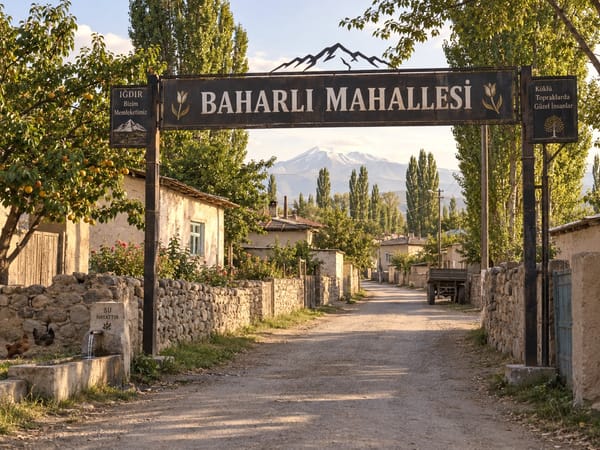
In 1930, two Kurdish leaders were at the forefront in Iğdır: Ahmed Şemo and Kerem Bey. Ali Mirze Bey was spending his days with his son Musa in Baharlı Neighborhood, in the tranquility and calmness that old age brings. He rarely went to the bazaar. Other Kurdish leaders were either in exile or had lost their material and spiritual strength due to poverty and the disarray following the rebellion.
One day, as Ahmed Şemo and Kerem Bey were chatting in Abdürrezak Bey's local, Numan Efendi's wife, Melahat Hanım, entered. She took off her headscarf and threw it in front of Ahmed Şemo and Kerem Bey: "If you are men, you will avenge Numan; if you don't, wear this headscarf on your heads, and let everyone know you as such!"
THE MURDER OF AZERI İSHAK BEY
Ahmed Şemo and Kerem Bey looked at each other. They decided that something had to be done. Kerem Bey summoned two individuals, an uncle and nephew, from Orgof (Suveren) village. Let's hear the rest from Yusufe Feqi from Orgof village:
"Elo (Ali), who killed İshak, is my own uncle. We live in Orgof village. As far as I've been told, there was once a very brave and troublesome Azeri named İshak in the Iğdır region. One day, somehow, he shot and killed Numan Efendi, one of the prominent Kurdish leaders. Upon this, the tribal leaders gathered and decided to have İshak killed. They entrusted this task to Elo's uncle, Mıhemmede Üzeyir. Ahmed Şemo and Kerem Bey gave him a horse and a pistol, encouraging Mıhemmede Üzeyir by saying, 'Don't be afraid, we will save you.'"
Mecit Hun writes in his memoirs that his father, Ahmed Şemo, was unaware of this murder plot, but various sources indicate otherwise. Ahmed Şemo gave his beloved Arabian horse, and Kerem Bey gave his pistol to the death squad. Moreover, money would be collected among the tribes and handed over to Elo's family.
Yusufe Feqi continues his narration:
"İshak's father-in-law's house was in Ağrı. One day, when news came that İshak was there, Mıhemmede Üzeyir summoned his nephew Elo, and the uncle and nephew set off for Ağrı. Since Mıhemmede Üzeyir's wife was Azeri, they had met İshak before. İshak even used to call Mıhemmede Üzeyir 'brother-in-law.' When the uncle and nephew arrived at the bazaar, Mıhemmede Üzeyir did not let his guard down.
"Elo, don't walk with me. Follow me. When I signal with my eyes, know that the man is İshak."
Mıhemmede Üzeyir finally found İshak in a coffeehouse and sat at his table. His father-in-law was also with him. They drank tea and chatted for a long time. Mıhemmede Üzeyir found an opportunity and signaled İshak with his eyes to Elo, who was standing at a distance.
After sitting a little longer, İshak and his father-in-law stood up and wanted to leave. At one point, İshak, somehow disturbed by Elo's gaze, expressed his concern to his father-in-law, saying, "My eye doesn't like this boor at all!" His father-in-law was indifferent: "İshak, who is that villager that you are afraid of him?"
They set off together.
When Mıhemmede Üzeyir was alone, he went to Elo and gave the command:
"Follow me; this time I will show you İshak's house. You will ambush him there and kill him. I will be waiting for you with the horse."
Together, they went to a house with a garden not far from the Governor's office. Mıhemmede Üzeyir left Elo alone and moved away. Elo waited for İshak in the garden. When no one came, he went back to the city center to gain time, wandering around. Towards evening, he returned home, entered the courtyard, and hid.
When İshak Bey and his father-in-law appeared in the distance, Elo readied the pistol in his hand. As they approached the courtyard, İshak Bey saw Elo and flinched, turning to his father-in-law and revealing his apprehension: "Didn't I tell you this boor would kill me? Look, he's in front of us again!"
His father-in-law paid little attention to İshak Bey's suspicion and unease. As İshak Bey headed for the door, Elo, with lightning speed, pointed the weapon in his hand at İshak Bey and emptied the bullets into him. His father-in-law fled in fear and disappeared. İshak Bey cried out in pain and fell to the ground. Mıhemmede Üzeyir was waiting near İshak's house, holding the reins of a mare. Hearing the gunshots, he jumped on his horse, ready to flee, waiting for Elo. However, when Elo went in the wrong direction, Mıhemmede Üzeyir moved away, galloping his horse to deliver the news of the death to the tribal leaders as soon as possible. When Mıhemmede Üzeyir arrived in front of Ahmed Şemo's tent with his horse, the horse, unable to withstand the exhaustion, collapsed and died.
As Elo moved away from the scene without running to avoid suspicion, he wanted to drink water from a fountain (Stork Fountain) he encountered. A woman standing near the fountain shouted:
"You killed that man. I saw it with my own eyes. May that water be forbidden to you!"
Elo panicked and moved away. At that moment, the gendarmerie and police arrived at the scene and pursued Elo. As Elo looked for a way to escape, he encountered someone trying to tame a wild horse in a garden. He pulled out his pistol and forced the man off the horse. As soon as the man got off the horse, the wild horse took advantage of the situation and galloped away. Elo, having lost his last hope, helplessly hid his weapon and surrendered to the gendarmerie. Under torture, he was forced to confess everything.
Elo was tried for many years with the death penalty. When his sentence was appealed, he received 20 years of life imprisonment. Five years of this sentence were pardoned due to Atatürk's death, and Elo was released after serving 15 years. He passed away in Orgof a few years ago."
İshak's relatives filed a criminal complaint, stating that "Ahmet Şemo and Kerem Bey encouraged and incited" the murder. Upon this complaint, the two respected and prominent leaders of Iğdır were arrested and imprisoned in Erzurum. Ahmed Şemo initially resisted, saying he had no knowledge of the incident. The prosecutor said, "How can that be? According to the intelligence we have, on the day you decided on the murder, you also said, 'Yes, yes!'"
Ahmed Şemo:
"If that's the case, then yes, yes!" he repeated his determination.
Many attempts were made to free the two Kurdish leaders from prison. Naci Güneş and Hacı İsa Yiğit, Ali Mirze Bey's son, managed to establish a special friendship with the judge, and they secured the release of Ahmed Şemo and Kerem Bey a year later.
Gurci Selçuk recounts:
To have İshak killed, my father, Kerem Bey, Osman Bey, Behçet Bey, and Eşref Bey were each going to give 100,000 liras to Mıhêmmede Üzeyir. My father also gave his best horse to Mıhêmmede Üzeyir. Osman, Behçet, and Eşref Beys, from the gentry of Doğubeyazıt, were Numan Efendi's friends and relatives of his first wife. In spring, we went up to the Sinek plateau. Meanwhile, Behçet and Eşref Beys were tracking İshak everywhere. Every day, news like 'İshak is in Erzurum, in D.Beyazıt' would reach our house. Finally, they cornered İshak in Ağrı city center.
İshak was walking arm in arm with someone. Mıhêmmede Üzeyir gave the pistol to Elo. Elo tracked İshak, and at an opportune moment, emptied the bullets into his back, then started running through the city center with the weapon in his hand. The police caught Elo at a fountain. In his very first interrogation, he confessed everything:
"Stop! I'll tell you everything. Ahmed Şemo gave the horse, Kerem Bey gave the pistol."
Mıhêmmede Üzeyir jumped on his horse to deliver the news and galloped towards the plateau. The poor animal, unable to withstand the exhaustion, collapsed in front of our house, gasping its last breath.
The soldiers first caught Kerem Bey. Kerem Bey had sent a message to my grandmother Gulizar: "They caught me, Ahmed should hide!" My father fled to avoid capture, hiding for a while in İsa (Konyar) Bey's house in Doğubeyazıt. He would occasionally come to the plateau but did not visit home. He secretly met with my mother Zeyno. One day, while my father was a guest in a house, soldiers surrounded the tent and caught my father.
They first took my father to Ağrı. He was held in prison there for three days. Meanwhile, my father found a way to summon our relative Qaso (Mala Sürmeli) and asked him to bring Temıre Gulê (the late Aziz Güney's father) to him as soon as possible. When Temıre Gulê arrived, my father made this request:
"I have been caught, and I don't know how many years I will stay in prison. I entrust my home, my children, and my possessions to you. Go and take the gold from my house to your own house. Everything of mine is entrusted to you until my children grow up!"
My father was later transferred to Erzurum Prison (Kelat). All the defendants were being tried with the death penalty. My father and Kerem Bey were staying in the same room. A young man named Mele Şeviç was also inside for an ordinary crime. Mele helped my father and Kerem Bey with their daily tasks, making them tea and so on. One day, he was airing their beds in the prison yard. My mother had sent a very beautiful carpet, which we called "carcim," to the prison to be spread over the beds. That day, Mele also took this "carcim" out and spread it on the wall in the sun. The judge's house was next to the prison. When the judge's wife saw the "carcim," she wanted to buy it, but Mele refused the offer, saying, "I am not the owner of the 'carcim'." When he explained this situation, my father said, "Next time you see the woman, tell her that if her husband helps us, I will give her the carpet for free!" A few days later, Mele Şeviç saw the judge's wife and conveyed my father's words.
One night, they secretly took my father to the judge's house. My father took this opportunity to tell his story. The judge said:
"Just as each of you gave 100,000 to have that man killed, now you will collect that much money and give it to me, and I will save you."
After returning to prison, my father explained the situation to Kerem Bey. Everyone sent word to their homes. Naci Güneş and Hacı İsa Yiğit delivered the requested money to the judge.
On the day of the trial, they knew they would be tried for death. Kerem Bey told my father: "Ahmede lo! Tu pêşiya me here!" asking him to sit in the front row. My father was calm. Kerem Bey's purpose in doing this was, in case a death sentence was issued, for him to maintain his composure by looking at my father. My father spoke and said:
"We do not know this person named Elo. We are well-known tribal leaders. Elo aims to get money from us by involving us in this matter."
The judge had already promised to help my father. My father and Kerem Bey were released.
After coming to Iğdır, my father and the others collected money among themselves and sent help to Elo in prison.
Dear reader! Today we know for certain that Numan Efendi was not killed by İshak Bey or his men. We also know with great certainty that the state did not plan this murder. Some books and articles state that the name Hüsnü Bingöl is behind the murder of Numan Efendi. This is also not possible because Hüsnü Bingöl's start date in Iğdır is 1932.
THE LATE CONFESSION
The soldier from Urfa who shot Aziz Gökbakan and accidentally killed Numan Efendi confessed on his deathbed. He had a letter written.
Let's hear the rest from Aziz Güney:
"We had a court clerk named İsrafil, originally from Ağrı and of Terekeme origin, who was the Chief Clerk. One day he pulled me aside and confessed: 'The soldier who killed Numan Efendi sent a letter, writing that he was suffering from pangs of conscience. His commanders had asked him to shoot Aziz Gökbakan, but the bullets accidentally hit Numan Efendi. When he learned how much Numan Efendi was loved in the city, he suffered from pangs of conscience for the rest of his life.'
When Numan Efendi died, he was buried as a single grave in a part of the town that would later become a cemetery. Unfortunately, this grave site is still lost. Sait Zor had promised to show me the grave site, but he passed away from a heart attack, and so it remained.
Mecit Hun concludes the chain of murder incidents as follows:
"This incident had a gratifying outcome: despite one of the deceased being Kurdish and the other Azeri, it did not lead to a Kurdish-Azeri animosity and conflict; common sense prevailed."
In fact, if these words are read carefully between the lines, these two murders can also be considered the beginning of a coolness and distant stance between the two groups.
A year after Numan Efendi's death, his wife Melahat and stepdaughter Semiha sold Numan Efendi's properties and settled in Bursa. Semiha married a teacher and continued her life.
Gurci Selçuk recounts:
"Years passed, Mecit (Hun) was doing his military service (1945-48), and one day we heard the news that Numan Efendi's stepdaughter had come to Tuzluca as an official. The young girl was inquiring, saying, 'My mother died. I am looking for my uncles Ahmed Şemo and Temıre Gulê. I learned that my uncle Ahmed passed away. I don't know anyone else.' Mecit went to Tuzluca after his military service, but Numan Efendi's daughter was no longer there. She had gone to a city no one knew. Since that day, no one has heard from that girl again."
DEAR READERS! THE IĞDIR AND MOUNT ARARAT REBELLION ARTICLE SERIES ENDS HERE.
IN MY NEXT ARTICLE, I WILL TALK ABOUT TWO IMPORTANT FIGURES WHO LEFT THEIR MARK ON IĞDIR.