Iğdır and the Mount Ararat Rebellion – Part 7
This part of the series details the final days of the Mount Ararat Rebellion, focusing on the human cost, the role of key figures like Ferzende, and the controversial involvement of Lawrence of Arabia, concluding with the rebellion's far-reaching consequences.
THE LAST DAY OF THE REBELLION
The rebellion now entered its final day. The army attacked from all sides. As the circle tightened, clashes intensified. The late Mahmut Alar describes the last day as follows:
“The military operation did not aim for total annihilation. There were mutual killings, but I did not hear of the soldiers systematically carrying out a massacre. If they had wanted to, they could have blocked the passes to Iran and, by moving at night, cleared out all the rebels. Indeed, most of the rebels fled to Iran, leaving their belongings behind.
During the general military assault, my father's house on Mount Ararat was among the rebels! I was a newborn, wrapped in swaddling clothes. That day, my mother was packing household items in front of the goat-hair tent and slowly loading eight oxen. Finally, it was time to dismantle the tent. Just then, my father appeared in the distance, galloping on horseback:
“Wife, it’s all over! We lost the war! Leave the house and the tents! We have no time to lose!”
They left our tent standing and our belongings inside, took a few blankets and me, wrapped in swaddling clothes, and quickly left the area.”
A ROMANTIC HERO: FERZENDE
Every war, every conflict, creates its own cowards and opportunists, just as it creates its own heroes. Heroes come in many forms. Some are those who, even in their most difficult moments, do not compromise on feelings of "humanity," "honor," and "sacrifice." They do not harbor feelings of "hatred" towards their enemy, or they do not fight with feelings of "hatred." In the Mount Ararat Rebellion, Ferzende (Ferzende Beg of Halit Beg) best represents this. Ferzende participated in the Sheikh Said Rebellion that broke out in 1925, and when the rebellion was defeated, he went to Iran with his loyal group.
Let's hear the rest from Gurci Selçuk:
“Mecit (Hun) was three or four months old (August 1925). Our encampment had moved to Arpa-Tepe (Mount Ararat). One day, two female cavalrymen, led by a guide on foot, came to our tents. The women were covered in white sheets. Everywhere they went, over mountains and stones, they asked, “We are looking for Ahmed Şemo’s house, how can we find it?” This is how they reached our house.
That day, Medete Gulê’s wedding ceremony with Ardê was taking place. My mother Fattê, with the curiosity and excitement of her youth, never missed a wedding or gathering. My mother Zeyno was very fond of Mecit; fearing the evil eye of the women at the wedding, she would not take Mecit out and preferred to stay home with him.
When the two women on horseback arrived at the house, my mother Zeyno was alone at home. Three or four-month-old Mecit was sound asleep. The women were coming from far away. One of them was named Besra. She was Ferzende’s wife, from the Hasanhan tribe. Ferzende, a relative of Cibranlı Halit Bey, was one of the important figures of the Mount Ararat Organization. Upon hearing the news that he was wounded, the two women had traveled from very far. The other woman was the wife of Sheikh Abdulhadi. Sheikh Abdulhadi was the brother of Sheikh Kasım, who was well-known in the region. Sheikh Kasım was also among the rebels.
The women drank tea. My father arrived. Mrs. Besra asked my father where she could find Ferzende. My father knew his location but did not tell her.
This is the story told about how Ferzende was wounded that day:
Ferzende received an offer for a meeting from Iranian government officials with a group of his friends. Sheikh Kasım was with them when the letter arrived. The Sheikh said, “I had a dream, let’s not go there, misfortune awaits us.” Despite this, they went to the meeting place. They were hosted in a building with high walls like a castle. At one point, the door opened, and a fat soldier entered and slapped Sheikh Kasım. The Kurds, reacting to this behavior, attacked the Iranians. Most of them died there due to the Iranian soldiers opening fire, and Ferzende escaped wounded.
Mrs. Besra stayed with us for a few days. My father sent word to Ferzende. When Ferzende allowed Besra to come to him, she went to a Kurdish village on the Iranian side, accompanied by my father’s guards. According to her account, when Mrs. Besra entered the room and saw Ferzende lying wounded on a floor mattress, she burst into tears and threw herself into his arms. She cried uncontrollably. They were left alone for a long time.”
Ferzende came to Mount Ararat in 1927 and joined Bıro Heski Telli. Mrs. Besra was also with him. Ferzende successfully carried out the responsibilities assigned to him. He was an exemplary leader. In a sense, he was the moral strength of the fighters. With his demeanor, behavior, speech, and courage, he quickly gained fame. One day, in a clash, two wounded Turkish soldiers were brought before him. Under the conditions of that day, execution was the preferred method. Ferzende, who had been wounded several times before, treated the soldiers with his own hands. He kept them in a cave for about a week to recover. At an opportune time, he sent them away from the war zone on horseback.
Sheikh Hasan Taysun recounts:
“Ferzende Beg, who was captured wounded by the Iranian government in a clash on (July 25) 1931, was imprisoned for ten years in Kasr-ı Kaçar in Tehran. He died in prison. While washing Ferzende Beg’s body, the Iranian officer on duty put his hand into Ferzende Beg’s eyes and said, ‘Who knows how many Iranian soldiers you killed with these eyes.’ Our relative who was present intervened and prevented the officer’s disrespectful behavior.”
Mrs. Besra followed Ferzende’s trail for many years. When she learned of his capture, she burst into tears. She left Iran and returned to her father’s house.
THE PAIN LEFT IN THE HEART BY THE MOUNT ARARAT REBELLION
The Mount Ararat Rebellion had a profound and multifaceted impact on the Kurdish tribes in the region. Some of the pains were naturally healed with the passage of time, but the psychological-sociological destruction and grievances that remain vivid in memory to this day continue to exist:
- The execution of innocent civilians, including children, women, and the elderly, from the Mametkan tribe, who had surrendered, on the Erhacı plain.
- The killing or victimization of civilians in the rebellion area during the suppression of the Mount Ararat Rebellion movement.
Oh, if only humanity had never known violence and war against its own kind; oh, if only the wars and massacres it committed had not been etched in its memory, perhaps it could have lived more peacefully. But we, helpless creatures, remember events from the near and distant past as vividly as if they happened today, seeing ourselves as victims or perpetrators, and continue our life's journey, stumbling and rising, with this pain or shame. The people of Iğdır also carry this memory with them.
HACI EKBER TUFAN'S HELPING HAND
There was a bond of friendship and sincerity between Bıro Heski Telli and Hacı Ekber Tufan, an Azerbaijani from the village of Melekli, that had developed since the civil war years in the Iğdır plain in 1919. To save the people in Melekli village, which was besieged by Armenian committees, Bıro Heski Telli came to Iğdır with a Kurdish cavalry unit from Bayezid province, took the civilians to the Erhacı plain, and ensured their safe passage to Iranian Azerbaijan. Strangely enough, this time Bıro Heski Telli asked Hacı Ekber Tufan for help. It was the last days of the rebellion. Mount Ararat was teeming with civilians. Hunger and thirst were at their peak. Bıro Heski Telli sent 70-80 children, women, and elderly people from the Mametkan tribe to Melekli village and conveyed a message to Hacı Ekber Tufan:
“The war here continues with full force. Hunger and scarcity have appeared. The army has decided to annihilate everyone who does not surrender. I ask you, as a friend, to take care of the civilian population until things calm down.”
Hacı Ekber Tufan, knowing that those who helped the rebels would be immediately shot, hosted the arriving civilians as best as he could. He placed one family in each house. However, the army was informed. The village was surrounded. The Mametkan people were rounded up one by one. They were loaded into five trucks and taken to Iğdır Center. Hacı Ekber Tufan had risked his life for the Kurdish civilians. He thought he would be shot. He was interrogated. Captain Nuri, who had helped Ahmed Şemo four years earlier, this time helped Hacı Ekber Tufan. He prevented him from being punished.
THE BITTER DAY OF THE MAMETKAN TRIBE
Five trucks, crammed with children, women, and the elderly, spent the night in İdirmava. Hacı Safiye Alagöz recounts what Salto Hanım, Bağır Aras’s wife, told her: “The trucks were lined up one after another along the canal. No one was allowed to get off. Water flowed through the ditch, but the children cried, ‘Water! Water!’ It was strictly forbidden for us to approach them. The residents of İdirmava looked at them with fearful eyes. They spent the night there. Early in the morning, the trucks moved and left.”
The trucks went to the Erhacı plain. The trucks were emptied. The civilians were gathered together. They were collectively shot. The bodies were left to their fate in the open. It is neither the number of those killed nor anything else that disturbs memories! The reason that lives vividly in memories, constricting hearts and knotting throats, is different: Wild animals consumed the bodies in the open field. Nothing was left. Despite this, Kurdish tribes did not go near the Erhacı plain for many years, not considering this piece of land, which was full of apprehension and pricked their conscience, as their own.
Years passed. One day, when everything was forgotten, a Kurdish tribe set up its goat-hair tent near the massacre plain. Children innocently played on the massacre plain. A child found a bead. He dug the earth and found other beads, pieces of clothing, a broken comb, a glove. He hid what he found from everyone, collecting them in a saddlebag. One day, his mother opened the saddlebag: It was crammed full of pieces of belongings. Soon it was understood what had happened, the tribe gathered, cried, cried, cried… It was as if the massacre had just happened!
THE FOUR LOST SISTERS
Almas Yancar, the granddaughter of Ali Mirze Bey, recounts:
“My father-in-law, Ehmedê Eli Ağa, actively participated in the Mount Ararat Rebellion. Ali Mirze Bey sent a message to my father-in-law in Korhan:
“Ehmede Eli Ağa, it seems the Turkish army has surrounded Mount Ararat from all sides. They will attack soon. Come with me to the Kandil plateau so that civilians are not harmed!”
My father-in-law did not warm to Ali Mirze Bey’s suggestion and decided to stay in the war zone.
The soldiers attacked one morning. The rebels, whose resistance was broken, began to retreat in groups towards the Iranian border. There was a complete panic. A few women and children who gathered together set off without waiting for others, fleeing day and night, over streams and hills, in a desperate struggle for survival.
My pregnant mother-in-law, taking her daughter Hatun with her, set off with Besê, who was also pregnant, and her daughter Cemile. When they saw soldiers approaching near the Iranian border, they hid.
The terrain was sandy and full of small bushes. My mother-in-law threw her two small daughters into a foxhole at the base of a bush, covering them with a blanket. Besê also hid behind the bushes.
The soldiers walked over the blanket but suspected nothing. However, Besê was not so lucky. The soldiers brutally killed Besê. My pregnant mother-in-law wanted to close her ears to the screams of death, but it was in vain. In the shock of what she experienced, she miscarried her child. After the soldiers left, she continued on her way with Hatun, crossed the border at a point called Dela Seva, and surrendered to the Iranian soldiers.
Hatun Hanım later married Şıh Hüseyin Balamir. Whenever she spoke about her childhood years, she would suddenly fall silent, her eyes fixed in space. Her memory of those years had been completely erased.
While these things were happening to my mother-in-law, my father-in-law was preparing to flee to Iran, putting his four daughters on horses.
Two younger stepbrothers, Mıste Eli and Xelile Eli, blocked my father-in-law’s way:
“Kekê (brother), on a day like this, you’re not thinking of anything but saving your own daughters, are you?”
My father-in-law took his four daughters, aged between three and thirteen, off the horse and hid them under a large oak bush:
“Don’t go anywhere, I’ll drop your uncles off in Iran and come back.”
However, when he returned, the Turkish soldiers had closed the border, so my father-in-law could not enter Turkey.
Towards winter, he crossed the border and went to Doğubayazıt. In those years, anyone who harbored or fed fugitives was immediately shot. No one wanted to take my father-in-law into their home. Finally, an acquaintance in Örtülü village took pity on his situation and opened his door.
It was the month of Ramadan. In the middle of the night, the homeowner loudly called his daughter Rukiye to wake her for sahur:
“Rukiye, Rukiye!”
My father-in-law woke up with a feeling mixed between half-dream and half-reality. For a moment, he thought it was his lost daughter Rukiye, but the homeowner’s daughter’s name was also Rukiye.
When he learned this, he cried uncontrollably. His crying lasted not minutes or hours, but days; he stopped eating and drinking, and died overwhelmed with sorrow.
His son Hüseyin decided to trace his four lost sisters. The names and ages of the sisters were as follows: Rukiye 13, Hazal 9, Zeynep 5, and Rabia 3. Hüseyin went to the region where his sisters had disappeared. He met an old woman living in one of the nearby villages.
The woman told this story:
“The place was a war zone. Unaccompanied children were fleeing in all directions. One evening, four girls came to my house. The eldest of the girls had tied the youngest of her sisters to her waist with a shawl and was holding her other sisters with both hands. The first thing they asked me was, ‘Metê av!’ (Auntie, give us water!).
About a dozen runaway children were hiding in my house. We were all in need of water. They stayed at my house that night. Towards midnight, the children were gasping for breath, their tongues hanging out from thirst, struggling for life. To alleviate their pain a little, I wet a piece of cloth with urine and applied it to their parched lips in turn. However, the newly arrived four sisters did not want me to do this to them. When I woke up in the morning, I realized they were not in the house, they had left.”
Hüseyin had learned that his sisters were alive. He would search for them his entire life, hope for them his entire life, and close his eyes to life with this longing in his heart without reaching a conclusion.”
BIRO HESKI TELLI CONTINUES TO FIGHT
The entire leadership cadre that organized the Mount Ararat Rebellion surrendered to the Iranian government. All except one: Bıro Heski Telli.
Sheikh Hasan Taysun recounts:
“Bıro Heski Telli rejected the Iranian government’s offer of asylum, saying, ‘I swore to pursue this cause until I die.’ He continued guerrilla warfare with his 50-man military force.
At one point, he made an agreement with the Iranian government and took Harman village as his residence. Iranian soldiers raided the village by surprise, surrounding Bıro Heski Telli. In the ensuing clashes, Bıro Heski Telli’s son Efrasiyav died, and his wife Rabia Hanım was captured. Bıro Heski Telli managed to break through the encirclement and escape.
Bıro Heski Telli continued guerrilla activities around Mount Ararat. On (July 25) 1931, Iranian soldiers, along with Milan tribal forces known as Geliya Sira, attacked Bıro Heski Telli.
Years later, I heard this story from one of the Milan tribesmen who participated in this attack:
‘As Milan militia forces, we were fighting at the forefront. We had made hot contact with Bıro Heski Telli and his friends and had them under siege. The clash continued with full intensity. Suddenly, Bıro Heski Telli’s rifle fell silent. Soon after, his brother Eyüp Ağa’s weapon, who was close to him, also fell silent. Bıro Heski Telli was seriously wounded. He was holding his rifle tightly. When one of our friends took the rifle from his hand, Bıro Heski Telli opened his eyes, looked at Mount Ararat, and spoke with difficulty.
“Alas! Glidağ ma bêxweyi!” (Alas! Mount Ararat is left without an owner!)
These were his last words.
With the death of Bıro Heski Telli, the Mount Ararat Rebellion also completely ended. The rebellion movement began with him and ended with his death.
ALMAS YANCAR RECOUNTS
After the forbidden zone was lifted (1950), we returned to Hıdırlı village and settled there. I had a friendship with an Azerbaijani woman named Ziver Hanım in Aralık district. Sometimes we would meet and chat. One day she told me this story:
“It was the days when the Mount Ararat Rebellion was dispersed. News was coming that civilians from the rebellion area had died, but since it was a forbidden zone, there was no coming and going. The only thing I knew was that every morning the dogs of our town would gather spontaneously like a flock of sheep and set off running towards Mount Ararat. When they returned in the evening, they would wander around with human bones in their mouths.”
Later, we learned that these dogs went to the Zemyan stream and ate the bodies lying in the open field there. The dogs had become so wild that no one could even approach them.”
THE FATE OF THE HELIKAN TRIBE
During the years of the rebellion, the entire Helikan tribe was settled on the Iranian side of the border. The Helikan tribe provided the greatest logistical support to the rebels. This aid disturbed the Turkish government. It issued an ultimatum to Iran to intervene. Iranian soldiers blockaded the Helikan encampment. This time, the Turkish government sent word to the Helikan tribal leader Halit Ağa, inviting him to Turkey. The entire Helikan tribe, unable to find a way out, entered Turkey. I leave the rest to Hüseyin Bademci’s account:
“The Helikan tribe, settled in Iran, crossed the border and came to Turkey in 1929, approximately 2000 families, upon the invitation of the Turkish Government. They were detained for about a month at the State Production Farm (in those years there were villages vacated by the Brukan tribe here), and later settled in Tuzluca (Kulp) for a year. The following year, our tribe, which hoped to live together collectively, was unfortunately shattered and scattered in all directions.
One day, suddenly loaded onto trucks, the Helikan tribe was taken to Trabzon port. The tribal leader Halit Ağa and some of his households were sent to Thrace, and the group my father belonged to was sent to the Aegean. (Those with animals were sent to Thrace, those without to the Aegean.) The tribe was separated, with no more than two families per village, and their identity and honor were offended.
Halit Ağa, the leader of the Helikan tribe, was a prominent figure in the region, known for his effectiveness, influence, common sense, and loyalty to his tribe. Halit Ağa, who was settled in Değirmen village in Çorlu, died and was buried there. Since he had no children, his brother’s children tried to lead the tribe.
The years of exile were not easy for my family. Tribe members transported by ships from Trabzon were taken to İzmir Train Station, and from there transported by trains to Aydın. After being detained for a week in Bey Camii, they were distributed to each village, with no more than two families per village. Their departure from the village was subject to permission. Even going to and from Söke center involved long and tedious bureaucratic procedures that damaged human dignity. Our family could not travel outside this village for 12 years!
When the DP came to power in 1950, the obstacles to families who wished to return were removed with an amnesty, and thus the scattered Helikan tribe gradually reunited in Hasanhan village through a reverse migration, eagerly embarking on a new life with the bitterness and longing caused by 20 years of separation. Today, approximately 80% of Hasanhan village belongs to the Helikan tribe, and the rest to the Keleşkan tribe.”
CONSEQUENCES OF THE MOUNT ARARAT REBELLION
The political, economic, social, and psychological consequences of the Mount Ararat Rebellion were severe:
- Due to three consecutive defeats within 10 years, the Kurds buried their political hopes. Kurmanji-Alevi Kurds were defeated in the Koçgiri Rebellion; Zazaki-Sunni Kurds in the Sheikh Said Rebellion, and Kurmanji-Sunni Kurds in the Mount Ararat Rebellion, respectively. The development of national consciousness was delayed for nearly 30-40 years. Due to harsh assimilation policies and gendarmerie pressure, an accumulation of "anger" built up among the Kurds, and in the political environment that developed from the 1970s onwards, this "anger" expressed itself in an "uncontrolled" manner. Turkey may still be paying the price for this "anger." Today, those who ponder the Kurdish issue must take into account past events and shape their political programs accordingly. Understandings that ignore or downplay the past cannot contribute to the development of peace in Turkey. It should not be forgotten that the spirit and mind of Kurdish youth are shaped by stories of victimization or heroism told to them from an early age.
- During the Mount Ararat Rebellion, the rebels did not receive sufficient financial aid promised by the Taşnak Armenians, nor did they receive serious diplomatic support beyond a few ordinary initiatives. For example, they did not publicize the civilian massacre in the Zilan valley to the international community, nor did they appeal to the League of Nations on this matter. Numan Efendi tried to inform Hoybun and the League of Nations to the best of his abilities, at least ensuring the creation of a League of Nations-controlled zone in Iranian territory. Civilians who took refuge there were dispersed as refugees around the world.
- On March 18, 1928, İhsan Nuri Pasha, who arrived at Mount Ararat, formed a war council. He made appointments for governors, district governors, sub-district directors, gendarmerie commanders, etc. The council determined the political and military objectives of the rebellion movement. A military hierarchy was established, but in practice, this structure did not function effectively. Ranks and assigned responsibilities had no practical equivalent. İhsan Nuri Pasha could not establish the modern army structure he desired. The war continued with habits inherited from the Hamidiye Regiments.
- The Armenian Taşnak Party, in a sense, first approached the rebellion movement as if it wanted the Kurds to share a similar fate of "deportation" or "genocide," and then distanced itself. After the rebellion, the Kurds were subjected to the implementation of a "partial deportation" or "forced settlement" law, targeting specific families and tribes, instead of mass deportation. The Hoybun Society's taking seriously the promises made by the Taşnak Armenians has been recorded as a historical mistake.
- The widespread participation of experienced Kurdish warrior units, once part of the Hamidiye Regiments, in the rebellion transformed it more into an act of "revenge" against the newly established Republic (due to the 1926 law on the exile of Ağa and Beys) rather than a national movement, and coordination among tribes could not be achieved. "National consciousness" was relegated to the background. The idealistic İhsan Nuri Pasha remained completely ineffective and inadequate. He failed to unite Kurds of different sects and languages, and even failed to eliminate hostilities within the critically important Celali tribe and establish peace.
- During the establishment of the Soviet Union, a bloody civil war lasting four years took place between the White Army and the Red Army between 1918 and 1922. In this civil war, the USA, Britain, and France supported the White Army. The unification of imperialist countries to destroy the world's first socialist country made the Soviets extraordinarily suspicious in those years. The Soviets, thinking that a rebellion supported by Britain and a state to be established on its border would create problems in the future, unconditionally supported Turkey, participated in bombardments with their planes, and Red Army units crossed the Aras when necessary to support the Turkish army. Not content with this, they issued an ultimatum to Iran and then entered Iranian territory, forcing Iran to take a stance against the rebels or accelerating this process. In later years, the Soviets made various demands from Turkey in return for these "favors," and these demands were met without hesitation. For example, Mehmet Emin Resulzade, the founder and first President of the Azerbaijan Republic, took refuge in Turkey but was expelled from Turkey in 1931 at the request of the Soviets.
- Most likely, when the Hoybun Society was founded, Britain, the superior will that brought Kurds and Armenians together under the same roof, promised weapons and ammunition to the rebellion movement, but this could not be realized in the desired quantity. The reader should not forget that in those years, Britain was the most powerful state in the world. America became a world power after the Second World War.
- The Hoybun Society, while planning the rebellion, hoped to receive support from Iran, which was of the same ethnicity, but they forgot that they were Sunni and the Persians were Shia. Shiism still holds a supra-ethnic power in Iran. Iran did not consent to the establishment of a Sunni state next to it.
- Kurdish tribes and civilians experienced deep suffering. Oral narratives passed down from generation to generation caused the new generation of Kurdish youth to distance themselves from the values of the Republic. If Turks and Kurds had been able to develop political projects suitable for the characteristics of the period within a framework of mutual trust and respect with the establishment of the Republic, they could undoubtedly have transformed into a world power as a country inheriting an empire. It is now too late to look for culprits retrospectively!
- Since the borders were closed, most of the rebels who could not flee to Iran scattered, spending the winter of 1930 in difficult conditions. They took refuge with acquaintances in villages. At the slightest tip-off, soldiers would shoot the rebels along with the families who hosted them. Such a situation also occurred in Karakuyu village. A rebel hid in the village, but the army was tipped off. The village was surrounded. If the rebel was found, the price would be heavy. Ahmed Şemo prepared a camel caravan and ensured that the rebel left the village as if he were the camel driver. The village breathed a sigh of relief.
- Because the Red Army took very strict measures along the Aras River, which forms the border, the flight of the Azerbaijani population living in the Soviet Union to Turkey was interrupted between 1928 and 1935.
- Three nations living in the same or neighboring geography—Armenians, Azerbaijanis, and Kurds—faced each other due to the nation-state project. For example, if we go back to 1910, Kurds and Armenians lived intertwined, village by village, town by town, in Eastern Anatolia in the Ottoman Empire. At the same time, Azerbaijanis and Armenians lived side by side in Tsarist Russia. While Kurds were divided between Iran and the Ottoman Empire, Azerbaijanis were divided between Tsarist Russia and Iran, and Armenians between the Ottoman Empire and Tsarist Russia. In such an extraordinarily difficult geography, one does not need to be a prophet to foresee that "catastrophes" would occur in the future. And these catastrophes have occurred in succession and continue to occur.
- Kurdish tribes (Kızılbaşoğlu, Sakan) who participated in the rebellion took refuge in Iran, lived there as refugees for years, and returned to Turkey in the 1950s. Kurdish tribes who did not participate in the rebellion were also removed from their villages around Mount Ararat, in a sense, left to their own devices.
If you wish, let me convey to you the experiences of the Gêloî tribe from Gurci Selçuk’s account:
“The Gêloî tribe spent the summer of 1930 in Tuzluca, on the Sinek plateau. In mid-September, the cold weather began, but the state did not allow the Gêloî tribe to return to the villages of Adetli and Karahacılı because they were within the forbidden zone. The tribe was in distress in their goat-hair tents. The animals would perish. My father, Ahmed Şemo, mounted his Arabian horse and went alone to Doğubayazıt. He reached the headquarters building to meet Salih Pasha. These were the days when the rebellion had just been suppressed. Soldiers were treating every Kurd they encountered badly. They confiscated my father’s Arabian horse.
My father appeared before Salih Pasha:
“Pasha! The villages where my tribe spends the winter are within the Forbidden Zone. Winter is at the door. I need help?”
“You can take your tribe and go towards Van or Muş.”
“No! The state made the Forbidden Zone decision, and we were victimized. The responsibility belongs to you, to the state. You must help.”
“Ahmed Ağa! You are a rich, wealthy man. Take your family and go to Istanbul. Let your tribe do whatever it wants!”
“Pasha! My camel caravans were confiscated to transport weapons for the military. A Forbidden Zone was declared, my village was confiscated. Your soldiers confiscated my Arabian horse. And now you are confiscating the fate of my tribe. Do you find all this right?”
Salih Pasha was both disturbed by my father’s audacious outburst and pleased that he questioned his sense of right and justice.
At that moment, an explosion was heard from afar. Salih Pasha opened the window, looked carefully towards Mount Ararat with binoculars for a while, then closed the window and returned to his desk.
My father said something that pushed the boundaries:
“Pasha, you are trying to see distant things with binoculars, but you are ignoring a situation that is nakedly before your eyes.”
Salih Pasha realized that he was facing someone he was not accustomed to. He tried to balance the situation:
“Alright! Agreed! Your tribe can settle in one of the mountain villages.”
“No! My village of Adetli, which is within the Forbidden Zone, is located at the beginning of the plain. It is not a mountain village. I want a similar village.”
Salih Pasha called his assistants. Telegrams were sent. Karakuyu village, which the Yazidis had vacated in 1920, was deemed suitable. Salih Pasha also ordered the release of the camel caravans and the Arabian horse.
As my father left the room, Salih Pasha handed Ahmed Şemo the binoculars hanging on the wall.
“I no longer need these binoculars! I can see everything better with my naked eyes. This is my gift to you in the name of our friendship. Also, I cannot compensate you financially for the damage you suffered because your camel caravans were confiscated, but I am giving you my gold watch. Thus, I want you to remember, every time you use it, that the state also strives to be fair and is committed to justice.”
The Geloî tribe spent the winter of 1930 in Karakuyu village, which was formerly a Yazidi village, abandoned for ten years, and turned into ruins, and settled there completely in subsequent years.
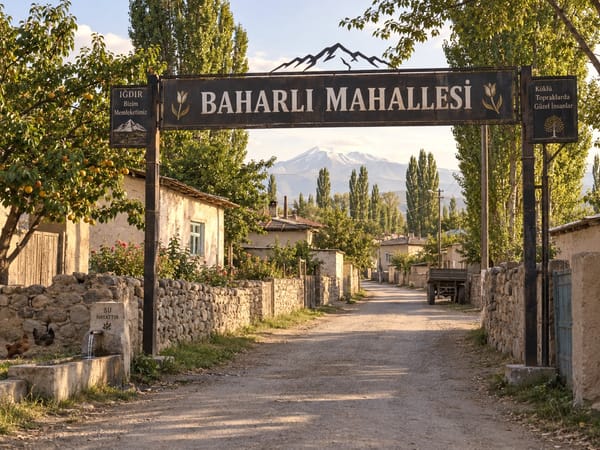
Ahmed Şemo and his father-in-law Ali Mirze Bey settled in the city by buying a house in Baharlı Neighborhood (November 14).
NOTE: Some claim that Salih Pasha contacted Ahmed Şemo before the rebellion was suppressed, and by gifting him binoculars and a gold watch, ensured his departure from the Mount Ararat region. This is not true. Salih Pasha assumed responsibility as the Commander of the 9th Army with the rank of Lieutenant General on March 18, 1930. At that time, the Gêloî tribe had already decided not to go to Mount Ararat. It was the lambing season for the sheep. They had set up their goat-hair tents in the Kıraçbağ reeds. Salih Pasha moved his headquarters to Bayezid province on July 20, 1930. Since the Gêloî tribe was already on the Sinek plateau at that time, he had no contact or closeness with Ahmed Şemo. Salih Pasha spent most of his time trying to persuade the tribes participating in the rebellion and managing the military operation.
LAWRENCE IN THE MOUNT ARARAT REBELLION
T.E. Lawrence, or Lawrence of Arabia as he is known, was a famous British spy. During World War I, he almost single-handedly incited the Arabs against the Ottoman Empire, largely succeeding in his aim.
During the Mount Ararat Rebellions, which continued between 1926 and 1930, oral accounts of Lawrence being in the region are quite intense among the people. Did the British really send Lawrence to the region to turn the Kurdish Rebellion into an Arab rebellion? No academic or historical study has been conducted on this matter. When I wrote the book Iğdır Sevdası (2002), there was no article or book written on this subject.
There is another British spy named Major Noel. The name Noel is confused with the name Lawrence. Major Noel was a British intelligence officer who operated in Eastern Anatolia during the Armistice of Mudros. On September 7-8, 1919, Mustafa Kemal received information that Major Noel was circulating. He telegraphed the Malatya Regiment Commander Cemal Bey and asked:
“A British major has arrived there. Please inform me of his name and who is with him.”
Cemal Bey replied:
“His name in his documents is Covbertin Noel. With him are Bedirhanzade Kâmuran, and Celadet Beys, as well as Diyarbekirli (Diyarbakır) Cemil Paşazade Ekrem Bey and Diyarbekirli Hilmi Efendi, and some other Kurds.”
In short, Major Noel definitely did not visit the Mount Ararat region.
LAWRENCE AND THE DOCUMENTS
However, everyone I interviewed had either heard the name Lawrence or had a memory of an event related to him. Initially, I approached the information I was given with skepticism. It did not seem logical to me to accept that the British spy Lawrence played a role in the Mount Ararat Rebellion. Nevertheless, I tirelessly compiled the information in the public memory and published it in my book Iğdır Sevdası. I received criticism from many quarters. Because if this information was true, it would prove that there was a British hand behind the Mount Ararat Rebellion. After the book was published, I continued my research.
I first encountered documents on this subject, interestingly enough, in the archives of the State Library in Moscow. The Russian press of the period wrote that the British had instigated the Ararat Uprising to create a buffer zone in eastern Turkey against Russia, armed the Kurdish rebels with machine guns and state-of-the-art pistols, and even sent the famous British spy Lawrence to Maku to organize the Kurds. The secret report dated August 11, 1930, sent by the British Consul General in Tabriz to his Foreign Minister, contained statements that Lawrence had helped the Kurds. Salih Omurtak Pasha also reported that Lawrence was seen in Baghdad, wandering among the people with a child under the pseudonym Hacı Mehmet.
There was an interesting situation: Turkey and the Soviet Union claimed that there was a British hand behind the Mount Ararat Rebellion, stating that it was an imperialist project at international meetings like the Comintern, but on the other hand, Turkey suppressed the Mount Ararat Rebellion, which was an "English project," with 100 aircraft, mostly British and Czechoslovakian-made Letov S-16s.
The rumor that Colonel Lawrence was seen around Mount Ararat in May 1930 is almost certainly accepted by both Turkish and foreign diplomats in the region. During the Ararat rebellion, in a secret report dated August 11, 1930, number 145, sent from Stanhope Palmer, the British Consul General in Tabriz, to Sir Clive at the Foreign Office in London, it was reported that the famous British spy Colonel Lawrence had helped the Kurds. The British press of the time wrote that rumors about Lawrence should not be considered suspicious.
WHO IS LAWRENCE?
Thomas Edward Lawrence (August 15, 1888 – May 19, 1935) was a British archaeologist, soldier, and diplomat. He is famous for his role against Ottoman Empire rule in events such as the Arab Revolt and the Sinai and Palestine Campaign between 1916 and 1918. He was popularly known as Lawrence of Arabia. He was awarded the Distinguished Service Order and the British High Knight’s Cross.
Lawrence was an extremely intelligent person who spoke French, German, Latin, Greek, Arabic, Turkish, Syriac, and Persian perfectly, and had the ability to quickly adapt to other languages. In the book The Golden Warrior: The Life and Legend of Lawrence of Arabia and other works, it is written that Lawrence, who conducted archaeological studies in Karkamış in 1911, met Kurds there and quickly learned Kurdish. Indeed, in the memoirs I will quote shortly, it is stated that Lawrence spoke Turkish, Kurdish, and sometimes Arabic with the people. I would like to remind you that there is a cave known as "Lawrence's Cave" in the north of the region known today as the Hell Valley of Mount Ararat. Lawrence spent most of his day in this cave.
LAWRENCE IN THE PEOPLE'S MEMORY
YAŞAR AYDIN RECOUNTS
“However, this struggle (Mount Ararat Rebellion) had nothing to do with the ‘Kurdish’ cause, as was thought. How could it? The militia forces (rebel forces) would raid villages like Kellehemo, Bızırxan, Zor, Alıköçek, Muça, and Kundo at the first opportunity they got and seize animals. As a result, the villagers sided with the state.
The British government also sent Lawrence to the region to closely monitor the rebels gathered on Mount Ararat. Lawrence brought quite a few Qurans with him to understand whether the rebels’ true intention was religion or nationalism. He gave lessons on religion, racism, and law. He explained that Prophet Muhammad commanded that ‘it is not meritorious for slaves to pray and fast.’ Occasionally, he would climb onto a large stone to pray, and it was later understood that he would place a battery-powered light bulb in his beard and pray with a radiant face (!). Those present would watch the sheikh (!) with great fear and admiration. They would respectfully kiss Lawrence’s skirts and even the stone on which he prayed.”
HACI ABDULLAH ÇOKTİN RECOUNTS
“One day, a man named Molla Hüseyin came to the camp (Mount Ararat). His appearance and speech were strange; he did not resemble our people. He was staying in a tent down in the valley. I was passing near the tent with my lambs in front of me. İhsan Nuri Pasha, who was chatting with Molla Hüseyin, called me over. Molla Hüseyin placed a bowl of water in front of me and covered me with a blanket.
“Son, what do you see?” he asked.
“Nothing, just water!”
Molla Hüseyin repeated angrily:
“Look carefully! What do you see?”
I really didn’t see anything.
“Just the bowl and water!”
Molla Hüseyin lifted the blanket from me and sent me away, saying, “Go!”
There was no one who didn’t know Molla Hüseyin. Women, in particular, flocked to him to have amulets written. Years later, I learned that this Molla Hüseyin was none other than the British spy Lawrence!”
ALMAS YANCAR RECOUNTS
“My father-in-law, Ehmede Eli Ağa, actively participated in the Mount Ararat Rebellion. According to him, in those years, there was a foreigner among the rebel forces in the Korhan region, known by the nickname ‘Sheikh’ but popularly called ‘Lovrens’ (Lawrence). He would wander around with a 14-year-old boy named Ahmet. This boy never spoke to anyone and never answered any questions asked. Sheikh Lovrens stayed as a guest in my father-in-law’s house for about a month. He spoke Kurdish with a different accent but mostly gave Arabic interpretations. Occasionally, he would enter a huge cave and shout in a language no one understood. When he came down, he would be covered in sweat.
Since my father-in-law knew Arabic, the ‘Sheikh’ would give him long interpretations and religious admonitions. The people in the region had somehow convinced themselves of the ‘Sheikh’s miracles. When they fell ill, they would go to him and ask for amulets to be written. For some reason, after a few patients recovered, their devotion to the ‘Sheikh’ increased even more. The ‘Sheikh’ also wrote such an amulet for my mother-in-law, admonishing her, ‘Do not part with this amulet; when you die, let it hang at your bedside!’ My mother-in-law never parted with this amulet until 1966. That year, she suddenly decided to burn the amulet, considering it a sin.”
It was late summer of 1930. Ali Mirze Bey conveyed this message to my father-in-law in Korhan: “Ehmede Eli Ağa, it seems the Turkish army has surrounded Mount Ararat from all sides. They will attack soon. Come with me to the Kandil plateau so that civilians are not harmed!”
My father-in-law had a nightmare that night. Mount Ararat had erupted, and he himself was thrown towards the Zemyan stream, barely surviving by grabbing a bush on the edge of the cliff. His body was swaying in the air in the strong wind. When he woke up, covered in sweat, he tried to make sense of his dream. Any dream interpreter would interpret the nightmare as ‘danger is coming, be careful!’ But he wanted to go to the ‘Sheikh’ and get his opinion. The Sheikh interpreted it in his own way:
‘Ehmede Eli Ağa, this dream means that you will defeat the Turkish Army and make Islam victorious. The bush you caught on the edge of the cliff represents Islam, which you will always trust. Hold on, victory is near!’
Upon the Sheikh’s interpretation, my father-in-law decided to stay in the war zone.
SHEIKH HASAN TAYSUN RECOUNTS
Lawrence, dressed as a sheikh, introduced himself as Sheikh Hüseyine Berjeri. He was accompanied by a thirteen or fourteen-year-old boy. They stayed in a cave on the northern slope of Mount Ararat. To give the impression of being a sheikh with miraculous powers, Lawrence would place a flashlight at his feet in the evenings and look out of the cave, bathed in light (!). Since flashlights and batteries were not yet known, the villagers showed great admiration and respect for the Sheikh (!).
Lawrence, who spoke Kurdish and Turkish beautifully, would cover his mouth when he laughed so that his fake beard would not show, saying, ‘My teeth should not be seen.’
Before leaving, Lawrence visited Bıro Heskî Telli, the most important leader of the rebellion, and advised him:
“It is impossible for you to deal with the government. The best thing is to seek a way to make an agreement with them.”
He threw his saddlebag full of books over his shoulder and set off towards Iran with the boy.
As soon as Lawrence moved away from the rebellion area, he took off his fake beard. Without his beard, he greeted a group of Kurdish fighters coming from the opposite direction and continued on his way.
When the Kurdish fighters arrived at the zom (camp site), Bıro Heseki Telli asked:
“Did you encounter Sheikh Hüseyin Berjêr on the way?”
The fighters:
“No! But we encountered a beardless man of forty to forty-five years old with a child.”
Bıro Heseki Telli did not suspect anything, merely saying, ‘He must have miraculous powers!’
GURCİ SELÇUK RECOUNTS
“We returned to Adetli village in the autumn (1929). Later, a Sheikh (!) whom we learned was British, went from house to house, inciting Kurdish tribes against the Turks (Romê Rêş). I saw this sheikh many times myself. His face was covered with a veil. He had a 12-14 year old boy with him. He also came to our house and communicated with my father in Turkish. I didn’t understand what they were talking about, but from their facial expressions, it was clear they were discussing a serious matter. Later, according to what was told, the Sheikh was saying, ‘Don’t follow the Turks. Follow me. I will extract salt and minerals here and distribute them to you.’ He came to our house one last time. My father, as usual, slaughtered a lamb and hosted him. After long discussions, when he couldn’t convince my father, he left in a huff. After he left, my father repeatedly told the household that this man was not a sheikh and that he didn’t trust him.”
CONCLUSION: LAWRENCE'S IMPACT ON THE REBELLION
We do not have full information about Lawrence's assessments regarding the Mount Ararat Rebellion or the coded reports he sent on this matter. However, we have the chance to understand and interpret the nature and content of Lawrence's recommendations indirectly. It is highly probable that in his observations in the Mount Ararat Region, Lawrence could not perceive any common "national consciousness" or strong "Turkish hatred" that would mobilize the Kurds. For example, the most important factor that mobilized Arab Nationalism was "Turkish hatred." However, this feeling was not strongly embedded in the consciousness of the rebels in the Kurdish Rebellion. I would like to make a reminder. While not a single Arab tribe supported the Turkish army during the Arab Rebellions, a considerable number of Kurdish tribes supported the Turkish Army in both the Sheikh Said Rebellion and the Mount Ararat Rebellion, and even participated in joint operations. In the Arab Rebellion, "Fusha," or standard Arabic, united all Arabs, thus leading to the emergence of a considerable "national consciousness." Since the Kurds had a fragmented structure in terms of language and sect, a "common denominator," or "national consciousness," did not form in terms of either language or religion. The cooperation of the Soviets, Turkey, and Iran in suppressing the rebellion was also the last straw. Lawrence most likely left the region in disappointment.
TO BE CONTINUED
IN MY NEXT ARTICLE, I WILL WRITE ABOUT THE MURDERS OF KURDISH NUMAN EFENDİ AND AZERBAIJANI ISHAK BEY. HOPE TO SEE YOU THEN..