Iğdır Youth and Vision
This essay explores the unique challenges and opportunities facing the youth of Iğdır, a city at the crossroads of diverse political, social, and religious influences.

I intentionally and knowingly included the word "Iğdır" in the title of my article. This is because the youth of Iğdır live intertwined with political, social, religious, economic, and other problems that do not exist in any other city or region of Turkey, or in other words, they are struggling in a multifaceted chaos. Unfortunately, the number of books and articles they can rely on for support in this regard is very limited. Furthermore, it seems almost impossible for an academic from outside to understand the hidden spirit of Iğdır. I hope that with this article, I can provide the beloved youth of Iğdır with a new perspective, even if only slightly.
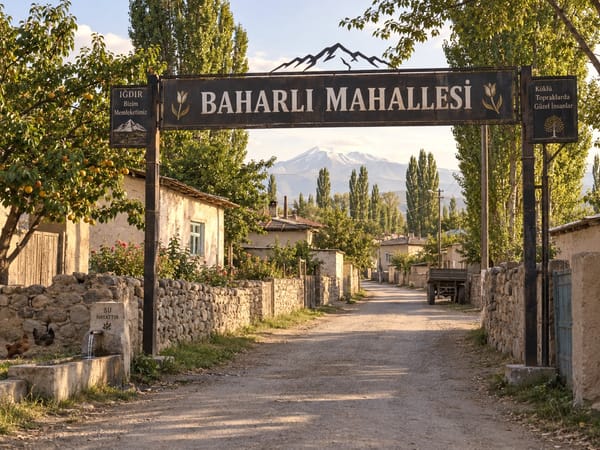
I, too, am a child of Iğdır's soil. I grew up in the shadow of Mount Ararat. My childhood was spent in Baharlı Neighborhood (14 Kasım Neighborhood). My neighbors' children were Azeri, Terekeme, and Kurdish. We played football together, lay on the dusty streets playing marbles, filled cinema queues together, and passed Texas-Tommiks comics from hand to hand. There was a sense of togetherness and unity in our souls. One day, the right-left polarization scattered us in all directions, like a strong autumn wind blowing the leaves of poplar trees. Of course, the right-left conflict was experienced all over Turkey in those years, but in Iğdır, this polarization manifested itself in a different and sharper dimension. My dear brother Adnan Şur penned his memories of that period on his Facebook page under the title "MY EXPERIENCES AND OBSERVATIONS AS A SOCIALIST DURING THE DARK YEARS OF TURKEY AND IĞDIR." He conveyed his experiences as a socialist with an objective and sincere emotion. I hope that in the near future, my Ülkücü (Idealist) brothers who lived through that period will also write down their feelings and experiences, leaving their experiences as a valuable legacy for the youth of Iğdır. Even if these memories sometimes seem incomplete and biased, they will help illuminate the path for today's youth and prevent them from repeating past mistakes, even if only slightly. They will also have the opportunity to learn from their fathers' past experiences and evaluate themselves better.
Now I want to get to the essence of the article: What are the political and sectarian values, or other similar ideas, that encircle the youth of Iğdır like an octopus, preventing them from breathing? I have always seen the youth of Iğdır as courageous and eager to surpass themselves. However, because their paths are not opened and their self-confidence is taken away, they cannot form a "vision," and unfortunately, they squander the great potential they carry within them by continuing their lives amidst the ordinary preoccupations of daily life.
Dear youth of Iğdır! Since I dedicate this article to you, I want to speak with you face-to-face and heart-to-heart. Let's discuss together the hidden, unnamed, and unspoken social and political tendencies and ideas, and from there, redefine ourselves.
The youth of Iğdır are under dual pressure in both macro (large) and micro (small) senses. Let's examine these two-pronged pincers together:
MACRO DYNAMICS OF IĞDIR YOUTH
As I stated in my previous articles, Iğdır has left behind an unfortunate and painful century. Geographically, it is located on a sectarian and ethnic fault line. First, let's discuss the macro missions (tasks) imposed on the youth of Iğdır. These issues can be grouped under the following main headings:
- TURAN IDEAL: Iğdır, due to its geographical location, serves as a bridge connecting Turkey to Central Asia. There are many books on how the Turan Ideal emerged. I do not find it appropriate to detail this here. After many changes, the best accepted definition is given by Ziya Gökalp. According to Ziya Gökalp, Turan is the common name for the ideal homeland that brings all Turks together. Ziya Gökalp describes all countries where Turks live and Turkish is spoken as Turan.
- KURDISTAN IDEAL: The Kurdish-origin youth in Iğdır carry the ideal of an "Independent and United Kurdistan," which emerged among Kurdish intellectuals in Istanbul at the beginning of the 20th century and was most debated in the 1970s, as a distant goal in a corner of their minds and hearts.
- SHIITE WORLD: The Azeri population in Iğdır belongs to the Ja'fari (Shiite) sect. The Iğdır Ja'fari community, which has produced very important spiritual and religious leaders, continues its existence as an important social force.
- NURCULUK AND NAQSHBANDIYYA: Similarly, especially among Kurds adhering to the Shafi'i sect, there is a strong Nurculuk and Naqshbandiyya movement at the grassroots and among the people, influenced by religious madrasahs that have secretly continued their existence for over a century.
The youth of Iğdır are trapped between the two political and two religious macro movements and definitions that I have grouped under the four main headings above.
Now I want to draw your attention to a more important point. The words and phrases I grouped under the main headings above have been defined as "forbidden" by the official state ideology, either in the past or currently. The word "Turan" was almost banned during İnönü's time, and in 1944, Nihal Atsız and his friends were subjected to legal prosecution. The use of the word "Kurdistan" still makes hearts tremble and instills fear. The official state approached those who adhered to the Ja'fari sect with suspicion for years. Ashura ceremonies were performed secretly. Nurculuk was banned for many years and continued its existence secretly. Because the youth of Iğdır are forced to choose between these "forbidden" or "contrary to official ideology" definitions, they miss the chance to be at peace with the state they live in, reducing themselves to the status of a secret "dissident." This hinders their creativity and takes away their chance to develop a vision.
Moreover, these religious and political definitions are in open or hidden competition in Iğdır. I would like to ask this question: In which region of Turkey can such four important macro definitions find a chance to exist within the borders of a single province at the same time and engage in an open or hidden struggle to assert themselves? In this sense, the youth of Iğdır are forced to choose one or more of these identities assigned to them from birth. Although the youth, whose individual freedom of choice is taken away, are physically "young," their minds and thoughts are crushed under the weight of centuries of political and religious definitions and sacred trusts.
MICRO DYNAMICS OF IĞDIR YOUTH
Now let's open up the discussion about the micro dynamics within which the youth of Iğdır find themselves. While the youth of Iğdır carry the macro-level religious and political values mentioned above in their minds and souls, they are actually unconsciously overlooking more important problems. Today, the main reasons for the unhappiness of Iğdır's youth can be listed as follows:
- UNEMPLOYMENT: The greatest punishment that can be given to a young person is to leave them unemployed. An unemployed young person feels that they are not valued and are worthless in society. Especially graduating from university or college and remaining unemployed is equivalent to carrying a deadly knife wound in one's heart. Youth who see themselves as "worthless" and "nothing" cannot be happy and make the society they live in unhappy.
- EDUCATION: A young person who cannot get into university or vocational school has almost no future. Iğdır has undergone a social transformation. A Kurdish young person whose father was involved in animal husbandry does not want to do animal husbandry even if they are unemployed. An Azeri young person whose father was a farmer does not want to do farming even if they are unemployed. Thus, educated unemployed and uneducated unemployed carry the same sadness, the feeling of "nothingness" and "worthlessness" in their hearts.
- PHYSICAL APPEARANCE: This may sound strange at first, but one of the most important sensitivities of youth is their inability to be at peace with their "physical appearance." They secretly carry this shame (!) within them, and because they cannot get psychological support, the "inferiority complex" and "lack of self-confidence," which are considered the diseases of the century, soon become a part of their personality. In Iğdır, there is a traditional weakness of giving "nicknames." The life of a young person who is called by the "nickname" given to them is, in a sense, darkened.
- FAMILY PROBLEMS: The problems young people experience with their own parents or siblings are also becoming increasingly serious. When this conflict becomes continuous, the self-confidence of the youth decreases, their horizons narrow, they continue their lives by taking refuge in a small world, or they rebel against the family and participate in religious or political movements that we define as macro, seeking an identity for themselves.
- SUBSTANCE ADDICTION: Since I do not have statistical information on substance addiction among Iğdır youth, I cannot elaborate on this issue further. However, general experience suggests that this could somehow exist in Iğdır and enslave the youth.
- GREED FOR MONEY AND MATERIAL: Turkey has turned into a consumer society. Youth are most affected by this. I assume that the ongoing greed for material and money among youth inevitably exists among Iğdır youth as well. Youth focused on today's "pleasure" cannot be expected to form a vision.
- STEREOTYPE (ESTABLISHED IMAGE): Since Iğdır youth differ ethnically and sectarially, it is a fact that there are "stereotypical" evaluations within themselves. Stereotypes lead to the development of prejudices and pave the way for discrimination. The understanding of "Are they one of us? Are they not one of us?" should be abandoned, and instead, the consciousness of being "from Iğdır" should be established.
- GENDER DISCRIMINATION: We know that some families do not want to send their daughters to school. This causes trauma in girls, leading to a lifelong continuation of the disappointment they carry deep in their hearts.
- DESIRE TO LIVE IN METROPOLITAN CITIES: The youth of Iğdır want to leave Iğdır and go to metropolitan cities at the first opportunity. There is no attraction in building a life or starting a family in Iğdır. Once, Iğdır experienced "capital migration," and now it is experiencing "labor migration."
THE IMPORTANCE OF VISION
How can the youth of Iğdır escape the macro and micro pressures summarized above and imposed on them? How can they design a future full of hope and peace? Within what values can the politically and sectarially fragmented youth come together?
There is only one answer to these questions: the enrichment of Iğdır and its transformation into a regional power. This can only happen with "vision," that is, strong foresight and projects. Suggestions that may seem "impossible" or "ridiculous" to us today can very well come true tomorrow. The youth of Iğdır can share in the growing wealth together, integrate, and also meet in a higher vision, freeing themselves from the macro and micro pincers that suffocate them. This change must come from the grassroots and be imposed on the state through the solidarity of civil society organizations. I know there are young people making efforts in this regard. Young people, the duty and responsibility are on your shoulders. You must now abandon the habit of expecting everything from the state and the family. You are faced with the responsibility of keeping the entrepreneurial spirit alive, establishing new businesses, making efforts in this direction, and believing in a vision and realizing it.
I believe with all my heart that in the near future, our Iğdır will transform into an esteemed city with its youth at peace with themselves and integrated.