The Anarchist Within Us
This essay explores the concept of anarchism, distinguishing it from terrorism, tracing its philosophical roots to Proudhon, and examining its historical impact and ongoing relevance.
My dear readers!
Did you know that, in one way or another, we all carry an anarchist spirit within us? I can imagine that some readers might find this claim too bold and refuse to accept my thesis. If you like, let's take a journey into the concept of "anarchism":
INTRODUCTION
First, I would like to make a reminder and a correction:
In the late 1960s and early 1970s, the violent actions of left-wing youth were often labeled "Anarchism-Terrorism" in the Turkish press, and the young people carrying out these actions were called "Anarchist-Terrorists." This created a negative public perception of the words "Anarchism" or "Anarchist," even leading to the words "Anarchist" and "Terrorist" being considered equivalent.
However, Anarchism is a system of thought that emerged as an alternative to Socialism and Capitalism. Therefore, equating the word "Anarchist" with "Terrorist" is not a correct usage. In this case, we might ask, what is Anarchism?
ANARCHISM
First, let's look at the etymology of the word, its origin: In Greek, the prefix "An" indicates negation. The word "Archos" means "Ruler." When we combine the two words, we get "Anarchos." Its meaning is clear: "To be against a ruler, or governance, or authority."
Anarchism has nothing to do with throwing bombs here and there and causing chaos, as is often mistakenly believed. Unfortunately, in Turkish, the term "Anarchism" is used in this sense.

The fundamental argument of Anarchism is this:
"Every kind of authority is an unnamed prison that restricts individual freedom. The state, religion, god, army, courts, family, corporations, universities – in short, all hierarchical structures – suffocate the individual, killing their spirit of freedom and creativity. All the authorities listed above are human inventions, that is, man-made. Humankind has, throughout history, punished and enslaved itself within the hierarchy it created with its own hands. We must destroy all authorities! Only then can we truly be free individuals!"
In short, anarchism is against traditional politics. It believes that the best solution is "statelessness." It advocates for self-governance where there is no authority.
Of course, the definition of anarchism has also changed over time, and various interpretations have emerged. However, for a short article, we will ignore these details for now.
According to classical anarchism, for example, parliament is a false institution, it is not the power of the people, and therefore one should not vote. The state is inherently evil. It must be destroyed. Well, Communists also advocate for the destruction of the state... So, we might ask ourselves, what are the points of intersection and divergence between Anarchism and Communism?
A GENIUS NAMED "PROUDHON"

The founder of anarchist theory is undoubtedly the French economist and philosopher Pierre-Joseph Proudhon (piyer jozef prudo). Proudhon was born in a French village in 1809. In 1840, he published his famous work "What is Property?". When he published "The Philosophy of Poverty" in 1846, anarchist philosophy slowly began to take root.
Considering that Karl Marx and Friedrich Engels, the founders of communist philosophy, published their famous book "The Communist Manifesto" in 1848, we can say that the anarchist Proudhon was one step ahead of the communists.
Karl Marx rolled up his sleeves to criticize Proudhon. He responded to Proudhon's "The Philosophy of Poverty" with his book "The Poverty of Philosophy." Karl Marx constantly read and developed himself to measure up to Proudhon. We can easily say this: if there had been no Proudhon, there would have been no Karl Marx!
Proudhon was the first to state that property is theft. Marx spent almost a lifetime in the British Museum Library to elaborate on this definition he borrowed from Proudhon. While dealing with mathematical formulas, he accidentally discovered the concept of "Surplus Value," that is, "the theft of labor." Let's shed light on Proudhon's book works:
- What is Property? (1840)
- Warning to Proprietors (1842)
- The Philosophy of Poverty (1846)
- Solution of the Social Problem (1849)
- General Idea of the Revolution in the 19th Century (1851)
- The Idea of Revolution (1851)
- Manual of a Stock Exchange Speculator (1853)
- Justice in the Revolution and in the Church (1858)
- War and Peace (1861)
- The Principle of Federation (1863)
- The Political Capacity of the Working Classes (1865)
- Theory of Property (1866) (Published posthumously)
- Theory of the Constitutional Movement (1870) (Published posthumously)
- The Principle of Art (1875) (Published posthumously)
- Correspondence (1875) (Published posthumously)
Before going to Europe, when I was a student at ITU, I read Marx's book "The Poverty of Philosophy" and through this book, I became acquainted with the name "Proudhon." In those years, leftists and socialists had made it a habit to view everything through the lens of "Marx, Engels, and Lenin."
Similarly, Engels had written a book criticizing the German philosopher and economist Karl Eugen Dühring (1833-1921) with his book "Anti-Dühring." We did not have the chance to read the books of either Proudhon or Dühring because they had not been translated into Turkish.
MY ENCOUNTER WITH ANARCHIST THOUGHT
If I'm not mistaken, it was late 1991... The owner of the company I worked for in Paris had invited me to a dinner at his mansion that weekend. There was a gentleman at our table whom I met for the first time. He was one of the pioneers of the Anarchist-Syndicalist movement called "Libertarian Alternative." There was a discussion about elections. The gentleman kept emphasizing the word "Anarchism" in his speech. The topic piqued my interest.
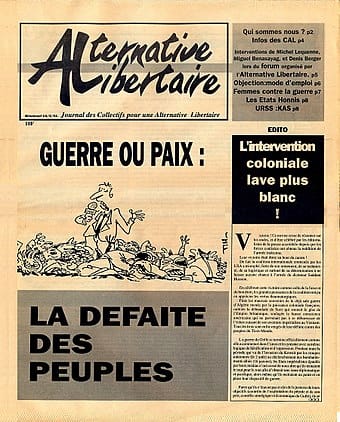
It was Sunday afternoon... At one point, we were alone. We had a discussion about "Anarchism." To be honest, I was prejudiced due to the definition of "Anarchist" that had been ingrained in our subconscious while in Turkey. The gentleman introduced me to the ideas of Proudhon and Bakunin.
The next day, I found an opportunity to go to FNAC (the famous French bookstore chain) and bought all the books by Proudhon I could find. If a person is truly curious about something, time is irrelevant. I was curious about the "Anarchism" philosophy I had just encountered. After reading a few books, my mind was in turmoil. Since we had accepted Marx and Engels as undisputed and flawless philosophers, I initially disregarded Proudhon's exciting lines, but his logical construction was brilliant and convinced me of his arguments.
My readers should know that communist thought emerged from and branched off anarchist thought. Just as much as Karl Marx was a student of Hegel, he also learned from Proudhon or developed himself to understand Proudhon.
When Proudhon passed away in 1865, this time Proudhon's follower, the anarchist Bakunin, and Marx confronted each other. At the First International in 1872, Bakunin clashed with Marx. Realizing Bakunin's superiority, Marx personally ended the First International. From that day on, Communists and Anarchists went their separate ways.
Here I would like to add a brief note: If there had been no October Revolution in Russia and Lenin had not introduced Marx to the masses, Marx's name would not be widely known today, because during his lifetime, his name had not reached as wide an audience in Continental Europe as Proudhon's; that is, he was not a popular figure.
PRISON AND EXILE
I want to return to Proudhon's life again... If we compare them, Marx was luckier than Proudhon. Apart from a few detentions, two government exiles, and his subsequent voluntary move to England and settlement in London, he had no major difficulties. He was poor in London but received help from his industrialist friend Engels.
Proudhon was not so lucky. In 1849, he was imprisoned for 3 years for insulting the French President. In 1858, an arrest warrant was issued against him for insulting the Church due to his book Justice in the Revolution and in the Church. Like Marx, he fled to Belgium. He stayed there for 4 years. He wrote his work War and Peace in Belgium in 1861.
Let's not forget that the most famous writers of the period showed interest in and adopted anarchist philosophy. One of them was the famous Russian writer Leo Tolstoy.
Eight years later, in 1869, Tolstoy named his own monumental work "War and Peace" to honor Proudhon, who was no longer alive.
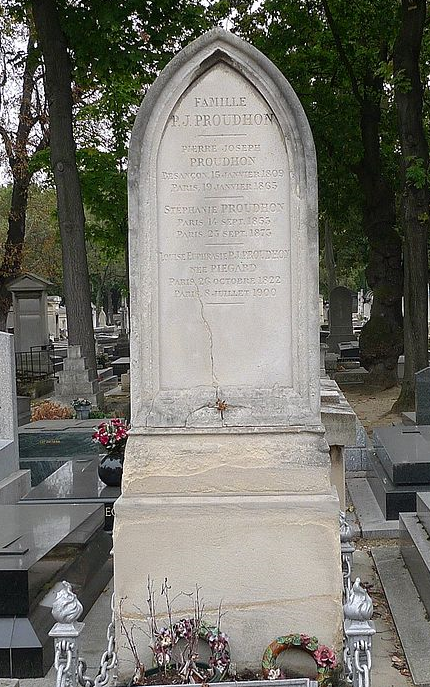
Proudhon returned to France in 1863 and passed away in 1865 at the age of 54. His grave is in Montparnasse cemetery. I know I have visited his grave several times.
THE SPANISH CIVIL WAR
I mentioned earlier that anarchists advocate for "self-governance." They always made us believe that Communists were the ones fighting at the forefront in the 1871 Paris Commune. It was even narrated that Marx and Engels participated in the war from the trenches. However, the true initiators and those who paid the real price in the 1871 Paris Commune were the anarchists.
The anarchists' desire for self-governance reawakened for the second time during the Spanish Civil War, which began in 1936. Tens of thousands of French anarchists flocked to Spain. Many writers who were devoted to anarchist philosophy (Hemingway, Malraux, George Orwell, Lorca, Tristan, Emma Goldman, Arthur Koestler, Ilya Ehrenburg, Pablo Neruda, etc.) prepared to defend the city of Madrid like a fortress. Their slogan was short and clear: "No Pasaran," meaning "They Shall Not Pass!"


Their luck did not hold this time either; the anarchists were defeated. Those who escaped survived, most died in the trenches. When General Franco broke the resistance and entered Madrid, he laughed and said: "They Shall Pass!"
In later years, anarchists organized in trade unions. Today, anarchist syndicalism is quite prominent and influential in many European countries. Interestingly, there is one point on which today's anarchist theorists agree: their declaration of and support for the administration in Rojava (i.e., Western Kurdistan. Reminder: "Rojava" means "West" in Kurdish) in northern Syria as the "self-governance" most suitable for anarchist ideals. The reason for this is Rojava's ability to govern itself without establishing a state and the highest level of protection for women's rights.
PROUDHON-MARX DEBATE


Proudhon and Marx were both accomplished philosophers. When they engaged in polemics, they attacked each other with philosophical jargon that the average reader would find difficult to understand, and their mutual exchanges continued without interruption until Proudhon's early death.
Here, I would like to apologize to my reader and convey the debate between these two philosophers in an understandable language:
PROUDHON: All authorities are enemies of the individual; they must be destroyed! The state is foremost among them.
MARX: You are right! I agree. The capitalist state must be destroyed. However, this cannot happen all at once. First, a Socialist state will be established. Over time, the state will dissolve itself, and a Communist system without a state will emerge. The individual will also be freed from the state. Everyone will work according to their ability and receive according to their need.
PROUDHON: Please assume that I tolerate the state structure during the transitional period (socialism)! When you transition to the communist system, you demand that the individual work according to their ability. Why do you compel the individual to work? The individual is free. They are not obliged to work according to their ability. You are usurping the individual's freedom. What difference is there left between you and the state?
MARX: People must live together so that they can produce and progress together. If we were to base ourselves on your idea, you would be taking humanity back to the Neanderthal (people living in caves and trees) period.
PROUDHON: Not at all! If you establish a communal system and compel the individual to work according to their ability, hierarchies will inevitably re-emerge in society very soon, and state-like structures will appear. The individual must be free. They should have no obligations to society. Only a free individual can show humanity salvation and be happy. The rest are just different cycles leading to the same outcome.
Yes, dear readers! I leave it to you to decide who prevailed in this simplified philosophical debate between Marx and Proudhon. While Marx accused Proudhon of being an "enemy of society," Proudhon did not remain silent, declaring Marx an "enemy of the individual."
I want to ask once again:
Is there an anarchist hidden within you and your soul?
Come on, don't be afraid, confess!... Because there truly is an anarchist sleeping hidden within me!