Hong Kong and Besso
This essay explores the profound impact of friendships and mentorship on personal and intellectual journeys, drawing parallels between historical figures like Einstein and Besso, and the author's own experiences in Hong Kong and France.
Dear readers!
The greatest fortune in life is to forge friendships that open the mind and lead one to correct thoughts. History is full of such examples. Would a figure like Alexander the Great, of Macedonian origin, have emerged without Aristotle, of Greek origin? Would a figure named Fatih Sultan Mehmet, of Turkish origin, have left his mark on history without Molla Gürani, of Kurdish origin? Would Albert Einstein (Turkish: Aynştayn / English: Aynstayn) have been able to finalize his theory of relativity, which he had pondered for so long, without his friend Besso?
EINSTEIN AND BESSO
Einstein, of Jewish origin, was born in Ulm, Germany. When his family moved to Italy after he finished middle school, he started Gymnasium (high school) in Munich. Einstein experienced a deep psychological crisis, reacting against the German education system. He dropped out of high school or was expelled. He returned to Italy to his family. His father was angry. Einstein, who would never receive a high school diploma in his life, prepared for the entrance exams of the Federal Polytechnic School in Zurich; the reason being that the Polytechnic school did not require a high school diploma. After completing his studies at the Polytechnic school in Zurich, Einstein found a job at the Patent Office in Bern. When Besso, whom he knew from his student years in Zurich, also started working at the Patent Office, a deep bond of friendship developed between the two friends.

Michele Besso was born in the town of Riesbach, Switzerland. He was also of Jewish origin. Einstein and Besso loved to sit at a table and engage in philosophical and scientific discussions.
Those were the days when Einstein, pondering the theory of special relativity, couldn't find a way out... One evening, he started a conversation with Besso on this topic. Besso made a very simple suggestion for a solution. Einstein quickly returned home and worked all night. The next day, when he met Besso, he uttered a single sentence: "Besso, thanks to you, I have proven the theory of relativity."
Einstein acted loyally towards his friend, immortalizing him by including Besso's name in the scientific paper where he proved the theory of special relativity.
***
I, too, have had similar friendships or respected mentors in my life. But one of them was clearly ahead. This exceptional personality was the late Jean Degremont, the General Manager of the company I worked for in France. Having served in Middle Eastern countries for many years, he knew the religious and cultural structure of the region very well. Before detailing Jean Degremont's influence on me, I must tell you about my Hong Kong adventure.
JOURNEY TO HONG KONG…
The year was 1991. I had started learning Chinese in Paris. My work was extraordinarily intense. Whatever I did, I tried not to miss the Chinese lessons given twice a week. The People's Republic of China was a closed box in those years. It was very different from today's China. It was completely closed to Western investors. It was as if it had built a Great Wall between itself and the wealth and splendor of capitalism. No one had any desire to visit Communist China either. In those years, the city of Hong Kong was under British rule. The 156-year British rule would end on July 1, 1997. Today, Hong Kong is a semi-autonomous Special Administrative Region under the People's Republic of China. According to the agreement with the UK, Hong Kong will be fully integrated into China in 2047.
Employees in France had a one-month holiday entitlement. That year, when my assistant found another job and left, it would be difficult for me, as Head of the IT Department, to be away from work for a month, so I had to spread my holiday over four separate periods, not exceeding one week each. I would take my first holiday in mid-July. In those years, the People's Republic of China had no tourist appeal whatsoever. Moreover, obtaining a visa required extraordinary formalities. Instead, I chose Hong Kong, where I could go without a visa.
As the plane descended towards Hong Kong, the peninsula and the dozens of skyscrapers built upon it stretched out dazzlingly. (I would later learn that Hong Kong had the most skyscrapers in the world.) I had money. I had booked a room at the Nippon Hotel, one of the most luxurious hotels. (The Japanese call their own country Nippon. Most of the customers were Japanese.) I could speak Japanese fluently, but my concern was to speak Chinese, to improve my Chinese. The hotel staff stubbornly preferred to speak English.

After settling into my hotel room, I went out into the street. I entered shopping centers. I soon realized that neither did I understand their Chinese, nor did they understand mine... In those years, there was no internet, nor handy encyclopedias like Google... I would soon realize that Cantonese was spoken in the Guangdong province of South China, including Hong Kong. The residents of Hong Kong did not understand Mandarin, the official language of the People's Republic of China, which I had learned in Paris. My desire to improve my Chinese was thus met with disappointment on the very first day. I tried to communicate with the locals by speaking English.
When I returned to the hotel in the evening, I approached a table near the entrance, covered with tourist brochures. I picked up a brochure and started reading. A woman came up to me. She asked me where I was from, speaking in English. When she understood that I was from France, she preferred to speak in broken French. She was a tour guide. Every day, she would take the tourists she gathered to Zhongshan (congshan) city in the Guangdong region of the People's Republic of China for a day trip by train. I agreed to join the next day's trip. I was excited to learn a little about life in the People's Republic of China.
It was the afternoon of the next day. We had entered the People's Republic of China and were touring Zhongshan (congshan) city. The female guide walked ahead with a flag in her hand, introducing the city's important monuments in English. What interested me most was the absence of a single car on the wide main roads or side streets. Thousands of bicycles stopped at red lights and moved when they turned green. It was a funny situation!
The guide took us to a market where all kinds of insects, reptiles, and wild animals were killed or sold alive. An unbearable heavy smell filled us. Some tourists looked like they were about to vomit, tightly covering their noses. How was I to know then that the Covid-19 virus, which would ravage the world in 2020, would spread from this market!

Noticing the grumbling and discomfort in the group, the guide quickly rescued us from hell. A scene I witnessed is still vivid in my mind today: The vendor took a live snake from a basket. With swift movements, he cut off its head and tail with a cleaver. He filled a glass with the flowing blood and offered it to his customer. The customer drank it with relish. Oh my God!
This time, the guide went ahead of the group and took us to the birthplace of Sun Yat-sen, the famous Chinese statesman, which was being used as a museum. I didn't know much about Sun Yat-sen. During my university years, I was strongly committed to socialist thought. In those years, the socialist youth movement in Turkey was divided into Soviet sympathizers and Chinese sympathizers (Maoists). My preference was clearly a pro-Soviet view. Although we saw Maoist organizations as "provocateurs," I respected Mao Zedong's Chinese Revolution. Moreover, I had in-depth knowledge about the Chinese Communist Revolution and Mao Zedong.
Since I was encountering the name Sun Yat-sen for the first time, I kept asking the guide questions, wanting to make the most of the opportunity. I do not intend to provide my readers with a detailed biography of Sun Yat-sen. I just want you to know that Sun Yat-sen, who studied medicine, led a revolution in 1911 based on the principles of "Nationalism," "Democracy," and "Welfare," bringing an end to the 2000-year-old Chinese Empire. China struggled with internal turmoil for a long time. Sun Yat-sen strived to unite the established regional governments. He became the first president of the newly founded Chinese Republic. When he died of cancer in 1925, he was succeeded by Chiang Kai-shek, who had a military background.
Mao Zedong, with the open support of the Soviets, launched a revolutionary movement to establish a Communist China. Soon, a civil war broke out between the Nationalist Army and the Communist Army. Chiang Kai-shek, being married to Sun Yat-sen's sister-in-law, declared himself the natural heir to the Chinese Republic, but the Communists did not recognize his authority. When the Communists took control of mainland China in 1949, Chiang Kai-shek and his associates fled to Formosa island and established the Republic of China (Taiwan). For this reason, the Communist Chinese declared Chiang Kai-shek a traitor and do not recognize the Republic of Taiwan. This tension continues to this day.
After summarizing Sun Yat-sen's personality and struggle, the guide continued: "When Sun Yat-sen died, Chiang Kai-shek became the leader of China, but he was unjustly forced to live on Formosa island and died in loneliness."
The Communist Chinese female guide, who was following us closely and knew English, was disturbed by this explanation. A fierce argument in Cantonese began between the two guides. Since no one in the 20-25 person tourist group knew Cantonese, we couldn't understand what was happening. Soon, security forces in military uniforms entered the museum with great discipline and surrounded us. We were forced out with rifle butts. An American couple was terrified. "They're going to shoot us!" they kept shouting.
We were escorted between two rows of soldiers to the train station. The doors and windows were locked, with the condition that they would be opened at the border. As we crossed the border and entered Hong Kong, a cheer erupted in the compartment. China was so closed to the world in those years that if they had given us life imprisonment or the death penalty, there would have been no power to stop it, and perhaps no one would have known. In those years, China was closed to the world. There were no investments from foreign companies or countries. In short, it had characteristics similar to today's North Korea.
Our guide kept apologizing to us, swearing never to take tourists to the People's Republic of China again.
I was sitting in the hotel lobby, sipping my green tea. The guide girl asked permission and sat next to me. She began to explain what had happened and the details we didn't know, in her broken French. I told her I understood English, but the guide, due to her profession, wanted to improve her French. There was no one else in the group who was both single and spoke French besides me. At one point, she made a suggestion: "If you have time, I can introduce you to Hong Kong. That way, I can also improve my French." It was impossible to say no to the suggestion.
The public transport system was packed but worked perfectly. As our bus moved, the guide began to speak: "Hong Kong has two faces. One is poverty, and the other is wealth. Nowhere else in the world is the income gap between the poor and the rich so wide. Now we are going to Sham Shui Po (sham shuyi po) in the Kowloon (kaulin) district, the poor neighborhood."

The guide frequently consulted her French-English dictionary, searching for words to form sentences. When we got off at a stop, I couldn't hide my astonishment. I had never encountered such a sight before. The apartments were intertwined, side by side. The balconies were filled with air conditioners and laundry hung out to dry. An uneasy feeling settled within me. The guide said that Europeans always reacted the same way to this sight. This time, we entered a very long market, exclusively for pedestrians. We had already seen a similar market in the Guangdong province of the People's Republic of China.
This time, the guide added with a laugh: "Now it's time to see the other side of Hong Kong!"
We took the subway under the sea and arrived at the Wan Chai district on Hong Kong Island. Luxurious and sparkling skyscrapers lined up one after another. I couldn't hide my admiration. The guide turned into a side street.
"This is the bar street. Foreigners love to kill time in these bars."

We entered a bar. The conversations were in English. We found a table and sat down. The air was stifling and hot. The air conditioners were working hard. It was impossible to say no to a beer. As we sipped our cold beers, we began to compare socialist and capitalist China. I asked:
"You know the People's Republic of China, Taiwan, Hong Kong, and even Macau under Portuguese rule. Where would you like to live?"
"Let me give you an answer I already know: I would never want to live in the People's Republic of China. As you can see, in a city of millions, it's impossible to see even a single car. Even the richest person only has a bicycle and a small house to call home. Maybe the poverty you saw in Sham Shui Po isn't there, but my choice would definitely be Hong Kong."
My socialist streak would not accept betrayal of Mao Zedong. Okay, I kept my distance from Maoist organizations and parties, but I had read Mao Zedong's books, especially on "People's War" and "Dialectics." With my ignorant mind, I tried to convince the guide to become a socialist. The guide burst into loud laughter. A few foreigners leaning over the bar, sipping their beers, turned their heads curiously to look at us. The guide knew Chinese history well:
"Sun Yat-sen is a name respected by all Chinese people. Whether you live in the People's Republic of China, Taiwan, or Hong Kong, there are definitely universities, parks, and streets named after Sun Yat-sen. I am also a fan of Sun Yat-sen. He studied medicine. His life was spent establishing the Republic in place of the collapsing empire. When he passed away, his brother-in-law Chiang Kai-shek took over the duty.

Chiang Kai-shek pursued a 'nationalist' policy. Mao Zedong and his comrades, on the other hand, had a 'communist' worldview. An interesting situation arose during World War II. The Japanese occupied China's Manchuria region. Chiang Kai-shek and Mao Zedong fought against the invading Japanese on different fronts, both against each other and together hand in hand. When the Japanese were defeated and left, the civil war between the nationalists and communists accelerated. Chiang Kai-shek was defeated and settled on Formosa island, establishing the Republic of China (Taiwan).
Today, 18 small countries like Belize, El Salvador, and St. Lucia officially recognize Taiwan. The US has a semi-official relationship with Taiwan. As the People's Republic of China strengthens economically and militarily, it will certainly want to incorporate Hong Kong, Macau, and Taiwan into its borders. Frankly, I don't believe any power in the world can oppose this desire. In fact, hundreds of thousands of Hong Kong residents, foreseeing this, have already started settling in the UK, Australia, and New Zealand!"

I had gotten used to the guide's French. At first, I would correct her mistakes and try to teach her the correct pronunciation. After a while, this started to bore me. Moreover, my well-intentioned interventions also disrupted the flow of the conversation. Since I understood the guide's unique French, I thought, why should I interrupt the conversation every now and then to correct her mistakes?
Since it was a topic I didn't know about, I asked:
"What do you know about Chiang Kai-shek?"
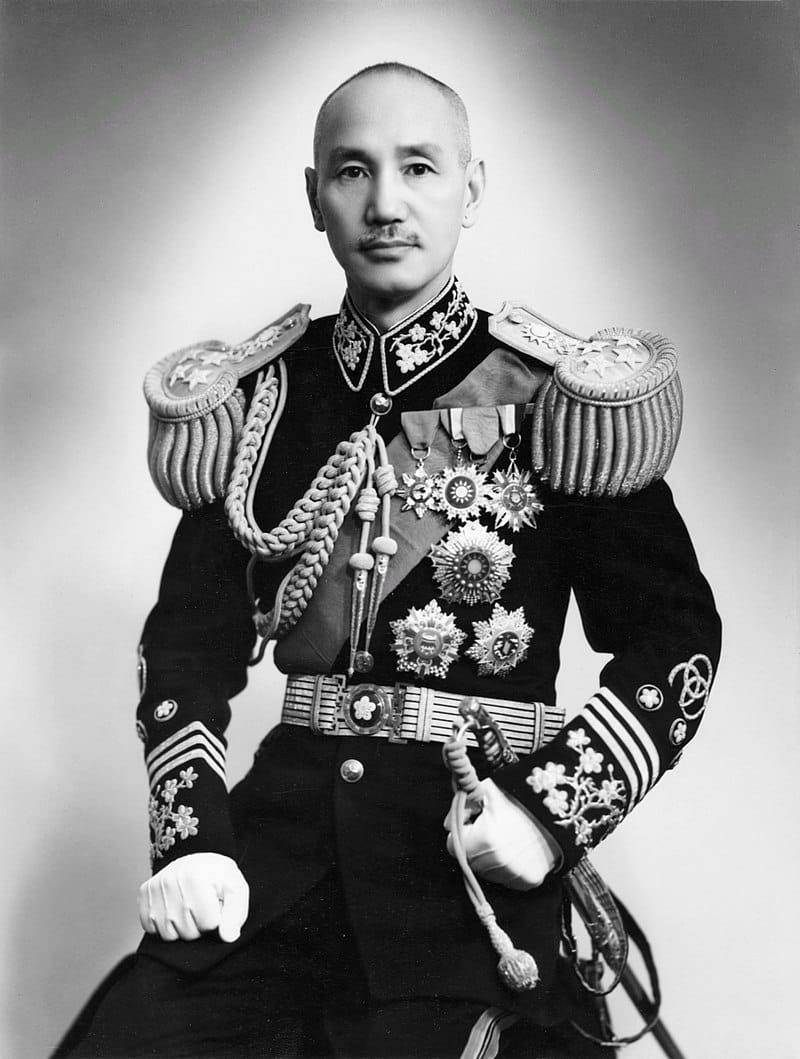
"After Sun Yat-sen's death, Chiang Kai-shek took power. He truly unified China by defeating the regionally independent states. He presided over the Republic of China between 1928 and 1948. When he was defeated by the Communists, he settled on Formosa island."
The guide was eager to open a topic she guessed I didn't know. She asked:
"Have you heard the name Soong Mei-Ling, Chiang Kai-shek's wife?"
Pursing my lips and shaking my head negatively, I said, "No!"
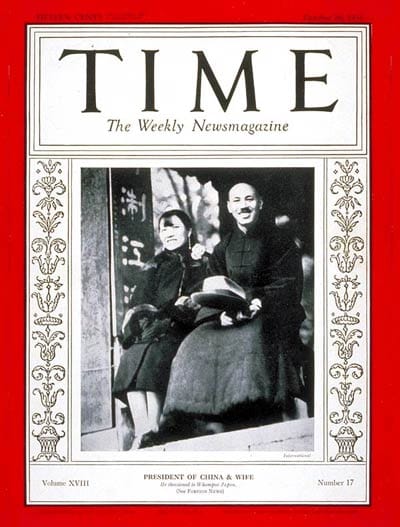
"Soong Mei-Ling was Sun Yat-sen's sister-in-law and Chiang Kai-shek's wife. She made an extraordinary effort to promote the cause of Nationalist China to the world. She was perhaps the most powerful woman in Chinese history. She was a role model for young people. When the Japanese occupied China during World War II, Madam Soong called on the demoralized Chinese people to resist the Japanese invaders. Madam Soong could speak English perfectly because she had received her higher education at a university in New Jersey, USA, and at Harvard University. After marrying Chiang Kai-shek, she became, in a sense, her husband's eyes and ears. She embraced war orphans and opened schools. She was so meticulous in this regard that she personally selected the teachers. In 1943, she launched a campaign in the USA for 8 months and tried to create public opinion. At one meeting, she addressed 30,000 people. She was featured on the cover of TIME magazine with the title 'Man and Wife of the Year.' The US Congress invited Madam Soong to give a speech. After the Republic of China (Taiwan) was established, she served on the board of directors of the International Red Cross. (Note: Madam Soong passed away in New York City in 2003.)"
Dear readers,
Fate has no language. Who would have thought that years later I would settle in America, marry a Chinese American who was born and raised in the USA but whose family had immigrated from the Canton region to America in the 1930s...
It was nearing evening. We were on the bus, returning to the hotel. She pointed to a place near the shore: "Don't go that way! Indian fakirs tell fortunes. The government has banned fortune-telling, but tourists can't escape falling into their trap."
"What do they do?"
"I don't know! They say they'll tell people their future and things like that, and they take all the money from them without using force. I read it in newspaper reports!"
When I heard the term 'Indian fakir,' my mind went back to my childhood years. I remembered the person known in our family circle as 'Iranian Molla.' He had been a guest in our house for about a month, and had told the fortunes of both family members and family friends. He was an extraordinarily talented person. Later, he returned to Tehran and died at a young age.
As we approached the hotel, the guide asked in a mocking tone:
"What are you planning to do tomorrow?"
"I want to wander the streets and go to the traditional Chinese bathhouse, whose reputation I've heard so much about."
"I'm sorry. You won't be able to leave the hotel for two days."
"Why?" I asked with emphasized curiosity.
"According to the weather report, a typhoon will be active for two days."
"I like rain. It won't be a problem."
The guide laughed:
"Apparently, you don't know about typhoons in Hong Kong. It's best if I don't go into too much detail. It's better for you to experience it."
The guide dropped me off at the hotel. She adopted a mocking attitude again and spoke in French:
"See you in two days... Au revoir! (Goodbye!)"
After making sure the guide had left the hotel, I went up to my room. My intention was to go down to the beach where the Indian fakirs were. I took out 500 Hong Kong dollars from the safe. I put 450 dollars in the wallet I wore around my neck and kept hidden inside my clothes. I put 50 dollars in my pocket. I promised myself: 'Mücahit, no spending more than 50 dollars!'
I left the hotel. The sun had set, but it was still semi-dark. I went down to the beach. It was deserted. I wanted to take a turn and come back. Suddenly, an Indian fakir appeared in front of me. His turban was wrapped in an interesting style. His eyes were large and motionless. He called out in English:
"Sir! Would you like me to read your future?"
I approached!
"What will be your fee?"
"First, I will give you a small demonstration to make you believe in my power. If I succeed in convincing you, I will take your 50 dollars. Then you will ask, and I will answer. Agreed?"
Involuntarily, I said, "Yes!"
He handed me a blank piece of paper and a pen.
"Turn your back! Write a sentence in any language you want! Fold the paper and put it in your pocket!"
I hadn't yet understood why he wanted this. I did as he said. I turned my back and scribbled a Turkish sentence: "I live in Paris." I folded the piece of paper and put it in my pocket. I turned my face back to the Indian fakir. I handed him back the pen.
"As you can see, I didn't see what you wrote."
He took a blank piece of paper from his pocket. He scribbled something. He handed it to me:
"Sir! I want you to compare what you wrote in your pocket with what I wrote."
I opened the folded paper he handed me. I was speechless at what I saw. There was the phrase, "I live in Paris," in my exact handwriting. I reached into my pocket and took out the piece of paper. Yes! Without a doubt, the writings on the two pieces of paper were exactly alike. It was impossible for him to have cheated. As my astonishment continued, the Indian fakir intervened with a confident remark.
"Sir! I hope you are well. As you can see, I have proven my power to you. I want you to pay the 50 dollars."

50 dollars were in my pocket. I took them out and handed them over. The Indian fakir added:
"Sir! If you want to know everything about your family, your past, and your life for the next two years, I will take your 300 dollars. Agreed?"
'Oh dear,' I muttered to myself. I had promised. I wouldn't spend more than 50 dollars. I turned my back. I took out 300 dollars from the wallet hanging around my neck.
"I accept. First, you will tell me. If I find it convincing, I will give you the money."
"You are one of six siblings. Two of your sisters live in Germany, and three of your brothers live in Turkey. Your mother and father are alive. You live in Paris. You are responsible for computer work."
The Indian fakir told me about my past and my family. He had saved the real punchline for the end. "Sir! Next year you will leave Paris and go to America. You will live there."
Until that moment, I had no plans for America in my mind. After the Indian fakir finished speaking, he asked for his money. 300 dollars were in my pocket. I handed them over as if mesmerized. The Indian fakir made an offer as if he knew how much money I had left in my wallet:
"If you want to know what will happen to your family members and your parents in the next two years, I will take your 150 dollars."
Again, I turned my back. I scooped out the last money left in my wallet.
"Okay, I accept! Please tell me! I'm listening."
The Indian fakir continued his speech. Everything he said about the past and present was true. Then he detailed what would happen to my siblings in the next two years.
As darkness fell, the lamps illuminating the shore began to light up one by one. At that moment, a whistle was heard from afar. Another Indian quickly approached us, speaking in a panicked tone in a language I didn't understand. The Indian fakir turned to me:
"Sir! Give me my money. I have to go!"
Without objection, I handed over my last remaining money. When the two Indians disappeared into the darkness, policemen came up to me. They checked my passport and took my statement on the spot. When they learned that I had given 500 dollars, they couldn't hide their astonishment. They noted where I was staying. They told me I could leave.
I walked away in astonishment. The Indian fakir had disappeared with my 500 dollars. To be honest, I didn't care about the money. The Indian fakir's performance was extraordinary. I tried to understand what had happened all night. Everything I witnessed was a "beyond-science" reality. It was impossible to understand or explain. It wasn't the lost money that bothered me, but rather my inability to make sense of the event.
Eight months later, when I suddenly resigned from my job in Paris and flew to America, the Indian fakir came to mind. He was right! I had set out for a new life in America. I remember smiling bitterly.
***
The next day, my intention was to go to the Chinese bathhouse. After breakfast, I wanted to go out to the address I was given. As it started to drizzle, I decided to sit in the lobby and kill time by drinking green tea. The tempo of the rain and wind suddenly increased. Soon, an incredible rain and strong wind began to shake Hong Kong. The wind turned into a storm. It was blowing so violently that the hotel seemed to sway. There wasn't a single person outside! All four facades of the hotel were covered with glass. I was afraid that the glass would break, unable to withstand the force of the storm. Suddenly, a pitch-black tornado appeared in the distance. It was rapidly approaching the hotel, spinning. The waiter serving tea understood my fear. He smiled: "Sir! The typhoon has just started. It will get even stronger. Don't be afraid. Our hotel is very solid."
The guide was right. It was impossible to leave the hotel in such weather. Life in Hong Kong had come to a standstill. The typhoon lasted two days. On the third day, the rain stopped. A stifling heat filled the air.
There were two types of bathhouses or spa centers in Hong Kong: the first was the traditional Chinese bathhouse, and the other was the spa centers operating within luxury hotels. I was more curious about the traditional bathhouse. My love for baths goes back to my childhood. I loved going to the Asri Hamam, which held the title of Iğdır's first bathhouse, with my older brothers. In Istanbul, I longed to go to the Cağaloğlu Hamam whenever I had the chance. In Paris, there was a very nice bathhouse in the Marais (mare) district, where many Jews lived, that I frequented. When I came to Hong Kong, my love for baths was rekindled. The guidebooks I read stated that the traditional Chinese bathhouse was a different experience.
I had the address of the best traditional bathhouse. The taxi driver dropped me off in front of the bathhouse. As I stepped down a staircase, a magnificent welcome awaited me. Beautiful girls immediately surrounded me. I was made to sit comfortably in an armchair. While I drank green tea, they handed me an English menu summarizing the services offered by the bathhouse.
I checked all the items presented to me. When the girl who took the menu from me saw that I had checked all the options, she let out a pleasant laugh:
"I understand! You're curious about everything, aren't you?"
Without hesitation, I said, "Yes!"
I was invited to a room. Two women undressed me and put a peştemal-style wrap on me. After they personally put high-heeled clogs on my feet, they took my hand and led me to the sauna section. Everything was lit by candles. A deep Chinese music, echoing from the walls, accompanied the flickering light of the candles. The interior decor, furnished according to Feng Shui principles, created a deep sense of peace in one's soul.
I was taken to a private compartment. One of the girls sang and washed me thoroughly. They switched places with another girl. The second girl had a broom-like bundle made of finely cut bamboo sticks in her hand. The girl sang and hit my back and legs with the bamboo broom. A deep peace and relaxation filled me.
They took me to a private room to rest and offered me green tea. I was almost falling asleep on the lounge chair. This time, another young girl entered, smiling. She took my hand and led me to another compartment. They gave me a long manicure and pedicure. They even brought a doctor trained in traditional medicine to treat a callus on my foot.
After the minor surgical intervention, the doctor gave me an ointment to use daily. The ointment, made with traditional Chinese herbs, was indeed very effective. In France, since I couldn't find large-sized dress shoes, I always had to wear tight shoes that hurt my toes. This caused calluses to form on the sides of my toes.
After the face mask application and facial hair removal were completed, my body was massaged with fragrant oils. They took my 150 dollars and waved me goodbye. Even today, that experience occasionally comes to mind as a pleasant memory.
***
The company I worked for in Paris was a semi-private, semi-public institution. Every year in September, the company held its general meeting, and job assignments were determined. In these meetings, the unions had significant bargaining power. I had been working as the Head of the IT Department at the company for nearly 7 years. I had been awarded a special certificate of achievement by the French Government, and my work was featured in newspapers specializing in the IT sector, where I was praised. I was hardworking. I was creative. My expectation was to be promoted to a higher position. However, racism overshadowed the September meetings, preventing my promotion to a higher position.
It was the end of September. The meetings were over, but there had been no change in my career or job position. I was in a state of disappointment due to the injustice I had suffered.
One day, General Manager Jean Degremont invited me to his office. We talked at length about our holidays, the books we read, and so on. Monsieur Degremont suddenly adopted a serious demeanor: "Monsieur Hun! I am aware of your superior talents. I also see that there is a racist attitude towards you. It is very difficult to break this racist resistance... My suggestions were rejected. I tell you frankly: As long as you live in this country, you will not easily get promoted. I wanted you to know this! I am very sorry!"
After leaving Monsieur Degremont's side, a deep and uneasy thought enveloped me. A hidden racism prevailed in every country! I was angry.
That same evening, I was sitting in a Café in the Montparnasse district, drinking espresso. I was thoughtful and sad. I had an American friend. He was also sitting in the same Café with his girlfriend, chatting. When he saw me, he came over. He invited me to his table. He said I looked distracted and sad. I told him what had happened. The American woman stepped forward: "Why don't you want to try your luck in America? America is a country that values meritocracy (talent and individual superiority). You'll be comfortable!"
As a result of the conversation I had that evening, I decided to go to America. It seems that human life moves along a predetermined, unchangeable path, just as the Indian fakir had foreseen.
I resigned from my job. I loaded my belongings onto a truck and sent them to my sisters in Germany. In April 1992, I took my first step into my new life in America with a language school in Berkeley, near San Francisco.
After all these years, I remember Jean Degremont with mercy, who conversed with me in a friendly manner and did not hesitate to show me the right path. He was an Aristotle, a Molla Gürani, and a Besso for me.
PART TWO
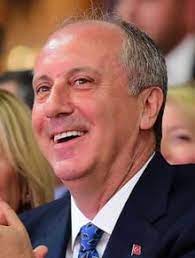
PEARLS FROM MUHARREM İNCE…
Like the famous philosopher Diogenes, I am searching for a true Social Democrat or Democrat or Liberal or humanist among party leaders with a lantern in broad daylight. Muharrem İnce, the leader of the Homeland Party, has stated the following regarding the demand for Kurdish education: "If it is suitable for pedagogy, know that it is also suitable for a unitary state. But this is not suitable for pedagogy!"
Dear gentleman from Yalova, dear physics teacher, little democrat! I will use a different expression for you: "If Muharrem İnce is suitable for the criterion of being an ordinary person, he is also suitable for being a party leader. But unfortunately, Your Excellency, you are not even suitable for being an ordinary person!"
Mr. Leader, listen carefully! Being from Thessaloniki on your father's side does not make you an Atatürkist. Give up the illness of seeing yourself as the natural heir of Mustafa Kemal Atatürk! Mustafa Kemal, with his mistakes and virtues, is the ancestor of all the peoples who founded the Republic of Turkey. Those who do politics by taking refuge in the shadow of Mustafa Kemal are no different from ostriches with their heads in the sand. Your racist ass is exposed, do you know?
Muharrem İnce, who makes fun of Kurdish languages and the right to education in the mother tongue, continues: "To say 'Let's teach physics and mathematics in Kurdish' means 'Hey Kurdish girl, young man, you become a doctor but don't work in İzmir, stay in Hakkari'."
Ah, demagogue gentleman! How you contradict yourself, don't you? You say that Kurdish is not suitable for pedagogy, and yet you express that people can be educated and become doctors with this language, and you even fear it.
I openly declare: If you know that it is possible to get an education and become a doctor in Kurdish, yet you say 'No!' to the right to education in the mother tongue in Kurdish, then you are a racist and a chauvinist! In the leftist jargon of the 1970s, there was a frequently used term: "Social fascist!" Well, you too have taken your place in Turkish political life as "Social Democratic fascists!" May it be beneficial for our Turkey!
Remember, Mr. İnce! Every Zaza and every Kurmanj child will be at the throats of racists like you. History will condemn you, and you will go down in history as "Cultural child murderers."
Some politicians constantly repeat concepts such as "Atatürk, flag, homeland, nation, unitary state, indivisible homeland" to do politics. Kurmanj and Zazas do not need citizenship lessons from anyone. Thousands of Kurmanj and Zazas fell as martyrs in the War of Independence, the Korean War, the Cyprus War, and the struggle against the PKK terrorist organization. I consider it an insult to repeat the aforementioned concepts in an arrogant manner, looking into the eyes of the people, especially in the provinces where Kurmanj and Zazas live. It seems to me that those who take refuge behind these concepts are trying to cover up their own shortcomings by repeating them. They have a problem with homeland, flag, nation, unitary state, and indivisible homeland. May God help them!