Physics and Politics
This essay explores the surprising parallels between the laws governing physics at different scales and the unwritten rules that operate within political organizations, from legal parties to clandestine groups.

I know that the words I’ve used in the title of this article don’t give you a chance to guess what I’m going to write about. To be honest, as I start writing, I’m wondering and worrying if I’ll be able to convey my message to my readers. Because I’ll probably be one of the first to make such an absurd comparison.
LAWS OF PHYSICS
Most of the laws of physics we learn are valid in the world we live in. You know, in elementary school they ask: “How many states of water are there?” Good students excitedly wave their fingers in the air: “There are four states: solid (ice), liquid (normal water), gas (steam), and plasma (invisible, so unknown).” True, in our world, water has four states. But in the universe, water has dozens of different states. Similarly, there are universal environments where different laws of physics apply:
- Subatomic (the world of electrons), i.e., micro laws
- Laws valid in the NORMAL life that humans live in
- Macro laws valid in black holes and neutron stars
After dividing the universe we live in into three main compartments, the question might come to your mind: “We already know all these distinctions, what’s your point, sir?” you might ask. I will innocently try to share my point with you.
Physicists formulate their theories aware of the laws existing in these three different situations (micro, macro, and the normal world we live in); otherwise, it would not be possible for us to take a step forward in understanding the universe.
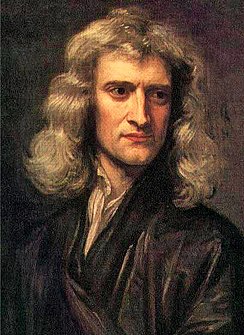
In the NORMAL world we live in, for example, in velocity equations, velocities are added or subtracted. This process seems natural to us, and we assume that this rule applies throughout the universe. I would like to give you an example. Let's imagine two very, very long trains, empty like a tunnel inside (we will disregard the doors between compartments). Let there be a horse in each train. The trains move at the same time, at the same speed, from the same point, in the same direction. Meanwhile, one of the horses stands still, and the other gallops. Let's assume we suddenly stop both the horses and the train after 10 minutes. Question: Which horse has covered more distance? Naturally, the running horse has covered more distance because it traveled further relative to the train's starting point, as you would arrive at this conclusion by adding the horse's speed to the train's speed. The idea that "velocities must be added" has been a naturally accepted reality by humanity since ancient times. This is why many scientists researching the speed of light produced incorrect theories. Although Newton was the one who researched the nature of light the most, he could not discover that the speed of light is constant because he accepted the law of adding velocities as a fundamental rule. This honor fell to Einstein, who set aside all axioms and theories before him. Even Newton was of the opinion that the speed of light should be added to the speed of the light source emitting it. However, when Einstein proved that the speed of light is independent and constant from the speed of its emitting source, many unknowns were clarified.
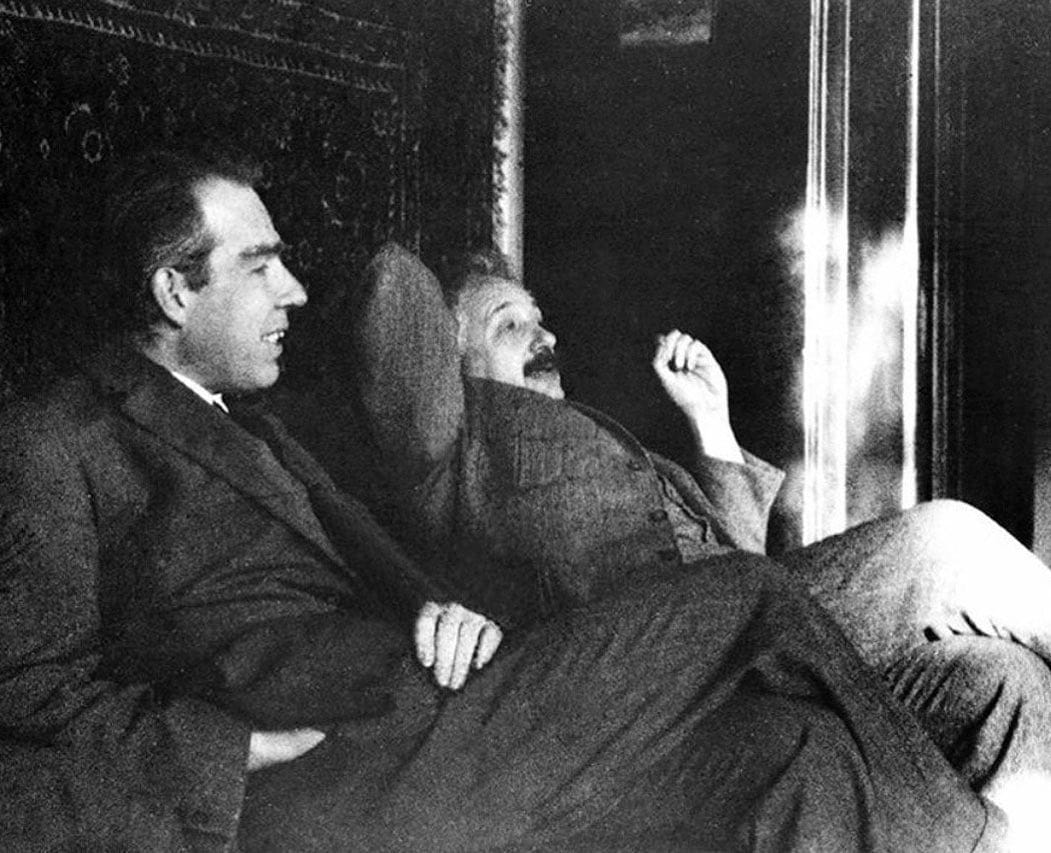
When we go to subatomic particles or the macro world, we see that matter has not just four states (ice, water, steam, plasma), but even hundreds of different states. Newton's laws are valid only for the sun, planets, and the Earth, but they are insufficient to explain the gravitational force in black holes or subatomic particles. Similarly, Newton's laws are not valid for subatomic particles. For example, the force that attracts two electrons to each other is electrostatic force, not gravity. Newton did not have knowledge of electrostatic force. We would discover this thanks to Niels Bohr. As you can understand, the rules in our world, whose existence we perceive with our sense organs, are not valid in the subatomic and macro worlds. It is no longer possible for us to say that the same laws apply throughout the universe.
LAWS OF POLITICS
All legal and illegal political parties in the world, just like the physical reality we explained above, consist of four different layers. The laws and rules in each layer are different. For example, we can take any party as an example. Let's assume this party is the AK Party.
In the AK Party, just like subatomic particles, there is a secret structure consisting of only 3-5 people. You should not confuse this with the Council of Ministers or the Central Executive Board. When our esteemed President wants to make extraordinary evaluations, the individuals whose opinions he seeks are most likely (purely speculative) Hakan Fidan, Binali Yıldırım, Mevlüt Çavuşoğlu, Bekir Bozdağ, Ömer Çelik, and his wife Emine Erdoğan. (It is interesting that Hakan Fidan is from the Kurdish Redkan tribe of Erciş origin, Binali Yıldırım is from a Kurdish family from Erzincan, Ömer Çelik is from a Kurdish family from Adana, Bekir Bozdağ is from a Kurdish family from Yozgat, and Mevlüt Çavuşoğlu is a Khorasan Kurd.) In short, the individuals our esteemed President trusts most within the AK Party (subatomic particles) are of Kurdish origin. Of course, there is nothing wrong with this, but it is noteworthy. Among this group, there is a secret political law that we cannot understand or solve. We can easily say that a special network of relationships, unimaginable to average people like us, is woven within this group, and this core staff governs Turkey.
After reviewing the "subatomic particles" of the AK Party, it's time for the second important group in its NORMAL world: we can include the Council of Ministers and the Central Executive Board in this group. When our esteemed President convenes the Council of Ministers and the Central Executive Board, different laws now apply. He cannot have the same conversations he had with the core staff mentioned earlier with the members of the Council of Ministers or the Central Executive Board.
The third circle is the party's provincial chairs, district chairs, that is, the ORGANIZATION. Here too, different laws apply. For example, our esteemed President cannot give the same speech he gives in the Council of Ministers to the provincial and district chairs. Now, different conditions and different laws are at play. And finally, there is the demeanor our esteemed President adopts in front of the average voter at rallies. The speech our esteemed President will give at a rally is, of course, different from the speeches he gives to provincial chairs.
In short, the world of physics and politics consists of different layers where different laws apply. Do not look at everything with the intention that there is only one "law" without considering the layers and hidden laws, otherwise, you will be no different from a PUPPET.
You might ask if it's possible to apply this logic to an illegal organization like the PKK. Of course, it is possible. The PKK's "subatomic core staff" consists of APO and the intelligence forces of international states. In the past, no one but APO was present at these meetings. All important decisions were made or continue to be made between APO and intelligence organizations.
When we look at the NORMAL world of the PKK, alongside APO, there are names like Murat Karayılan, Bahoz, and Cemil Bayık. They are unaware of the content of the negotiations APO conducts with intelligence forces. In short, this time, another law comes into play between APO and his staff. In the third stage, different laws apply between APO's staff and the armed forces under their command, and this process continues in this manner. Now you will tell me that APO is in prison in İmralı. How does he meet with intelligence forces? I am not the one to answer this question; the relevant authorities are.
ANECDOTES AND JOKES
(Note: The following anecdotes and jokes are published for the first time.)
A GLIMPSE INTO MY MOTHER'S DAILY LIFE
We had a farm called "QOM" in the Karakuyu meadow, surrounded by a wall like a fortress. (This farm still stands in ruins today.) Its huge, wide gate with iron wings was the only entrance to the farm. The rectangular farm, built on 30 decares of land, had a barn with about 50 cows in a distant corner, another barn for calves and yearlings a little further away, and a small house consisting of a hall and a room in another corner. Directly opposite the house, a huge, not-so-symmetrically built granary blocked half of the house's view.
In the middle of the farm, we had lots, or haystacks, made either from loose hay or hay compressed with wires using a baling machine. There was no electricity or water. An artesian pump somewhere between the barn and the house met the water needs of the house and the animals. My mother lived alone in this house for 30 years. Occasionally, one of her daughters would come, stay temporarily, and help out. Eventually, they would have to leave due to school. Whenever I found time from my high school or university life in Istanbul and returned to Iğdır, I would always stay with my mother and mow hay all day with the scythe.
My mother would wake up very early in the morning, milk the cows, and carry the milk to the granary. In the garden, she would heat the milk in a large black cauldron placed on three huge stones, stirring it gently, and occasionally dipping her finger into the milk to check its temperature. The milk shouldn't be too hot. She would slowly pour the yeast, which she had mixed in a large bowl, into the cauldron of milk, stirring it thoroughly. After this process was finished, she would cover it with a huge tray and leave it to ferment. Finally, when she found a moment to rest from her work, she would prepare tea on a small stove, and we would sit down for breakfast together. We would have nothing but bread, cheese, and çökelek (curd cheese) in front of us.
Soon after, my mother would hastily get up, lift the lid of the cauldron, and check if the yeast had set. This time, the most laborious part of the work would begin. With the help of the shepherds, the cauldron would be moved to the artesian well, and its contents would be gradually strained through a cloth sieve called "barzun" with a huge ladle. The water strained from the barzun was also valuable. It was used in making çökelek, called "şor." Preparing the cheese molds was quite laborious and took hours. I would get on the scythe machine and return to my work. Until I returned in the evening, the animals would be aired out in the garden, the barn would be cleaned, the cows would drink water from the long wooden troughs in the garden, then they would be put back into the barn, and interestingly, each cow would go to its place and wait as if it had memorized it. The shepherds would not neglect to attach the neck ties to the cows just in case. Towards evening, my mother would milk the cows a second time, but this time she would leave most of the milk to the calves, which we called "golik." She would store the milk in the granary to boil it with the milk she would milk the next day. After all these tasks were done, my mother would hastily peel potatoes, clean onions, and mix in pieces of meat to prepare dinner. We and the shepherds would eat the same meal at separate tables.
After the sun set, the most disturbing thing was the huge swarms of mosquitoes circulating. I wasn't used to it. My mother would light fires with dried dung in a few places around the house, then put wet dung on top, and the smoke from the unburnt wet dung would fill the air. Mosquitoes, not liking the smoke, would stay away, but those thirsty for human blood would dive into the smoke and cling to my skin. The smoke would be so dense it would almost suffocate a person. Trying to get rid of mosquitoes, we would almost suffocate from the smoke. My mother's 30 years of life passed like this, alone here.
(Note: A deranged politician from Iğdır, who served as the Chairman of the Democracy Party founded in 1991, wrote in a book that my mother lived comfortably in a villa with a Bosphorus view in Istanbul. When I read that article, I couldn't help but wonder whether to laugh or cry. I was truly appalled by the wretchedness and jealousy of some primitive-minded Kurdish intellectuals (!) and continue to be so.)
MY MOTHER'S EVIL EYE BEAD
One day, my mother was alone in her farmhouse, and the season was rapidly progressing from autumn to winter. My mother had four loyal dogs, chickens, heşterxan (Iranian chickens), and turkeys. When the cold set in, a female wolf (dêlegur), probably unable to find food for her pups, approached the farm.
In those years, there was no settlement between our farm and the village of Orgof (Suveren). Everywhere was covered with bushes. The university had not yet been built.
The dogs attacked the wolf through the small, open entrance gate of the farm. The female wolf was strong and relentless. She caught the first dog that approached her by the throat and strangled it. Seeing the other dogs coming, she disappeared among the bushes behind the farm.

When my mother arrived at the scene with a flashlight, she witnessed her favorite dog struggling in its death throes. She sat down and began to cry uncontrollably. She swore, "I will avenge him!" The shepherds also arrived at the scene. They buried the dead dog properly.
My mother knew the female wolf would return. She sent word to the village. One of the best young marksmen came with his Mauser rifle. My mother slipped some pocket money into the young man's hand. The young man didn't want to take it, but my mother, to emphasize that she cared about the wolf being killed, somehow managed to put the money in his pocket.
The young man climbed onto the roof of the house. To avoid being seen from afar, he built a small stone barrier and lay in wait with his Mauser. He also had binoculars in one hand. My mother, through the shepherds, provided the young marksman with his needs such as food, tea, and cigarettes.
On the first day, there was no news of the female wolf. The second day also passed quietly. On the evening of the third day, just as the sun was setting, the female wolf appeared among the bushes about 1 km away from the farm. The marksman, who hadn't slept for three days, aimed his Mauser and waited for the wolf to approach. The wolf must have smelled a trap because it didn't approach the farm and tried to turn back and dive into the bushes. At that moment, the young marksman fired his Mauser. A howl was heard, but the marksman was not sure if he had hit the wolf.
He jumped from the roof and ran towards the wolf. Yes, he had shot the wolf. The wolf was wounded in the neck and struggling in its death throes. Soon after, my mother and the shepherds also arrived at the scene. My mother was happy to have avenged her dog. Before leaving, she called one of the shepherds aside and whispered in his ear: "Cut off the wolf's female organ without anyone noticing! It brings good luck when dried and hung." The shepherd did as he was told, cut off the wolf's female organ, and handed it to my mother. My mother hung it with a rope on the pole in front of the house. Of course, as time passed, the piece of meat dried up and turned into an unrecognizable object.
I had come from Istanbul. A few days later, this dried piece of meat caught my attention. I asked what it was. My mother avoided answering. "Someone gave it to me! It brings good luck," she merely said. I was curious. I knew my mother was giving me a dismissive answer. I didn't press her.
One evening, again, to keep the swarms of mosquitoes away, the dried dung was lit, and the air was filled with smoke. The shepherds were eating their meal on a floor table on the small balcony of the house. My mother had gone to the granary to get cheese. As one of the shepherds stood up to change places, his hat brushed against the dried piece of meat hanging on the balcony pole. The dried piece of meat fell to the ground. One of the shepherds, seeing this, warned his friend in Kurdish: "Hang the wolf's vagina back in its place, or we'll have trouble with Sister Naciye."
In the following days, one of the shepherds told me what had happened. My heart broke when I thought of the dog that died struggling, the wolf that died struggling, and my mother crying for her dog. A feeling of rebellion arose within me: "Oh nature! Oh God! If you were going to make them suffer, why did you create humans, animals, plants? I wish living beings had never existed. We are nothing but pathetic creatures living in fear of death and life. Continuing my existence in the universe as stone and earth, rather than spending it as a deceptive and insignificant period called LIFE, would have made me even happier."
NOTE: In Turkish, some inappropriate names have been replaced with new ones and have gained general acceptance. For example, instead of the word "Kapıcı" (doorman), the phrase "Apartman Görevlisi" (apartment attendant) is now generally used. However, I must express my discomfort that we still have to use the word "Çoban" (shepherd) because there is no generally accepted alternative for it.
DUST AND SMOKE
In the 60s, a Kurdish villager, with his donkey in front of him, set off from Doğubayazıt road towards Iğdır to do some shopping. In those years, the road between Doğubayazıt and Iğdır was a dirt road, a chaussée. The scattered sand would quickly disperse to the sides, leaving behind a very thin layer of soil that would kick up dust if you blew on it. When cars passed by, a relentless cloud of dust would cover the area and hang in the air for minutes.
A villager who had spent his life in mountain villages and had not served in the military because he had no birth registration, was driving his donkey when a TIR passed by him. The Kurdish villager, allergic to dust, was seized by a coughing fit. Just as he recovered, a truck sped past in the opposite direction. The dust and smoke hung in the air for an even longer time. Again, just as he recovered, a car sped past the villager. The villager, who had never seen a vehicle other than a tractor in his life, shook his head angrily and said: "Oh God! I don't understand! Why do people make cars just to kick up dust?"
THE CAT'S SADNESS
A cat chased a mouse. The mouse barely escaped through a small hole at the base of the wall into the neighbor's garden. The cat, thinking the mouse was inside the hole, extended its paw, hoping to catch it. One of the dogs in the garden saw the cat's paw and delivered a hard swipe. The cat thought this swipe came from the mouse. From that day on, it never went near mice again.
One day, as it was lounging comfortably, a mouse scurried past. Another cat didn't miss the opportunity, pounced on the mouse, caught it, and happily walked away. The cat that had been swiped on the paw earlier muttered to itself: "You were strong enough for me, weren't you? Why didn't you swipe this cat too!"
THE STUBBORN HEN
One of Aunt Zerri's hens stubbornly refused to lay eggs. One day, to see if it was mating with the rooster, she started following the hen. The hen entered the neighbor's garden. When chased out from there, it fled to another neighbor's garden. Then, tired and weary, it returned to the house's garden.
It was afternoon. The rooster mated with the hens in turn, then proudly lifted its head and crowed "üüürüüüü."
Then it was the turn of the hen that wasn't laying eggs... The rooster circled the hen cautiously and carefully but couldn't find a suitable opportunity to mate. The hen became restless, chased the rooster away, and wouldn't allow mating.
Aunt Zerri smiled to herself: "I was like that in my youth. From morning till night, I would do the housework, cook, bake bread, wash clothes, and become exhausted. Towards evening, my husband would come home cheerfully, swinging his arms, eat his meal, take off his underpants, lie down in bed, and call me to his side. I was human too, I couldn't stand it and would burst out: 'May your house be destroyed! Do I have any strength left to come and get into your bed?' I would shout and chase after him."
SHOW OF FORCE
It was one of those difficult days in the 1970s, when the Right-Left conflict was raging. Two revolutionary youths, famous for their fights and fists, were walking in the middle of the bazaar when they saw two assertive ultra-nationalists, also known for their fights and fists, approaching from the opposite direction. Both sides looked at each other sideways, ready for a verbal spat and fistfight that could break out at any moment. Thankfully, nothing happened, and everyone went their own way. All four, unaware of each other, took a deep breath and sighed, "Thank God! No fight broke out! Otherwise, we would have been ruined!" Then they continued on their way, without compromising their upright and showy walk.
MUTUAL AID
An Azerbaijani farmer intends to cut down his mature, tall poplar trees. Unable to find anyone to hold the other end of the huge saw, he asks his Kurdish neighbor for help. Working intensely without a break, they cut down all the poplars by evening. When the work is done, the Kurdish neighbor asks permission to return home. His wife has prepared a meal on the floor. She asks curiously:
"You worked so hard, did he at least give you any money?"
"It would have been shameful! Even if he had given it, I wouldn't have taken it."
"At least he could have given you one cut poplar tree."
"He's so stingy, he wouldn't even give a leaf from the tree!"
"Then go at night and secretly take a tree and bring it!"
"Wife, the trees are too big, I can't carry one alone. And you're pregnant. You can't help."
His wife is naive:
"He asked you for help to cut the trees. Now it's your turn, go knock on his door and ask for help to carry the tree to our garden! And whatever you do, don't give him any money for the work he did! Heartless!"
THE FATE OF THE GRAVEKEEPER
In the 1970s, there were prominent figures among the ultra-nationalist and revolutionary groups who developed their bodies by drawing bows and lifting weights every day, and who walked at the forefront. One day, the ultra-nationalist group and the revolutionary group met in the middle of the bazaar. The shopkeepers, not wanting an incident to occur and their goods to be damaged, pleaded with both sides: "Instead of all of you fighting, let two people fight, that's enough!"
The tough-looking ultra-nationalist and the revolutionary decided to settle their score one-on-one at 9 PM in the Narınçoğlu cemetery, next to the newly dug, empty graves, instead of fighting in the middle of the bazaar.
By chance, on that day, dark clouds covered the sky, and there was not a single ray of light. The cemetery caretaker, responsible for the cemetery, was about to finish his last round and return home. First, the revolutionary youth arrived. In the dim light, he vaguely saw the caretaker, mistook him for the ultra-nationalist, pounced on him, and punched him repeatedly. The man collapsed to the ground. The revolutionary youth grabbed the caretaker by the foot and threw him into the newly dug grave next to him, then left.
The caretaker regained consciousness, trying to understand what had happened. He climbed out of the grave, and just as he was about to head home, the ultra-nationalist youth vaguely appeared before him. The ultra-nationalist, mistaking the caretaker for the revolutionary youth, pounced on the caretaker, punched him repeatedly, and then grabbed him by the foot and threw him into the empty grave.
The caretaker struggled to get out of the grave. After two terrible beatings, he barely made it to the caretaker's hut. His wife, seeing his condition, cried out in distress:
"What happened to you?"
"Wife, whatever you do, don't wander in the cemetery in the dark of night. It's full of ghosts... One beats you and throws you into a pit, and as soon as you get out of the pit, another ghost appears before you, and it also beats you and throws you into the pit. I barely saved myself before the third one came!"
DIĞIR (Short-Statured)
In Iğdır and its surroundings, the word "Dığır" means short-statured or dwarf. One day, a short-statured man from Iğdır went to the army. The company commander, at the morning assembly (roll call), intended to both take attendance and get to know his soldiers with a paper and pen in hand. At one point, the Commander shouted: "Mehmet Karataş." There was no sound from the company. The Commander shouted again and again, but no one answered. Next to the name, IĞDIR was written as the soldier's birthplace. "Who among you are from Iğdır?" Dığır raised his hand. The company commander shouted angrily:
"The paper says Mehmet Karataş!"
"Commander, everyone in Iğdır calls me 'Dığır'."
"What does Dığır mean?"
Mehmet acted cunningly:
"Commander, my fellow townsmen are very playful. They changed the letters in the word 'IĞDIR' and gave me this name."
The Commander, who was from Karaman, muttered to himself. "It's a good thing I'm not from Iğdır. Otherwise, they would call me MAKARNA (pasta)."
KILLING
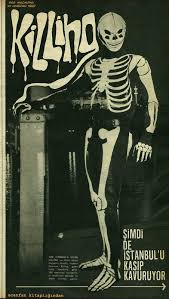
The English meaning of the word "Killing" is "murder, slaughter." In 1967 (I was 9 years old), a film titled "Killing in Istanbul," starring İrfan Atasoy, was released. I still remember today how my hair stood on end while watching the film at Aras Cinema. This was perhaps the first horror film I ever watched. The film was a great success because it was constantly talked about by the neighborhood children, who tried to scare each other by playing the role of Killing.
One day, one of the young men in our neighborhood had an idea and had a Killing costume made, just like the one in the picture above. At night, he ambushed in the place I often mentioned in my previous anecdotes, called "Meşe Kerem'in gelemeliği (Kerem's poplar grove)" at the entrance of the neighborhood. He put on his Killing costume and waited for his prey. In those years, the roads were either poorly lit or not lit at all.
He saw someone approaching leisurely from the opposite direction. In the dim darkness, he suddenly appeared in front of him: "Hand over your money or you're dead!" he threatened. The poor man, out of fear, raised both hands in the air, and the watermelon under his arm fell to the ground and shattered. Killing snatched the man's wallet and disappeared into the darkness.
The next day, after this incident became known, no one dared to pass by the grove at night. Killing, of course, was disheartened by this situation, but he stubbornly pursued new prey. Towards midnight, he took his usual position.
He saw someone approaching in the dim light from afar. He waited for him to get closer. He suddenly appeared in front of him. And what did he see? The approaching man was also wearing a Killing costume! A dispute began between them. The old Killing warned the newcomer: "I am the Killing of this neighborhood! Go find yourself another place!" The new Killing replied: "I also live in this neighborhood. If you want, let's do this together." They agreed.
Someone appeared in the distance, walking unsteadily. The two Killings simultaneously appeared in front of the man. The man was dead drunk. He felt no fear. He didn't even care what he saw. He muttered to himself: "It's so obvious I'm drunk. I'm seeing two Killings instead of one. Now it will be clear which one is real." He brought the spare bottle full of wine he was carrying under his arm down on the head of one of the Killings. The Killing who took the blow collapsed to the ground, almost dead, and the other disappeared. As the drunkard continued on his way, he muttered to himself: "Good for me! How did I guess which one was the real Killing on the first hit? When the real one fell, the other one I saw double disappeared on its own!"