Palestinian Romanticism (!)
This essay explores the complex history of the Israeli-Palestinian conflict, challenging common narratives and highlighting the roles of Zionism, Kibbutzim, and internal Palestinian divisions, while also delving into the historical roots of anti-Semitism.

Dear readers!
In recent weeks, the war between Palestine and Israel has drawn the attention of the entire world. Is this the first time this has happened? No. Those who truly understand what is happening between Palestine and Israel may not appear in the media or may remain silent, but in this article, with all my sincerity and honesty, I want to draw your attention to the Palestinian Issue, which I have witnessed since I was 15, read countless books about, and which, in a sense, now creates a feeling of weariness in my soul because it constantly repeats itself.

THE PALESTINIAN ISSUE
We would not be making a big mistake if we said that the Palestinian Issue emerged with the establishment of the State of Israel on May 14, 1948. When World War II ended in 1945, the world faced a reality: European states had collaborated in perpetrating genocide against the Jewish people, causing the deaths of millions of Jews.
Most people assume that only Nazi Germany carried out genocide against Jews. This is not true! For example, when Nazi Germany occupied France in 1940, France was divided into two regions by the armistice agreement signed between France and Germany on June 22, 1940.
According to the agreement, one of the regions was under German occupation (including Paris), and the other was a puppet state, Vichy France, which, on paper, was under the full sovereignty of the French, with its capital in the city of Vichy. Germany had one request from Vichy France: "You will hand over the Jews you capture to us!" Petain, the head of Vichy France, embarked on a hunt for Jews. Everyone informed on each other. Thousands of innocent and guilty people were loaded onto trains and sent to Germany. Did only the French do this? No! Franco in Spain, Mussolini in Italy, and all states occupied by Germany (Netherlands, Poland, Belgium, Romania, Greece, etc.) handed over the Jews they captured to Germany on trains with nailed doors. One of the most important reasons why Hitler quickly gained control of continental Europe was his slogan: "I have come to save you from the Jews!"

In short, all of Europe is responsible for the genocide of the Jews. After the war, the surviving Jews sought a state. Only one solution lay before them: to implement the idea of Zionism, put forth by Theodor Herzl, an Austrian-Hungarian journalist and political activist of Jewish origin, in his book "The Jewish State," written at the end of the 19th century, influenced by the Dreyfus Affair in France.

THE FIRST JEWISH MIGRATION TO PALESTINE
Theodor Herzl and the Zionists realized that they needed an agricultural class to form a state, but almost all European Jews were engaged in trade. In those years, a series of massacres known as pogroms were carried out against Jews engaged in agriculture in Russia. The Zionist movement offered these persecuted Jewish farmers the opportunity to leave the country and settle in Palestine. From 1870 onwards, Jewish farmers began establishing agricultural settlements on Palestinian lands.
Theodor Herzl, as if foreseeing what would happen in World War II, tried to attract European Jews to Palestinian lands as soon as possible. King Solomon's Temple had to be rebuilt, and a Jewish state had to be established. The slogan of this idea became known as "the Promised Land."
After World War II, Jews who survived the genocide in Europe began to flee to Palestine, which was under British occupation, sometimes legally and sometimes through clandestine routes. The British, unable to discipline the Arabs alone, secretly protected the Jews and enabled them to buy land, thus paving the way for the establishment of the city of Tel Aviv. In this way, the foundations of the Jewish state were laid. In a short time, a significant portion of the world's Jews flocked to Palestine, and three years later, in 1948, the independent state of Israel was established. Currently, 160 states (83% of the member count) out of 192 members of the United Nations recognize Israel. Turkey also recognized the state of Israel in 1949.
Many intellectuals, writers, and artists appear on television screens, claiming that the State of Israel unjustly seized its current territories from a small region, thus engaging in antisemitic heroism. Let's give an example from our own history: the Ottoman Empire also became an empire ruling three continents, starting from a small principality confined to the Bilecik-Söğüt region. A similar situation applies to many countries. Historical issues cannot be explained with "right-wrong" concepts and proceed on the principle of non-retroactivity, as in legal laws.
KIBBUTZ FARMS
The Jews who settled in Palestine acted cleverly and established the Kibbutz system. The word Kibbutz means "community" in Hebrew. Each Kibbutz is like an independent small city-state. Kibbutz politics played a primary role in the establishment of the state of Israel.
Kibbutzism, which practically combines socialism and Zionism, is a unique Israeli experiment and one of the greatest communal social movements in history. Each Kibbutz is responsible for its own protection. Kibbutzim are secured with strong walls like castle walls and technological systems like cameras. There is a division of labor among them in terms of production and technology. In fact, my readers who are familiar with the history of Socialism will recall that a similar concept to Kibbutzism was developed in the 19th century by utopian socialists and philosophers like Saint-Simon and Robert Owen.
Today, there are 270 Kibbutzim, or small statelets, in Israel. The Kibbutz movement played an important role in the rapid emergence of the state of Israel. Kibbutzim sprang up like mushrooms all over Palestinian land, far from each other. The Palestinian Arabs, finding themselves surrounded by Kibbutzim, became unable to breathe, and often, either voluntarily or by selling their settlements for money, left the region and sought refuge in Arab countries like Jordan, Syria, and Lebanon. As the Arab population decreased between the independent Kibbutzim, the Kibbutzim politically united and established the State of Israel.
Today, over six million Palestinians live in Syria, Jordan, and Lebanon. Here, I want to open a parenthesis and continue my writing. 70% of Jordan's population is of Palestinian origin. 2 million of the Palestinian population live in refugee camps. The fact that Palestinians live in refugee camps in an Arab country is a shameful situation in terms of political decency. Arabs do not produce solutions among themselves; they keep themselves in the background and distort the Palestinian Issue, turning it into a global problem. However, today Jordan and the State of Palestine could unite and become a single state, thereby strengthening political stability in the region.
Those living on Kibbutz farms gather once a week to decide on the main issues of Kibbutz life, elect the secretary, other official staff, and factory managers. Additionally, the general assembly decides on economic, financial, cultural, housing, and health matters through the votes of various committee members.
Karl Marx has a famous answer to the question of what kind of society communism is: "From each according to his ability, to each according to his need." Today, in Kibbutzim, the principle of "everyone should help according to their ability" is followed. In consumption, this principle is "to each according to their need." Basic needs are met through centralized services. Those living in a Kibbutz share housing, clothing, food, and care needed in old age and illness on an equal basis. In short, there are 270 communist statelets in Israel today.

Kibbutzim, in principle, collectively raise and educate children. Most children in Kibbutzim live in nurseries under the supervision of trained caregivers. As they grow older, they develop within evolving groups and organize themselves according to democratic principles. Children receive 12 years of uninterrupted education until the age of 18. Initially, Kibbutzism was agriculture-based, but today, technology and industrial production are also carried out.
***
In the summer of 1993, I visited Israel with my Chinese-American wife. We rented a car in Tel Aviv. We crossed the Negev desert and arrived in Eilat. The Gulf of Aqaba stretched brightly before us. After staying one day in a hotel, we turned back and headed towards the Dead Sea. The Dead Sea is the lowest lake in the world and the third saltiest. When you enter the water, you don't need to swim. Due to the high buoyancy of the water, it's possible to lie on your back and float leisurely on the surface. I also knew that the salty water of the Dead Sea was a cure for many ailments. After the Dead Sea, we were going to see the Sea of Galilee, the city of Nazareth where Jesus lived until he began his prophetic mission, and the hills of Hattin where Saladin defeated the Crusader armies, then return to Tel Aviv.
It was midnight. There were no hotels on the road. We went to a nearby Kibbutz and asked where we could find a hotel. They hosted us. We had breakfast together. They showed us around the Kibbutz and gave us information about its establishment and activities. Everyone had weapons. They said that Palestinian terrorists frequently raided them, that they were responsible for the defense of their own Kibbutzim, and that they did not receive help from the state in this regard. That day, I understood that the Kibbutz tradition was the reality that brought the State of Israel into existence. In those years, the West Bank and Gaza were under Israeli occupation. That meant it was possible to cross into the West Bank without passport control. (One year after the Oslo Accords in 1993, the West Bank and Gaza came under Palestinian Authority control, and border crossings were opened between them and Israel.)
My wife and I innocently entered the West Bank, driving our car towards Nablus, a city entirely populated by Palestinians. Since our car had Tel Aviv license plates, we were suddenly pelted with stones in the middle of the city. My wife was driving. I got out and shouted in English, "I am a Muslim too," but I couldn't stop the stones raining down on us. When my wife got out of the car, her Chinese features made the Palestinians believe we were foreigners, and they stopped trying to lynch us. When we arrived in Tel Aviv, we scolded the car rental company for not giving us this information. The employee adopted an innocent demeanor: "You are the first couple to visit Israel and not be aware of this fact. Don't worry! Since the car is insured, I will not ask you for any money."
- SOLOMON'S TEMPLE AND AL-AQSA MOSQUE
Dear readers!
Now, if you wish, I would like to provide some information about Al-Aqsa Mosque. As you know, according to Islamic history, Al-Aqsa Mosque is the first Qibla of Muslims. However, there is a reality that is forgotten or made to be forgotten.

Our Prophet was born in Mecca in 570 and passed away in Medina in 632. The first revelation came to Prophet Muhammad (PBUH) at the age of 40. Revelations continued to descend for the remaining 22 years of his life. This means our holy book, the Quran, did not descend in one night (Laylat al-Qadr). When our Prophet experienced the miracle of Mi'raj (ascension to heaven), he was 52 years old, and in the same year, he migrated (Hijra) from Mecca to Medina (622). Prophet Muhammad (PBUH) lived in Mecca for 12 years from the first revelation. The question is: Did the Prophet and the first Muslims pray during the 12 years they lived in Mecca after he declared his prophethood? If the answer is yes, where was the Qibla? Considering my extensive readings, the first Muslims did not pray when they were in Mecca. This is because the five daily prayers were enjoined upon Prophet Muhammad (PBUH) by Allah after the Mi'raj event. The Mi'raj event occurred 18 months before the Hijra. In other words, the first Muslims did not know how to pray for approximately 11 years. Of course, there was no Qibla either.
When Prophet Muhammad (PBUH) arrived in Medina (622), half of the city's population was Jewish. Jews had believed in Abraham and the holy book Torah for 2600 years. Their places of worship were called synagogues. When they prayed, they turned their faces towards Jerusalem (Solomon's Temple, i.e., Bayt al-Maqdis – the Holy Land). The first Muslims also accepted Jerusalem as their Qibla when they prayed. Influenced by the synagogue structure, the first mosque, Quba Mosque, was built. Muslims prayed facing Jerusalem for 16 months and accepted it as their Qibla. Later, when a dispute arose with the Jews, they accepted the Kaaba as their Qibla. The change of Qibla was revealed to Prophet Muhammad in Medina through Surah Al-Baqarah: "We have certainly seen the turning of your face toward the heaven, and We will surely turn you to a Qibla with which you will be pleased. So turn your face toward al-Masjid al-Haram (Mecca); and wherever you [believers] are, turn your faces toward it. Indeed, those who have been given the Scripture surely know that it is the truth from their Lord. And Allah is not unaware of what they do." (Surah Al-Baqarah, Verse 144)

(As can be seen in the map above, when Prophet Muhammad (PBUH) passed away, there was not a single Muslim in Jerusalem. Therefore, Al-Aqsa Mosque was not built during the time of Prophet Muhammad (PBUH). There were only the remnants of King Solomon's Second Temple (the Western Wall). Al-Aqsa Mosque and the Dome of the Rock were built after the passing of Prophet Muhammad (PBUH). The Mi'raj event of Prophet Muhammad (PBUH) occurred by ascending to heaven from Bayt al-Maqdis – the holy land – which is where the ruins of the Second Temple of Solomon were located.)
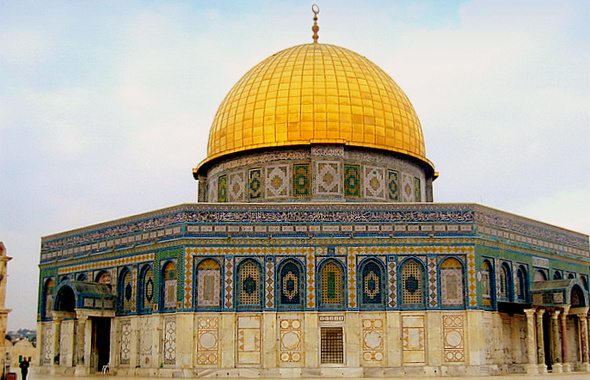
Some writers say that the first Qibla was Al-Aqsa Mosque. This statement is not correct because in those years there were no Muslims in Jerusalem, nor was there a mosque. The first name of the holy place was Bayt al-Maqdis, meaning the Holy Land. The name Al-Aqsa Mosque was given by Abd al-Malik ibn Marwan after the Umayyad Caliph Al-Walid I (705-715) thoroughly renovated the structure known as Bayt al-Maqdis after the death of Prophet Muhammad (PBUH). In short, the first Muslims, including Prophet Muhammad (PBUH), did not use the name "Al-Aqsa Mosque." Furthermore, the structure known today as the Dome of the Rock Mosque did not exist during the time of Prophet Muhammad and the first Muslims. It was a basilica (church) built by the Byzantine emperor Justinian I on the ruins of Solomon's temple. In later years, when Muslims conquered Jerusalem, the church, like Hagia Sophia, began to be used as a mosque.
I want to explain why it became necessary to provide this detailed information. Today, Al-Aqsa Mosque and the Dome of the Rock, considered sacred by Palestinians and Muslims worldwide, were built on the site of Solomon's Temple, which is considered sacred by Jews. The First Temple of Solomon was destroyed by the Babylonian King Nebuchadnezzar. When the Jews, taken captive to Babylon, returned to Jerusalem years later, they built the Second Temple of Solomon on the ruins of the First Temple. This temple was also destroyed by the Byzantines, leaving only the wall used as the Western Wall. According to Jewish belief, the Messiah will come when the Third Temple is built in place of the Second Temple. For the Third Temple to be built, Al-Aqsa Mosque and the Dome of the Rock, considered sacred by Muslims, must be destroyed. The conflicts currently reflected on television screens mostly take place in this area. In fact, similar situations, where the same place is considered sacred by many countries, are quite common. For example, Hagia Sophia is sacred to both Orthodox Christians and Muslims.
Now, I want to present a thesis that you might not like at all: Palestinians, using the "religious" sensitivities of Muslims worldwide, somehow cause incidents at Al-Aqsa Mosque every religious holiday, drawing the world's attention to the Palestinian Cause. Let's not forget that the Second Temple, upon which Al-Aqsa Mosque and the Dome of the Rock stand, was built by Jews much earlier. It is also a sacred place for Jews.

THREE DIMENSIONS OF THE PALESTINIAN ISSUE
I want to ask you this question: Does a Palestinian State exist? I don't know what most of you think, but let's consider the reality together. Today, there is a Palestinian State recognized by dozens of countries and granted observer status by the UN. Elections are held, and a President is elected. Its capital is the city of Ramallah. The Palestinian State consists of two parts: the West Bank and Gaza. These regions are not under Israeli administration because the Palestinian State has the status of an independent state. The current war is taking place between the Palestinian State and the State of Israel. Many commentators on television approach the issue as if the West Bank and Gaza are under Israeli occupation.

Another emotional exploitation often brought up in the media is the "Gaza Siege." An impression is created as if Gaza is completely surrounded by the State of Israel. However, Gaza is connected to Egypt, an Arab country, via the Rafah Border Crossing. Just as Jordan, an Arab country, treats Palestinians as refugees and humiliates them, Egypt also prevents aid from reaching Palestinians in Gaza. Arabs are indeed very cunning. They victimize Palestinians and then cry out, "Israel is destroying Gaza!" Egypt is perfectly capable of providing all the food and medicine needed by the civilian population in Gaza without the help of any other state. They don't do this because they are trying to keep their bargaining chances with Israel alive by using the Palestinian Issue as an excuse. In this sense, there is more of an Inter-Arab (among Arabs) problem in the Middle East than an Israeli-Palestinian problem.

Yasser Arafat truly initiated the Palestinian Resistance movement. His organization was called Fatah. It was the Cold War era. Americans supported Israel, and the Soviets supported Fatah. Therefore, Fatah's founding ideology was socialist. Fatah guerrillas received guerrilla training in the Beqaa Valley between Lebanon and Syria in the 1970s. Deniz Gezmiş and many other revolutionaries received guerrilla training in the Beqaa Valley. In those years, going to Beqaa was a matter of pride for socialists. The phrase "We supported our Palestinian comrades!" was uttered with pride.
Those who went to Palestine for guerrilla training walked around proudly and were respected. In the 1970s, at the Gümüşsuyu Campus of ITU where I was studying, a student who was a member of the TİKKO organization was rumored to have "smelled the soil" of the Beqaa Valley, meaning he had received guerrilla training. The blessed gentleman was insufferably arrogant! In the meantime, I am also stating this fact: the first defenders of the Palestinian Cause were left-wing and socialist youth. The Islamist youth took up the Palestinian issue much later.
Soon, a "Palestinian Romanticism" emerged all over the world. Thousands of socialist youths from Germany, Japan, and Argentina, like Carlos, received training in the Beqaa Valley and took up arms against Israel. In later years, Kurdish socialists also intensely succumbed to this romanticism. Some of these young people died and some were arrested. Of course, in those years, there was neither Hamas nor Hezbollah. The Palestinian State had not yet been established. In short, Fatah, with its left-wing views, constituted the FIRST DIMENSION of the Palestinian cause.
In later years, Jordan expelled the Palestinians living as refugees in its country to Lebanon. In Lebanon, Nusayri (Alawite Arabs) Arabs were in the majority. When the Islamic Revolution took place in Iran, the Alawite Arabs in Lebanon contacted the Shiite Iranians. In this process, the Shiite Hezbollah organization was established and settled in Southern Lebanon, beginning to attack Israel. The Shiite Hezbollah organization became the SECOND DIMENSION of the Palestinian Issue. In response to the Shiite Khomeini Revolution, Sunni Muslims began to make their voices heard by forming Al-Qaeda and similar organizations. Under these conditions, the Sunni Islamic HAMAS was established in Gaza. This became the THIRD DIMENSION of the Palestinian Issue. Turkey and Qatar officially recognized Hamas. According to most other countries, Hamas is a terrorist organization.
In short, I want to say this: Today, Israel is witnessing a power struggle between SHIITE and SUNNI Muslims. The priority of the religiously rooted AK Party is to help the Islamic Organization Hamas, which is based in Gaza. Mr. Erdoğan invites Palestinian President Mahmoud Abbas, a member of Fatah (i.e., left-wing), to Turkey as per protocol, but his heart is with Hamas. Mr. Erdoğan invited Hamas leader Khaled Meshaal, whom the whole world recognizes as a terrorist organization, to Turkey in 2013 and held a three-hour meeting.
Iran has no contact with either Fatah or Hamas because they are Sunni. Iran prefers to help Shiite Hezbollah, which is located on the Israeli border in southern Lebanon. The population of the Palestinian State, including the West Bank and Gaza, is roughly 5 million. One of the Palestinians' unceasing demands is to declare Jerusalem as their capital. When Israel also sees Jerusalem as its natural capital, another dimension of the conflict emerges. My request from the Palestinian State is that, while negotiations for East Jerusalem to be the capital continue, the Palestinian State should be governed without emotional exploitation in the heart of the Islamic World. The Intifada era is over; the era of state governance has begun. When you cannot govern the state you have, you turn around and blame Israel! Unbelievable!
THE STATE OF ISRAEL
If you wish, let's briefly look at the State of Israel. Its population is roughly 10 million. 20% of this population is Arab. So, the State of Israel is not entirely Jewish. Do Arabs in Israel live under oppression? Not at all! Arabic is recognized as a regional official language, meaning Arabs living in Israel can receive education in their native language and even obtain university degrees by speaking Arabic. There is also a legal Arab Party in Israel: RAAM. This party played a key role in forming the government in the last elections. Did you know these things?
Furthermore, the State of Israel does not feel uncomfortable with Arab public administrators in Arab regions and does not appoint trustees. Considering all this reality, if we compare an Arab living as a citizen within the State of Israel with a Kurd (Kurmanji/Zaza) living as a citizen within the Republic of Turkey, the State of Israel appears more democratic. Unfortunately, this reality is never brought up or discussed in television debates.
On the other hand, an impression is created that Jews are attacking to destroy the religious values and mosques of Muslims. This does not reflect the truth. If you wish, I can provide a list of mosques within the State of Israel:
Mosques in Israeli-Administered Jerusalem
Al-Aqsa Mosque – Old City
Al-Khanqah al-Salahiyya Mosque – Old City
Marwani Mosque – Old City
Mosque of Omar – Old City
Abdeen Mosque – Wadi al-Joz
Sultan Ibrahim Ibn Adham Mosque – Beit Hanina
Mosques in Northern Israel
el-Jazzar Mosque, Acre
el-Jazzar Mosque – Acre
Mahmood Mosque – Haifa
al-Muallaq Mosque – Acre
White Mosque – Nazareth
Makam al-Nabi Sain Mosque – Nazareth
Mosque of Ali Ibn Abi Talib (Old Mosque) – Shefa-‘Amr
Mosques in Central Israel
Sidna Ali Mosque, Herzliya
Al-Bahr Mosque – Tel Aviv
Hassan Bek Mosque – Tel Aviv
Mahmoudiya Mosque – Tel Aviv
Siksik Mosque – Tel Aviv
Sidna Ali Mosque – Herzliya
White Mosque – Ramla
Mosque of Salahaddin al-Ayyubi – Tayibe
Mosque of Ali ibn Abi Talib – Tayibe
I address the Palestinian people: You are fragmented within yourselves, as Fatah, Hamas, and Hezbollah. Hamas and Fatah clashed, and thousands of Palestinians died. Do you hold Israel responsible for these deaths too? You currently have a state with its capital in Ramallah, recognized by 138 member states of the United Nations. You are represented in the United Nations with observer status. Do you have the right to manipulate the soul of the Muslim world by forcibly causing incidents at Al-Aqsa Mosque every religious holiday?
Facts are distorted. The average Muslim in the world believes that there is no state called Palestine, that the West Bank and Gaza are groaning under Israeli occupation, and that Gaza is completely blockaded and living under oppression. We have seen that these are not true. I must also add that when thousands of rockets are fired from the Palestinian State (Gaza) at the State of Israel, not only Israel but no state can remain a spectator to such an attack. If Gaza were completely blockaded, the question of how these rockets entered Gaza would be a separate issue.
No country recognizes the Kurdistan Region of Northern Iraq, which has a population of 6 million, slightly more than the Palestinian State, and deserves independence as much as the Palestinians, nor do they have observer status in the United Nations. I call on the Palestinian State: If you have the courage, be the first to recognize the state of the Northern Iraqi Kurds, who have suffered as much as you have. I would like to remind you that we are tired of your "selfish and self-centered" approach, which has placed your own problem at the center of the world for years. We no longer want to hear the names Hamas, Hezbollah, or Fatah. You have a state. Learn to govern a state. Stop constantly pumping out hatred for Israel and drawing attention to yourselves.
Unfortunately, we have reached a point where some Muslim countries have seen parties emerge that win elections simply by propagating "anti-Israel sentiment." It's bitter but true!
Meanwhile, I have a piece of advice for the Kurdistan Region of Northern Iraq and for you: abandon the obsession that Kirkuk and Jerusalem "will definitely be our capital"! If the area in Jerusalem defined as "Holy Land," where Al-Aqsa Mosque and the Dome of the Rock are located, is declared a historical site by UNESCO, then no state will be able to make changes there; it will only be open to visitors. This is currently the most reasonable solution.
In the 1970s, everything was very different. As a socialist, I was an admirer of Yasser Arafat. During my years in Paris, I donated to Palestinians who set up stands in the streets. Do you know how long my romantic attachment to the Palestinian cause continued? It continued until Saddam Hussein attacked Halabja, where Kurds lived, with chemical weapons and carried out a massacre, and no Palestinian organization condemned it. Arab nationalism prevailed. In fact, a statue of Saddam Hussein was erected. I feel sorry for the civilians who died in Gaza, but I also feel sorry for the civilians who died in Israel. In fact, Turkish and Israeli diplomats have been victims of terrorism in similar ways in the past. Armenian ASALA militants targeted our diplomats, and Palestinian terrorist groups targeted Israeli diplomats. Condemning one terrorist organization and legitimizing another is contrary to the spirit of international relations principles.
I have a suggestion: Shiite Iran and Sunni Turkey should join hands, combine their armies, and launch an attack against the State of Israel, because high-ranking officials of both states frequently make populist statements like "We will completely destroy Israel!" If their goal is to establish a Palestinian State, it already exists. However, if their goal is to destroy the state of Israel, I have bad news. A nuclear war would start in the world before the Iranian and Turkish armies even set out. Has anyone calculated this? Jews, who have experienced exclusion, massacres, and exiles for centuries, possess a strong will never to be annihilated before the world is annihilated. We must accept this reality and live with it.
ADDITIONAL INFORMATION: After the above article was published, a friend I value called me on the phone. He made a request: "I wish you had also included why Jews have been unwanted or disliked throughout history!" In response to this, I am writing the following text.
First of all, I want to clarify the words "Jew" and "Judaist." The word "Jew" is the name of an ethnicity, while "Judaist" is the name of a person who has adopted the religion of Judaism. In general religious literature and daily life, these two words can be used interchangeably. Although there are exceptional cases, when "Jew" is mentioned, "Judaist" comes to mind, or conversely, when "Judaist" is mentioned, "Jew" comes to mind.
Now I want to answer my dear friend's question. It is true that Jews are disliked in many countries. In this regard, I want to draw your attention to an important point. Jews are disliked in countries where Abrahamic religions (monotheistic) such as Christianity and Islam are dominant. For example, in countries that are not Abrahamic religions, such as Africa, China, Japan, etc., anti-Semitism is not an issue. This understanding exists only in Christian and Islamic countries. The reason for this is as follows:
Abrahamic religions emerged in the following order: Judaism (Abraham 2000 BCE), Christianity (Jesus 0 CE), and Islam (Muhammad 610 CE). If you delve into the history of religions and place the Torah, the Gospels, and the Quran side by side, you can see very significant similarities between them. These similarities are so numerous that I cannot list them all here.
First, Christians hated Jews. The event unfolded as follows: Jesus, who was himself a Jew, preached a new religion, stating that the Jewish religion and the rabbis (religious leaders), which had been institutionalized for 2000 years, had deviated from the principles of Abraham, and accused them of collaborating with the occupying Romans. He traveled from village to village with his disciples, performing miracles and spreading the religion that God had revealed to him. In a sense, this was a "religious uprising." He was arrested and imprisoned. On the other hand, a Jewish organization, disregarding the rabbis, waged guerrilla warfare against the Romans. Their leader was named Barabbas.
One day, a new Consul (Roman governor) is appointed to Jerusalem. To endear himself to the people, the Consul decides to release either Jesus or Barabbas, both condemned to death, taking advantage of a Jewish religious holiday. He brings both before the people and asks, "Which one do you want me to release?" The rabbis and Jews, seeing Jesus' teachings as a rival, unanimously request, "Release Barabbas!" Jesus is then crucified and executed. For centuries thereafter, Christians (Orthodox, Catholic, Protestant, etc.) held Jews responsible for the death of Jesus, ostracized them, and massacred them whenever they had the opportunity. This hatred continues to this day.
When it comes to Islam, the situation is slightly different. When Prophet Muhammad migrated to Medina, half of the city was filled with Jewish tribes. Prophet Muhammad tried to spread his prophethood among the Jews as well but encountered stiff resistance. Prophet Muhammad, who until then had prayed facing Jerusalem like the Jews, accepted Mecca as the Qibla with a new revelation. The attitude and claims of the Jews were as follows: "You (Muslims) and Christians are imitating our Holy Book, the Torah. Judaism has existed for 2600 years. Therefore, you Muslims and Christians are deviant religions. We are the ones who truly represent the teachings of Abraham. There is no need for a new religion!"
When Prophet Muhammad realized that he could not win over the Jews to Islam, he went to war with them. His most famous battle was the conquest of the fortress of Khaybar, which was under Jewish control. A belief developed in Islam: if the Jews were destroyed, it would no longer be debatable that the Quran was not an imitation of the Torah, which is the foundation of the Jewish religion. Christians, too, for a long time, joined hands with Muslims to try to eliminate the Jews to prove that the Gospels were not an imitation (or reinterpretation) of the Torah.
The Romans, already wanting to get rid of the constantly rebelling Jews, destroyed the Jewish Temple, Bet Amikdash, in 70 CE and scattered the Jews to the four corners of the world. Jews did not scatter to the four corners of the world to exploit it, as some claim.
There is such a relationship between these three sibling Abrahamic religions:
JEWS: They do not recognize Jesus and Muhammad as prophets; on the contrary, they see them as heretics who imitate or reinterpret Abraham.
CHRISTIANS: They see Abraham as a prophet. They also believe that Jesus descended from Abraham.
MUSLIMS: They recognize Abraham and Jesus as prophets. Muslims claim that the lineage of Prophet Muhammad goes back to Prophet Ishmael, the son of Prophet Abraham. Jews find this claim amusing because Prophet Ishmael is the son of Prophet Abraham, the founder of Judaism, and he himself is a Jew. Jews claim that Muslims put forward this claim to spread the belief among Muslims that "Our religion has no connection with Judaism."
In summary, to avoid having to prove that Christianity and Islam were not reinterpretations of Judaism, they have for centuries joined hands to try to wipe Jews off the face of the earth, constantly harboring anti-Jewish sentiment, and massacring them at every opportunity. This is the historical reason for "Jewish hatred," not their "greed for money or stinginess" as some claim. Humanity owes its greatest discoveries to scientists raised in Jewish culture. I want to give a few examples: Karl Marx (philosopher and sociologist), Einstein (scientist), Ayn Rand (writer), Mark Spitz (athlete), Niels Bohr (founder of quantum physics), Franz Kafka (writer), Sigmund Freud (founder of psychoanalysis), Mendelssohn (composer), Spinoza (philosopher), Rosa Luxemburg (feminist socialist), Trotsky (Bolshevik politician), Abraham, Moses, David, Solomon, Samson, Mark Zuckerberg (founder of Facebook), Milton Friedman (economist).
ANECDOTES AND JOKES
Note: The following anecdotes and jokes are published for the first time.
FEAR
In a meadow in Iğdır, a tortoise slowly advanced when it saw a dog approaching. In fear, it pulled its legs and head into its shell, remaining motionless like a stone. The dog approached the tortoise, which had just been moving but was now still, sniffed it, and tried to understand what it was. At that moment, a horse in the meadow, curious about the tortoise the dog was sniffing, approached. Frightened by the horse's imposing size, the dog took three or four steps back in fear, but with a displeased expression on its face. The horse curiously sniffed the tortoise. Just then, the tortoise moved, and the horse jumped back in fear, trying to gallop away. The dog, assuming the horse was afraid of it, followed the horse, barking. The tortoise, seeing all that had happened, muttered to itself: "What is this, for goodness sake! It's not clear who is afraid of whom!"
TWO STORKS
Two storks were chatting. One expressed its opinion:
"Mashallah, the Iğdır Plain is very fertile this year! We had a great time!"
"Yes! It's full of snakes, scorpions, frogs! What more could you want!"
ALWAYS COMPLAINING
It was spring. The seeds had just been sown. Due to days of rain, the fields had turned into lakes, and the seeds had surfaced. The Azerbaijani farmer, wearing his boots, struggled with great difficulty to drain the rainwater from his field, all the while cursing to himself. At that moment, a Kurdish horseman, with whom he had a friendship, appeared beside him. The Kurd spoke with a somewhat mocking tone:
"It's a good thing we Kurds don't engage in agriculture. When it rains little, you complain and curse, and when it rains a lot, you also curse and complain. May God give you patience!"
The Azerbaijani did not hold back:
"It's a good thing we don't engage in animal husbandry. Otherwise, every year, one of our family members would either be killed or imprisoned because of pasture disputes."