The Great Prince and Quçê (Kuçe) Village
This essay uses the literary device of a "Great Prince" to critique societal issues in India and a Kurdish village in Turkey, highlighting the psychological and socio-political dimensions of conflict and neglect.
I was learning French in Paris. One day, our teacher came into the classroom holding a book. Waving its purple and yellow cover in the air, he added: "I strongly recommend this book to those who are just starting to learn French, like you." The book the teacher was waving was called The Little Prince. I bought it and started reading. I remember reading it in one sitting without needing to consult a dictionary much, as it was written in a simple and understandable language.

Published in 1943 by French writer and pilot Antoine de Saint-Exupéry (antuandö san ekzuperi), The Little Prince quickly became one of the world's best-selling and most-read books. The book tells the story of the adult world through the eyes of a child. The events and conversations begin with an astronaut crashing in the Sahara Desert and encountering the Little Prince.
The author wrote this book in a hotel room in New York and even did the drawings himself. Although the author planned to write a children's book, The Little Prince attracted more attention from adults in later years. The themes it addresses are precursors to the postmodernism movement. The author offers a radical critique of the human condition, the ongoing Second World War, despair, authority, and scientists. The Little Prince, which quickly became popular, has been translated into 210 languages.
The author himself was a pilot. In 1935, he once crashed in the middle of the Sahara Desert while attempting a speed record. This is why he chose the Sahara Desert as the setting for his book.
The plot of the book is briefly as follows: The author's plane breaks down, forcing him to land in the Sahara Desert. There, he meets the Little Prince. The Little Prince begins to tell the author about his home and his adventures. He is a prince living alone on his asteroid (planet) named B612. He carefully tends to the rose he loves dearly on his planet. He has to travel to other planets because he wants to find ways to be more useful to his rose. Thus, one day, he found his way to Earth.
***
Recently, while browsing the internet, I read an article and saw a picture. The famous French astronaut Thomas Pesquet (tomas paske) was looking at Earth from the space station and saying: "Below, I only see continents and blue oceans. Everything looks so beautiful from here!"
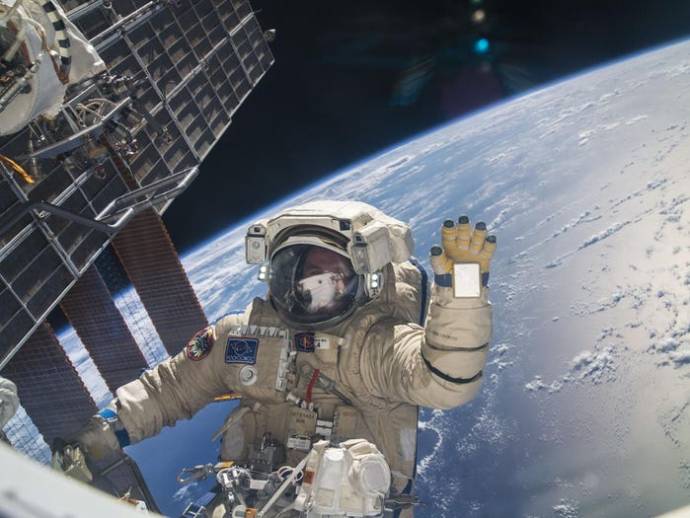
I was furious! So, everything on Earth looks beautiful and perfect, huh! I immediately headed to my wardrobe. Ah! Before I forget, I want to clarify something:
In my childhood, I was quite keen on reading Superman comic books. One day, my aunt, who was a tailor, was sewing a dress on her Singer sewing machine, singing as she worked. I was lying by the stove, engrossed in the new issue of Superman. When my aunt saw the Superman picture on the book cover, she offered to cheer me up: "If you really want it, I can sew you the exact same outfit." Since I enjoyed emptying the stove's ashes and carrying dung, my aunt must have wanted to make me happy. She took my measurements and sat down at the sewing machine.

I proudly wore the Superman outfit my aunt had carefully sewn. I showed off to my neighborhood friends. Since the outfit was made of silk fabric, I was worried it would tear. For this reason, instead of wearing it outside, I preferred to keep it in my mother's hope chest.
I had become an adult, but I still occasionally took the Superman outfit carefully out of the chest, put it on with difficulty, and looked at myself proudly in the mirror. This continued for a while. Then I stuffed the Superman outfit into a corner of the chest and forgot about it, until...
***
When I got angry at the French astronaut, the first thing I did was put on my Superman outfit and fly into space. Astronaut Monsieur Pesquet (paske) was happily looking at Earth, which appeared like a blue sphere from the window of his spacecraft. With an irritated gesture, I reached under his unbreakable helmet and grabbed his ear.
"Monsieur Pesquet! I read what you said. I'm going to take you to Earth. Let's see if everything is as beautiful as you see it from here!"
He tried to use force to get away from me, but he was unaware of Superman's superior strength. I pulled him out of the spacecraft. We sped towards Earth. Soon, we plunged into the atmosphere and approached the first landmass we encountered. We had landed near Sangli Miraj, a city with half a million inhabitants in the state of Maharashtra, west of India. We walked towards the city.
Monsieur Pesquet asked:
"Which country are we in?"
"India!"
"What bad luck! I know Chinese, but I don't know Hindi."
"Don't worry, I do. I will help you."
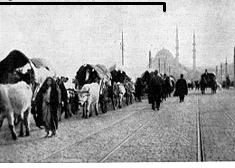
It was afternoon. Tens of thousands of people, utterly distraught, were carrying their relatives who had died from the coronavirus epidemic, wrapped in sheets, on their shoulders through the streets. The astronaut became curious:
"Little Prince! What's happening here? Where are these people going?"
"Monsieur Pesquet! You see, I'm over 1.90 meters tall. Wouldn't it be better if we changed the word 'Little' to 'Great'?"
"Alright! Alright! In that case, I will address you as 'Great Prince'. I want to repeat my question: Where are these people going?"
"The people are looking for a place to cremate their relatives who died from coronavirus."
"I thought hospitals had crematoriums!"
"The capacity of crematoriums in hospitals and morgues is insufficient. People are burning their dead in open areas with brushwood and logs they collect."
"What a dire situation!"
Monsieur Pesquet tightened his helmet on his head, fearing he would contract the COVID virus. He readjusted the oxygen tank on his back.
We rushed into one of the hospitals. Everywhere was packed. Two or three patients shared a single bed. Everything was filthy and squalid. Someone in a special suit was walking around. Assuming he was a doctor, I wanted to get some information:
"Doctor! How is the situation?"
"I am not a doctor. I am an officer responsible for maintaining order. There are no doctors or nurses in the hospital!"
"How can that be! Why are there no doctors?"
"Most of their friends died from coronavirus, so they all resigned from their professions and fled. The patients were left to their own devices. There are no medicines or vaccines!"
Monsieur Pesquet flinched when he heard this. I could feel him trembling with fear.
"Great Prince! Please, let's get out of here!"
Since I was still angry with him, I grabbed Monsieur Pesquet by the ear, and we ascended into the sky, flying for a while. Monsieur Pesquet became excited when he saw the snowy peak of Mount Ararat in the distance:
"Let's take a break near that mountain over there. Then we'll continue our journey."
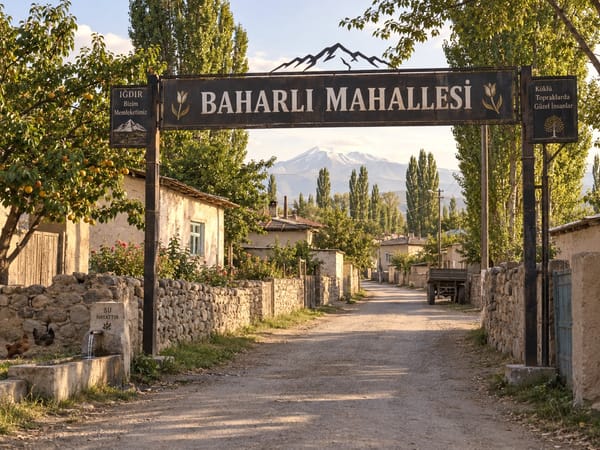
We landed near a mountain village, about 30 km as the crow flies from Mount Ararat, which the local people call "Quçê." In fact, Quçe, or Kuçe, is a neighborhood belonging to a village named Mezraa, but it is commonly known as a village.
Monsieur Pesquet's face was smiling because we had arrived at a calm and pastoral place after the crowds of India. He expressed his joy:
"Aaah! Look at these mountains and greenery! How magnificent! I would love to spend my life here."
He was right. At first glance, the pastoral scenery and the tranquility of rural life brought peace to one's soul.
I immediately added:
"What a coincidence, Monsieur Pesquet! My relatives live in this village."
"Which country are we in?"
"Turkey!"
"What bad luck! I can speak six languages, but I don't know Turkish."
"The people in this village know Turkish, but they speak Kurdish among themselves. Don't worry. I will help with the language."
We lay down to rest in a valley near the village. Just then, a fight broke out among the young shepherds grazing their sheep nearby. Being Superman, I could hear even the slightest sounds. Monsieur Pesquet asked curiously:
"Why are the young people arguing?"
"Over grazing land! Both sides claim the grazing land belongs to them."
"Isn't there coronavirus here? Are they worried about grazing land?"
"There is coronavirus, but grazing land and their animals are more important to them."
"Aren't the lands in this country registered?"
"The situation is very complicated! There are titled, possessed, and treasury lands. The population is constantly increasing. That's why villagers are competing to forcibly seize possessed and treasury lands. The strong one wins. Sometimes unwanted incidents, injuries, and even deaths can occur. Let me add this: All the people living in this village are relatives. They are united by a common seventh ancestor. Despite this, they can act ruthlessly towards each other."
As our conversation continued in this vein, a stick fight broke out among the young men. They attacked each other mercilessly. The blows were hard and deadly. The young men, injured by blows to their heads, fell to the ground. They dragged an unconscious young man and threw him into the stream. Monsieur Pesquet flinched at this brutality, even looking as if he was about to vomit. It was clear he had never witnessed such ruthless violence before. Despite having a black belt in judo, Monsieur Pesquet was horrified by the deadly fight among the young men.
Monsieur Pesquet snapped at me:
"Great Prince! You said the villagers are your relatives. Why don't you gather them and make decisions that everyone will agree to? You seem like an educated person; I didn't expect this from you."
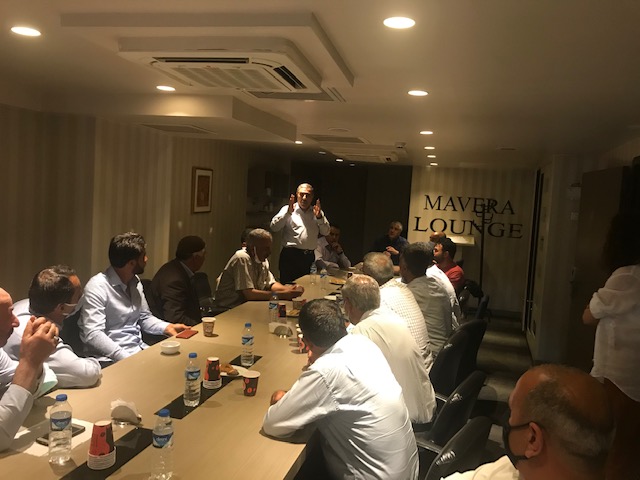
"You are being unfair to me, Monsieur Pesquet! Just last week, I brought the parties together. When they couldn't reach an agreement, the meeting broke up. My power also has its limits! It's not easy to resolve long-standing family feuds in one meeting."
"Can't the state intervene?"
"As a rule, the state intervenes in cases of death and injury. If people are determined to kill, it's impossible for the state to foresee and prevent it! The state's mistake is not implementing programs in time to regulate and encourage animal husbandry, which is the sole livelihood of the people in the region."
"Great Prince! What kind of program could be a solution?"
"Monsieur Pesquet! Everything has value and meaning when done at the right time. Animal husbandry, which has been the sole source of livelihood for Kurds almost since the establishment of the Republic, has been neglected, thus preventing Kurds from becoming wealthy and educated. While countries around the world abandoned nomadic pastoralism or open-field animal grazing in the 1950s and transitioned to indoor, intensive animal farming, this has not yet happened in the Eastern Anatolia region. In fact, Iğdır had a great opportunity in the 1950s. The Kazım Karabekir Agricultural Enterprise (then called the State Production Farm) was established. Sugar beet cultivation had also just begun. Sugar beet pulp plays an important role in animal feeding. If a sugar factory had been established in Iğdır in those years, intensive animal farming could have accelerated at the State Production Farm, and large dairy product enterprises could have been established. Unfortunately, the state's agricultural and especially animal husbandry policy in the Iğdır region has been bankrupt since 1950. While Eastern Anatolia should have been the center of animal husbandry, discriminatory policies led to Western Anatolia and Thrace becoming the center of modern intensive animal farming, and Eastern Anatolia was neglected. The situation is such that even if a transition to intensive animal farming were made today, it would no longer be a solution."
"Why are you speaking so hopelessly, Great Prince?"
"For intensive animal farming, large dairy factories like Pınar and Sütaş must first be established in the center of Iğdır, and the milk collected in the villages must be sold to these factories. Furthermore, today, the Kurds in the region are engaged in small ruminant husbandry, like sheep, not cattle. However, factories like Pınar and Sütaş are established 100% based on cow's milk. The villagers load their sheep, which they graze in the highlands, onto trucks on special days like Eid al-Adha and take them to Antep or western provinces, selling them for almost nothing. Since families have many children, the money they earn has no real value."
"Great Prince! If the large companies you mentioned establish factories in Iğdır, and the state helps families engaged in animal husbandry with modern barns suitable for intensive animal farming, and also takes measures to encourage cattle farming instead of small ruminant farming, would this be a solution?"
"No, it wouldn't, because large companies establish their own intensive animal farming centers with their own money. And they are right! They don't want to leave the milk needed by the factory to chance. Monsieur Pesquet! Currently, there are milk collection centers in Iğdır. There are also small-scale businesses and dairies that produce ayran and cheese. Some bring their milk from Kars. As I said before, these businesses prefer cow's milk. Families engaged in cattle farming in central Iğdır or surrounding villages currently meet this need. Moreover, these businesses also have their own livestock. The important thing is to solve the economic, sociological, and political problems faced by families living in mountain villages."
"What do you mean by sociological problem?"
"The birth rate is high in mountain villages. Every family has at least 6 children. Since the amount of land has not changed, there are either inheritance disputes among siblings or land disputes with neighboring families. When an incident breaks out, reconciling them doesn't seem to be a solution either. Most young people migrate to western provinces and work especially in the construction sector, but when there is animosity towards their families, they leave their jobs and come to the village, taking sides in the conflict. I haven't even mentioned the main sociological problem yet."
Monsieur Pesquet became curious:
"What is it?"
"Well, today everyone has a smartphone. Young people who cannot go to big cities and stay in the village buy second-hand smartphones, access the internet, and watch what is happening in the world. They become convinced that they are forced to be shepherds in remote, waterless villages in the mountains, far from the pleasures of the world, in desolate, rainy, cold mountains. Even if it's their own sheep, doing this work seems arduous and an unacceptable injustice to them. While those living in big cities have lovers and cars, being thrown into secluded corners in the desolate mountains sharpens feelings of resentment and revenge in the hearts of young people. Since they lack the power to hold political authorities accountable for this, they attack each other to the death over the smallest land dispute, or even a dog fight."
"Great Prince! You mentioned that the situation also has a political dimension. Could you explain that?"
"Ah, Monsieur Pesquet! Listen carefully to what I'm about to tell you. I know that one has to pass many exams to be selected as an astronaut. Therefore, I assume you have superior intelligence. The fact that you speak six languages fluently is already an indication of this.
The situation is as follows: I will take you back to the late 1970s. In Turkey during those years, there were dozens of right-wing, left-wing, and nationalist Kurdish legal and illegal organizations. One of these was the illegal organization named 'PKK,' which is the Kurdish abbreviation for 'Kurdistan Workers' Party.' When the 1980 military coup occurred, right-wing and left-wing organizations disappeared overnight. The ruthless and lawless military dictatorship captured members of right-wing and left-wing organizations and executed them one by one. Social hatred against the military regime was secretly growing. In 1984, when the PKK launched armed resistance against the military coup, Turkish and Kurdish leftists illegally crossed the Syrian border and went to the PKK's military training centers in Lebanon due to the hatred against the military administration in society. At first, the PKK propagated an internationalist discourse. The main founders of the PKK, Haki Karer, Kemal Pir, Duran Kalkan, and many others, are of Turkish origin. During these years, the PKK's actions were generally accepted and silently observed. The PKK threatened tribal structures and targeted the elders of the village or tribe. With this approach, the PKK won the hearts of poor villagers. When the village guard system emerged, the PKK then massacred village guard families, regardless of whether they were children or adults. In 1990, with the collapse of the Soviet Union, the PKK transformed into an ultra-nationalist Kurdish organization. For the unemployed and idle Kurdish youth I just described, the PKK became an attractive center. While they were insignificant and ordinary young people in the village, the PKK promised them weapons and responsibilities, giving them a sense of importance. When the PKK could not achieve its goals, it began to resort to acts of terrorism. At the point reached today, the PKK has turned into a terrorist organization, using young people who join it by force or voluntarily, in line with the wishes of dark and international intelligence organizations.
Today, every Kurdish village is full of young people who once fought in the ranks of the PKK, and then were either released after benefiting from the repentance law or after being caught and serving their sentences. All these villages have unfortunately turned into arms depots. During a fight, not only sticks but also weapons speak, and the incident quickly spreads, gaining a social dimension. If I summarize briefly, the youth in Kurdish villages were subjected to state neglect before 1980, and after 1980, they became puppets in the hands of the PKK. Currently, there is no system or social value that these young people can lean on and trust. Their minds are empty, and their hearts have lost their emotions. The only thing they think about is revenge, revenge, and revenge. And the easiest revenge is to kill the closest person for small excuses."
I paused to catch my breath. Monsieur Pesquet was asking a lot of short questions, trying to understand the situation in its full dimension. He was astonished. If it were a difficult math problem, he would solve it in a flash, but he was dumbfounded by what I was telling him. Monsieur Pesquet asked hopelessly:
"Great Prince! Do you have a solution in mind?"
"To be honest, I would say no. My only hope is to transform the tribe, which is built on primitive bargaining like blood money, bride price, and milk money, into a social organization, a civil society organization where social solidarity and sacrifice gain importance. For example, a friend of mine in the Southeast, whose name I won't mention, transformed his tribe named Metina in this way. Through the network of associations he established, he strengthened the tribe's power and effectiveness in a way that takes into account the needs of the era. They prioritize the education of young people, provide scholarships to university students, and offer special services to the elderly. I hope we can do this, but I also know that a lot of effort needs to be made. Because in such situations, even your closest ones are ready to stab you in the back."
"As I understand it, the problem arose due to past economic, social, and political neglect or mistakes. How do you define the current problem?"
"The dimension of today's problem is PSYCHOLOGICAL. In short, Kuçe village and similar incidents need to be viewed from a psychological perspective. In other districts and villages of Iğdır, inter-tribal or intra-tribal plateau conflicts are endless. Since people do not have a spirit of social solidarity where they feel safe and can receive help in difficult times, small problems can lead to undesirable consequences. The solution to this, as the Metina Tribe did, is to open solidarity associations, instill in the heart of every tribe member the feeling that they are valuable, and make them believe in the power of associations that can help them in difficult times. Establishing a sense of self-confidence is the only solution to eliminate all the damage of the past."
Monsieur Pesquet was tired.
"The situation here is even worse than in India! Please take me back to my space station. I promise I won't make big statements like 'everything looks so beautiful from here' again."
As our friendship had strengthened, this time, out of courtesy, I took him by the arm, and we ascended, piercing through the atmosphere. Soon, we had reached the space station. Before parting, I asked a simple question:
"Monsieur Pesquet! Now please tell me. Is it more important for humanity to go to the stars or to bring water and peace to Kuçe village?"
He just stared silently.