Al Capone and Iğdır
This article explores the life of Al Capone, the notorious Italian-American mafia leader, and draws a parallel between his criminal empire and the alleged rise of mafia-like activities in the Turkish city of Iğdır.

AL CAPONE AND IĞDIR
Al Capone (El Kapon) is the name of a famous mafia leader of Italian origin. There is no one in the world who doesn't know him. Many films have been made about him. Books have been written. I am saving the reason why I wanted to write about Al Capone in today's article for last. First, if you like, let's take a look at the life of Al Capone, who became an example for all mafia leaders in the world and, in a sense, established the fundamental rules of the Mafia.
He was born on January 17, 1899, in Brooklyn, a neighborhood of New York predominantly inhabited by Italian immigrants. His father was a barber and originally from a town near Naples. The family immigrated to the USA. His mother was a seamstress. She was also of Italian origin. Italian was spoken at home. He belonged to a family of nine children. Al Capone was the eldest. Events unfolded as follows: while his mother was pregnant with Al Capone, the family moved to the USA. Al Capone was born in the USA. He began his education at a Catholic school. At the age of 14, he was expelled from school for punching his female teacher. He worked in a candy store and a bowling alley. For a while, he worked as a bartender in a nightclub.
Soon after, he became involved with various gangs. He participated in child gangs. He served in the Manhattan-based Five Points Gang. During this period, two Mafias were competing in New York. Both were Catholic: the Irish and the Italians. The Irish initially held the upper hand. Al Capone found a way to infiltrate the Irish-American mafia members. Meanwhile, he continued his relations with the Italian mafia. Soon after, he organized a mafia similar to the Cosa Nostra in Italy.
My readers will immediately wonder what Cosa Nostra means: Cosa Nostra means "Our Thing" in Italian. It is another name for the Mafia. What made Cosa Nostra important were the rules it established and that its members sought to perfectly uphold: I would like to remind my readers of these rules:
As you know, Moses has Ten Commandments. Based on this, Cosa Nostra (the Sicilian Mafia) had ten commandments that its members sought to fulfill:
1. No one can introduce himself directly to another 'family' member (Mafia member). A third person must do this.
2. Do not look at friends' wives with ill intent.
3. Never be seen with the police.
4. Do not go to bars and clubs.
5. Always be ready for tasks assigned by Cosa Nostra, even if your wife is giving birth.
6. Never be late for your appointments.
7. Treat your wives with respect.
8. Always tell the truth when asked for information.
9. Do not keep money belonging to other 'family' members (i.e., Mafia members) or other 'families' for yourself.
10. Those with police relatives, those whose family members work for both the mafia and the police, and those who exhibit bad and immoral behavior cannot be members of Cosa Nostra.
Al Capone adhered to these ten commandments throughout his life and built his Mafia empire on this foundation. Capone briefly handled collection and hitman duties, while also working in a nightclub. One day, while working at the club, he was attacked by the brother of a girl he had insulted, receiving three knife wounds to the left side of his face. He earned the nickname Scarface (Skerfeys, meaning Scarred Face) because of this wound. After a Mafia leader fled to Italy, he took over the organization in the Chicago area.
CHICAGO DAYS
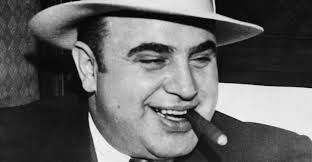
In Chicago, he met someone who was smuggling alcohol from Canada. At that time, alcohol was prohibited in America. He began smuggling alcohol across Lake Michigan. He killed his rivals one by one. Al Capone now possessed a vast fortune. He also manipulated politicians. In the 1924 elections, he ensured the Mayor's victory through fraud, but the Mayor, concerned for his own future, expelled Al Capone from Chicago. Al Capone settled in Florida but continued his illegal alcohol organization in Chicago. Then the Irish Mafia also got involved in the same business. Hostility arose. Al Capone's annual income from alcohol smuggling was around 500 million. This was an enormous amount of money under the conditions of that time. Later, he established illegal alcohol sales centers in various parts of America. He entered the prostitution, heroin, and gambling businesses. In his meetings, he spoke beautifully: he attracted media attention and stated that he was merely a businessman, and his only desire was to be a man of the people.
This time, the murders accelerated. Many traps were set for Al Capone, but they were unsuccessful. To hasten Al Capone's death, his rivals would mark the tips of their bullets with an 'x', thereby increasing the damage caused by the bullet. Interestingly, they would also rub garlic juice on the tip of the bullet, so that the garlic juice entering the body with the bullet would act as a poison.
MURDERS
A new gang had emerged. They had hijacked planes carrying illegal liquor for Al Capone's gang and killed two of the puppet mayors loyal to Al Capone. Al Capone was waiting for the right opportunity. His trusted men disguised themselves as police. On Valentine's Day, February 14, 1929, they raided Moran's place. Six gang members and one visitor were lined up against a wall and mowed down without resistance. Since the murders were not fully clarified, there was no trial. Al Capone refuted the accusations against him by proving he was in Florida on February 14, 1929.
Al Capone infiltrated the state with his mafia organization. He formed close friendships with many governors and mayors. Some of them were under his command. His actions were overlooked thanks to this. One day, he had the chance to meet American President Hoover. Hoover was in trouble. As a result of wrong economic policies, he had dragged the state into the Great Depression of 1929. Hoover could not control the labor unions. Al Capone forcibly suppressed workers' strikes. Soon after, he also gained a wide circle within the police force.
The state was helpless against Al Capone's power. Finally, an investigation was launched against him for tax evasion in 1931. His lawyers requested a plea bargain. They attempted to bribe the judge and threaten some officials. After a long trial, he was found guilty of tax evasion on October 17, 1931. He received an 11-year prison sentence and was sent to federal prison. First, he was sent to Atlanta Prison, and from there to the famous Alcatraz Prison. In this island prison, his connection with his men and the outside world was completely severed.
When he was released, his prison days and separation from the gang plunged Al Capone into depression. His health problems worsened due to syphilis. Capone, whose mental balance was partially disturbed, suffered a stroke at his home in Florida on January 21, 1947. He died on January 25, 1947.
PROSTITUTION-DRUGS-ARMS SMUGGLING-MURDER
Dear readers:
I have summarized the life of the famous mafia leader Al Capone. In short, the Mafia organization is shaped like a quadrangle. In one corner there is Prostitution, in another Drugs, in another Arms Smuggling, and in another Murder. In the middle of this rectangle is RENT. This rent is incredibly large. Mafia leaders use this rent to buy off journalists, police, prosecutors, judges, and mayors. Hitmen are deployed against those who resist. Murders are committed.
IĞDIR AND THE MAFIA
Dear readers!
Our Iğdır has been surrendered to mobsters. This is not slander or misinformation. It is a reality. The police and the Public Prosecutor's Office are doing their utmost with all sincerity. However, this has turned into a power that transcends the state. They have seriously taken root. Such an environment has formed, benefiting from the rent, that they immediately target for death those who bring this issue to the agenda in a negative way. They eliminate those they can overpower. No one dares to bring the issue to the agenda out of fear. We know that they have employees on salary so that no one writes about them. They both offer girls for prostitution and pay people salaries to keep the issue from being reflected in public opinion and to keep them silent.
The shelves of the Iğdır Public Prosecutor's Office are full of files containing crimes of murder, prostitution, drugs, and arms smuggling. I also ask the people of Iğdır: Be curious, ask around, where are these prostitution houses (under the name of casinos), where are drug sales taking place, where is arms smuggling being done? If you find the answer yourself, a common civil will shall emerge to save Iğdır from this scourge, and we will have the chance to remove this filth and stain from our Iğdır. Otherwise, Iğdır will become a city associated with gambling, prostitution, and drugs, just like Las Vegas. But do not forget that the number of those playing the role of Al Capone in Iğdır and the competition among them is quite high. There is a deadly struggle for rent. Do not fall into their trap, do not think about it, and do not become a target. Mobilizing the public by forming a civil will is the right way. Al Capone's Mafia had Ten Commandments to be followed. The Iğdır Mafia has no rules to adhere to. We are facing a lawless, dirty MAFIA.
I CALL UPON ALL OF YOU FOR A CLEAN IĞDIR.
Sincerely,