Iğdır in the Memoirs of a Doctor
This article explores the memoirs of Dr. Mehmet Derviş Kuntman, a military doctor who witnessed critical periods in Iğdır's history, including the Balkan War, the Sarıkamış Front, and the Turkish War of Independence.
INTRODUCTION
Dear readers! In today's article, I want to introduce you to a person who witnessed the most critical periods of Iğdır: Doctor Mehmet Derviş Kuntman. He is originally from Kilis. He is a military doctor. After graduating from the Military Medical Academy in 1909, he first did his internship at Gülhane, then was appointed as a battalion doctor. After that, he found himself in wars, first participating in the Balkan War, and then the Sarıkamış Front. He treated soldiers and officers in the Allahüekber Mountains.
He participated in the War of Independence. He moved a military hospital, which he established at the foot of Mount Ağrı (in Iğdır) with 500 beds, equipment, and supplies, along with two doctors, a pharmacist, a disciplinary officer, an accounting officer, and 50 soldiers, to the Western Front after a four-month journey.
In those years, the ignorance of the people in all matters was also evident in the field of health. Derviş Kuntman mentions an interesting incident in his memoirs. A man with eczema (a skin disease) on his neck once applied to Doctor Kuntman. The doctor wrote a prescription, handed it to the man, and explained: "Take this, apply it to your neck, and tie it with a cloth!" When the man went home, he placed the prescription paper over the wound on his neck, tied it tightly with a cloth, and went out to the market.
Doctor Kuntman traveled from front to front with the military unit he was assigned to. After World War I, this time he participated in the War of Independence under the leadership of Mustafa Kemal, and he sincerely penned his views and feelings about those years.
Dr. Kuntman's memoirs were first published on September 1, 1965, in the Armed Forces Magazine. A part of these memoirs contains a section about Iğdır in the 1920s. I wanted to share this section, which I believe every resident of Iğdır should read. (Source: General Staff Presidency Military History and Strategic Studies Department Publications / General Staff Printing House 2009)
Before moving on to Doctor Derviş Kuntman's memoirs, I would like to draw your attention to a few points:
“THE LEGEND OF MARTYR MEHMET ÇAVUŞ”
As you know, I previously presented my thoughts on the Iğdır Civil War in my article titled IĞDIR AND HAMIDIYE REGIMENTS (Jalali Tribes). One of the issues I mentioned in that article was that the Hamidiye Kurdish Regiments in the Beyazıt Province, Iğdır's local Kurdish and Azerbaijani militia forces, and soldiers under Karabekir Pasha simultaneously entered Iğdır, that the Armenians had evacuated Iğdır days before, and therefore Iğdır was included within the borders of the Grand National Assembly without a single shot being fired. Doctor Kuntman also confirms this reality from another perspective.
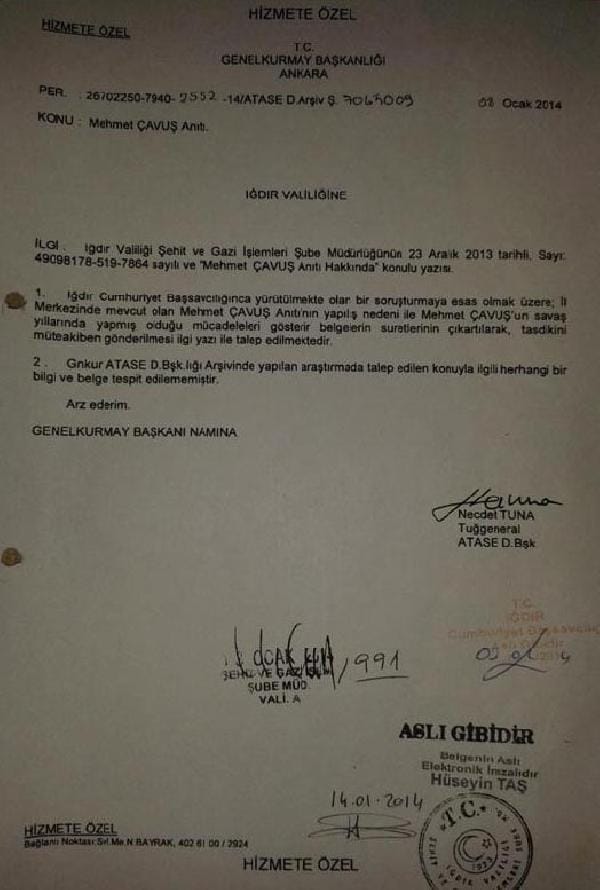
However, the official view, deliberately created by some circles, claims that the military units under Karabekir Pasha clashed with Armenians when entering Iğdır, and that a soldier named Mehmet Çavuş from Çankırı was martyred. Unfortunately, this claim, like the "Boraltan bridge" legend, is a lie built on emotional exploitation. Iğdır was empty when it was taken. There was no single clash, not a single shot was fired. So why is the claim of "Martyr Mehmet Çavuş" kept alive, especially by some writers and politicians from Iğdır? Let me answer immediately: This claim aims to downplay and ignore the Kurdish and Azerbaijani militia forces who, for two years (1918-1920), showed the greatest resistance and struggle against the Armenians in the Iğdır Civil War.
If real martyrs are sought, they should be sought among the militia forces under Ali Mirze Bey, Ahmed Şemo, Kerem Bey, Hacı Ali Ekber Tufan, and Şamil Bey. Mecit Hun's own uncle, Mustafa Bey, was martyred off Taşburun in an attack against Armenian komitacıs (1919). While there are hundreds like this, portraying someone who was not martyred as martyred hurts the souls of the real martyrs. The Iğdır writer Mr. Ziya Zakir Acar deepens the issue further, claiming that Martyr Mehmet Çavuş's family originally migrated from Azerbaijan to Çankırı (https://yesiligdir.com/haber/detay/24862/). The purpose here is to try to instill an unnecessary inferiority complex in the minds of the people, such as "an Azerbaijani saved Iğdır." In my research in Kayısın village of Ilgaz district of Çankırı, it was stated that all of them were of Karaman or Central Anatolian origin, and there was not even a single family of Azerbaijani origin among them. Given this situation, why are such lies needed?
I appeal to our esteemed Governor: The Martyrs' Monument should represent all our martyrs. I submit my proposal to change its name to "Iğdır Martyrs' Monument" or a similar name to your attention in the presence of the public. Otherwise, we will hurt the spiritual feelings of families whose grandfathers and relatives were martyred in the Civil War.
According to Mr. Ziya Zakir Acar, Mehmet Çavuş and his three friends went to Hacı Ali Ekber Tufan's aid, armed the people, and thus saved Melekli town and Iğdır. Allegedly, Kazım Karabekir Pasha assigned Cavit (Elden) Pasha, the Commander of the 11th Division, for this task. Cavit Pasha also unofficially sent Mehmet Çavuş and his three friends as civilians on a secret mission to Iğdır. And all this happened in 1917-18. Perhaps it is enough to remind you that Kazım Karabekir Pasha was appointed to the Command of the 15th Corps in Erzurum on March 2, 1919. Cavit Pasha, who served as the commander of the 11th Division in Ağrı, came under the command of Kazım Karabekir Pasha from this date. As you can see, unfortunately, the dates do not match.
Let's continue: According to the same author, the three soldiers who infiltrated Iğdır with Mehmet Çavuş allegedly helped Hacı Ali Ekber Tufan with the weapons they carried, defeated the Armenian komitacıs, and saved Melekli. Neither Cavit Pasha nor Mehmet Çavuş went to Hacı Ali Ekber Tufan's aid. The person who rescued the people of Melekli from the siege and took them to the Erhacı plain was Bıro Heski Telli, a member of the Hamidiye Regiment under İbrahim Bey from Beyazıt province, and the Jalali cavalry unit he commanded. I am not saying this. The late Hacı Ekber Tufan explains everything in detail in his published memoirs.
Since we are talking about martyrs, this time I would like to draw your attention to what another intellectual (!) wrote. Mr. Cengiz Atlı, who works as an Assistant Professor in the History Department at Iğdır University, published an article in the journal Turkish Studies. Mr. Cengiz Atlı writes in a part of his article:
"Iğdır and its villages are among the regions most intensely exposed to Armenian massacres in the years 1915-1920. During that period, a large part of the population of Iğdır (more than eighty thousand) was massacred, and those who survived were forced to leave their homelands."
Mr. Cengiz Atlı claims that 80,000 people were massacred by Armenians in the Iğdır plain. (Source: http://turkishstudies.net/files/turkishstudies/1730246014_04Atl%C4%B1Cengiz-trh-39-53.pdf )
Serious non-governmental organizations in Iğdır, such as ASIM-DER, closely monitor the atrocities and massacres committed by Armenians against the civilian population, especially between 1914-1920, and have serious publications on this matter. In addition, the authorized institutions of our state have also published figures on the subject at various times: The number of our martyrs is as follows:
Obaköy 98
Hakmehmet 83
Küllük 14
These numbers may change by 5-10. Apart from this, we know that civilian populations in Koçkıran, Gedikli, and Bayraktutan villages were also subjected to massacres. If we need to give a number for our martyrs, we can state a figure between 300-400. Saying that 80,000 people were massacred, as Mr. Cengiz Atlı claims, implies downplaying the real martyrs. This is a shameful situation! Especially for someone bearing the title of a scientist, this is an unacceptable manipulation.
Here I have a suggestion for my authorized friends from ASIM-DER: There is a Kurdish village named Kucak on the Iğdır-Ağrı provincial border. Families belonging to the Karaçöllü, Gelturan, and Xellesini (Sıpkan) tribes reside there. Kucak village is currently connected to Doğubayazıt, but before 1920, it was under Russian administration, like Oba and Hakmehmet villages. The Russian-Ottoman border passed right next to the village. When Armenian komitacıs declared the Republic of Armenia, they attacked Kucak village in 1919, massacring the entire population, numbering between 180-200 people (only one person survived), by slitting their throats. In my opinion, based on ASIM-DER's experience so far, conducting a study on Kucak village and sharing this information with the media will strengthen the association's status because Kucak Village shared the same fate as Hakmehmet, Oba, and other villages at the same time. I also suggest that the authorized bodies of the state (IĞDIR/AĞRI) deal with this issue and organize a symposium. Furthermore, I believe that the official distribution of the number of our martyrs who were subjected to Armenian massacres in Iğdır, by villages, should be published as a list by an official institution on social media, and everyone should refer to it. Everyone gives different numbers for martyrs, which encourages speculation.
“270 MEDALS OF INDEPENDENCE”
In the same article, Mr. Cengiz Atlı prepares and publishes a scientific (!) article stating that there are 270 people who received the Medal of Independence in Iğdır. (Mr. Ziya Zakir Acar gives the number of medals as 192.)
As you know, the Medal of Independence was awarded to individuals who showed heroism and sacrifice at the front or behind the lines during the War of Independence, which lasted from May 15, 1919, to September 9, 1922. What was the situation in Iğdır in those years?
For example, I want to ask how many Muslim (Azerbaijani and Kurdish) people lived in the Iğdır plain in the summer of 1919 or the first months of 1920. Let me answer immediately: There was not a single Muslim in the plain! Iğdır center and the surrounding villages were under the control of Armenian komitacıs. The Azerbaijanis had fled to the safer Iranian Azerbaijan during the "Kaça-Kaç" (flight), and the settled Kurds (Brukan and Redkan) had fled and settled in Muş and Van. Only in the mountainous region were militia forces under Ali Mirze Bey, Ahmed Şemo, Kerem Bey, and Şamil Bey fighting a guerrilla war against the Armenians. At that time, there was not a single soldier from Iğdır in the Ottoman or Grand National Assembly army because Iğdır was under Armenian/Russian rule until November 14, 1920. Moreover, Tsarist Russia exempted the Azerbaijani population from military service. Therefore, the Azerbaijani population had neither weapons nor a desire to be soldiers. Doctor Kuntman conveys his interesting observations on this matter.
The Azerbaijani and Kurdish population gradually returned to Iğdır starting from 1921. Conscription began with great difficulty from November 1921. Those conscripted served on the Eastern or Southeastern fronts, but by this date, the war on these fronts (Gaziantep, Maraş, etc.) had already ended. There was not much reason to receive a medal. The war was only being fought against the Greeks on the Western front. There may be people from Iğdır who received the Medal of Independence, but this number is not 270.
As you know, the Medal of Independence is a great honor for a family. Such a medal passes down from generation to generation. There is even a law enacted on how the medal will be passed down within the family. If the claim of 270 Medals of Independence were true, in a small place like Iğdır, everyone would know by heart which family owned a Medal of Independence. I suggest to the claimants, Mr. Cengiz Atlı and Ziya Zakir Acar, to conduct research in Iğdır villages and the city center and to list the families that have Medals of Independence, village by village, name by name.
IĞDIR MARTYRS AND VETERANS
Iğdır has given martyrs and had veterans in five different periods from 1918 to the present.
- 1918-1920 PERIOD: During this period, the Muslim population of Iğdır was under Armenian/Russian rule, resisted Armenian komitacıs, and had martyrs and veterans.
- WAR OF INDEPENDENCE PERIOD: The War of Independence ended on September 9, 1922. The Muslim population that evacuated Iğdır gradually returned from 1921, and conscription began in November. Soldiers from Iğdır fought on various fronts. The number of soldiers from Iğdır is not very high. Unfortunately, the exact number of our martyrs and veterans is unknown.
- KOREAN WAR: Our fellow citizens from Iğdır participated in the Korean War between 1950-53, and we had martyrs and veterans.
- CYPRUS WAR: We had martyrs and veterans among those from Iğdır who participated in the First and Second Cyprus Peace Operations in 1974.
- In the struggle against PKK, FETÖ, and other terrorist organizations, we have had martyrs and veterans.
There is a Martyrs and Veterans Solidarity Association in Iğdır. I believe it continues its existence with limited resources. They do not have a website. I wish that the names of our martyrs and veterans covering all the periods I mentioned above were listed. In fact, our Governorship could publish a complete list of our martyrs and veterans on its website for public access. Iğdır yearns for accurate information.
In the article he published, Mr. Cengiz Atlı lists the distribution of those who received the Medal of Independence by villages as follows:
IĞDIR:
Center: 7
Melekli: 7
Kuzugüden: 1
Karakunzun: 14
Kazancı: 3
Karaağaç Neighborhood: 1
Halfeli: 2
Yukarı Çarıkçı: 1
Total: 35
ARALIK DISTRICT
Ortakent (Ortaköy): 19
Aratan: 2
Aşağı Çiftlik: 3
Yukarı Çiftlik: 3
Başkent (Aralık Center): 34
Total: 61
KARAKOYUNLU DISTRICT:
Bayatdoğanşali: 2
Cennetabad: 4
Dize (Koçkıran): 3
Zülfikar: 2
Koçardoğanşalı: 1
Gökçeli: 1
Karakoyunlu Center: 1
Total: 14
TUZLUCA DISTRICT
Ekerek: 30
Oğruca: 1
Akdiz: 7
Elmalık: 2
Pırsak: 1
Pernavit (Gaziler): 23
Tekaltı: 10
Turabi: 2
Çıraklı: 3
Perçenis: 1
Süku: 11
Aliköse: 5
Kamışlı: 15
Kalaca: 2
Karataş: 2
Kılıçlı: 3
Kuruağaç: 2
Kırkbulak: 1
Karacaören: 1
Kağın: 8
Kirempe: 14
Yukarı Sami: 2
Yukarı Aktaş: 5
Dirsah: 3
Bağlaraltı Mah: 1
Aşağı Mahalle: 1
Uğruca: 1
Mirzahan: 2
IĞDIR TOTAL: 270
According to Cengiz Atlı, the list above only includes those who received the Medal of Independence. Of course, this number is not correct. In fact, some of the villages above do not exist. I cannot attribute the publication of such a list without field work to a scientist. If our people cannot get accurate information from the university and scientists, from whom will they get it? I leave the judgment to my fellow citizens of Iğdır and ask this question: Are there families in your villages who own this many Medals of Independence?
Why are such exaggerations and lies needed? Azerbaijanis and Kurds fought hand in hand in the Civil War, suffered, and showed their share of heroism. Neither Ahmed Şemo nor Ali Mirze Bey nor Hacı Ali Ekber Tufan nor Şamil Bey nor Kerem Bey received the Medal of Independence. They did not fight to receive the Medal of Independence either. They considered it their duty to protect the honor and existence of their people. Claiming 270 Medals of Independence in a sense aims to downplay the aforementioned personalities. Societies where justice does not permeate souls will never find peace.
Iğdır has been exhausted by this clannish mentality for years. A society that cannot free its mind from lies cannot progress. Voicing such baseless claims in the media, which enslave the minds of Iğdır residents like poisonous ivy and are built on emotional exploitation and clannishness, is a betrayal of our Iğdır and our country. Iğdır, unfortunately, has been cutting the branch it sits on for years with such clannish, fabricated stories. It seems that instead of blaming the government and the state, we have to look for the culprit within.
IĞDIR'S FIRST NEWSPAPER: ARAS
In my book "Iğdır Sevdası" published in 2002, I listed the newspapers or magazines published in Iğdır according to their publication dates as follows:
1. IĞDIR Newspaper Cengiz Ekinci September 28, 1950 Iğdır
2. ARAS Magazine Ramiz Özler October 30, 1950 Iğdır
3. DİL Newspaper Mecit Hun July 9, 1952 Iğdır
4. Fırıldak Mecit Hun January 21, 1953 Iğdır
5 Şarkın Dili Mecit Hun May 16, 1953 Iğdır
6. Pamukova Mecit Hun July 30, 1954 Iğdır
7. Yeni Iğdır Cemil Aydın February 28, 1955 Iğdır
8. Yeşil Iğdır Fazıl Şıktaş September 1, 1955 Iğdır
After reading the memoirs of Doctor Derviş Kuntman, we understand that the first newspaper published in Iğdır was the ARAS magazine, published weekly by Derviş Kuntman in 1921.
Now I leave you with the memoirs of Doctor Mehmet Derviş Kuntman:
DOCTOR MEHMET DERVİŞ KUNTMAN'S YEARS IN IĞDIR
WAR WITH THE ARMENIANS (October 7, 1920)
The Armenian government, while settling in the vicinity of Yerevan by massacring the Turks there, had attacked us from Bardiz to annex the Kars-Ardahan region, which had been ceded to us by the Treaty of Brest-Litovsk and temporarily evacuated due to the armistice, to its own country. At this time, since Kâzım KARABEKİR Pasha had taken the title of Commander of the Eastern Front and partial mobilization had been carried out, he immediately launched a counter-attack, captured Sarıkamış on October 12, 1920, and stopped the Armenians. Our division, formed by the 18th, 33rd, and 34th Regiments in Bayezid, could not get reserve soldiers from anywhere due to the situation, and since the strength of the battalions could not exceed a certain number of people, it had called for help from the Karapapak tribe in Karaköse and the Jalali tribe in Bayezid (Both are Hamidiye Regiments. Mücahit). The division was busy preparing them. I was giving practical and theoretical lessons for the provision of health services during the campaign and was busy procuring missing medicines and materials.
OCTOBER 25, 1920
Our 34th Regiment, with the Jalali Tribe, moved to the Iğdır Front. We took the trenches assigned to us: This was the left flank of our division's front, extending from the foot of Mount Ağrı to the Sinekli Plateau. In front of us was the Iğdır Plain; further ahead, the Aras River, and in the distance, Yerevan, with Mount Alagöz to its left and Mount Ağrı to our right. Our trenches were commanding and very secure positions. There was no contact with the enemy on the front yet. Although people were seen passing among the trees in the far distance, no hostile movements against us were perceived from them. Apparently, all the strength and activities of the Armenians were on the Kars side... For this reason, we set up our tents in the sheltered places of our trenches; with binoculars in hand, we kept watch over the surroundings.
The Treaty of Brest-Litovsk was a peace treaty signed on March 3, 1918, between Russia and Germany, the Austro-Hungarian Empire, the Ottoman Empire, and Bulgaria. As a result of the insistence of Talat Pasha, who represented the Ottoman Empire, all territories occupied by Russia during the 93 War in 1878, namely Ardahan, Kars, Artvin, and Batum, were to be immediately returned to Turkey. After the signing of the agreement, the Ottoman armies immediately entered these regions.
Although it had been fifteen days since we arrived here; we heard neither cannon nor rifle fire. We live in constant silence. Only the noises of the tribal soldiers break this silence. They constantly talk with their white conical hats, bushy mustaches, and strange clothes.
NOVEMBER 12, 1920
Kars had been captured, and the Armenians had fled towards Gümrü. Although they had also evacuated Iğdır at the same time, we were unaware of Iğdır's evacuation because our division and front were very wide and most of our forces were irregular.
NOVEMBER 26, 1920
Only today did the entire division, with its tribal regiments, flow into the Iğdır Plain. Each regiment began to advance in the direction given to it. We did not encounter anyone from the Armenians. They had withdrawn a long time ago; there was no one left in the streets of Iğdır except for hungry cats and dog packs. Nevertheless, the state of the tribes was worth seeing: They were attacking the empty Iğdır Plain like Don Quixote, at full gallop, with drawn swords, pretending to be heroes. In this way, we went to the Aras shore and stopped there. However, at this time, our army in Kars had captured Gümrü, and the war had ended. In this way, the Armenian megalo idea had been overturned; they, squeezed into the narrow area beyond the Aras and Arpaçay, had begged us for mercy. But our soldiers, who had waited in the mountains for days to take revenge on the Armenians, were very saddened by their unnoticed escape, and found comfort and relief by soothing the fire in their hearts with the waters of the Aras flowing from the Bingöl mountains. I, too, felt great joy at the defeat of the Armenians and the collapse of the Ararat government, considering it a sign of our victories on other fronts, and thanked God.
DECEMBER 25, 1920
After the war on this front ended, the division headquarters, with the 33rd Regiment and artillery, settled in Iğdır; our 34th Regiment settled in a large farming village called Pulur. Iğdır is the most developed town in this region, and with its single-story solid buildings, vineyards, and gardens, it gives one the feeling of a civilized city. But its villages are equally primitive. Especially the village we were in was deprived of all kinds of facilities, its streets impassable due to mud and dirt. After finishing my duty, I would retreat to my room, writhing in the sadness and suffering caused by the environment and loneliness. After front-line life, this place felt like a dungeon to me. I longed for the pure, calm, brave atmosphere of that place. Oh, how comfortable I was there!
JANUARY 21, 1921
Tonight, as I sat in my room in Pulur, lost in thought, the idea of creating a newspaper draft came to mind. This had become a recurring habit from my life as a battalion doctor. I shared this idea with my friend Zihni, the Captain of the Machine Gun Company, and he approved. We immediately prepared a small newspaper called Aras, to be published weekly, and after writing some literary and humorous pieces for it, we sent and distributed the newspaper to Iğdır. This was an entertaining thing for the people of Iğdır. Everyone eagerly took and read the newspaper. Hoping that this would be well received by the commanders, we sent a copy of the newspaper to Kâzım KARABEKİR Pasha in Sarıkamış. About ten issues were published. Although many articles in the newspaper attracted everyone's attention, the critical sections were not liked. At that time, poker playing had become an epidemic in Iğdır. Even stablemen in the stables were leaving their work to engage in this game. We drew the attention of the authorities by writing an article on this matter. The division commander showed sensitivity and strictly prohibited this game with an order. For this reason, a person from the Hatunoğulları (Note: Today, there is a large family named Hatunoğulları in Kars. Engineer Fuat Hatunoğlu, who carried out the construction work of the Iğdır State Production Farm, and Sakıp Hatunoğlu, a former Senator from Erzurum, are from this family. Mücahit) was offended by us. Sitting in the village and criticizing city social life was considered impertinence. But we, ignoring everything and encouraged by the appreciation of our commanders, did not hesitate to write about the irregularities we saw and heard.
I was promoted to Major, effective from October 1920. I was very pleased with this. Because my prestige in the Regiment increased a little. Iğdır Hospital (May 24, 1921) By order of the Eastern Front Command, I was appointed Chief Physician of the Iğdır Position Hospital. Once again, I was relieved from battalion doctor duty. This appointment was a true reward for the difficulties and hardships I had endured for two and a half years. I immediately severed my ties with the regiment in Pulur, closed the Aras newspaper which had kept me quite busy and comforted me, and came to Iğdır.
I started working at the hospital after taking over from Doctor Mazhar Bey. First, I brought my family from Bayezid, found a house with a garden near the hospital, and settled them. Then, I started working by dedicating all my material and spiritual strength to the hospital. Upon the movement of the 11th Division to Ardahan under the name of the 2nd Division, the units in Iğdır were placed under the command of the group, and the mobile hospital took the name of the 300-bed Iğdır Position Hospital. For this reason, when I took over the hospital, I saw that it was not yet fully established and found many deficiencies. In particular, there was no cleaning area, quarantine ward, or laboratory. Since it was not possible for it to operate in its existing state, and since it would take a long time to do it through official channels, I made the hospital operational by completing the deficiencies with the efforts and help of the stonemasons and carpenters I found among the hospital soldiers. At this time, they informed me that Group Commander İsmail Hakkı Bey would visit the hospital. The disciplinary officer became agitated. He wanted to change the patients' bed sheets and blankets with new ones. I asked him the reason. He said that the previous doctors did so. I said, I want to appear as I am, there is no need for ostentation. The next day, the commander came, I explained what I had done and what I would do, and he left satisfied.
SEPTEMBER 18, 1921
We had won a great victory in the Battle of Sakarya. This news created great joy in Iğdır. In the evening, a big feast was given at the division headquarters. Speeches were made. A writing of mine, some parts of which I have placed below, was also read: After the World War, the Armistice of Mudros that wanted to drown us, and the Treaty of Sèvres that ended our lives, no one believed that this nation would survive. Even the Istanbul government, convinced that there was no other way but to implement these armistices and agreements, wanted to make us miserable and wretched like the people of Israel by staining our national honor and the sacred values of three hundred million Muslims. The nation, which understood this situation beforehand, rebelled by throwing those rags in the faces of those who made them and those who wanted to implement them. Such a conscious, nationally motivated rebellion is rarely encountered in history. This uprising from the soul of the nation forced it to take up arms against its enemies again. Today's Western Front is the Kaaba of our honor and sacred values. It is a characteristic ability to live and a high character of our nation to create such a great front in such a dire situation and to honor it with a great victory like Sakarya.
As signs of the joy that the Sakarya victory aroused in public opinion, there were frequent gatherings and entertainments in the houses and gardens of Iğdır; local musical groups also participated in these, and joy and pride echoed everywhere. What the Azerbaijanis played and sang the most was this:
On the plain of Şeşkilan
A gazelle roams in its essence
Let me die, let me die
The melodies of the folk song were so poignant and touching to me that they reminded me of the Eğin tunes, saddening me to the depths of my soul. Now; with the stabilization of our political and military situation, a great commercial activity began in Iğdır. Trade with Armenians at the Markara Bridge increased. The people of Yerevan bought the salt they needed from us and sent various manufactured goods in return. The people of Iğdır, who were very skilled in trade, benefited greatly from this exchange.
SEPTEMBER 1921
Group Commander Colonel İsmail Hakkı Bey organized a series of conferences among the officers; we would gather occasionally and benefit from them. The conference given by Captain İhsan Sezai from Bitlis about machine guns amazed everyone. The knowledge and speaking power of this officer were beyond imagination. I was assigned to give a talk about syphilis. I did it, but I vowed never to speak in such a crowded place again. I described my state at this conference to my friend Captain Zihni, who had been transferred to Sarıkamış, as follows:
Today, as I speak about syphilis, I feel a great burden lifted from my heart by expressing the sadness I feel. Last month, when I spoke about cholera, I attributed the distress that arose to my embarrassment and inexperience, but today I clearly understood that I absolutely have no talent for public speaking; I felt that my way of expression was bothering the audience, my tongue was tied. If I had continued a little longer, I would have put everyone to sleep. No one understood anything from the medical terms I used, they weren't even listening. Everyone was lost in their own imagination, living in their own world. Occasionally, they would look at me as if to say, "Don't test our patience anymore." As I saw these, my knowledge about syphilis left my mind, my tongue was tied, cold sweat ran down my temples, my eyes darkened, and I felt like I was going to fall. This is how I finished the conference. Nevertheless, the gentleman commander pleased me by saying that the conference was beneficial.
OCTOBER 1921
An order from the Eastern Front stated that I was appointed as the Rank Doctor of Sarıkamış Hospital and that while working there, I should also write for the newspaper published by the front and act quickly. I was suddenly surprised. Then I realized that this was at the instigation of my friend Zihni in Sarıkamış. I immediately went to the division commander and asked them to relieve me of this duty, saying that I did not have the time or ability to write for newspapers, and requested to be kept in my current position. The understanding commander accepted my request and did not send me there.
OCTOBER 1921
If one sits by a window in Iğdır and glances around at night, the view appears magnificent: a flat, wide Iğdır Plain in a dim light, the Aras River flowing through it like a main artery; on one side, Mount Ağrı, the mountain of mountains, and on the other side, Mount Alagöz, facing each other as if looking at each other. Above them, the endless sky with its sparkling stars... Although a light breeze like a breath blows around, a deep, sublime silence prevails. In the face of this infinite grandeur of nature, I feel that the truly eternally living and, with the changing seasons, laughing, rejoicing, fading, weeping, is this vast world, and we are mortal, helpless creatures upon it. For this reason, I felt like a wretch, living a mole's life in these mud-roofed houses of Iğdır, amidst the sounds of jackals and the howling of dogs, crawling and condemned to become earth at any moment.
NOVEMBER 1921
The people of Iğdır are being conscripted for the first time. For a nation that has not done military service, this was an extraordinary event. The people of Iğdır leave no stone unturned to avoid separation from their children and to save them; they struggle constantly. They think that if their children go to the army while thousands of mothers, fathers, and children are standing healthy before their eyes, they will die immediately. For this reason, those called to military service resorted to a thousand tricks. A committee was formed in the hospital to examine them. The front of the door was impassable due to the crowd; more relatives of soldiers had come than soldiers themselves. In the examination, those who were falsely ill occupied us the most. Among them, a young man entered bent over, leaning on a stick. He stated that his back was crooked and that he had been walking with a stick for a long time. Since they entered the examination naked, it was possible to see every defect, and it was obvious that his movement was a false illness role. Our patience had run out. I wanted to make him confess that his act was a lie, as I did in the battalions. But since we did not have time to wait, I found a very quick method. I immediately hit his naked body and crooked back once or twice with the leather whip in my hand; there was no need for more. He immediately dropped his stick, straightened his back, and rushed out the door. In this way, we both saved him from being in a difficult situation and saved ourselves from the headache of an inexperienced fake patient. But did we gain a good soldier? I don't know that part.
The deficiencies of Iğdır Hospital were now complete, winter provisions and fuel were prepared, the blue blankets that had been previously procured and distributed here and there were collected and covered the patients; our patients were fed with the milk and yogurt of about ten cows in the hospital. In short, with the valuable help of my hospital friends Dr. Hamdi SOFULAR, Dr. Haydar, and Pharmacist Vasıf Bey, this place had reached the desired level and we had the opportunity to be useful to the patients. A Russian nurse who had worked voluntarily in Nakhchivan Hospital one day came to work in our hospital. She started working with the permission of the division. We provided her with all kinds of comfort. She found this place more orderly than the one in Nakhchivan. After working for a while, she was returned to Nakhchivan again.
DECEMBER 1921
Winter came to Iğdır. The weather here is extremely humid and the cold is effective. The mountains surrounding the plain have now turned completely white. Especially Mount Ağrı, wearing its white mantle down to its foothills, had begun to chill one to the bone. They say that the climate of a country determines the style of its buildings. It is very true. Here, the houses are all in gardens, single-story, made of stone and adobe, and their roofs are covered with hard earth. The interiors of the houses are oil-painted, and they are heated by wall stoves called "peç". These are fireplaces built into the wall between two rooms, heating everywhere like a radiator. Only one load of wood is needed to light one. For this reason, the issue of fuel comes first here. We manage by burning vine stumps here. Utility water is taken from the irrigation ditches flowing in front of their doors. Drinking water is also provided by passing this ditch water through a stone filter. These stones are considered a great blessing for this place. The Aras River, which almost always flows turbid and muddy, becomes clear and drinkable thanks to this.
JANUARY 1922
The roads leading to Iğdır were closed. Communication was cut off from all sides. It was as if we were under siege. The foggy weather and the wolf packs coming close to the town completed this siege, and we were confined to our homes. Especially at night, morning never came, and we were delirious in the nightmare of the sorrows caused by the situation. Nevertheless, we would occasionally gather at Dr. Hamdi's house at night and spend enjoyable hours. The news that our division would move to the Western Front was heard. We were extremely pleased with this. Because we would both escape from this region and participate in the real National Struggle. With this goal, we had started preparations for the journey, forgotten how the days passed, and embarked on a feverish activity. Movement to the Western Front (February 10, 1922) After the signing of the Treaty of Gümrü and the Victory of Sakarya, there was silence on the Western Front, and it was time to withdraw the excess units here to the Western Front and strike a decisive blow against the Greeks. For this purpose, our group was given an order to prepare for movement. All units were preparing for the campaign with great enthusiasm and effort.
FEBRUARY 11, 1922
The group commander, with his order, announced that all units' heavy equipment should be sent to Sarıkamış in advance by their own means, that 30 beds of infirmary material should be allocated to the hospital, 20 for Iğdır and 10 for Bayezid, and then we should be ready to move with all our remaining belongings, provisions, etc. Since most of our transport vehicles consisted of ox carts, after first checking the wheels and yokes and making the necessary repairs, we sent our ten-cart load as the first convoy today.
FEBRUARY 13, 1922
Today, at the European hour, all doctors, female nurses, medical soldiers, and our transport vehicles gathered in front of the group headquarters in battle dress. The commander came and inspected us. It seems that our departure day is approaching.
MY COMMAND OF THE ECHELON (February 15, 1922)
The group, for ease of movement, was divided into three echelons: infantry, artillery, and technical units. The First and Second Echelons moved under the command of regimental commanders. I was appointed as the commander of the Third Echelon, which consisted of the remaining wireless, engineering, cavalry, transport companies, and the hospital. This was a rare honor given to a doctor. This, in any case, stemmed from the appreciation of the inspection I gave yesterday by the command, or from a necessity because there was no other major in the echelon besides me. Whatever the reason, I was very pleased with this assignment.
FEBRUARY 20, 1922
Early in the morning, according to the daily order I wrote, all echelon units gathered in front of the group headquarters. As I gave the commander the full report and left, he told me to deliver the wireless to Sarıkamış with all our strength. We said goodbye to the other friends who remained there and set off. The echelon, consisting of soldiers and officers from various units, various war equipment, different types of transport vehicles such as camels, buffaloes, oxen, and horses, and officers' families in covered wagons with portable tents, formed a long column, resembling a migration convoy with its slow and heavy march. The echelon commander at their head, with the fatherly demeanor given by his former battalion doctor position, resembled a tribal regiment commander; nevertheless, everyone continued their journey with great order, obedience, and maturity. In this way, walking, getting stuck on the stones of bad roads, and sinking into their mud, we reached the town of Kağızman in three days.
We rested for a day in this country with gardens. Here, one of my friends' wives gave birth. We considered this a good omen for our journey. We also took advantage of this break to repair broken carts and wheels and to have ice nails hammered into the animals' hooves. Since our next journey was snowy and icy, such an arrangement was desperately needed. The next day, we stayed in the village of Kötek, at the foot of the Paslı Pass. This pass was a very high neck point between Kağızman and Sarıkamış, rising like a wall in front of us. How were we going to cross it now? How were we going to get this heavy wireless over the mountain? I kept thinking about this. When morning came, trusting in the strength of three pairs of buffaloes, we started walking uphill. But the wheels got stuck in the snow. Although we struggled for a long time, we could not get them out. We were forced to return to our old lodging. This place was also very dirty. No one was comfortable. On the contrary, the next day there was a terrible snowstorm. No one could leave their place. Now, this lodging that we disliked began to look charming to us. We had forgotten our own troubles. We kept thinking and planning how we would deliver this wireless, which was expected in Sarıkamış, to its destination, and finally we found a solution.
FEBRUARY 26, 1922
Before dawn, while the snow was still frozen solid, we first made the camels, then the soldiers, walk to pack down the road. After the other vehicles passed, the snow became very compact. Then, coming to the wireless, we helped the buffaloes and moved the machine. In this way, we approached the pass. We spent the night here in a place like a cave. The next morning, moving in the same way, we brought the wireless to the plain. This was a great success; we were all happy. Now, we easily reached Sarıkamış with peace of mind, staying in the villages of Selimköy, Yolçekmez, and Yedikilise. On March 7, 1922, our echelon entered Sarıkamış in an orderly manner, just as it had left Iğdır. The wireless machine behind the steaming buffaloes was at the very front, and everyone watched it with curiosity. The group commander, who had not expected the wireless to be brought over the mountain, was very pleased with this and considered it a success on my part. As I entered Sarıkamış, I remembered those disastrous days of the general war. As I looked around, I still felt as if I was experiencing the painful and agonizing moments of that bloody tragedy that had occurred a little beyond the pine forests, and my heart ached. On the other hand, my chest swelled with pride to see our glorious flag waving over this magnificent winter garrison built by the Russians and to see that it was now the center of the Eastern Front Command.
sources
https://www.haberler.com/igdir-in-kahramani-cankirili-mehmet-cavus-a-6387667-haberi/