Zekeriya Yapıcıoğlu, Four Constitutions, and Some Notes
This essay discusses Zekeriya Yapıcıoğlu's proposal to remove Article 4 of the Turkish Constitution, which prohibits changes to its first three articles, and reviews the historical context of Turkey's four constitutions.

Dear Readers:
As reported in the press, Mr. Zekeriya Yapıcıoğlu, Chairman of HÜDA-PAR (Free Cause Party), suggested during a television program that Article 4 of the Constitution should be abolished. As is known, Article 4 explicitly prohibits the amendment of the first three articles of the Constitution.
Before elaborating on the topic, I would like to state the following:
One does not need to be a Professor of Constitutional Law to express an opinion on the "Constitution." In my opinion, when it comes to the "Constitution," one should particularly steer clear of Associate Professors and Professors of Constitutional Law. Almost all of them are obsessive and have a "I know best" attitude. They proudly carry in their pockets eclectic (selective/compiled) draft constitutions that they have cobbled together from the constitutions of different countries.
Indeed, the 1982 Constitution was gifted to us by a professor who was a faculty member in the Department of Constitutional Law at Istanbul University Faculty of Law. Although it is said that "the 1982 Constitution was prepared by the Consultative Assembly," it was actually prepared by a small committee chaired by Prof. Dr. Orhan Aldıkaçtı, accepted as is by the Consultative Assembly, and then submitted to a referendum.
A COURAGEOUS VOICE IN TURKISH POLITICS: ZEKERİYA YAPICIOĞLU
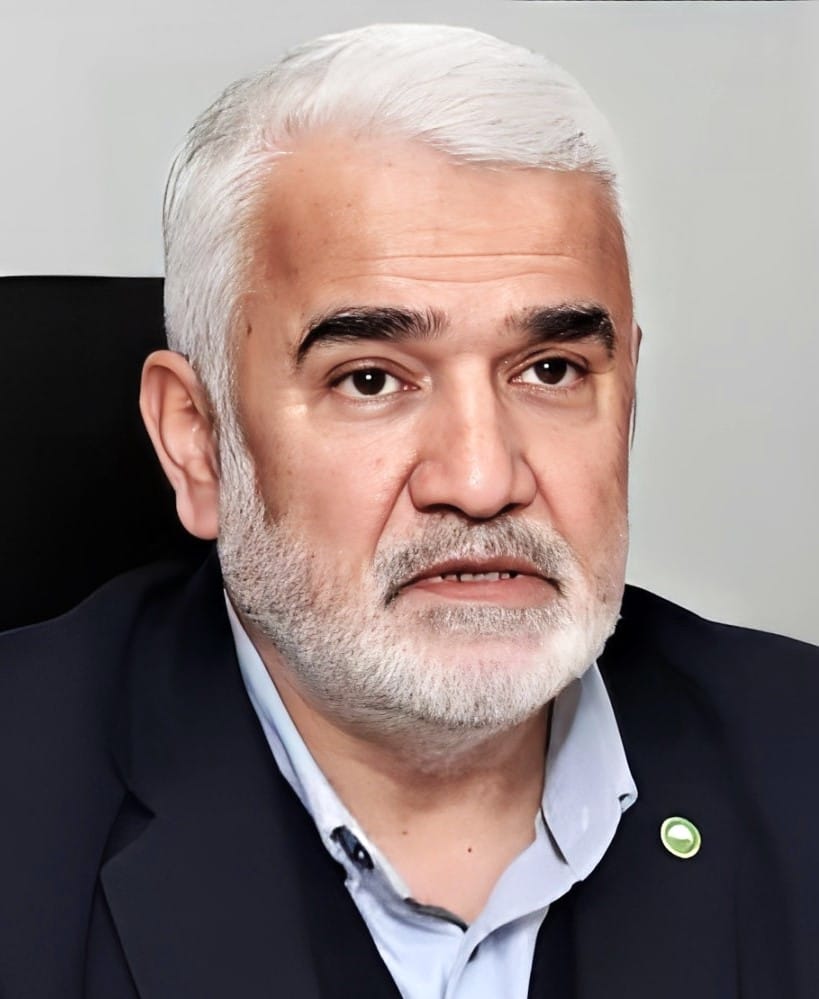
Mr. Zekeriya Yapıcıoğlu, Chairman of HÜDA-PAR, causes discomfort in many circles with his open and frank views. In particular, his suggestions regarding "Kurdistan," "Kurdish as an Official Language," "the Use of the Kurdish Flag," and "the Kurdish National Anthem" occasionally create the effect of a giant meteor in the political world. Political history teaches us that freedom of thought is the right of every citizen for the healthy development of political and social balances in a country, and that members of political parties, in particular, should be open-hearted and courageous in this regard.
A large majority of those who reacted to Mr. Zekeriya Yapıcıoğlu's statement proudly claim that the real reason HÜDA-PAR wants to abolish Article 4 is that it wants to establish a "Sharia state," and that Article 4 of the Constitution prevents this.
These unfortunates should know that only five countries in the world have the "principle of secularism" in their Constitutions: France, Japan, Mexico, Portugal, and Turkey. And only in Turkey is this article guaranteed by the provision "cannot be changed." In other words, according to the reasoning of these unfortunates, 188 of the 193 member countries of the United Nations (195 countries including Palestine and Vatican) are governed by SHARIA or are in danger of being governed by Sharia at any moment, because their Constitutions do not contain the "principle of secularism"!
(NOTE: The concepts of laicism and secularism are often confused. Laicism refers to the relationship between religion and the state; secularism refers to the relationship between religion and society. The first laicist state was France, the first secular state was the USA. For example, in the USA, Presidents take their oath by placing their hand on the Holy Bible. However, this is not possible in France.)
If you wish, let's briefly look at the four Constitutions that have accompanied the history of the Republic of Turkey (1921, 1924, 1961, and 1982), evaluating each Constitution with its internal contradictions. Since the first four articles of the Constitution are the subject of debate, I wanted to shed light on the real situation by presenting only the ORIGINAL form of the first four articles:
THE 1921 CONSTITUTION
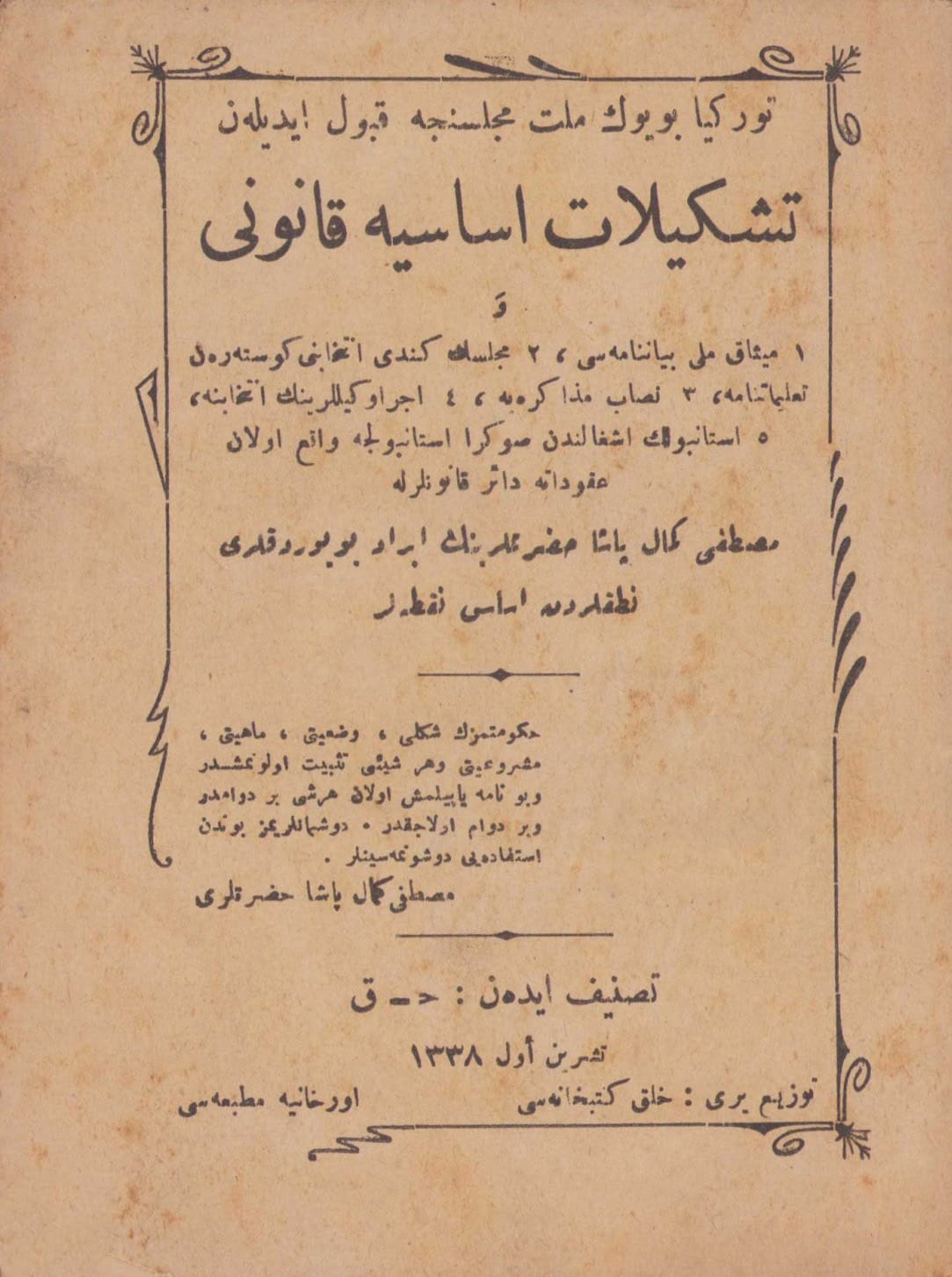
TEŞKİLÂTI ESASİYE KANUNU (FUNDAMENTAL LAW)
Law Number: 85 Accepted Date: 20/1/1337 (1921)
Article 1. Sovereignty belongs unconditionally to the nation. The administrative system is based on the principle that the people directly and actively manage their own destiny.
Article 2. Executive power and legislative authority manifest and are concentrated in the Grand National Assembly, which is the sole and true representative of the nation.
Article 3. The Turkish State is governed by the Grand National Assembly, and its government bears the title "Government of the Grand National Assembly."
Article 4. The Grand National Assembly is composed of members elected by the people of the provinces.
EVALUATION: The first four articles of the 1921 Constitution, prepared by the Grand National Assembly chaired by Gazi Mustafa Kemal, are as above. As can be seen, the first four articles do not include "Republic," "Official Language is Turkish," or the principle of "Secularism," and most importantly, the principle of separation of powers (judiciary-executive-legislative), which is a fundamental principle of a state. Furthermore, there is no provision stating "the above articles cannot be changed." This means the Constitution could be changed as desired. Indeed, Articles One, Two, and Four of the 1921 Constitution were amended in 1923.
THE 1924 CONSTITUTION
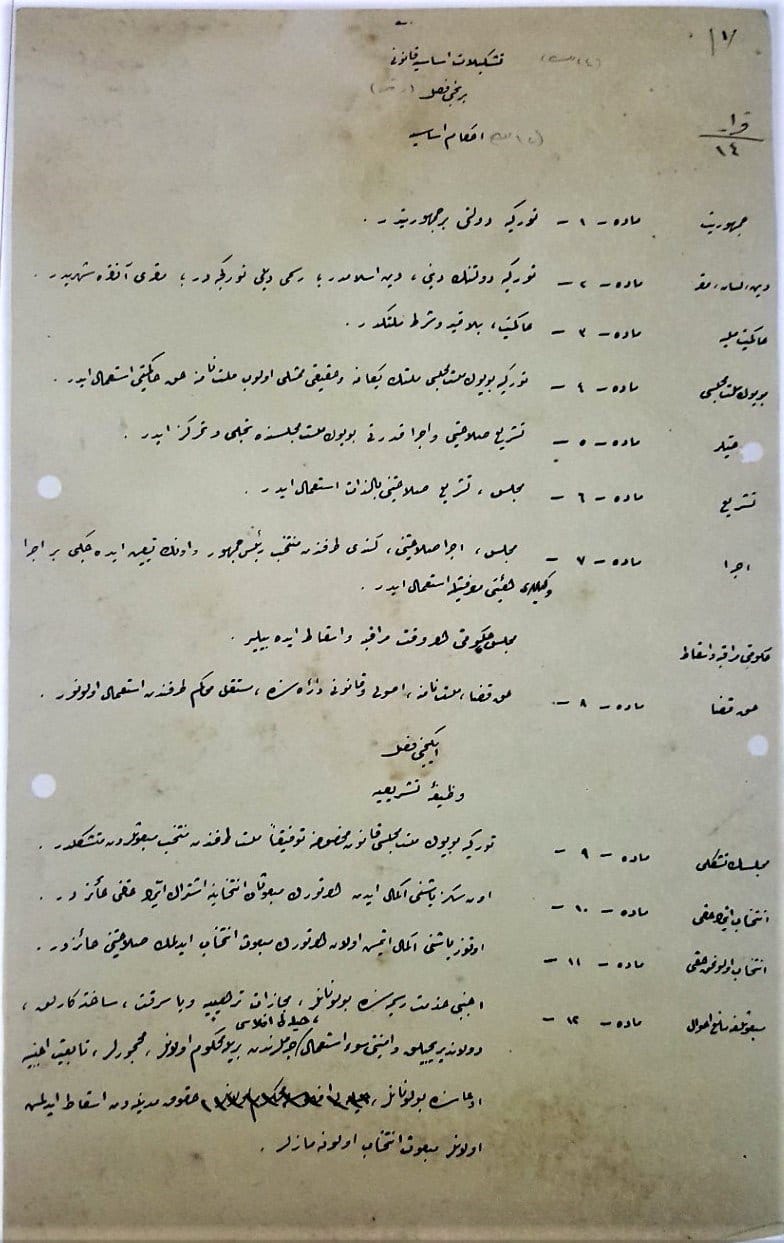
TEŞKİLÂTI ESASİYE KANUNU (FUNDAMENTAL LAW)
Law Number: 491 Accepted Date: 20/4/1340 (1924)
CHAPTER ONE
Fundamental Provisions
Article 1. The Turkish State is a Republic.
Article 2. The religion of the Turkish State is Islam; its official language is Turkish; its capital is the city of Ankara.
Article 3. Sovereignty belongs unconditionally to the Nation.
Article 4. The Grand National Assembly of Turkey is the sole and true representative of the nation and exercises the right of sovereignty on behalf of the Nation.
EVALUATION: The first four articles of the 1924 Constitution, prepared by the Grand National Assembly during the period when Gazi Mustafa Kemal was President, are as above. As can be seen, the first four articles do not include the principle of "Secularism" or the principle of separation of powers (judiciary-executive-legislative), which is a fundamental principle of a state. Not only is the principle of "Secularism" not included, but by stating "the religion of the State is Islam," it actually implies a "Sharia" state in a sense. Furthermore, there is no provision stating "the above articles cannot be changed." Indeed, Article Two of the 1924 Constitution was amended twice in 1928 and 1937, while Mustafa Kemal Atatürk was still alive. The principle of "Secularism" was introduced into the Constitution in 1937.
THE 1961 CONSTITUTION
CONSTITUTION OF THE REPUBLIC OF TURKEY
Law No: 334 Accepted Date: 9/7/1961
PART ONE
GENERAL PRINCIPLES
- Form of the State.
- Characteristics of the Republic.
III. Integrity of the State; official language; capital.
ARTICLE 3. The Turkish State is an indivisible whole with its territory and nation.
Its official language is Turkish. Its capital is Ankara.
- Sovereignty.
EVALUATION: The first four articles of the 1961 Constitution are as above. As can be seen, the first four articles do not contain the principle of "unamendability." There is only an article in Article Nine regarding the unchangeability of the form of the state: (ARTICLE 9. The provision of the Constitution concerning the form of the state being a Republic shall not be amended, nor shall any proposal for its amendment be made.)
Based on Article Nine, it is possible to establish an "Islamic Republic" provided it is a Republic. Similarly, since the 1921 and 1924 Constitutions did not include the phrase "The Turkish State is an indivisible whole with its territory and nation," it implies that the establishment of an independent Kurdistan was open during those years. If desired, hundreds of similar different inferences can be made.
Furthermore, the principle that the judicial, legislative, and executive powers are independent of each other was accepted for the first time in Turkey with the 1961 Constitution. In other words, the "principle of separation of powers," which is an indispensable principle of the state, was not included in the 1921 and 1924 Constitutions championed by Mustafa Kemal Atatürk. Would it be appropriate to judge Mustafa Kemal Atatürk's statesmanship by taking this into account?
THE 1982 CONSTITUTION
Law Number: 2709 Accepted Date: 18/10/1982
PART ONE
GENERAL PRINCIPLES
1. Form of the State
Article 1 – The Turkish State is a Republic.
2. Characteristics of the Republic
Article 2 – The Republic of Turkey is a democratic, secular, and social state of law, respectful of human rights, loyal to Atatürk nationalism, and based on the fundamental principles set forth in the Preamble, in a spirit of public peace, national solidarity, and justice.
3. Integrity of the State, Official language, flag, national anthem, and capital
Article 3 – The Turkish State is an indivisible whole with its territory and nation. Its language is Turkish.
Its flag, whose shape is specified in its law, is a red flag with a white crescent and star.
Its national anthem is "İstiklal Marşı" (The Independence March).
Its capital is Ankara.
4. Unamendable provisions
Article 4 – The provision of Article 1 of the Constitution concerning the form of the State being a Republic, the provisions of Article 2 concerning the characteristics of the Republic, and the provisions of Article 3 shall not be amended, nor shall any proposal for their amendment be made.
EVALUATION: The first four articles of the 1982 Constitution are as above. As can be seen, Article Four states that the first three articles cannot be amended. The first three articles are, in a sense, the manifestation of two fears internalized since the establishment of the Republic: closing the door to a possible independent Kurdistan and a possible Islamic Republic.
CONCLUSION
We see that the four Constitutions in force from 1921 to the present day have been shaped on different principles and contain different expressions. In many places, one Constitution even contradicts another. Each Constitution has not only been shaped according to the characteristics of its own period, but some changes have also been subsequently added according to emerging needs.
What surprises me most is that, on the one hand, so-called democrats and intellectuals who describe the September 12 Coup as a "Fascist Coup" and thus view the 1982 Constitution as the "Constitution of the Fascist Junta," cling tightly to Article Four when it comes to it, most likely due to their hatred of Kurds and Islam, and do not even make it a subject of discussion. Such meaning is attributed to it as if Article Four was included in the Constitution by the founding fathers of the Republic and Mustafa Kemal Atatürk.
My suggestion to these so-called intellectuals is this: Let's return to Mustafa Kemal Atatürk's 1924 Constitution, which, while not containing fundamental principles like the Separation of Powers, was more liberal because it did not use prohibitive expressions like "unamendable."
There is no constitutional continuity in Turkey. Each Constitution emerged according to the characteristics of its own period. Today, the expectations and demands of the people are in a different direction. In such times, attention should be paid not to the suggestions of Associate Professors or Professors of Constitutional Law who carry draft constitutions in their pockets, but to the voice of the people.
Undoubtedly, the politician who most courageously voices and brings to the agenda the demands of the people today is Mr. Zekeriya Yapıcıoğlu.
Let's not forget that every great change requires courage and sacrifice. Although Mr. Zekeriya Yapıcıoğlu is seen by many as a "dissenting and unwanted voice," he has in fact taken his honorable place in our political history as a symbol of courageous initiatives.
Mücahit Özden Hun 21 September 2024 Time: 12:00