Solo Anarchist: Ted Kaczynski
This essay explores the life and motivations of Ted Kaczynski, the "Unabomber," analyzing the traumas that shaped his anti-technology philosophy and led to his violent acts.
Dear Readers:
All of us, at some point in our lives, have unknowingly been filled with feelings of hatred and rebellion against the family structure, educational institutions, the police, the state, society—in short, against AUTHORITY. If we individualize this feeling of rebellion and seek revenge, we cannot go very far. For this reason, those who suffer injustice prefer to resist as a social force by organizing into unions, NGOs, student associations, legal-illegal organizations, and political parties, instead of fighting alone.
In the 20th century, only one person dared to act individually and set out alone to take revenge on the state, universities, technology companies, airlines—that is, capitalism, imperialism, and the INDUSTRIAL society: Ted Kaczynski.
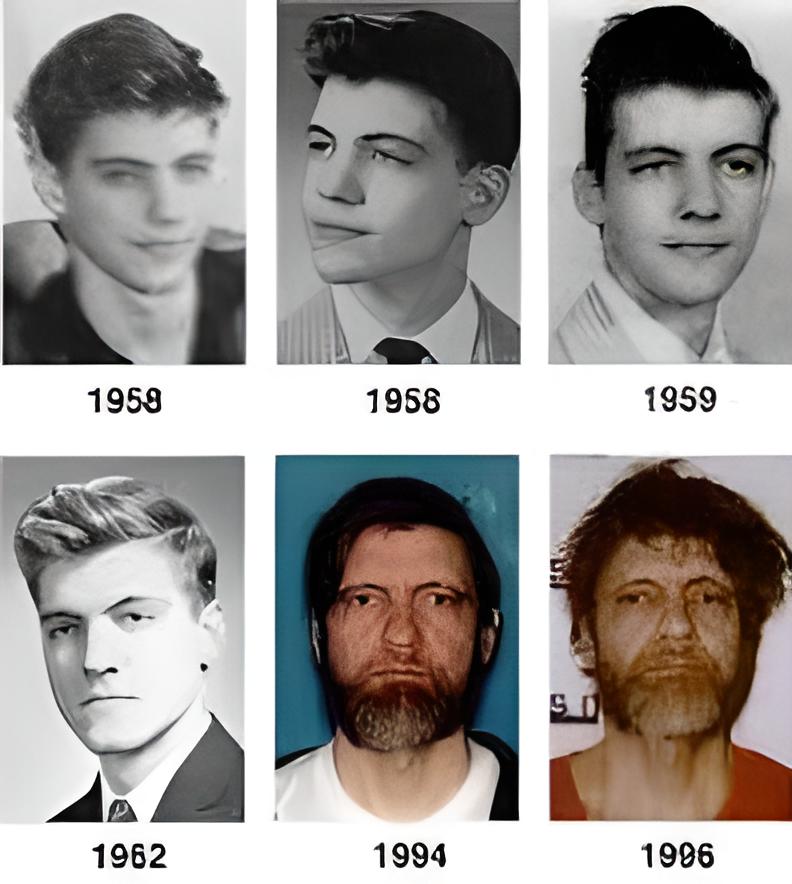
Portraits of Ted Kaczynski from various periods of his life
This solo (lonely) anarchist, who lived in a country like the USA where intelligence is most powerful, planned bomb attacks for 17 years without being caught, causing the death of three people and the injury of 23, was found dead in his cell this morning (Saturday) at 8 AM in the Federal Prison in Butner, North Carolina, where he was incarcerated.
In my opinion, Ted Kaczynski's life should be examined as a "Case Study" in universities, and his life should be opened up for discussion. The purpose of this article is to contribute to such studies.
Let's not forget that Ted's view of society was shaped by a unique philosophy he developed, caught between the TRAUMAS he experienced from childhood and the internalised HATRED OF AUTHORITY in later years.
HIS LIFE AND TRAUMAS
Ted Kaczynski's father's name was Ted Richard (May 31, 1912 - October 2, 1990), and his mother's was Wanda Theresa (May 13, 1917 - September 16, 2011). His father was known by his friends as "Turk." Although his parents came from Catholic families, they decided to be atheists when they married.
Richard and Wanda married on April 11, 1939. Their first child, Ted, was born on May 22, 1942, in Chicago.
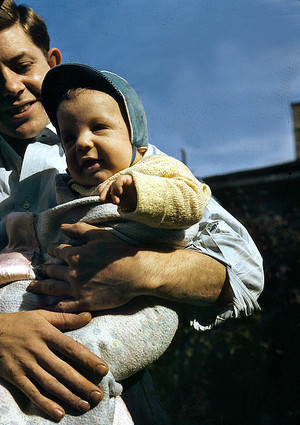
Baby Ted with his father
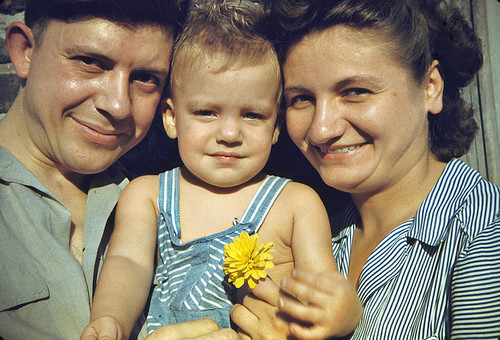
Ted with his father and mother
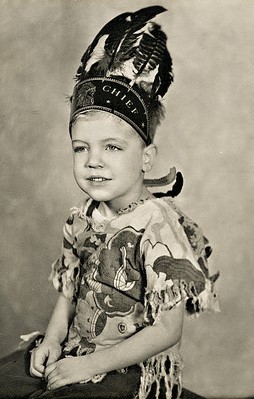
Ted in Native American attire
As a child, Ted contracted hives. Because the disease was contagious, he was quarantined in the hospital. He was not allowed to see anyone.
Years later, his parents recounted that before he contracted the disease, Ted was an extremely cheerful and happy child, but after being quarantined in the hospital, he became withdrawn, did not speak to anyone, and showed no emotional reactions.
Apparently, Ted experienced his first TRAUMA with the hives.
Ted attended primary school in Chicago until the fourth grade. In 1949, his brother David was born. The family then moved to Evergreen Park, in the same state, in 1952. Ted started middle school in this city. During his middle school enrollment, his IQ was determined to be 167 in an intelligence test, causing him to skip a grade. Ted skipping a grade was his second TRAUMA. He was separated from his friends with whom he socialized and got along, and was forced to study in the same class as students older than him who sometimes bullied him.
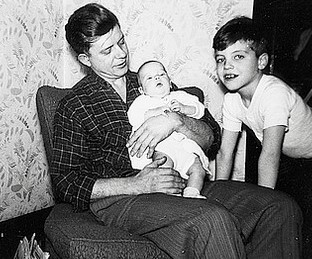
Ted with his father and newborn brother David
After middle school, Ted continued to high school in the same city. While playing the trombone in the school band, he also participated in activities in mathematics, biology, coin collecting, and German student clubs. He enjoyed spending hours solving difficult math problems. His superior intelligence caused discomfort among his friends, making it impossible for Ted to socialize with them.
Ted skipped another grade due to his success in mathematics. Soon, Ted prepared and taught the lessons. He graduated from high school at 15. He was nominated for a National Achievement scholarship by the school. Ted applied to Harvard. In 1958, at the age of 16, he began his university education at Harvard on a scholarship. He graduated from the Department of Mathematics in 1962.
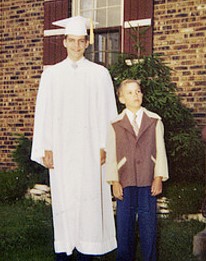
High school graduate Ted and his brother David (1958)
As a sophomore at Harvard, Ted participated as a guinea pig in a psychological experiment. The experiments continued for 200 sessions. During the experiments, Ted was verbally abused and humiliated. This was Ted's third TRAUMA.
In 1962, Ted enrolled at the University of Michigan. He earned his master's and doctoral degrees in mathematics in 1964 and 1967, respectively. Ted specialized in complex analysis and geometric function theory.
In 1966, Ted experienced intense sexual fantasies of being a woman for a while and decided to change his gender. He scheduled an appointment with a psychiatrist but changed his mind in the waiting room. Later, he considered killing the psychiatrist and other people he hated. This was Ted's fourth TRAUMA.
In late 1967, 25-year-old Ted began teaching undergraduate courses in geometry and mathematics at the University of California, Berkeley. He was the youngest mathematics instructor. However, students were uncomfortable with Ted's teaching style. He developed an attitude of not answering students' questions. He was experiencing communication difficulties. Students petitioned the department head to complain about Ted. Disturbed by this situation, Ted resigned from his position without explanation on June 30, 1969. This was his fifth TRAUMA.
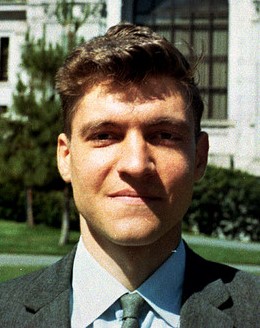
Ted, Mathematics Instructor at Berkeley University
MONTANA YEARS
After resigning from the university, Ted returned to Lombard, the city where his family lived. He stayed with his family aimlessly for two years.
All these traumas caused an upheaval in Ted's inner world. He sought a life close to nature, away from people. He bought a few acres of land in the forest near Lincoln, Montana. He built a small, single-room cabin of 12 square meters. He began to live in this cabin without electricity or water. He worked odd jobs in the town and also received continuous financial support from his parents and David. He commuted by bicycle to Lincoln, 4-5 km away. Ted grew produce in his garden to meet his own needs. He frequently visited the Lincoln Public Library, reading world classics in their original languages while also reading books on wilderness survival.

Ted's 12-square-meter cabin in the forest near Lincoln, Montana
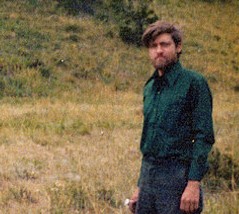
His first days in Montana (Lincoln)

Ted in Montana (1981)
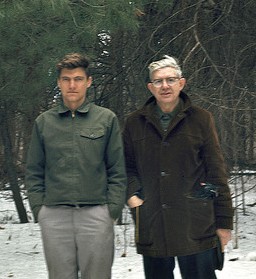
His father visiting Ted's cabin in Montana (early 70s)
While everything was going on as usual, one day, a lumber mill started operating near his cabin. Ted, who loved silence, was disturbed by the sound of the machinery. A feeling of hatred towards industry and machines grew within him. On such a day, he came across the book "The Technological Society" by the French philosopher Jacques Ellul. Ted now defined himself as an anti-technology and anti-science person.
He planned sabotage actions against the lumber machine. At night, he filled the machine's gearbox with sand. They repaired it, and Ted continued to fill the machine with sand. This continued for several years because they did not suspect Ted. During this process, Ted developed a view and understanding that industrial society was destroying humans and nature. He believed that industrialization and technology needed to be stopped.
BOMBING ATTACKS
In 1978, Ted decided to take action. He read books on how to make bombs. He made some attempts. At one point, he went to Chicago, to his family. (Chicago and Lincoln are about 2400 km apart)
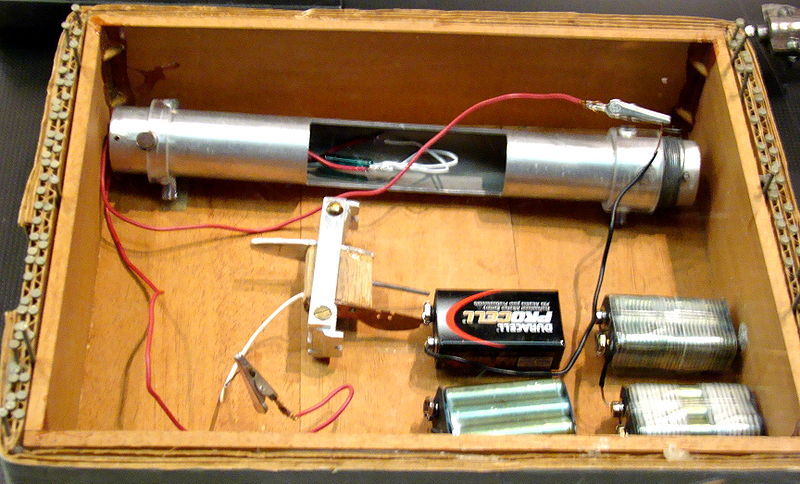
Ted's homemade bomb device
His father and brother worked in a rubber factory. He started working in the department his brother was responsible for. Ted, whom everyone had treated as a "genius" since childhood and had high hopes for a great career, had left his university job and, in despair, agreed to work an ordinary job under the responsibility of his brother, who was 7 years his junior. This was his sixth TRAUMA.
He asked a girl working at the same workplace out, but she always refused. When Ted posted an inappropriate note about the girl on the workplace bulletin board, his brother David got angry and fired Ted (1971). This was his seventh TRAUMA.
After this incident, Ted decided to take action against the technological society he hated. On May 25, 1978, he prepared a bomb package in Chicago. He placed it on the ground in the parking lot of Northwestern University in the same city. He made it seem as if a professor at the university had sent a package to someone else, but the package had been returned. When someone found the package on the ground in the parking lot and saw it was a return, they took it to the professor in question. The professor, knowing he had not sent such a package to anyone, became suspicious and contacted the campus police. The police officer was injured in the hand when the bomb exploded as he opened the package.
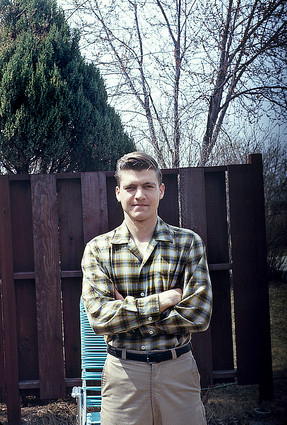
Ted, at his parents' home just before his first bombing attack
Ted returned to Montana. This time he targeted airlines. In 1979, he arranged for a bomb-laden box he prepared to be loaded as cargo onto an American Airlines plane. The bomb's mechanism was connected to an altimeter, a device sensitive to altitude. When the plane, with 88 people including the crew, ascended, the mechanism activated, but the bomb partially exploded, causing a fire in the cargo hold. When smoke reached the passenger cabin, the plane had to make an emergency landing.
Since bombing a plane is a federal crime under US law, the FBI took over the case. Because of its similarity to the bomb at Northwestern University, the FBI named this unknown assailant "UNiversity-Airlines BOMBER," or UN-A-BOMBER. The FBI formed a special team of 150 people. Thus began the largest "manhunt" in American history. This pursuit, which lasted 17 years, cost the US nearly $100 million.
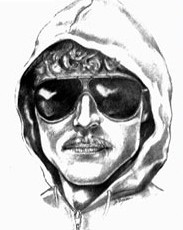
FBI's composite sketch of Ted, who was wanted
Ted continued his package bombing attacks, which began in 1978, until 1995. With 16 bombs he prepared in packages, he caused the death of three people and the injury of 23. He carved the letters "FC" for "Freedom Club" into the metal part of the bombs.
"TIMOTHY MCVEIGH" JEALOUSY
On February 28, 1993, the US Bureau of Alcohol, Tobacco, and Firearms (ATF) attempted to search a farm belonging to the Branch Davidian cult, located 14 km northeast of Waco, Texas, with a court order. In the ensuing shootout, four ATF agents and six cult members died. The Federal Bureau of Investigation besieged the farm for 51 days. The cult leader set the farm on fire to avoid surrender. 76 people, including 21 children and the cult leader, burned to death.
Timothy McVeigh and his friends decided to take revenge on the Federal Government for this. Approximately two years later, on April 19, 1995, they attacked the Federal Building in Oklahoma City with a truck bomb. 168 people died in the attack. Suddenly, Timothy McVeigh's name took center stage in the media.
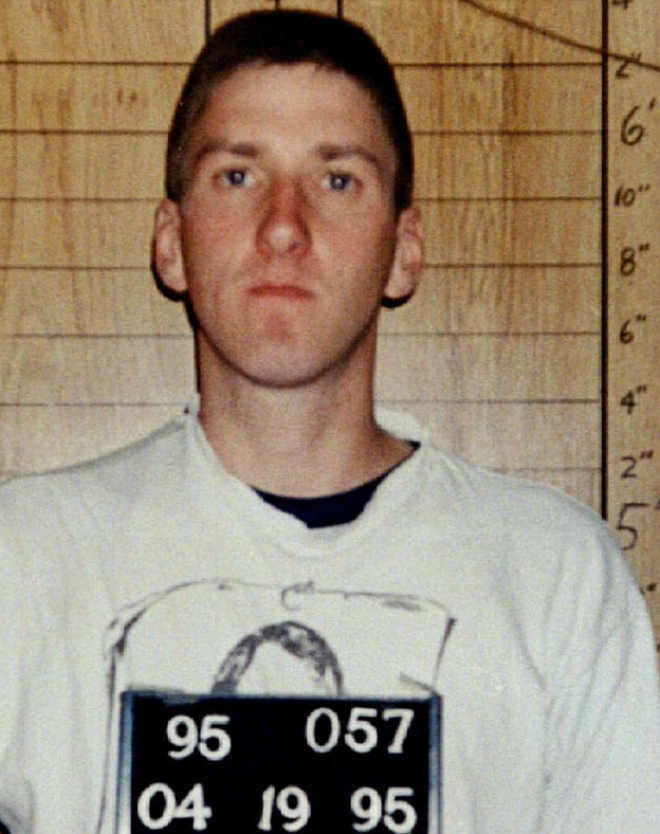
Oklahoma City bomber Timothy McVeigh
Ted, feeling that his name had been forgotten, decided to take action. On April 24, 1995, about a month after the Oklahoma City bombing, he sent a bomb package to the President of the California Forestry Association. The President died on the spot when he opened the package. The name "Unabomber" once again took center stage in the media.
HIS CAPTURE
Ted now wanted to end his bombing campaign, which had lasted 17 years. He prepared a 35,000-word manifesto titled "Industrial Society and Its Future" and sent it simultaneously to The New York Times and The Washington Post. If his manifesto was published without any censorship, he would cease his actions. The FBI allowed the newspapers to publish the manifesto (September 19, 1995). The FBI hoped to get a lead. And so it happened. His brother David, reading the manifesto, recognized his brother's style. Seeing that he had used similar expressions in a letter sent to him years ago, he informed the FBI. After a brief investigation, Ted was considered a suspect. A special team was sent to Montana. Ted was apprehended in front of his cabin.
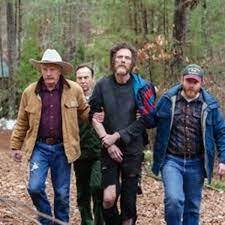
Ted, the day he was captured (April 3, 1996)
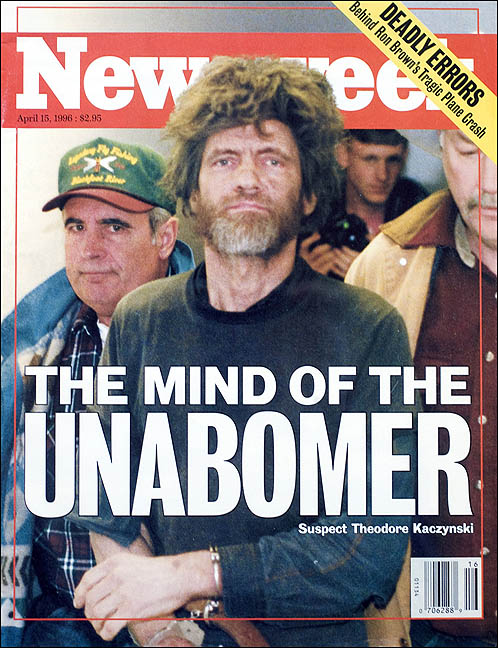
Title: "The Mind of the Unabomber (Ted)"
David asked for his identity to be kept secret, but when Ted learned in prison that his brother had reported him, he was disappointed, expressing his anger by saying, "I will never forgive him." Ironically, Ted, who was imprisoned in 1996 for his actions that lasted 17 years, remained in prison for 17 years until his death on June 8, 2023. During this time, he absolutely refused to see his brother David.
MANIFESTO

Ted's manifesto, titled "Industrial Society and Its Future," begins: "The Industrial Revolution and its consequences have been a disaster for the human race." He claimed that technology has a destabilizing effect on society, makes life unfulfilling, and causes widespread psychological suffering, and that due to technological advancements, people spend their time on unnecessary pursuits, distracted by artificial goals such as scientific work, consumption of entertainment, and following sports teams. At the end of the manifesto, Ted called for a return to the wilderness.
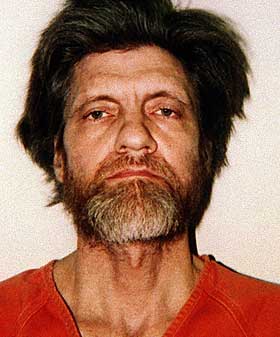
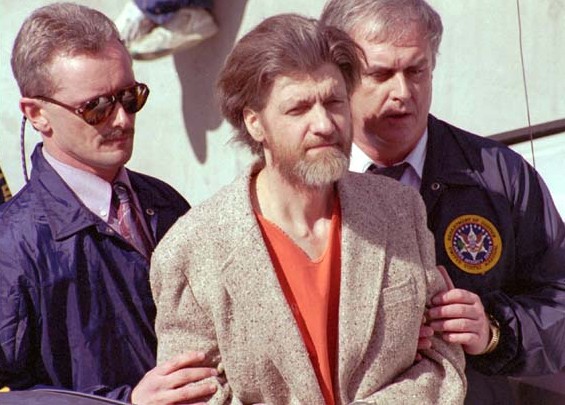
Ted, being taken to court
During his defense, Ted said, "I acted out of a desire for revenge." Psychiatrists diagnosed him with paranoid schizophrenia, but Ted vehemently rejected this. When his lawyers said he was not mentally sound, he tried to fire them. When he failed, he tried to hang himself with his underwear. In an interview with Time Magazine in 1999, he said: "I am sure of my sanity. I have no delusions or anything!"
HIS BROTHER DAVID (deyvıd) NARRATES (2016)
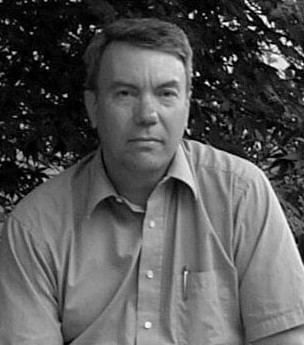
Ted's younger brother David
Many people around me ask why my parents didn't acknowledge my brother Ted's mental and psychological health problems for so many years. Of course, there are many reasons for this:
First and foremost, in the 1950s and 60s, psychologists attributed the cause of schizophrenia to family discord. In other words, they held parents responsible for their children developing schizophrenia. That's why my family didn't want to accept or denied that Ted had psychological problems. Accepting that Ted was "sick" would, in a sense, mean that the whole family was "sick." Outsiders might evaluate Ted differently. But for me, Ted was my brother and my only older brother.
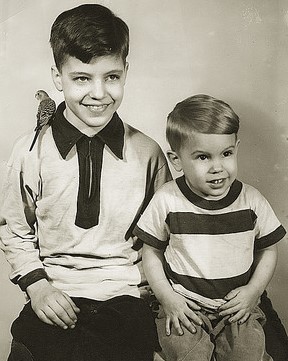
Ted and his younger brother David
Secondly, Ted was extraordinarily intelligent. This, in a sense, allowed Ted to secretly cover up the emotional chaos he was experiencing. When I saw my brother's strange behavior, I attributed it to his being very intelligent. Ted was extremely successful at manipulating ideas and thoughts. In this way, he could camouflage his strange behaviors. Sometimes, without knowing that my brother was struggling with a psychological illness, I would object to his thoughts, thinking that maybe I could help him think differently and strangely. One reason I normalized Ted's development of an attitude contrary to social norms was that our parents encouraged it. According to them, children could only truly know themselves in this way, and by breaking social norms, they could pave the way for personal development. For a healthy child, this approach would, of course, yield good results. However, for a child like Ted, who was struggling with psychological problems, this freedom to be "different" granted by his parents could lead him to create his own unique world, become trapped within it, and close himself off to the opinions of others.
Another reason for Ted's psychological problems, which he experienced from childhood, to escalate to a different dimension was his participation as a guinea pig in psychological research during his student years at Harvard University. In those years, the government and the CIA both pressured universities and provided financial support for them to conduct research on "mind control."
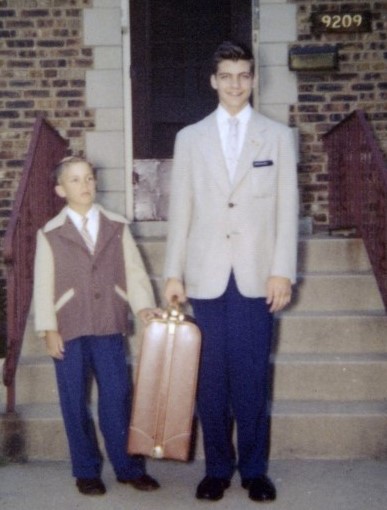
Ted, with his suitcase, preparing to go to Harvard University, with his younger brother David in front of their house
These experiments might be one reason for Ted's later hatred of "mind control" and "technology," but I don't think they played a role in his resorting to violence. Because dozens of students participated in these experiments, but none of them resorted to anti-social violence like Ted. Ted's real problem lies hidden in the trauma he experienced in his childhood. Psychological experiments escalated this trauma, leading him to social isolation.
My brother and I were, in a sense, both more like brothers than other siblings, and in a sense, quite different from other siblings. As you can see, our similarities and differences coexisted. We both loved nature, and we both found the lifestyle of the average American family strange, thinking differently about their approaches to career, marriage, and family. For this reason, I admired Ted for many years and imitated him. But after a while, our paths diverged: Ted resolutely regarded people and culture as a "dead end," while I viewed them optimistically, believing that everything had a solution.
My father was diagnosed with lung cancer. In the final stages of cancer, my father attached a hose to the exhaust pipe of his car. He closed the car windows, directed the hose into the car's cabin, and started the car. He died by asphyxiation from the carbon monoxide gas from the exhaust (1990).
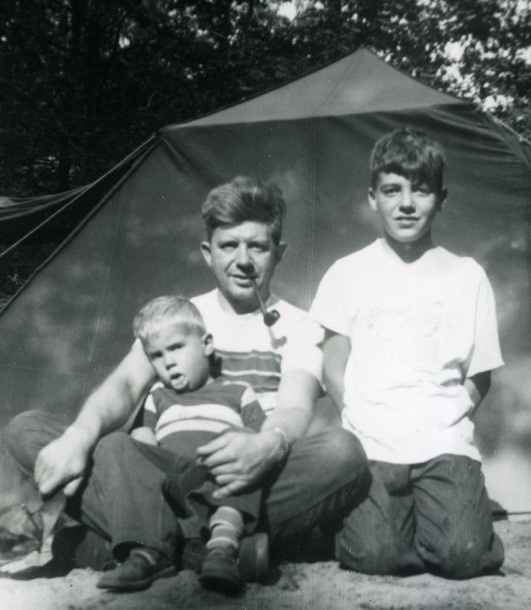
Ted, with his younger brother David and father at camp (1954)
Ted, seeing himself as resilient to suffering and realistic, viewed his father's suicide as a rational act to be admired. However, even after all this time, I still feel cursed and obsessed by my father's suicide. Of course, it's hard to know what went through my father's mind during the suicide, but I think by committing suicide in this way, he wanted to prevent the mercy and tenderness that those who loved him, especially my mother, would show him. My father abandoning us in this way caused me great disappointment. It was then that I first faced the bitter reality of life.
My wife Linda had felt close to the ethical values of Buddhism for many years. One day in August 1995, Linda asked a difficult question: "Could the killer they call the Unabomber be your brother Ted?" I didn't think it was possible, but a doubt did arise within me. Linda often said that my brother was a wanted person and encouraged me to take action. According to Linda, if we remained silent knowing that Ted was a wanted person, we would bear moral responsibility for every painful event that occurred. Furthermore, according to Buddhist "Karma" theory, if a person hurts others, they actually do greater harm to themselves. She said that Ted, with every act of violence he committed, was actually dragging himself into moral, psychological, and spiritual collapse. She believed that in addition to protecting others, we needed to stop him for Ted's own good.
After Ted was caught, I chose to remain silent for many years. One day, my lawyer snapped at me: "If you don't talk about Ted's psychological and spiritual problems, everyone will be left with the image of an evil, untreatable killer, as defined by the Federal prosecutor. Perhaps he will be executed." Knowing that my mother would be very upset if Ted were executed, I decided to speak the truth to the media.
During his years in prison, I didn't have the chance to see Ted because he didn't want to. I send him two or three letters a year, and occasionally books that I think might interest him. Since he doesn't reply to my letters, I content myself with following developments about Ted mostly through the media.
CONCLUSION
We should not forget that there might be a "Ted" living inside all of us. The traumas we experience in infancy and childhood can unknowingly leave their mark on our lives in later years, distancing us from social reality, just as Ted experienced, and locking us into certain behaviors, pushing us to find solace by focusing on a single issue with an OBSESSIVE approach. In short, a "Ted" might be hidden in our subconscious. Awareness is the most important precaution and the most important step in seeking a solution to the problem. Let's not forget this!
The following two tabs change content below.