Dancing with Russian and Leningrad
This article explores the author's lifelong connection with the Russian language and culture, from childhood in Iğdır to a poignant encounter in post-Soviet Leningrad, alongside a tribute to Iğdır's first American daughter-in-law and a humorous anecdote.
Dear Readers,
Today's article consists of three parts: First, you will read my piece "Dancing with Russian and Leningrad." In the second part, I will continue by presenting a short greeting message to the people of Iğdır from Claudette Aras, Iğdır's first American daughter-in-law, who is preparing to celebrate her 94th birthday. Finally, in the third part, I will conclude my article with an anecdote from Hamit Hun, Iğdır's greatest anecdotal wit of all time. DANCING WITH RUSSIAN Iğdır is a unique city where languages and cultures blend, and brotherhood finds its embodiment. In my childhood, I used and lived with three languages simultaneously. My father, mother, and siblings spoke Turkish with each other. This was almost an unwritten rule. My mother's father belonged to a Turkish family whose roots extended to Bitlis. My maternal grandmother was a member of the Cibranlı tribe. However, in my grandfather's house, Turkish had found its place as the language of daily life. It was said in the family that my maternal grandmother sang Kurdish folk songs for her special guests, and people came from far away to hear her beautiful voice. Our neighbors were Azeri and Terekeme. I played with the neighborhood children and used Azeri extensively and to my heart's content. In this sense, my childhood language was Azeri. Although I did not pronounce this language according to its own rules, I understood what was being said and had no difficulty. My paternal grandmother, Fattê Hanım, lived with us. She carried the pride and honor of her father, Ali Mirze Bey, in her heart. She knew no language other than Kurdish. In a sense, she seemed to invite us to learn and speak Kurdish. She understood Turkish and would indicate this by nodding her head. My father was the unconditional leader of the tribe. Our house was always full of members of our tribe and Kurdish guests coming from villages and distant places. My grandmother spoke to them in flawless Kurdish. She had a strong memory. She would ask guests questions and note down what was happening in the village, on the plateau, and among the tribes in a corner of her memory. Witnessing these things caressed my child's soul, and I would listen to them with rapt attention. My grandmother counted Russian numbers perfectly. When I insisted, she would laugh and count to ten, saying, adin, dva, tri, çıttiri... and I would enjoy it immensely. This was my first Russian language course. I was living a life right in the middle of a trilingual culture. The year was 1967. Our house in the Baharlı neighborhood was now lit by electricity. I would like to inform my readers about television broadcasts in Turkey in those years: The first television experiments in Turkey began in 1952 at the Electrical Engineering Faculty of Istanbul Technical University (İTÜ), where I would later become a student. During my student years at İTÜ, our esteemed professor Adnan Ataman, whose books I never put down, successfully continued these experimental broadcasts. The first broadcasts were black and white. They could be watched for a few hours a week, only around the campus. In 1964, the idea of regular television broadcasts by the state came to the agenda. Ankara television began broadcasting in 1968. The broadcast duration was limited to 3 days a week, a few hours a day. At that time, there were no television broadcasts in Istanbul or Izmir yet. In Istanbul, package programs were introduced in 1971, and in Izmir in 1974. MASTER KADİR (PARLAK) AND ALTAN BEY Master Kadir (Parlak) was originally from Konya. In the 1920s, he was trained in Kâzım Karabekir Pasha's army, married the sister of Hamdi Kalafat from the Kalafat Family in Iğdır, and settled in Iğdır. Kadir Bey had two sons named Erol and Altan. Master Kadir was an expert in diesel engines. The repair and maintenance of the engine that provided electricity to Iğdır was Kadir Usta's responsibility. He continued this duty for years with great dedication and diligence. Master Kadir's eldest son, Erol Bey, chose a career in civil service. Altan Bey went into business. He became a successful businessman by making the first white goods and TV sales in Iğdır. Thanks to Altan Bey, the people of Iğdır would quickly become acquainted with TV sets and TV culture. TV BROADCASTS IN THE SOVIET UNION The Soviet Union, victorious in World War II, launched a major technological revolution. Soon after, Moscow TV broadcasts began in 1948. The three socialist republics in the South Caucasus, Armenia, Azerbaijan, and Georgia, became acquainted with TV broadcasts starting from 1956. The year was 1968. My father was interested in technology. My father brought one of the first tractors to Iğdır. It was also my father's fortune to bring the first hay mower. Thanks to my father's passion for innovation, a Grundig brand TV entered our home in 1968. With an antenna placed on the roof of the house, it was possible to watch broadcasts from Moscow, Baku, Yerevan, and Tbilisi. Interestingly, the people of Iğdır, in the most remote and forgotten corner of Turkey, had a TV culture that Istanbul residents did not yet possess. The only problem was having to frequently go up to the roof and change the direction of the antenna when we said, "Let's watch Baku or Yerevan broadcasts for a bit." The first TV set in our neighborhood was in our house. During the day, neighbors would come and watch this interesting invention, a talking box, with admiration. Moscow broadcasts started in the morning and continued until midnight. Yerevan, Tbilisi, and Baku broadcasts were limited to between 6 PM and midnight every day. Thus, our antenna was constantly directed towards Moscow. The household would be content to watch the screen with the TV sound off. I would always turn on the sound and try to make sense of what was being said. At certain hours of the day, the announcer would open or close the broadcast by saying "Dobri deyn," "Dobri viçır," "Spakoynıy noçi," and "dasvidanya" meaning "Good morning," "Good evening," and "Good night." I had already memorized such idiomatic expressions. This became my second Russian lesson. Years passed. I was a student at Kabataş High School. My brother Selahattin was studying Mechanical Engineering at METU. In those years, METU was the center of left-leaning ideologies. Admiration for the Soviet Union was widespread in left-wing circles. Perhaps because of this, when Selahattin came to Iğdır for the summer holidays, he brought a book titled "Russian Grammar," prepared in English-Russian. I did not put this book down for a long time. Again, years passed. It was 1979. I was a student at the İTÜ Electrical Engineering Faculty. I was staying at the Abdi İpekçi Student Dormitory in Maçka. The rooms were for four people. One of my roommates was named Metin Topçu. He was a Bulgarian immigrant. His family had come from Bulgaria and settled in Bursa. Metin was an Aeronautical Engineering student. Since he had attended primary and secondary school in Bulgaria, he knew Russian. One day he told me, "If you go to the Bulgarian Consulate, they give Bulgarian language books for free there. Bulgarian and Russian are very similar. I can teach you Bulgarian." So, with the idea that this would lead to Russian, I started learning Bulgarian. Metin taught me how to write Cyrillic alphabet letters by hand. This continued for a while. In 1984, I was working as an engineer at a French company in Paris. My greatest wish was to go to Leningrad and complete my doctorate there. I started learning Russian again. In those years, there was no institution teaching Russian in Paris. There were public courses at the Soviet Union Embassy. I registered and started attending the courses regularly. It was the summer of 1985. I wanted to go to the Soviet Union Consulate and get a visa. I was a socialist. I was an idealist. It was my biggest dream to study in the center of socialism, in Leningrad. When I went to the Consulate, I was very surprised. There was a long queue for visas. All of them were black Africans. Some had come with their children. Occasionally, a Consulate official would come out and speak to the crowd of hundreds of people queuing hopelessly, as if insulting them in French, pushing and shoving those in line. Seeing this scene, I was disappointed and left. It was the first few months of 1986. The whole world was talking about the Chernobyl nuclear explosion and leak, which would, in a sense, bring about the end of the Soviet Union. The Soviet Union, which I had idealized and found no fault with, had shown its true face. From that day on, I abandoned my efforts to go to Moscow and learn Russian. Again, many years passed. In 1995, I graduated from Wharton Business School in the USA and started working for oil companies. When the Soviet Union collapsed in 1991, the oil fields were in disarray. They needed Western help and investment to bring these fields back into production. Western oil companies were in fierce competition to get a share. The American company I worked for wanted to send a team to Russia, but my American colleagues were hesitant to go to Russia. The most important reason was the Russian Mafia. They were kidnapping foreign engineers and demanding ransom. I volunteered. Two teams were formed: one's operational center was Moscow, the other's St. Petersburg. I volunteered for the St. Petersburg (Leningrad) team, which I had dreamed of for years. Thus, I started studying on my own to improve my Russian. LENINGRAD DAYS When I went to St. Petersburg, the name "Leningrad" was still common. I settled in an apartment in the city center. The majority of the team were petroleum engineers. My job was to economically evaluate the information given by the engineers about the oil fields and to report to the headquarters which initiative could be profitable. My days usually passed in Leningrad. There was great poverty in Russia. Elderly women known as "Babushkas" would place whatever they could sell in front of them at the entrances of the subways and wait for customers. These scenes saddened me. There was a stark contrast to the wealth and magnificent scenes I had watched on TV at home in the years 1969-70. My adherence to socialist thought still pursued me. As if I was going to save Russia, which had collapsed, disintegrated, and fallen into the clutches of poverty and hunger, I carelessly distributed the dollars in my pocket to the babushkas. I was a benefactor to them. The babushkas, seeing me approaching the subway, would surround me and tearfully ask me to buy their products.
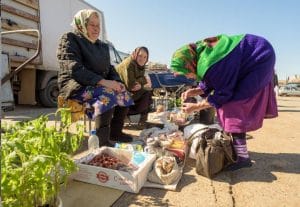
Babushkas selling their products at the entrance of a metro station in the 1990s One day, a babushka appeared before me, holding a medal from the Soviet era and similar family heirlooms to sell. When I took the medal in my hand, the babushka said, "The state gave me this medal for the sacrifice I showed during the siege of Leningrad," and I felt something break inside me. I had read dozens of books and watched documentaries about the siege of Leningrad. Here before me was a Russian woman trying to sell the medal of honor she had received for her sacrifice during this siege. Hitler attacked the Soviet Union on June 22, 1941, with Operation Barbarossa. One of his three goals was to reach the Baltic Sea and occupy the industrial city of Leningrad. The Nazi attack on Leningrad lasted for 2 years and four months between 1941-44. This is known as the longest city siege in human history. Hitler planned to capture Leningrad and destroy its people by starvation. In fact, his orders stated, "there is no need to enter the city, let the people starve to death." The only route to the city was a narrow ice road over Lake Ladoga. The babushka who wanted to sell me her medal had carried food and ammunition on this "road of life." I had no intention of keeping the medal I bought from the babushka. There was a Georgian restaurant near the subway. I sat down with the babushka and we started talking. Hearing the savagery experienced in Leningrad from the voice of a person who lived through the siege was chilling. According to her, there were 2.5-3 million civilians in the city at that time. During the siege, food stocks ran out. Bread rations dropped to 125 grams per day. Thousands died from cold, disease, and hunger. The babushka also lost her family on such a day. The total civilian death toll during the siege was about 1.2 million. People had to boil and eat cats, dogs, and even the glue on the walls. Despite this, the city did not surrender to the Nazis. Not only that, but the people of Leningrad continued to produce weapons, tanks, and ammunition in the city throughout the siege. To keep public morale high, the Leningrad Philharmonic Orchestra even played Shostakovich's 7th Symphony under bombs in 1942. Despite impossible conditions, over 1 million people were evacuated across Lake Ladoga. The babushka participated in all these efforts. I returned the medal to the babushka, who was 75-80 years old. I left a substantial amount of money in her pocket and made her promise: "This medal will never be sold." The babushka's eyes welled up. Her hands trembled. She was ashamed of me. As she put the medal in her pocket, she cursed the leaders who had brought them to this situation. Today, looking back, my dance with Russian and the tears of the Leningrad babushka seem to summarize the instructive shattering and upheaval of the idealism rooted in the soul of a young man who was introduced to Russian in his childhood and later adhered to socialist ideals. IĞDIR'S RUSSIAN CREOLE The Iğdır region remained under Tsarist Russian rule between 1828 and 1917. The Russians left, but Russian words still find use in the daily life of Iğdır. The main ones among these words are: ведро (vedro) Bucket (widely used among Iğdır Kurds) глава (glava) Regional administrator (especially in Iğdır Historical research) спичка (spiçka) Matchstick (used among Iğdır Azeris and Kurds. Kurds say “pîşka”) лопатка (lapatka) Shovel (used as an agricultural tool among Iğdır Kurds and Azeris) конфета (konfeta) Confectionery (used as “kanfet” among Iğdır Kurds) картофель (kartofel) Potato (used as “kartol” among Iğdır Kurds and Azeris) самовар (samavar) Samovar семечки (semeçki) Sunflower seeds, used as sımişka especially among the Azeri population стол (stol) Table чайник (çaynik) Teapot PART TWO: CLAUDETTE ARAS, IĞDIR'S FIRST AMERICAN DAUGHTER-IN-LAW I occasionally communicate via email with Claudette (Klodet) Aras, Iğdır's first American daughter-in-law. In her last correspondence, she sent greetings to the people of Iğdır. She is preparing to celebrate her 94th birthday on December 17, 2025. In an email she sent on October 1, she writes: “This week it seems half the people in the family have birthdays — and realizing I have one in a few months reminded me of Bağır Aras’s 100th birthday celebration I attended in a large meeting hall in Ankara.
Father Aras and I were actually good friends. He would visit us when we lived in Ankara and always took the time to try and teach me to speak Azeri. My accent always amused him.
One of the things I remember he told me was: “My daughter, as you get older, there is one thing you must not forget: always make friends with people 30-40 years younger than yourself — otherwise, when you get really old, you won’t have any friends left; they will all have died.”
And it’s true! As my 94th birthday approaches, all my good, lifelong friends of my own age have died; though I still meet with them from time to time when I meditate. All the friends around me now are at least 20 years or more younger than me. Yet they all think I am their age — because somehow I look as young and active as they are. Probably strange genetics!”
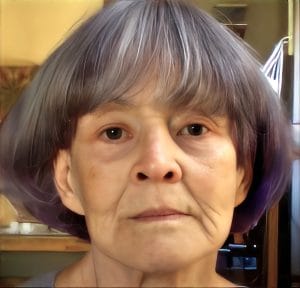
Claudette (Klodet) Aras, Iğdır's first American daughter-in-law, is preparing for her 94th birthday. As the people of Iğdır, we congratulate Claudette (Klodet) Aras on her 94th birthday and wish her a life of over 100 years, like her father-in-law Bağır Aras! For my readers who may not know, I would like to add a note. In 2001, I published a book titled "Mazlum and Klodet" about the lives of Mazlum Aras and Claudette Aras. Given the conditions of the time, this love and marriage generated great interest among the people of Iğdır and was etched into memory as an indispensable topic of home conversations.
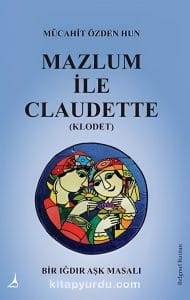
Mazlum Aras was born in Iğdır in 1924, the child of Bağır Aras and Saltanat (Salto) Hanım. He completed primary school in Iğdır. Bağır Aras was ready to make sacrifices for his son to receive the best education. With great difficulty, he sent Mazlum to Istanbul. Mazlum Aras completed middle and high school at St. Joseph, which offered French education and was considered one of Turkey's most prestigious schools at the time. He continued his education at İTÜ Mechanical Engineering and successfully completed it. He won a scholarship from MIT University in the USA, went to the USA, and continued his postgraduate education at the University of Minnesota in Minneapolis. He met Claudette there. They married in a simple ceremony in June 1950. The couple had two daughters. Mazlum passed away in Florida on March 20, 1980, from a heart attack. His ashes were scattered over the Atlantic Ocean.
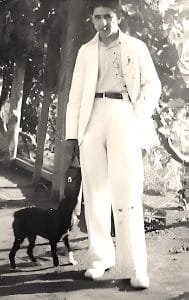
Mazlum Aras and his dog Fındık (Mazlum Aras goes to the USA. Years pass. One day he returns to Iğdır for a visit. Loyal Fındık has not forgotten Mazlum. Fındık does not leave Mazlum's side as long as he stays in Iğdır.) We must be loyal to history. I would like to briefly mention Bağır Aras to my readers. He is one of the most important figures of 20th-century Iğdır. He was open-handed and generous. He lived for over 100 years. When Edip Koçkaya, the CHP Iğdır District Chairman, died in a traffic accident in 1949, Bağır Aras temporarily took over this duty. In Turkey's first multi-party elections (May 14, 1950), Bağır Aras was the CHP Iğdır District Chairman. With Bağır Aras's support, Mir Ali Ural was elected Mayor from the CHP. Later, he handed over the district chairmanship, which he had temporarily held, to Rıza Yalçın. Bağır Aras, an unconditional CHP member, hosted high-level CHP officials visiting Iğdır with grand and magnificent feasts in his home. Among them were figures such as Nihat Erim and Kasım Gülek. When İsmet İnönü came to Iğdır on July 15, 1935, Bağır Aras gave a grand feast to the Prime Minister. İnönü would not forget this open-handed and generous Azeri friend until his death.
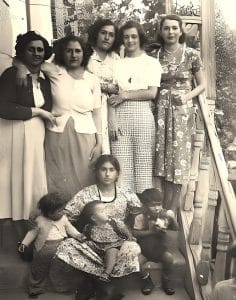
Mazlum Aras and Claudette visit Iğdır in 1952. This picture is taken on the balcony of the house. From left to right, standing: second Naciye Hun, third Nazire Kakioğlu, fourth Mazlum's younger sister Zeliha, fifth Claudette (Klodet). Sitting: Safiye Alagöz. Children: from left to right, Aysel Aras, Selahattin Hun, Atila Hun. I would also like to draw your attention to a tragic situation experienced by the ARAS family. Saltanat Hanım (Salto Xala) fell ill in 1958. They took her to Erzurum for treatment. Despite all interventions, Saltanat Hanım could not overcome her illness and passed away in Erzurum. Since it would be difficult to bring the body to Iğdır, she was buried in Erzurum.
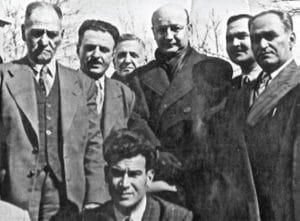
From left to right. Bağır Aras, Nihat Erim (third from left, with glasses) and Rıza Yalçın Not even a year passes. Bağır Aras, a staunch CHP member, learns that CHP Chairman İsmet İnönü will come to Erzurum. He is among the welcoming committee. When İsmet İnönü meets with the Iğdır delegation, he asks, "There was an open-handed, generous, and sincere party member named Bağır Aras in Iğdır. What happened?" Bağır Aras gets excited, rushes forward saying, "May you live long!" but as he tries to speak, his heart seizes, and he passes away (August 18, 1959). Bağır Aras is buried next to his wife Saltanat Hanım. Fate brought them together in the Erzurum cemetery, far from Iğdır, in a way they had never planned.
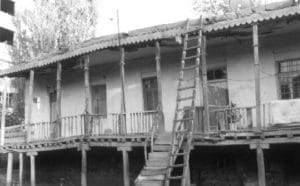
I took this picture of Bağır Aras's house in 2001. My father rented this house between 1950-1959. If you go up the middle stairs and turn right, there is a small two-room apartment. I was born in this room on November 4, 1958. PART THREE: HAMİT HUN ANECDOTE
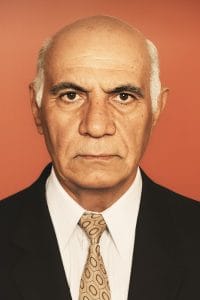
Hamit Hun (1921-1997) (Hamit Hun, son of Ahmed Şemo, left his high school education in Istanbul and returned to Iğdır. The enthusiasm of his spirit and his superior creative ability, in a sense, became a breath of fresh air for Iğdır, which was lost and forgotten in the shadow of Mount Ararat.) The Humanist Teacher Cebiş Hamit Hun is passionate about literature. He has Ottoman-era poems memorized. It is the mid-1970s. The antenna on the roof of Hamit Hun's house is turned towards Baku. He is watching an Azerbaijani film titled "Teacher Cebiş" with rapt attention. Teacher Cebiş in the film is an idealistic educator who serves as both a chemistry and physics teacher. The city of Baku is going through difficult times amidst the hardships of World War II, famine, economic turmoil, and conditions that demoralize people. Students are not eager for lessons or education due to the war environment. Teacher Cebiş is saddened by this situation. He makes an extraordinary effort to make students love school. As Hamit Hun watches the film with great pleasure, his young daughter enters, angrily throws her bag into a corner of the room, and says, "I'm not going to school anymore. My literature teacher is being chauvinistic. I'm the only Kurdish girl in the class. In every lesson, she asks me the most difficult questions to demoralize me." Hamit Hun silently watches his daughter's complaint and her retreating to a corner to cry. The next day, Hamit Hun goes to the high school. He tells the principal that he wants to speak with the literature teacher. Soon after, the literature teacher comes to the principal's office. "Please come in, Mr. Hamit, you wanted to speak with me." Hamit Hun calmly continues: "I couldn't sleep last night. Questions about Ottoman poets came to my mind. I came hoping to get answers from you as a literature teacher." "Please, Mr. Hamit!" "How do Fuzûlî's metaphysical depth in his understanding of love and Bâkî's treatment of love as a worldly pleasure produce two different answers to the question of 'the source of love' in Ottoman poetry?" Faced with the difficult question, the literature teacher stumbles and stutters. Hamit Hun continues. "I see you don't know the answer either. I hope you can answer my second question." "Please, sir." "In Divan poetry, the 'self' is constantly hidden under a mask of humility; however, in Fuzûlî, the self is 'the subject of deprivation,' in Nef‘î, 'the voice of anger,' and in Şeyh Gâlib, 'the essence of mirror metaphysics.' Do these different forms of self show that the search for truth in Ottoman poetry conflicts with poetic form?" The literature teacher stumbles over these difficult questions. Hamit Hun does not miss the opportunity: "What I don't understand is this! There is the humanist Teacher Cebiş in Baku, and there is the Chauvinist Teacher in Iğdır. Please, don't you also take your bag and run home like my daughter, throwing your bag into a corner of the room, saying, 'I can no longer tolerate these Kurdish parents asking questions. They are being chauvinistic and asking me difficult questions.'" What is Democracy? One day, an educated young man asks Hamit Hun: "Uncle, what is democracy according to you?" Hamit Hun thinks for a moment, then replies: "Son, my dreams are of two kinds. In my normal and peaceful dreams, I am always the hero. I do what I want, I am free. Being able to do in my dream what I cannot do in real life gives me great happiness. In fact, when I wake up, I feel sad, thinking, 'I wish I hadn't woken up, I wish my dream had lasted a little longer.' But sometimes instead of a dream, I have a nightmare. In a nightmare, I am no longer the hero. I become someone who is constantly afraid, worried about new disasters befalling them. I impatiently wait for the nightmare to end so I can escape these fears. Some nightmares are so terrifying that even when I wake up, I am afraid to go to bed, fearing that nightmare will return." The young man cannot resist asking: "But Uncle Hamit, what does this have to do with democracy?" Hamit Hun smiles: "Son, sometimes a dictator sits at the head of a country. That's when the people living in that country live as if in a nightmare. They are always in fear, sighing, 'If only this dictator would die so we could be free.' But sometimes people feel free and valuable, as in peaceful and happy dreams, knowing they can say and do what they want. The administration in which individuals living in a country believe they can do whatever they want is called democracy."