Two Souls in the Heaven of Spirits: The Dalai Lama and Desmond Tutu
This essay explores the author's journey into Buddhist philosophy, the historical context of the Hippie movement and its connection to Eastern thought, and the profound spiritual leadership and friendship of the Dalai Lama and Desmond Tutu.

Dear Readers:
My real introduction to Buddhist philosophy came in 1992 when I went to the USA. I was attending advanced English courses in Berkeley, California. One day, our teacher came in with a book by the German author Herman Hesse called "Siddhartha."
"Buy this book. I want you to prepare a 3-4 page essay about its content."
I started reading the book. I looked up unfamiliar words in the dictionary and took notes. Then, suddenly, I found myself captivated by the book's magical atmosphere.
In his youth, Herman Hesse was interested in Eastern philosophy and Buddhism. Inspired by this, he wrote the book "Siddhartha."

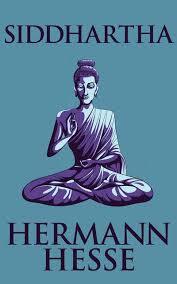
Herman Hesse and his unforgettable book that left its mark on an era: Siddhartha
The novel tells the spiritual quest and journey to enlightenment of a young Indian man named Siddhartha. Despite coming from a Brahmin (noble) family, Siddhartha is not satisfied with traditional religious practices and societal expectations, and embarks on a search for true wisdom and inner peace. During this process, he goes through various stages of life, lives with samanas (religious mendicants who have renounced worldly pleasures), lives a life of extreme pleasure and abundance, experiences a period of deep inner emptiness and despair, and finally begins to live a simple life alongside a loyal man working as a ferryman on a river. Siddhartha's journey includes the theme of continuous change and transformation, symbolized by the endless flow and repetition of the river.
To be honest, I was impressed by the book. Like the protagonist of the novel, I felt as if I was on an inner quest. I was constantly being tossed from one country to another. I completed my assignment, doing justice to the book.
THE HIPPIE MOVEMENT AND THE '68 GENERATION YOUTH
Soon after, I would learn that the Hippie movement originated in the mid-1960s in the area known as the San Francisco Bay Area, encompassing the cities of San Francisco, Oakland, San Jose, and Berkeley. The Berkeley University campus and its surroundings, in particular, hosted this movement.
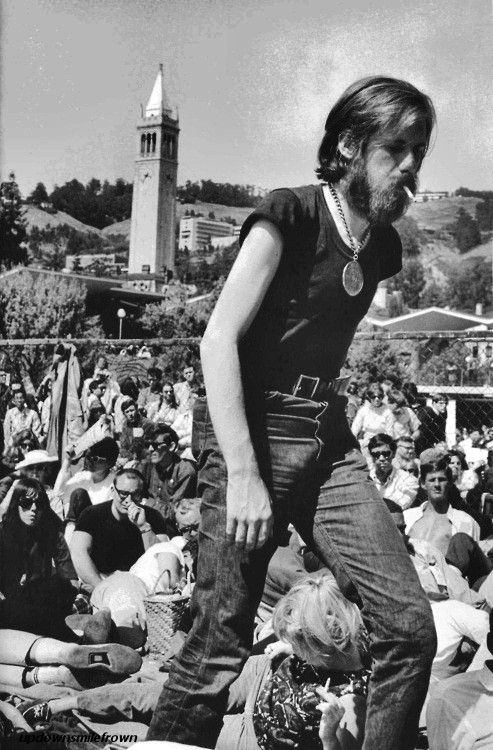
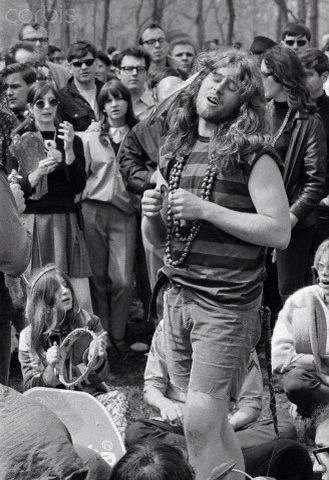
The first nucleus of the global youth movement: student youth protests in Berkeley in 1965
The first protests began in 1965 on the Berkeley University campus. Students and faculty organized demonstrations against the Vietnam War. This also preceded a series of events known as the "Free Speech Movement" among global youth, which rapidly spread to Europe. In Europe, this movement first found supporters in Paris. In May 1968, students clashed with police in the Latin Quarter of Paris, where universities were concentrated. However, in Europe, it acquired a more socialist and communist essence. Youth in Turkey were soon influenced by Europe, and thus the '68 Generation emerged.

Paris, May 1968 student youth movement
Students in Berkeley argued that the war was unethical, that America's presence in Vietnam was wrong, and that the war should be ended. These protests attracted media attention and helped increase opposition to the Vietnam War nationwide.
In short, the city of Berkeley and its university campus took on a historical role as the birthplace of the global youth movement and the Hippie tradition.
Hippies embraced ideals of peace, love, and freedom, and opposed societal norms, consumerism, and war. In search of an alternative lifestyle, they turned to Eastern philosophy, psychedelic (mind-altering and perspective-shifting) music, drug use, and environmentalism. This movement also brought with it a fashion sense that emphasized freedom of expression. The Beatles and Rolling Stones dominated the era as the most listened-to music genres.
When hippies turned to Eastern philosophy, they suddenly discovered Herman Hesse's book "Siddhartha." "Siddhartha" was central to the Hippie movement because the novel opened a window to the spiritual traditions of the East for Western readers and addressed important themes of freedom, inner peace, and self-discovery that many hippies desired.
In a sense, this book became the handbook of the Hippie tradition. My English teacher, who was a Hippie in both dress and lifestyle, had asked us to read "Siddhartha" for this reason.
This period also brought with it an increased interest in Eastern philosophy (Buddhism), meditation, yoga, and alternative lifestyles.
Coincidentally, a few years later, my niece Rabun would begin her high school education as a boarding student at The American School (TASIS) in Montagnola, Lugano, Switzerland. I remember visiting her one day and paying my respects to Siddhartha at the green and flower-filled grave of Nobel laureate Herman Hesse, who was buried there.

Herman Hesse's grave in Montagnola, Switzerland
INTRODUCTION TO BUDDHIST PHILOSOPHY
Fate would have it! When I married a Chinese-American from a Buddhist tradition, I had more opportunities to learn about Buddhist customs and practices. Through this, I had the chance to witness how many white Americans embraced Buddhism as a way of life.
Buddhism is a philosophy and religion founded on the teachings of Siddhartha Gautama, who lived in India in the 6th century BCE. Siddhartha Gautama later became known as "the Buddha," meaning "the Awakened One." The fundamental philosophy of Buddhism is based on understanding the nature of life and how people can escape suffering and attain enlightenment (Nirvana). The cornerstones of this philosophy are as follows:
THE FOUR NOBLE TRUTHS
Dukkha (Suffering): States that life is inevitably filled with suffering, dissatisfaction, and anguish.
The Origin of Suffering (Samudaya): Desire, craving, and attachment lie at the root of suffering.
The Cessation of Suffering (Nirodha): It is taught that suffering will cease with the abandonment of desires.
The Path to the Cessation of Suffering (Magga): Known as the Eightfold Path, which is the way to attain Nirvana.
The Eightfold Path: Consists of eight parts: right understanding, right thought, right speech, right action, right livelihood, right effort, right mindfulness, and right concentration. This path includes ethical conduct, mental discipline, and meditation practices.
Buddhism also accepts the law of karma; that is, it believes that a person's past actions shape their present and future lives.
THE DALAI LAMA AND DESMOND TUTU
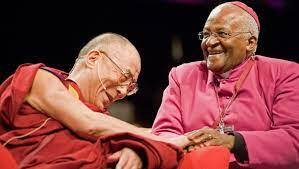
The Dalai Lama (left) and Desmond Tutu
The Dalai Lama is the spiritual leader of Tibetan Buddhism. Desmond Tutu is the Archbishop of the Anglican Church of Southern Africa. While Desmond Tutu fought against Apartheid, the Dalai Lama strives for Tibet's freedom and cultural independence. Both have taken on a historical mission as the most influential and respected spiritual leaders of modern times. Although their lives and struggles took place in different geographies and political contexts, both are known for their deep commitment to peace, justice, and human rights. Both were awarded the Nobel Peace Prize for their contributions to world peace through their efforts. The Dalai Lama received the award in 1989, and Desmond Tutu in 1984.
THE DALAI LAMA'S INFINITE LOVE FOR HUMANITY
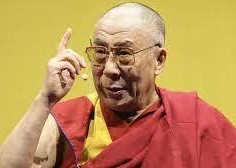
One day, the Dalai Lama was invited to New York. The Dalai Lama was to give a speech in a large venue to share his message of peace. During his visit, he insisted on meeting with a group of children from a local school, as he always found interacting with young minds to be deeply enriching and enlightening.
On the day of the meeting, the children gathered with their teachers in a small hall, fidgeting with excitement at the prospect of meeting such a revered figure. When the Dalai Lama arrived, he greeted everyone with his warm smile, immediately creating a relaxed and joyful atmosphere.
As the children sat around the Dalai Lama, a little girl raised her hand and asked a question: "What can we do to make the world a better place?" The room fell silent.
The Dalai Lama replied:
"To begin, choose a friend! Let it be someone from a different background and belief than yours. Try to get to know your friend, to understand their suffering and needs. Only in this way can we make the world a warmer, more compassionate place."
THE WEREWOLF
Once, the Dalai Lama was a guest on an Australian presenter's program. The topic turned to China. China, which has occupied Tibet since 1950, was disturbed by the Dalai Lama's international diplomatic efforts.
The presenter asked the Dalai Lama:
"The Chinese government has declared you a Werewolf. What do you think about this?"
The Dalai Lama burst into laughter at this remark. Then he pulled faces, trying to contort himself into different shapes. The presenter became curious:
"Your Holiness! Is there something bothering you?"
The Dalai Lama mischievously replied:
"I'm trying to become a werewolf. Let's see if I can succeed!"
DESMOND TUTU'S UNDERSTANDING OF TOLERANCE

One morning, Desmond Tutu embarked on a journey to one of the country's most remote corners to rekindle hope. The sun cast a golden glow over the red earth. When he arrived at the village square, the people gathered silently to listen to him. But instead of making grand speeches, Tutu asked them to bring him an ordinary chair. The astonished villagers complied with this unusual request.
Tutu sat on the chair and right there, in the village square, in front of everyone, he took off his shoes. He felt the earth with his bare feet, sensing the warmth of the sun and the coolness of the soil beneath his soles. Then he smiled:
"Look, all our feet stand equally on the earth. Even though Apartheid tried to separate us, these lands unite us all."
Soon after, the villagers, led by Desmond Tutu, took off their shoes, experiencing the simple joy of connecting with the earth.
This act was not just a show of solidarity, but also a metaphor for Desmond Tutu's struggle against Apartheid.
Desmond Tutu was one of those rare individuals who had the power to bring people together and ignite the flame of hope in their hearts.
MUTUAL LOVE AND RESPECT

Desmond Tutu and the Dalai Lama shared a deep and meaningful friendship. Many anecdotes reflect the joyful, compassionate, and humanitarian approaches of both leaders. This friendship serves as a powerful example of how they both found hope and joy even in difficult times. Here are a few anecdotes from their shared public life:
For the Dalai Lama's 80th birthday, Desmond Tutu traveled to Dharamsala, India, where the Dalai Lama lives in exile. The events during this visit clearly demonstrated the deep friendship between the two and the joy of their time together. Videos and photos show them joking, laughing, and even smearing birthday cake on each other's faces. This shows that, in addition to their messages for humanity, they also shared a zest for life and joy.
Desmond Tutu and the Dalai Lama held deep respect and love for each other. Desmond Tutu referred to the Dalai Lama as "my brother." He admired his determination on the path of peace and compassion. The Dalai Lama, in turn, praised Desmond Tutu's struggle for justice, peace, and human rights, calling him "my spiritual brother."
From the 2000s onwards, the two were frequently seen in public expressing deep respect and love for each other. The friendship between Desmond Tutu and the Dalai Lama was further strengthened by their public dialogues and events, as well as their shared views on the challenges facing humanity.
CONCLUSION
There are important lessons to be learned from the lives of Desmond Tutu and the Dalai Lama. Both fearlessly resisted injustice in their countries but never compromised on universal human love and compassion. Undoubtedly, our world, adrift in endless wars, feels the need for such political figures more and more each day.