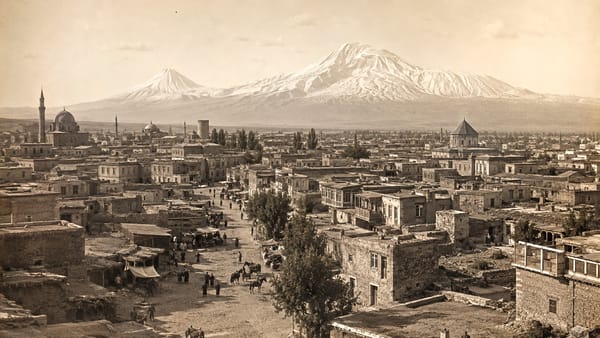
The Last Khan of Revan: Huseyin Kulu Khan
This essay explores the life and legacy of Huseyin Kulu Khan, the last ruler of the Revan Khanate, and his resistance against the encroaching Russian Empire in the early 19th century.

Dear Readers,
Some cities do not fall in a single day, nor does a veil of dust cover them overnight. Before their castle gates are broken, their memory tires; before their walls are breached, their spirit is wounded. Their markets remain open, bread is baked in their ovens, and children's voices echo in their streets. Life, seemingly, goes on. But those who look closely know that the city is no longer the old city. For some cities are engulfed in the darkness of history, succumbing not to cannon fire but to the relentless waves of time.
Revan (Erivan) was such a city.
Once a capital where khans reigned, commanders galloped, and the wind of the Aras River struck the stones of its walls, this ancient border capital became the target of armies in the first quarter of the nineteenth century, besieged by history itself. Grapes still ripened in the vineyards, voices rose in the marketplaces, and gates still opened in the mornings. But the smoke on the horizon was not only a sign of approaching foreign soldiers but also of an era about to close.
In those days, there was a man in Revan. Some called him khan, some a serdar (commander). The people, however, saw him as the last bastion. For some people do not merely govern a city; they carry on their shoulders the last order of a world on the verge of disintegration.
That man's name was Huseyin Kulu Khan Qajar.
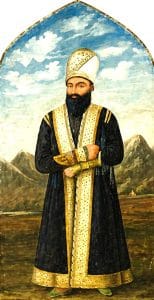
Huseyin Kulu Khan Qajar
Huseyin Kulu Khan was a statesman forged not in comfortable palaces but in harsh geographies. He was born around 1742 in the South Azerbaijan region. He belonged to the Qoyunlu branch of the Qajar Dynasty. In his youth, he served in the court circles of Shiraz. He rose in an era dominated by dynastic struggles, assassinations, and suddenly shifting loyalties.
In such times, courage alone is not enough to survive. One must also know how to read faces, listen to silence, speak at the right moment, and remain silent at the right moment. His rise was the result not only of military capability but also of political intuition.
Fath-Ali Shah Qajar recognized his loyalty and talent. He entrusted him with the administration of a difficult region like Khorasan. Finally, in December 1806, he sent him to head the Revan Khanate. The title "Serdar" bestowed upon him was not merely an insignia but the commander-in-chief of the forces on the left bank of the Aras. Thus, he was not just the ruler of a city but the guardian of a border world.
Revan in those days was not just a fortress. It was a living geography with its vineyards, gardens, inns, caravan routes, villages, and arteries extending into the plains. Today's Iğdır plain was also one of the silent extensions of this historical world. The Aras carried not only water; it also carried news, trade, fear, and hope.
Huseyin Kulu Khan's success would be incomplete if sought only on battlefields. He monitored the productivity of villages. He inquired about the condition of pastures. He had new canals dug. He opened empty lands for settlement. He established vineyards. He provided seeds and animals to farmers. He gave capital to merchants. He eased taxes during droughts and reduced the burden on the people during disasters.
According to a legend told around Revan, in a year of drought, villagers, fearing they would be crushed by the tax burden, were brought before him. On such days, Huseyin Kulu Khan would remain silent, walk to the window, look at the parched earth, and say: "It is tyranny to demand from man what the earth has not given."
Whether it is legend or truth is unknown. But popular memory often preserves not only powerful men but also just men.
However, a new power was rising in the north. The Russian Empire was descending south, seeking to incorporate the khanates and fortresses in the Caucasus into its centralized system.
Huseyin Kulu Khan saw the approaching danger early. He deepened the moats of the Revan Fortress. He strengthened its walls. He increased the garrison. In 1807, with the help of French engineers, he fortified the castle in the European style. This was not merely military preparation. This was a historical response to the approaching century.
REVAN FORTRESS
The Revan Fortress rose on the left bank of the Hrazdan River, at a strategic point dominating the city. Its first major construction was carried out by Ferhad Pasha in 1582–1583. In subsequent centuries, it suffered heavy damage due to wars, sieges, and the 1679 earthquake; it was then rebuilt and strengthened. During the period of Iranian rule, the last major modifications to the fortress were made by Huseyin Kulu Khan Qajar.
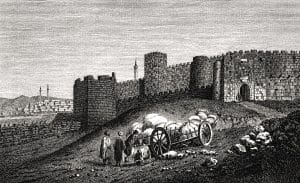
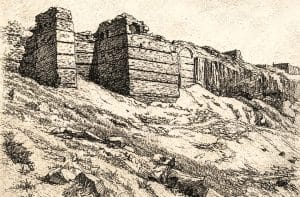
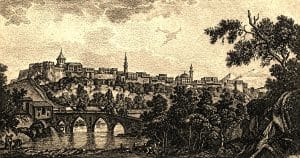
Revan Fortress
The fortress was surrounded by double walls on its northern, eastern, and southern fronts. These walls featured numerous towers and bastions. The western front was protected by the deep Hrazdan valley, which served as a natural defensive line. It had two main gates: Bab-i Shirvan in the north and Tabriz Gate in the south. It also had secret passages leading to the river for water supply during sieges.
In the 17th and 18th centuries, the Erivan Fortress was considered one of the strongest castles in the East, difficult for Ottoman and Iranian armies to capture. Thanks to its deep moats, large garrison, rugged geography, and multi-layered defenses, it was able to withstand for a long time. For this reason, it went down in history not only as a military structure but also as one of the symbols of the power struggle in the Caucasus.
***
Russian armies came repeatedly. They besieged. They opened fire. But each time, they found not only stone walls but also an organized will.
During the sieges of Revan, Huseyin Kulu Khan was not alone. In this geography, loyalty is sometimes written not on paper but in words, sometimes defended not by official armies but by tribal cavalry.
During the days of the siege, cavalry units from the Jalali, Redkan (Redki), and Brukan (Bruki) tribes supported him. They held mountain passes, carried news, and participated in sudden raids. The wild cavalry were invisible when the fog descended but suddenly appeared at dawn.
This support showed that the Revan resistance was not just that of a khanate but a common defense of different communities.
In 1827, the great siege returned. The Russian army advanced to the gates of Revan. Forces under the command of General Paskevich encircled the city. Inside the fortress were thousands of defenders, cannons, and grain stocks prepared months in advance.
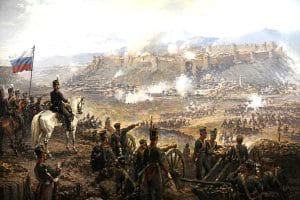
General Paskevich besieges the Revan fortress
It is said that on one of the heaviest nights of the siege, Huseyin Kulu Khan ascended the walls. He looked at the darkness that had settled over the city. Enemy fires burned in the distance. Below, there was a city that did not sleep. A child cried in one house, prayers were offered in another, and the footsteps of a guard echoed in a street.
Perhaps at that moment, he thought of his youth. Perhaps of his first victories. Or perhaps he thought of nothing at all. For on some nights, there is only a heavy silence in one's mind.
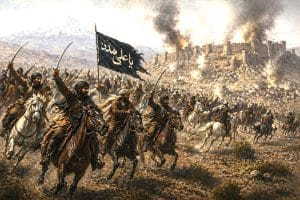
Kurdish cavalry units go to support Huseyin Kulu Khan
Offers of surrender came. Promises of money were made. He refused. But when the fortress was completely isolated, he withdrew to protect the remaining forces. His brother, Hasan Khan, continued the defense. Revan fell.
The stones were captured. But the memory could not be captured.
The fall of Revan was not merely a military defeat. It was also the end of an administrative mindset. The khanate system was replaced by the imperial provincial system. Registers changed. Seals changed. Tax methods, administrative language, and official institutions changed. In the following years, a new structure was established under the name of the Erivan Governorate.
To interpret this new period as simply good or bad is incomplete. Every historical system is a product of its own conditions. The new administration brought a centralized registration system, different types of institutions, and a different management logic. But the personal influence of the old khanate world, the color of the border aristocracy, the local political language, and its unique spirit also came to an end.
One era closed. Another era opened in its place.
After Revan fell, Huseyin Kulu Khan's path became lost in the mists. The man who once commanded armies, issued decrees, and opened gates was now a traveler on the roads of exile.
Sources say different things about his final years. Some accounts describe him living in South Azerbaijan, far from his former power, in silence and with limited means. Other accounts say that he regained his prestige, served in Qajar service, and completed his life in prosperity.
What is certain is that he is believed to have died in 1831.
But history never puts an end to the lives of historical figures. For their lives are completed not on their gravestones but in memory. Huseyin Kulu Khan was one of them. What matters more than where he died is what he represented in his death. When he died, not only a man but also the last great shadow remaining from Revan's old era withdrew.
The Shadow Falling on Today
Two centuries have passed. Khanates have faded into history. Modern cities have replaced fortresses, highways have replaced caravan routes, and electronic commands have replaced decrees. But the destiny of the geography has not entirely changed.
Today's tensions around Iran, struggles over energy routes, and great power calculations show that this region is still under the harsh winds of history. Yesterday, the Revan Khanate was the border gate of pressure between the Qajar State and the Russian Empire. Today, the broader circle of the same geography is again at the center of global calculations. Yesterday, cannons spoke; today, missiles and sanctions speak. The tools change; what does not change is the geopolitical weight of this line.
History sometimes does not repeat itself exactly. But it passes through the same valleys again.
Today, as the sun sets over the Iğdır Plain and evening silence falls along the Aras, one sometimes feels that history still lingers there. It is as if mounted guards appear on a distant hill. It is as if the wind carries the name of a forgotten commander.
Huseyin Kulu Khan was not only the last khan of Revan. He was one of the last dignified faces of a closing world.
When the sun sets, the light does not disappear instantly. It lingers on the horizon for a while longer.
And sometimes an era lives as long as the last crimson glow in the sky. The name of that last light on Revan's horizon was Huseyin Kulu Khan.