Marcel Proust and the Kurds
This essay explores the concept of change in art and politics, drawing parallels between artistic movements and Kurdish political thought, advocating for a "Proustian" approach that values detail.

Dear Readers:
In art, politics, religion—indeed, in every field imaginable as an object of human creativity—change has always been difficult. The transition from one level to another has required significant effort and struggle. What is interesting is that changes in different fields often bear similarities and develop in parallel.
KABATAŞ BOYS' HIGH SCHOOL AND STILL LIFE PAINTING
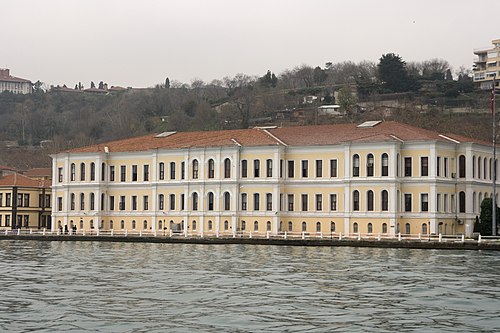
Kabataş Boys' High School on the shores of the Bosphorus
In the autumn of 1973, I began my high school education at Kabataş Boys' High School, in that magnificent castle (!) on the shores of the Bosphorus. I was in class 1-G. The subject I found most peculiar was Art Class. It was the first time in my life I had encountered oil paints. Our teacher, Ms. Zeliha, as if we all possessed innate brush skills and technique, skipped this detail entirely and, from the very first lesson, asked us to paint a composition of a vase, roses, and fruits arranged on a table directly onto the canvas with a brush, without using charcoal.
It was the first time I had heard the word "natürmort" (still life). It was difficult to pronounce. I didn't really know what it meant. Years later, when I learned French in Paris, I would finally grasp the true meaning of the word "natürmort."
The word, written as "nature morte" in French, was pronounced "natürmort" and thus used in Turkish. The literal translation of this word means "dead nature." Therefore, a true still life work only features plants, flowers, and fruits picked from their branches, and sometimes dead game animals.
Most of the class was clumsy with brushes, oil paints, and canvas. Until the mid-term break, our art lessons consisted of scribbling on the canvas we painstakingly carried with us. The mid-term was approaching. Our teacher gave us an assignment for the mid-term grade. The subject, of course, was still life. A week later, our teacher would go around the desks and grade our paintings.
It was the last day for the assignment. We were in a panic. No one had done their homework yet.
It was evening study hour. We sat at our desks, staring at the blank canvas in front of us, gloomily contemplating the next day.
In our class, there was a friend whom everyone called "Yamyam" (Cannibal), whose real name I never learned. "Yamyam" wasn't good at his lessons. He had a restless disposition, constantly picking fights with everyone. It was that evening that we first realized that the "Yamyam" we looked down upon was an extraordinary oil painter. "Yamyam" had completed his still life assignment and was proudly showing it to us. We all started to plead. For a small allowance, he accepted our request.
"Yamyam" was talented. He would spend a maximum of ten minutes on a canvas, carefully painting different still life compositions each time. By the end of study hour, we all had a still life painting on our canvases that we could proudly present to our teacher. We were happy.
The next day, Ms. Zeliha began going from desk to desk, giving grades. Whenever she picked up one of "Yamyam's" paintings, she would say, "Oh, what a magnificent still life! Well done!" Thanks to "Yamyam," we boarding students passed Art Class without difficulty. Unfortunately, "Yamyam" was expelled from school before the academic year was over due to inappropriate behavior, so we would struggle again in Art Class during the second semester.
JEAN SIMÉON CHARDIN (jan simeyon sharden)
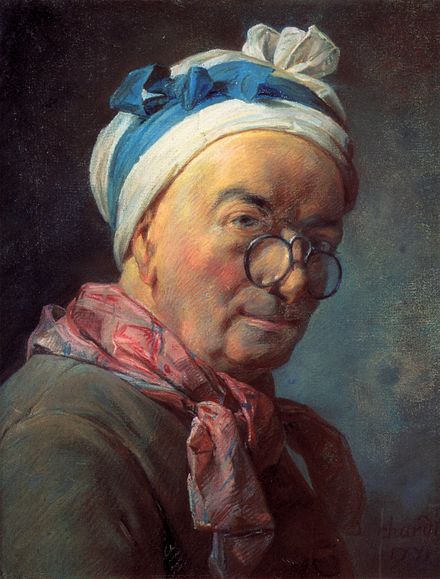
French painter Chardin
After high school, I had no interest in painting. After completing my degree in Electrical-Electronics Engineering at ITU, I started working in France. The French are a nation steeped in art. I have not encountered another society that has internalized art so deeply and consciously in daily life. In every conversation, every meal, every attire, there is always a trace of art hidden.
One day, I went to the Louvre Museum with a French friend. I admired the works of Impressionist painters like Van Gogh, Cézanne, and Monet. Then I found myself in a hall exhibiting the works of 18th-century painters. The paintings in a small room, in particular, captivated my interest. My French friend asked curiously:
"Apparently, you like still life paintings, don't you?"
I didn't answer. It had been years since I had forgotten the word "natürmort." Suddenly, my high school years came to mind. The still life paintings Ms. Zeliha had made herself and proudly shown us as examples for the class flashed before my eyes. The French painter Chardin was the founder and most important figure of this school. I, too, was mesmerized by Chardin's works. I remember sighing to myself, "Oh, if only I could have painted one of these paintings in high school and shown it to Ms. Zeliha."
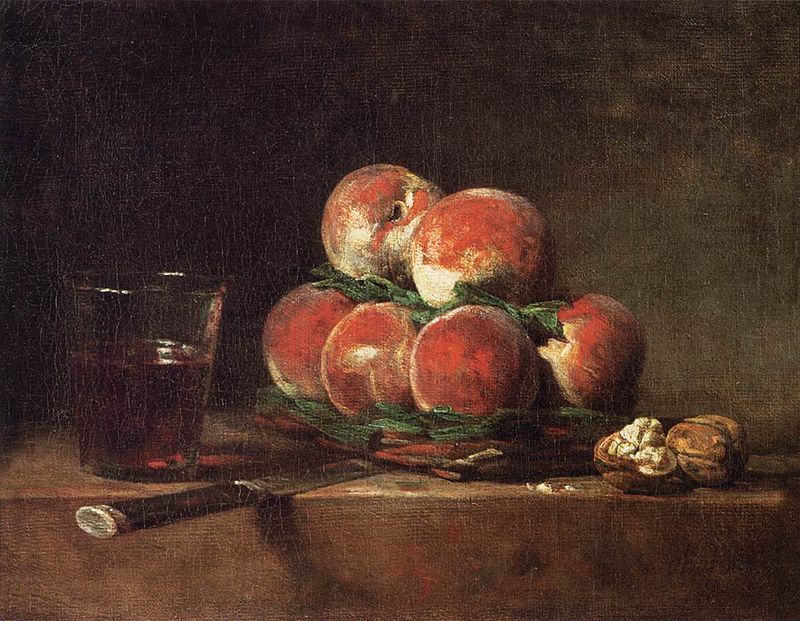
Chardin's "Basket of Peaches" still life
Noticing my excessive interest in Chardin's paintings, my French friend felt the need to add a brief note about realist and impressionist schools:
"For many years, the French were influenced by Chardin, who lived in the 18th century, in terms of painting. When the Impressionists emerged in the late 19th century, the French initially disparaged them. They considered them insignificant. It was not easy for the French to understand that a new era in painting had begun, to appreciate the Impressionists, in short, to break free from the influence of Chardin, the representative of the realist movement. Today, the situation is quite the opposite. The French, who admire the Impressionists, now politely disregard Chardin's works, saying, 'He was important in his time, but not suitable for the spirit of the modern era.'"
My French friend's explanation piqued my curiosity:
"What's the difference between the two?"
"Chardin first draws the big picture, then goes into detail. With the Impressionists, it's the opposite: the big picture is reached from small details."
MARCEL PROUST (marsel proust)
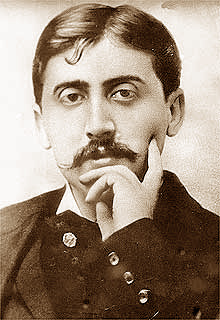
Soon enough, I would experience a similar situation in French literature. In my early years of learning French, I enjoyed reading authors like Albert Camus, André Malraux, Victor Hugo, Balzac, and Émile Zola. I particularly reread Albert Camus's novels again and again. I almost knew his novel "L'Étranger" (The Stranger) by heart. Probably in those years, I had the same state of mind as Meursault, the protagonist of "The Stranger." Even while in Turkey, I carried within me the process of "alienation" from society and my own self. It was as if, like Meursault, I was gradually being dragged towards committing a crime and execution.
It was on such a day that I fell into a literary conversation with a French friend, who was keen on literature, at a café in Montparnasse. My French friend, who taught at the Alliance Française Language School and was also a good literary critic, immediately made a suggestion when he heard the names of the authors I enjoyed reading:
"You must read Marcel Proust. Proust opened the door to modern literature. Although he may not yet be generally accepted, Proust's value is understood more and more each year. The future belongs to Proust."
So I began reading Proust's seven-volume, 3000-page book series, "À LA RECHERCHE DU TEMPS PERDU (In Search of Lost Time)." I was reading, but I wasn't enjoying it at all. I was drowning in details. I even got tired and stopped reading for a while. However, one day, after reading an article in the literary supplement of Le Monde newspaper, I returned to Proust. I started reading again with a different understanding. I confess, anyone who truly reads Proust would no longer want to touch other books. (I regret to note that almost a hundred years after Proust's death (1922), his works as a whole have not yet been translated into Turkish.)
Proust is a writer who shatters mental molds and liberates the soul. As I read Proust, I understood that my soul was gaining its freedom. While other writers made me try to understand the lives of others, empathize with them, and further burdened my soul with tragedies and dramas, Proust confronted me with my own self, mercilessly faced me with my fears and prejudices, and then liberated me like a pigeon thrown into the air. Proust, like a calmly flowing river, connects details, and then suddenly confronts us with a big picture. Proust is a writer who says, "The big picture cannot be reached without seeing, understanding, and internalizing the details." What the Impressionists achieved in painting, Proust achieved in literature.
AND THE KURDS…
"Kurd and Kurdistan" have been concepts that have occupied my mind since my early youth, whose meaning and importance I have questioned for myself. Just as an image slowly emerges when a photographic film is developed, for me, Kurdish consciousness has similarly and slowly evolved from a vague state to a distinct one over the years, and continues to evolve.
Regardless of the country they live in or the political organization they belong to, I have taken it upon myself as a natural responsibility to closely follow Kurds worldwide. My conclusion is this: Kurdish intellectuals still stubbornly adhere to a political understanding that moves from the big picture to the details.
The big picture, that is, "Greater Kurdistan," has a homogeneous definition in their minds. Individuals speak the same language, believe in the same religion and sect, and possess the same cultural characteristics. Because of this, when the details that exist in real life present linguistic, religious, and cultural differences to Kurdish intellectuals, they fall into a helpless state of not knowing what to do, and instead of confronting reality, they get stuck in a stubborn "denial" mentality.
In short, Kurdish intellectuals do not dare to confront the differences they carry within themselves, that is, the details. They still see their independent languages as "dialects," and if they had the power, they would develop such an indifferent attitude as to say, "We all speak the same language." They ignore the importance of their religious and sectarian differences in daily life, and stubbornly continue an understanding that disregards cultural differences that vary from region to region. They are even ashamed to utter the identity of "Tribe," which is the natural fabric and millennia-old form of existence of the Kurds, and even consider it a betrayal.
A "modern" understanding must emerge in Kurdish politics. Just as in Proust, unless a political understanding emerges that values details, and evolves towards the big picture based on the dynamics hidden in those details, Kurds will not be able to escape from dreams, futile efforts, and adventures. I believe that political understandings that bury their heads in the sand like ostriches and ignore details should be abandoned, and a Proustian understanding that values details should be instilled in Kurdish politics.