The Surrealist Dimension of the Kurdish Question / Ashik Şenlik
This essay explores the surrealist nature of the Kurdish Question, drawing parallels with René Magritte's art, and features a historical account of Ashik Kasım Şenlik from an old Iğdır newspaper.

Dear Readers:
At one point in my life, I developed a passion for oil painting. I enjoyed sitting for hours in front of the canvas, bringing colors and dreams together. Perhaps for this reason, whenever I see an oil painting, I get lost in the allure of the colors and surrender my soul to another world.
It was a few days ago. The fact that the Belgian surrealist painter René Magritte's 1954 painting, "L'Empire des lumières" (The Empire of Lights), broke an auction record in New York, selling for $121.16 million at Christie's, one of the world's oldest and most prestigious auction houses, honestly didn't surprise me much.
Wars, intractable problems, economic crises, those clinging to the edge of life, or lives writhing in pain inevitably incline the human mind towards surrealism. In the surrealist world, the boundaries between dreams, the subconscious, illogical situations, and reality blur, and the question of what is real and what is imaginary loses its meaning.
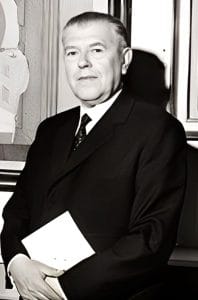
Famous Belgian surrealist painter René Magritte
Perhaps for this reason, I have a special interest in surrealist painters, trying to understand the message they want to convey. Not only that, but I also scrutinize the works of famous surrealist painters like Salvador Dalí, René Magritte, and Max Ernst, sometimes down to the finest detail, questioning the imagery they create in my mind.
There is no doubt that the world we perceive as real is progressing along a surrealist line. Illogical and contradictory elements develop intertwined. Through surrealism, we try to understand this mysterious dimension of life through works of art.
While examining René Magritte's painting "L'Empire des lumières" (The Empire of Lights), the surrealist images used deeply affected my imagination. The light paradox created by the painter in the canvas strangely and surprisingly invited me to another world, causing me to evaluate the Kurdish Question, which has been an indispensable part of my mind since childhood, in a different context.
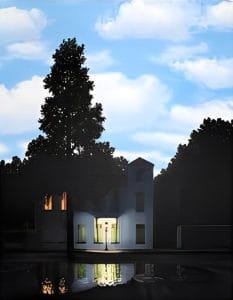
René Magritte's famous painting
Surrealist paintings often contain surreal, absurd, and sometimes shocking scenes. They usually bring together everyday objects in illogical or contradictory ways, causing us to question the relationship between visual and mental perception.
René Magritte's painting above depicts a night scene under a sunny sky. The presence of the night lamp evokes "night," while the bright sky evokes "day." Paradoxically, night and day coexist. However, despite the coexistence of the night lamp's light and the sky's brightness, the houses and trees are still in darkness. The painting shatters the mental inference that "the sun is there, a light-emitting lamp is there, so we know all reality." Despite natural and artificial light, a significant part of the landscape is dark. The Kurdish Question resembles such a painting.
The Kurdish Question, despite all that has been written and drawn, all the ambitious propositions, and all the magnificent (!) political analyses, is largely in darkness. It smiles at us from behind a surrealist veil of mist. For centuries, it has kept its secrets hidden from view, despite all the lights shone upon it.
I ask, does the Kurdish Question attract our interest precisely because it maintains its mystery and paradox?
***
PART TWO: A PAGE FROM THE HISTORY OF IĞDIR
DİL newspaper is Mecit Hun's first and Iğdır's third newspaper (after Cengiz Ekinci's IĞDIR and Ramiz Özler's ARAS magazine). DİL newspaper, which began its publication life on July 9, 1952, was printed as a single page on a stencil machine.
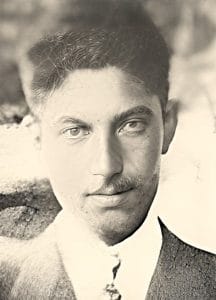
Mecit Hun
Ramiz Özler published an article titled "FOLK POETS I KNEW" in the December 2, 1952 issue of DİL newspaper. In one part of this article, he recounts his encounter with the son of the famous folk poet Ashik Şenlik of Çıldır.
Ramiz Özler writes in DİL newspaper:
Ashik Kasım Şenlik (from the pen of Ramiz Özler)
Is there anyone in the East who hasn't heard the name of the famous Şenlik of Çıldır, or doesn't know a few of his poems by heart? I had heard of the fame of Şenlik's son, Ashik Kasım, but hadn't had the chance to see him.
On February 3, 1952, I was coming to Iğdır from Kars by postal carriage. In Kötek, an elderly folk poet with his saz sat next to me in the driver's seat. How delightful it is to travel and converse with a folk poet. After greeting the poet:
"Where are you from, master?"
"I'm from Çıldır."
"Are you Ashik Şenlik's son?"
"Yes."
"I'm very pleased to meet you. Master, I've heard your name and fame a lot. What a good coincidence!"
"Is your journey to Iğdır, I hope?"
"I'm going to Pernavut (Gaziler). I'll come to Iğdır in a few days. How did you know I was Şenlik's son?"
"I saw your picture in a book called Sevdakâr."
The machine started moving. We were progressing on dusty and rough roads. One of the passengers asked the poet to sing a folk song. The poet began with his father's "Pireler" (Fleas) and "The poem he recited while dying."
Kasım Şenlik was born in 1893 in the village of Suhara, Çıldır. He received lessons in poetry from his father at a young age. He recited his first poem at the age of 13. He was illiterate. He took his father's name as his surname. He earned his living with his words and saz. He traveled extensively, especially in the villages of Kars, Iğdır, and Tuzluca. He was married and a father of 4 children. His eldest son, Nuri, is a valuable folk poet. I saw his younger son, İsmet, with Yeksani in Taşburun. He is also a budding talent.
Ashik Kasım's father, Şenlik, passed away when Kasım was 26 years old. He admired the folk poets Hasta Kasım and Şair Abbas.
At İsmail Ağa's wedding in the village of İrabat, while Şenlik was playing the saz and singing in the assembly, the village elders asked Şenlik to engage in a deyişme (poetic contest) with his son Kasım. Şenlik initially refused this offer, saying:
"Let him go and compete with his peers. He has no place in this assembly." However, with the insistence of the ağas, they managed to pit the father against his son, Ashik Kasım, who was 12 years old at the time.
***
WHO IS ASHIK ŞENLİK?
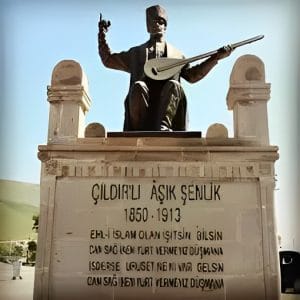
Ashik Şenlik was born in 1850 in the village of Yakınsu, Çıldır, into a Terekeme family. His real name was Hasan. At the age of 19, he learned to play the saz from Ashik Nuri of Ahılkelek. He traveled to Kars, Erzurum, Tbilisi, and Yerevan, engaging in contests with other saz poets of his time. After his journey to Yerevan in 1913, he fell victim to the jealousy of rival saz poets there; poison was added to his food, and he passed away in Arpaçay before reaching his homeland, Çıldır (1913).
During the Ottoman-Russian War of 1877-78 (the 93 War), a saying he uttered in his "93 Koçaklaması" (heroic poem) spread by word of mouth:
"While life remains, do not surrender the homeland to the enemy."
***
WHO IS ASHIK KASIM ŞENLİK?
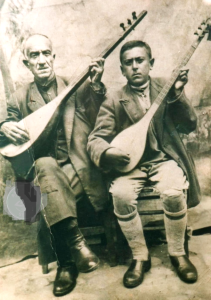
Ashik Kasım (left) with his son Ashik Nuri
Ashik Kasım Şenlik was born in 1872 in the town of Suhara, Çıldır district. His father was Ashik Şenlik, and his mother was Huri Hanım. He had three sons named Nuri, Yılmaz, and Salih. Ashik Kasım inherited the art of ashik from his father Şenlik and passed it on to his three sons in the most proper way. Ashik Kasım passed away in 1959. His grave is next to his father's.
***
ABOUT RAMİZ ÖZLER
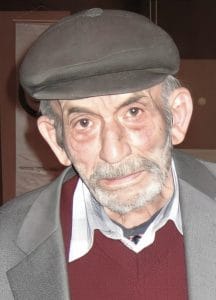
I made the following note about the late Ramiz Özler in my book Iğdır Sevdası, published in 2002:
"With the elections of May 27, 1950, Turkey entered a new era. In this environment where democratic movements and rhetoric gained momentum, past injustices were questioned, and events and individuals were exonerated. One of these was the effort to explain firsthand to the public the injustices suffered by intellectuals who were devoted to the ideal of 'Turanism' in 1944 and thereafter. For this purpose, associations were established, and books and newspapers were published. Iğdır did not remain a spectator to this change in Turkey; under the leadership of some of its intellectuals, it published the Aras magazine, bringing this political initiative and intellectual richness to Iğdır. On October 30, 1950, talented young people like Ramiz Özler, Turgut Sungar, Ahmet Karaca, and Cafer Eroğlu published the ARAS magazine, which adopted the ideal of Turanism and Turkism as its principle. The bi-weekly magazine, printed on a stencil machine, attracted the interest of readers; especially with its poetry section and thought-provoking articles, it managed to bring literary richness to Iğdır."
***
I commemorate Ramiz Özler, Ashik Şenlik, and his son Ashik Kasım Şenlik with mercy.
Mücahit Özden Hun November 20, 2024