Roots and Migrations
The author reflects on the emotional complexities of migration and family separation through the visit of his two sisters from Germany to their hometown of Iğdır.

Dear Readers:
My two sisters, Süheyla and Leyla, who have been living in Germany for over forty years, came to Turkey for a visit after a long absence. We spent about ten days together, enjoying our time in Iğdır, where we were born and raised.
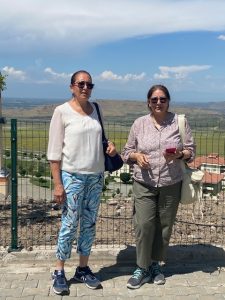
My sisters Süheyla Aksoy and Leyla Gül Özalp
This emotionally intense reunion was an interesting experience for me in terms of observing what changes and what remains unchanged in the human soul. The realities, joys, disappointments, and the flood of emotions that enveloped my two sisters as they reconnected with their roots were, in a sense, a brief summary of what every individual forced to migrate from their homeland experiences.
MIGRATIONS FULL OF PAIN AND SEPARATION
Especially from underdeveloped countries like Turkey to developed countries, namely Europe and the USA, there have been migrations spanning many years. Some of these migrations were voluntary, while others were forced due to political pressures and the search for refuge. Families were torn apart. Years passed. Psychological and sociological differences emerged between family members, i.e., siblings, living in Turkey and abroad. They became estranged from each other. It is impossible to deny that the traumas brought about by this estrangement have reached serious proportions.
Undoubtedly, migrations have been an integral part of the human story throughout history. The pursuit of economic opportunities, the hope for a better life, or escape from political pressures have uprooted many from their homelands. Especially since the 1960s, millions of people who migrated from Turkey to Europe and America have experienced profound cultural and social transformations while building new lives.
Migration is both an opportunity and a major source of stress for individuals. The process of adapting to a new country, language barriers, cultural conflicts, and economic difficulties are among the main problems faced by migrants. Those who migrate from Turkey to developed countries, although generally seeking a better life, must contend with the feeling of "cultural deprivation" created by being uprooted from their homeland, their roots. This situation leads to psychological problems such as identity crises, loneliness, and the erosion of a sense of belonging.
Over time, significant sociological differences emerge between migrating family members and those who remain in the homeland. While migrants try to adapt to the social norms and values of their host countries, family members remaining in Turkey generally continue their lives within the framework of traditional values. This situation leads to disagreements and, in the long run, estrangement among different members of the same family. Especially younger generations drift away from their elders due to cultural differences, struggling with a sense of "identitylessness" as they are caught between two cultures and value systems.
For my sisters, their childhood years seemed frozen, untouched in their minds. Yet, realities and values had changed. Their brother, nicknamed "Hacı," consumed by greed for profit, had sued them. As if the paternal inheritance he had plundered for years was not enough, this time he coveted his sisters' share, spreading false statements to grab a larger portion. After all, his sisters were "Alamancı" (Turks living in Germany). They had a lot of money, and it was permissible to usurp their rights (!).
At every friend's house they visited, the sisters had to contend with Hacı's false narratives of victimhood (!), carrying deep disappointment and anger in their hearts for being put in such a situation.
Their hearts filled with joy when they saw family friends who remained unchanged, loyal and respectful to their values. When Ercan Taşkınsu, the son of our late neighbor Yusuf Taşkınsu, hosted my sisters with friendly feelings and generosity at his restaurant "Semeni" in the town of Melekli, I must admit my sisters' eyes welled up. They found solace, saying, "So, there are beautiful things that haven't changed!" Sitting at a table and drinking tea with two important figures of my tribe, Hacı Reşit İldiz and Tevfik Akpınar, meant infinite happiness to them. Their spirits darkened when they learned that their childhood friend Meliha, daughter of the late Kelbayı İbrahim Bayat from Alıkızıl (Aşağı Topraklı) village, was battling cancer. As they wandered through the garden of their ruined ancestral home, childhood memories revived, and they tried to rekindle the memories lost in the faded traces left by rapidly passing time.
The abandoned and dilapidated state of the farm house called "Qom" in Karakuyu village, where our devoted mother spent a lifetime educating her children, broke their hearts. They were proud of the Iğdır University Campus, which majestically stretches along the foothills of Mount Ararat.
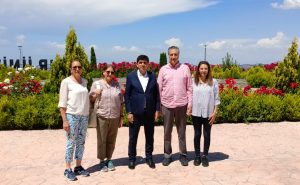
Iğdır University Campus (from left to right): Süheyla Aksoy, Leyla Gül Özalp, our Rector Prof. Dr. Mehmet Hakkı Alma, Mücahit Özden Hun and Şeval Hun
Yes, friends! Migrations leave deep marks both individually and socially. The stories of families spread across the world from Turkey, and the difficulties brought by migration, constitute one of the most critical issues of the modern world. In our country, which has given and received great migrations, there has been almost no "External Migration Literature" to deeply depict the human drama.
I know of only a few works that address the life struggles, cultural conflicts, and family dynamics of migrants who went to European countries, especially Germany.
My wish is that cultural and literary studies related to external migration gain depth, and that the emotional bonds between separated and distant family members are artistically mended. I know our country needs this. Undoubtedly, repairing lost years and embracing sorrowful hearts with love will further strengthen the spirit of unity and solidarity in our country.