Nation-State Struggles in the Shadow of Religions and Sects from the Caucasus to the Persian Gulf
This essay explores how nation-state and national identity struggles in the region from the Caucasus to the Persian Gulf were shaped by ethnic, religious, and sectarian divisions in the 19th and 20th centuries.

Dear Readers:
In today's article, I will try to present a brief summary of the nation-state struggles that took place in the region extending from the Caucasus to the Persian Gulf in the 19th and 20th centuries:
As the effects of the French Revolution on the nation-state and national identity rapidly spread across Europe and the world, one of the most affected regions was the area stretching from the Caucasus to the Persian Gulf, which formed a mosaic in ethnic, religious, and sectarian terms. While coexisting ethnic groups became alienated from each other and engaged in civil war for national ideals, religious and sectarian differences also played a significant role in this process.
THE FRENCH REVOLUTION, THE CONCEPT OF THE NATION-STATE, AND NATIONALISM
When one thinks of the Nation-State and Nationalism, the French Revolution of 1789 comes to mind. This great social and political change, which erupted in 1789, left deep marks on history. The French Revolution led to radical changes not only in France but also in social structures, forms of government, and intellectual movements worldwide.

The Beginning of the French Revolution: The Storming of the Bastille Prison (July 14, 1789)
The Revolution emerged as a result of a people, rising with ideals such as liberty, equality, and fraternity, questioning centuries-old monarchical and aristocratic structures. However, perhaps the most lasting legacy of this revolution was the rise of the concept of the nation-state and the idea of nationalism.
Before the French Revolution, people were primarily defined by local identities, family ties, and feudal allegiances. But with the revolution, the concept of 'nation' came to the fore. This new idea allowed individuals to see themselves as part of a nation and to unite around a common identity with others who shared the same history, culture, and language. This led to political borders becoming more aligned with cultural and ethnic identities and paved the way for the strengthening of nationalist movements in Europe and worldwide in the following years.
THE ENTRY OF TSARIST RUSSIA INTO THE NORTH CAUCASUS
The main reasons for Tsarist Russia's entry into the North Caucasus were based on strategic, economic, and political interests. On the one hand, it aimed to gain an advantage over powerful regional states like the Ottoman Empire and Iran by reaching warm seas, specifically the Black Sea and the Persian Gulf. On the other hand, it considered the nation-state and nationalist movements rapidly spreading among the peoples of the North and South Caucasus to be dangerous for the survival of the empire, deeming it necessary to bring them under control. From 1817 onwards, we see Russia attempting to establish dominance in the Caucasus.
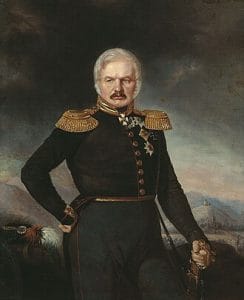
Tsarist Russian officer who changed the balance in the Caucasus: General Yermolov
Under the command of General Aleksey Yermolov, Russia launched a major military campaign to subjugate the local peoples in the North Caucasus. During these years, the nation-state ideal of the French Revolution was rapidly spreading among the peoples of the North Caucasus, and nationalist ideas were mobilizing these peoples to establish their own states. The prominent peoples of the region were the Circassians (Adyghe), Abkhazians, Chechens, Ingush, Dagestani Peoples (Avars, Lezgins, Dargins, Laks, Tabasarans, and Kumyks), Ossetians, Karachay-Balkars, and Nogais.
However, there was a major problem: it was impossible for the North Caucasian peoples, divided by religious and linguistic differences, to resist the powerful armies of Tsarist Russia individually. In such a process, peoples sharing the same sect and religion put their nation-state aspirations aside and resisted Tsarist Russia by forming an alliance based on common religious and sectarian values. Especially in Dagestan and Chechnya, which were on the route of Tsarist Russian armies, the Imamate Movement emerged under the leadership of Sheikh Shamil, and resistance intensified. However, the peoples in the North Caucasus formed a fragmented religious structure. Imam Shamil's struggle was a jihad-based resistance carried out under Islamic leadership within the framework of the Naqshbandi order. The Circassians were very attached to their traditional way of life and acted according to their own cultural codes.
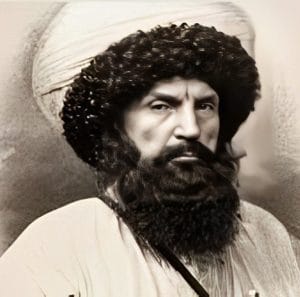
Imam Shamil
The Circassians embraced Islam very late (from the 15th century onwards), and it was not easy for them to abandon their local beliefs and pagan traditions. If the Circassians had been able to contribute to the Holy War initiated by Imam Shamil, they would have had the chance to realize their nation-state aspirations in later years, and most likely the "Circassian Exile" would not have occurred. However, it was not possible for them to organize a common resistance with Imam Shamil. Imam Shamil was of the Sunni (Shafi'i) sect. For this reason, he did not receive the necessary support from the Shi'i (Ja'fari) Azerbaijanis in the South Caucasus. Sectarian differences enabled the Russians to quickly dominate the region.
Tsarist Russia gained full control of the region in 1864, leading to a large population movement. Tens of thousands of Caucasian people who resisted Russia's assimilation policies were forced to migrate to Ottoman lands. This process of exile, also known as the "Great Circassian Exile," led to a great tragedy for the Caucasian peoples. The nation-state demands of the peoples in the North Caucasus would be postponed for a long time.
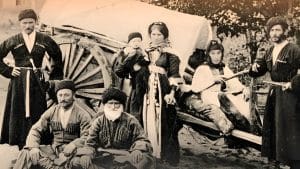
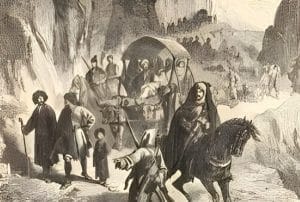
The Great Circassian Exile (1864)
THE ENTRY OF TSARIST RUSSIA INTO THE SOUTH CAUCASUS
Tsarist Russia's descent into the South Caucasus occurred through a gradual process of invasion and diplomacy. From the late 18th century onwards, its expansionist strategy towards the region brought conflict with regional powers such as the Ottoman Empire and Iran. The South Caucasus was a region of great importance to Russia due to its strategic location and natural resources. Furthermore, Russia harbored ambitions of reaching the Persian Gulf through this region.
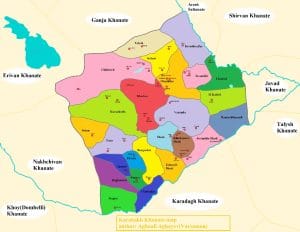
Khanates in the South Caucasus (1750-1828)
During this period, there were Khanates in the South Caucasus. These khanates, independent in their internal affairs, paid tribute to the Qajar Dynasty of Iran. There was no unity of language and religion within the khanates. In those years, only the Kingdom of Georgia stood out as a strong entity in the South Caucasus. Tsarist Russia and the Kingdom of Georgia signed the Treaty of Georgiyevsk in 1783. With this agreement, Georgia came under Russia's protection, and Russia positioned itself as a protective power against Ottoman and Iranian influence in the region. Georgia's acceptance of Russian protection paved the way for Russia's establishment in the South Caucasus. Soon after, Tsarist Russia managed to bring the khanates under its control one by one.
Between 1804 and 1813, Russia fought Iran and won the war with the Treaty of Gulistan. As a result of this agreement, the Azerbaijani khanates came under Russian control. This further solidified the Russian presence in the South Caucasus. Russia, also victorious in the 1826-1828 Russo-Iranian War, signed the Treaty of Turkmenchay, incorporating the Nakhchivan and Erivan Khanates into its territory. Thus, a large part of the South Caucasus came under Russian domination.
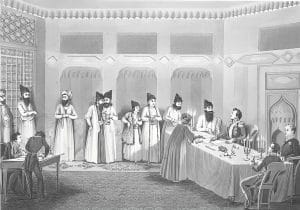
Treaty of Turkmenchay, February 10, 1828
Since the Khanates harbored Sunni and Shi'i Muslims, and partly Christians, the Qajar Dynasty of Iran could not organize a Shi'i Resistance similar to Imam Shamil's against Tsarist Russia's invasion. The realization of the nation-state aspirations of the Azerbaijanis and other peoples was already impossible under these conditions. If the Shi'i Resistance had gained strength in the South Caucasus, a United Azerbaijan state would probably have emerged today.
THE GEORGIAN NATION-STATE QUEST
After the annexation, Georgians tried to preserve their cultural and religious identities. Georgian Nationalism and the aspiration for a nation-state developed as a hidden nucleus within the Georgian Orthodox Church. So much so that being a Georgian Orthodox Nationalist, in a sense, coincided with the aspiration for an independent Georgia.


Tbilisi in the 19th century (administrative capital of Tsarist Russia in the South Caucasus)
In the mid-19th century, with the Georgian enlightenment movement beginning in Tbilisi, Georgian intellectuals worked to strengthen cultural identity. During this period, studies were conducted on Georgian language, literature, and culture. The subordination of the Georgian Orthodox Church to Russia also strengthened the quest for independence. Fighting for the independence of the Georgian Church, in a sense, meant fighting for an independent Georgia. In other words, the Georgian nation-state idea was hidden under the wings of the Georgian Church.
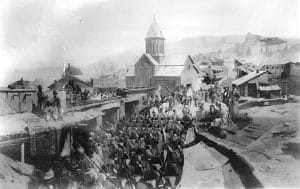

Left, the entry of the Tsarist Army into Tbilisi (November 16, 1799) and right, the arrival of the Tsar in Tbilisi (September 29, 1888)
During the 1905 Russian Revolution, demands for independence began to rise among Georgians. Georgian social democrats and other political groups took advantage of Russia's weakening to engage in pro-independence activities. Pro-independence movements gained strength, especially in Tbilisi and other major cities.

The intellectual father of Georgian Nationalism: Ilia Chavchavadze (1837-1907)
With the October Revolution in Russia in 1917, the Tsarist regime collapsed, creating an opportunity for independence for the peoples of the Caucasus. On May 26, 1918, the Democratic Republic of Georgia was declared. This first period of independence lasted until the Soviet Red Army invaded Georgia in 1921.
Georgia joined the Soviet Union in 1921, but secret independence movements and rebellions continued during this period. After Stalin's death in 1956, demands for independence increased among Georgian students and intellectuals. In 1978, pressures on the Georgian language were protested.
By the late 1980s, with the weakening of the Soviet Union, the Georgian independence movement regained strength. On April 9, 1989, dozens of people lost their lives when Soviet soldiers attacked demonstrators in Tbilisi, accelerating demands for independence.
Georgia declared its independence on April 9, 1991, as the Soviet Union began to disintegrate. From this date, Georgia began to exist as an independent republic.
THE ARMENIAN NATION-STATE QUEST
When Tsarist Russian armies descended into the South Caucasus, Armenians lived scattered across the Ottoman Empire, Iran, and the South Caucasus. They were not concentrated in one region like the Georgians. Furthermore, there were historical conflicts and tensions between the Armenian Apostolic Church and the Russian Orthodox Church. These conflicts were based on both religious and political reasons.
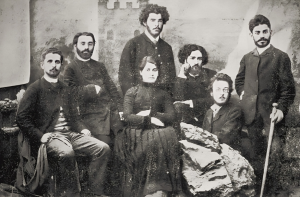
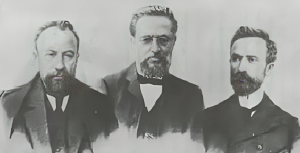
Founders of the Hunchak Party (left) and Founders of the Dashnak Party (right)
The Armenian Apostolic Church is one of the oldest churches in Christian history and has its own independent tradition, liturgy, and administrative structure. The Russian Orthodox Church represents a different interpretation of Christianity and is an important part of Russia's religious and national identity. Religious differences between these two churches have sometimes led to rivalry and conflict.
While Tsarist Russia tried to bring Armenians under its influence through Orthodoxy, Armenians also tried to organize their nation-state aspirations within the Armenian Apostolic Church.
In the mid-19th century, the Russian Orthodox Church sought to increase its control over Christian communities in the region. During this period, the independence and authority of the Armenian Apostolic Church began to be questioned by the Russian Church. In fact, the Russians' fear was not the existence of the Armenian church, but the Armenian nationalist movements protected by the church.
After the Treaty of Turkmenchay in 1828, Armenians living scattered in Iran and the South Caucasus migrated to certain regions, forming population concentrations. Thus, Armenians found an opportunity to develop their cultural and political rights in a safer environment, and this situation also inspired Armenians in the Ottoman Empire. Armenian intellectuals in Russia began to develop ideas of independence and autonomy. The Hunchakian Party (Hunchaks), founded in 1887, and the Armenian Revolutionary Federation (Dashnaktsutyun), founded in 1890, rapidly developed on the principle of a nation-state, with assistance from the Armenian Apostolic Church.
Following the Russian Revolution of 1917, Russia's presence in the Caucasus weakened. In 1918, a short-lived independent Armenian Republic was established in what is now Armenia. However, this state ended in 1920 with the Soviet Union's invasion of Armenia, and Armenia became part of the Soviet Union. Armenia was re-established as an independent republic in 1991, with the dissolution of the Soviet Union.
THE IĞDIR CIVIL WAR (1919) AND THE YAZIDIS
In August 1919, a religious war took place among the peoples living in the region within the present-day borders of Iğdır province. The Yazidis, despite being ethnically Kurdish and speaking the independent Kurmanji dialect of Kurdish, put their national identity struggle second, clashed with their Muslim Kurdish brethren against a Muslim front composed of Ja'fari Azerbaijanis and Sunni Kurds, and sided with the Armenians.

Mount Ararat (Greater and Lesser) and the Aras River, which witnessed many sorrows
The Yazidi population settled in the Iğdır region crossed the Aras River and took refuge in present-day Armenia. Today, Yazidis living in Armenia actively support Kurdish movements in various parts of the world that strive for the establishment of a nation-state. The priority of religious versus national identity among Yazidis remains a controversial issue.
THE KURDISH NATION-STATE QUEST: THE ARARAT REBELLION (1926-1930)
The Ararat Rebellion was initially launched as a resistance movement by İbrahim Ağa (Bıro Heski Telli) in response to the Law on the Exile of Aghas and Beys, enacted in 1926. In 1928, with the dispatch of Captain İhsan Nuri by the Hoybun (Xoybûn) Society, founded in Beirut, an insurgency was organized on the basis of a modern nation-state. However, when nationalist ideas failed to resonate with the people, the religious leadership of Sheikh Abdülkadir (Kotan) came to the forefront.
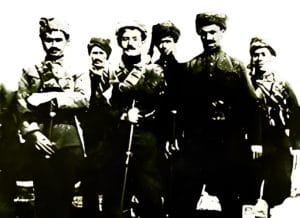
Leadership of the Ararat Rebellion: (From left to right) Halis Bey (Öztürk), İhsan Nuri Pasha, and Ferzende Bey

(Right) Sheikh Abdülkadir (Kotan) and his son Hasan Kotan (left)
THE AZERBAIJANI NATION-STATE QUEST: THE AZERBAIJAN NATIONAL GOVERNMENT
The Azerbaijan National Government was an Azerbaijani state established in the Azerbaijan region of Iran in November 1945 with the support of the Soviet Union after World War II, and overthrown by the Iranian government in November 1946 after the Soviet Union's withdrawal.
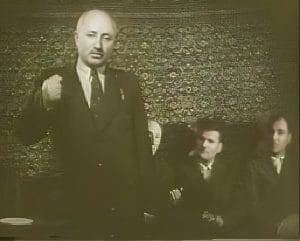
President of the Azerbaijan National Government, Jafar Pishevari
Northern Azerbaijan, centered in Baku, had continued its existence as a socialist republic within the Soviet Union since 1920. After the Soviet Union emerged victorious from World War II, socialist ideology gained importance in neighboring regions and countries. In Southern Azerbaijan, centered in Tabriz, the priorities were as follows: 1. Proximity to the Soviets due to socialist ideology; 2. Proximity to the central government due to the Shi'i sect; 3. An independent Azerbaijani State (nation-state aspiration).
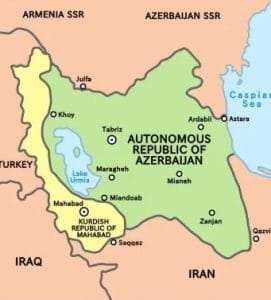
Azerbaijan National Government and the Mahabad Kurdish Republic (1946)
When the Soviet Union withdrew its support in November 1946, integration with the central government due to proximity to the Shi'i sect came to the forefront in the Azerbaijan National Government. If socialist ideology and the Shi'i sect had not been priorities, a United Azerbaijan State could have been established in the 1920s. Today, the nation-state aspiration in Southern Azerbaijan has been relegated to a secondary position within the Shi'i sect.
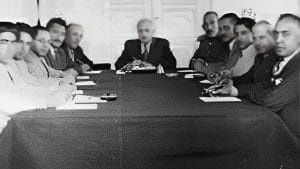
Azerbaijan National Government meeting chaired by Jafar Pishevari
THE KURDISH NATION-STATE QUEST: THE MAHABAD KURDISH REPUBLIC
While the Mahabad Kurdish Republic, founded in 1946, was established by Sunni-Shafi'i Kurds, the Shi'i Kurds in the neighboring provinces of Saqqez, Kermanshah, and Ilam did not support this formation, instead siding with the central Shi'i government.
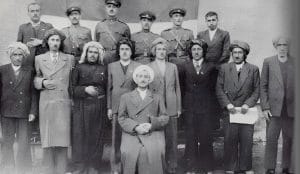
Qazi Muhammad (seated in front) and officials of the Mahabad Kurdish Republic Government
Sunni-Shafi'i Mullah Mustafa Barzani from the Northern Iraq region had to go to Mahabad to support the Mahabad Kurdish Republic. Furthermore, the Kurmanji-Sorani linguistic difference within the Republic also hindered the Mahabad Kurdish Republic from gaining strength.
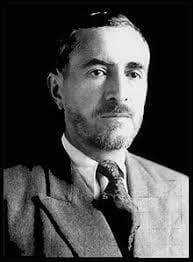
President of the Mahabad Kurdish Republic, Qazi Muhammad
Moreover, the Mahabad Kurdish Republic was not organized as a modern nation-state; rather, social ties were maintained primarily under the leadership of respected religious figures, and the nation-state formation progressed slowly.
THE SUPPRESSION OF NATION-STATE ASPIRATIONS: THE IRAQ-IRAN WAR
Towards the end of the 20th century, while national identity struggles continued in Iraq, there was also constant tension between Shi'ites and Sunnis. Following the Iranian Islamic Revolution in 1979, Saddam Hussein, being a Sunni Arab himself, pursued a policy that, when necessary, favored Sunni Kurds over Shi'ite Arabs.
Iran and Iraq particularly wanted this war to continue along religious lines, thereby postponing or preventing the nation-state aspirations of the Kurds, Azerbaijanis, Balochis, and other peoples living in their own countries, under the shadow of a sectarian war.
The main reason for the Iraq-Iran War stemmed from the Sunni Arab governments' reflex to suppress their Shi'ite populations and prevent Shi'ite thought from becoming a regional power, in response to the spread of the Shi'ite sect, which had become a significant political force and aligned with Persian culture. Similarly, the most important reason for Saddam's invasion of Kuwait was to stop the spread of the Shi'ite sect's influence at the borders of Kuwait (40% of Kuwait's population is Shi'ite) with the material and moral support he received from Sunni Arab states in the region, and to prevent it from spreading to other Arab countries. Despite all these obstacles, Iran today is the leader of the global Shi'ite movement. It is the undisputed leader and staunch defender of the Shi'ite sect across a wide geography extending from Lebanon to Central Asia.
Towards the end of the war, which began on September 22, 1980, Iran, despite knowing that it could set an example for the Kurds in its own country, desperately sought to gain an advantage against Iraq by helping the Kurds struggling for autonomy and a nation-state in Iraq. Realizing that the possibility of an independent Kurdistan emerging from the power vacuum created by the eight-year sectarian war was gaining increasing importance, Saddam attacked the city of Halabja within his own country's borders with chemical weapons on March 16, 1988, massacring more than 5,000 Kurdish civilians. Iran, also realizing that the nation-state aspirations of peoples like Azerbaijanis, Kurds, and Balochis could gain strength from the power vacuum caused by the sectarian war, ended the war on August 20, 1988.
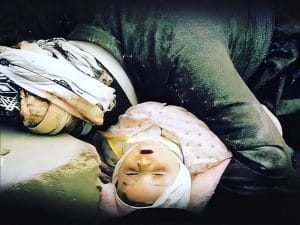
Father and his baby killed by chemical weapons in Halabja
CONCLUSION
In short, in the geographical corridor extending from the North Caucasus to the Persian Gulf, over two centuries, sometimes nation-state building and national identity struggles came to the forefront, while at other times religious and sectarian preferences prevailed. Nation-state aspirations were forced to be hidden within religious and sectarian identities.