Racism and Pages from History
This essay explores racism through personal anecdotes and historical events, from the author's childhood memories to the stories of Tosawi, Nâzım Hikmet, Stalin, Zoya, and Mata Hari, culminating in the Nazi euthanasia program.
Dear Readers:
In this article, I wanted to bring to your attention a few pages from both my own life and from history:
In my childhood, I would eagerly leaf through the stacks of newspapers and magazines my father brought home, and I particularly enjoyed reading the "History Corner" pages. Short but impactful anecdotes left deep impressions on my mind.
In those years, keeping a "diary" was fashionable. In high school, I bought a notebook with decorated page edges and regularly jotted down topics that interested me, though not every day.
One notebook would get lost, and then I would buy a new one and continue writing my diaries. The diaries I kept during my university years scattered like autumn leaves and disappeared. In later years, I largely lost the habit of keeping a diary, but I developed an interesting habit of keeping a "mental diary."
Today's article is an excerpt from my "mental diaries."
PREJUDICES
Prejudices are as sharp as a honed knife. No matter which way you swing them, they will cause harm. We swim in a sea of prejudices, yet we are not even aware of it. Sometimes, I ask myself, "Is humanity perhaps a creature condemned to live with its prejudices?"
The hardest thing in the world is for an individual to confront their own prejudices and try to overcome them. Prejudices are both the engine of life and the enemy with which an individual constantly struggles. Perhaps this is why the Jewish-born Einstein, implying a protest against his anti-Semitic colleagues who deliberately excluded him, said, "It is harder to crack a prejudice than an atom."
NATIVE AMERICAN CHIEF TOSAWİ
The year is 1869. The Native American-White war in the United States continues mercilessly. A captured Native American tribal chief and his aides are detained in a fort called Fort Cobb in Oklahoma. This Native American chief, named Tosawi, sees American General Sheridan while walking in the fort's courtyard and approaches him. Wanting to emphasize that his tribe was different from other warlike, resistant, and savage (!) Native American tribes, he says in his limited English:
"Me Tosawi, good Indian."
General Sheridan casts a harsh glance at Tosawi and replies:
"The only good Indian is a dead Indian."
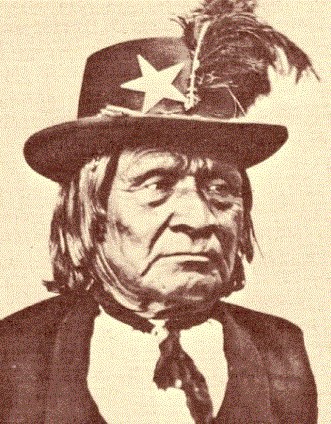
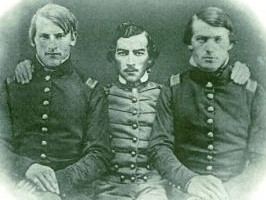
Native American Chief Tosawi General Sheridan (center)
"THE ONLY GOOD KURD IS A DEAD KURD!"
In 2008, I joined the Change Movement initiated by Mustafa Sarıgül and his friends. I frequently visited their office on Iran Street in Ankara and participated in political evaluation meetings. We also had an online newspaper. An article of mine on the "Kurdish Question" had been published.
Some time later, a "Science Board" was formed. I, a retired Colonel, and a former Director General of Forestry were appointed as members of the Science Board.
It was to be our first meeting. The Colonel and I were sitting around a long table, waiting for our Director General friend to arrive.
We were meeting for the first time. We started killing time with questions like "Where are you from?" and "What do you do?". As the conversation continued its course, the Colonel, without any reason, said in a harsh and jarring tone, "The only good Kurd is a dead Kurd." I was astonished. The Colonel, deemed worthy to work on the Science Board, was openly racist, and moreover, he was saying this to someone he probably guessed was Kurdish.
Ordinary, simple racism is nauseating. It can even make you think that the perpetrator is "sick." At that moment, I felt such an emotion and stared blankly and meaninglessly at the Colonel.
A RACIST MOVE IN IĞDIR
From Iğdır, the city where I was born and which I love, the nauseating, ordinary yet provocative "racist" drumbeats have recently been reaching Ankara. The interesting thing is that respected state institutions in Ankara are also being instrumentalized in this racist project, going to Iğdır with a "political order" and contributing to the racist show. Without regard for party-political differences, former and current MPs of Iğdır, taking local administrators with them, form special lobbies and go door-to-door in Parliament, waving the glorious (!) flag of racism and spewing venom and hatred.
Throughout the Republican era, Iğdır periodically succumbed to waves of "racism" and went through difficult trials. Of course, these days too will pass. Currently, the slogan "The best Kurd is the Kurd who has been fired!" is setting the agenda in Iğdır. Those who have fallen into this meaningless and nauseating delusion should know that there is a balance of common sense and sects rooted in Iğdır. No one will be able to harm the true spirit of peace that has taken root in Iğdır. The hands of future generations will be on your collars, and their consciences will choke you.
"OH, I WRONGED THE KURDS!"
An interesting situation has become a tradition among Turkish intellectuals, civil administrators, academics, politicians, and soldiers. Whenever Azrael (the Angel of Death) slowly approaches them with his scythe, whenever they see the pale face of death in the mirror, whenever they feel they are living their last moments, only then do they murmur or write: "I disregarded the rights of the Kurds. I did not act conscientiously."
One of the best examples of this situation is Nâzım Hikmet. In the most active days of his life, during the most prolific period of his poetry, he ignored the injustices suffered by the Kurds and said nothing about it. He adhered to the Kemalist ideology's principle that "a single language, a single culture is necessary for nation-building" and turned his back on the national struggle of the Kurds.
QEDRÎCAN AND NÂZIM HİKMET
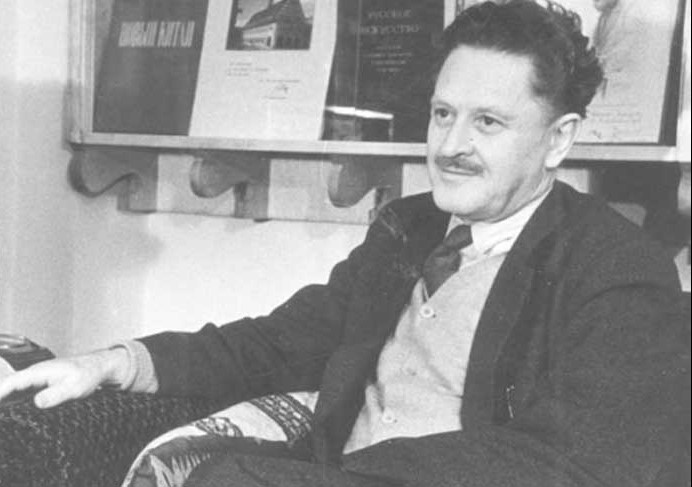
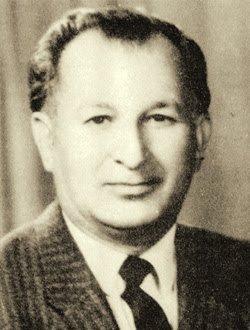
Nâzım Hikmet Qedrîcan
Qedrîcan, whose real name was Abdulkadir Can, was a socialist internationalist Kurdish writer and poet. He was born in 1911 in Derik, a district of Mardin. He completed his primary education in Derik and graduated from Konya Teacher Training High School. After the Sheikh Said Rebellion broke out in 1925, he settled in Damascus. His poems, written in Kurmanji, were published in Kurdish magazines named Hawar and Ronahî. In a sense, he is considered the father of modern Kurdish poetry.
In 1962, Qedrîcan went to Moscow to attend the World Youth Conference. Nâzım Hikmet was also in Moscow.
Qedrîcan recounted an incident from those years to the famous Kurdish folklorist Ahmet Aras:
"It was during my days in Moscow. I learned that Nâzım Hikmet would be speaking in a hall. I went to the hall and listened carefully to his speech. Nâzım Hikmet finished his speech. The audience raised their hands and asked questions, and Nâzım Hikmet answered them.
I also raised my hand. Nâzım Hikmet pointed at me and said:
"Please!"
I stood up:
"I am from the Kurds of Turkey. Like you, I fled the oppression of the state and settled in Syria. Like you, I am a writer and poet. I read your poems with admiration and love. I write poems in your style. However, there is something that catches my attention: In your poems, you talk about African blacks, Latin American and Chinese poor, but you write nothing about the poor Kurds. Moreover, you are one of the closest witnesses to the oppression against the Kurds. Can you clarify this issue?"
Nâzım Hikmet got angry and replied in a harsh tone:
"Stop! Stop! Let's discuss this privately after the meeting."
After the meeting ended, Nâzım Hikmet scanned the hall, and referring to me, he shouted:
"Who was making a fuss just now? Come here now!"
We entered a room. We started talking and arguing. I didn't find what he said logical. I was disappointed. Without feeling the need to say anything more, I left the room."
***
From 1953 onwards, Nâzım Hikmet began to experience health problems. At one point, he suffered a serious heart attack and narrowly escaped death. In a poem he wrote on September 10, 1961, he felt death very close:
My turn is coming
Suddenly I will leap into the void
I will not know of my decaying flesh
Nor of the insects crawling in the hollows of my eyes
I think of death incessantly
My turn is near, it seems…
Feeling death approaching step by step, Nâzım Hikmet, on such a day in 1962, one year before his death, perhaps in the days following his discussion with Qedrîcan, sent a letter to Kâmuran Ali Bedirhan, a Kurdish nationalist, lawyer, writer, and politician who was a lecturer at the Institute of Oriental Studies at the University of Paris. (Note: Nâzım Hikmet's Polish-descended grandfather and Kâmuran Ali Bedirhan's Polish wife were distant relatives.)
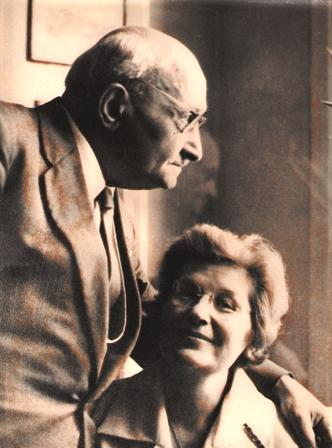
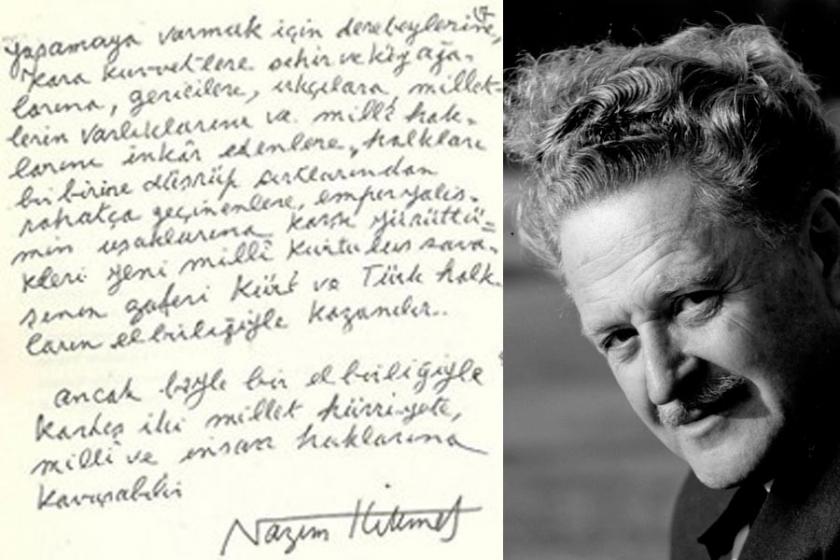
(Left) Kâmuran Ali Bedirhan and his wife, Polish princess Nathalie d’Ossovetzky
(Right) Nâzım Hikmet and the letter he sent to Kâmuran Ali Bedirhan
In this letter, Nâzım Hikmet, in a sense, confesses his sins regarding the Kurds and writes:
"With roots reaching deep into centuries, with its history and culture, a significant majority of the Kurdish nation lives in one part of Anatolia. The Turkish nation living in other parts of Anatolia considers the Kurdish nation its brother. Both nations, like all empires, were bound by the heavy chains of Turkish and Kurdish feudal lords and the Ottoman Imperial administration in the Ottoman Empire, which was a prison for peoples.
After the collapse of the Ottoman Empire, both nations formed a single front against imperialism and fought. The Anatolian national liberation movement is one of the most glorious pages in the history not only for Turks but also for Kurds. One of the most unforgettable folk songs from those fighting years, later banned by Turkish administrators, begins with 'Strike, Kurdish lad, it is a day of honor.'
After the establishment of the Republic of Turkey, Turkish administrators and dominant circles did not recognize the national and human rights they had promised to the Kurdish movement. They even went so far as to deny the very existence of the Kurdish nation as a nation.
This period is when Turkish administrators and dominant classes began to compromise with imperialism. The emergence of this denial and this compromise at the same time is not just a coincidence.
Today, Turkish politicians, who have made the Republic of Turkey one of the strongholds of imperialism in the Middle and Near East, insist on denying the national existence of the Kurdish nation and do not grant the Kurdish nation even the rights they grant to other minorities within the borders of the Republic of Turkey.
The fact that the Turkish and Kurdish peoples within the borders of the Republic of Turkey yearn for the same goals in domestic and foreign policy frightens today's Turkish administrators. Both nations want to develop their fraternal national cultures and national economies, and to gain access to land, agricultural tools, freedom, and democratic rights. The Turkish and Kurdish peoples long for the Republic of Turkey to pursue a neutral policy and to cease being a base for imperialism.
Just as true Turkish patriots wholeheartedly support the struggle of their Kurdish brothers to achieve their national rights within the borders of the Republic of Turkey, true Kurdish patriots likewise support the struggle of the Turkish people for democracy and national independence.
Reactionary, exploitative, dark forces, who want to sow discord between the Turks and Kurds living in Anatolia, are working hand in hand with imperialism to more easily oppress our peoples. The victory of the new national liberation war waged by the Kurdish and Turkish peoples against feudal lords, dark forces, city and village aghas, reactionaries, racists, those who deny the existence and rights of nations, and those who pit peoples against each other and comfortably live off their backs, the servants of imperialists, will be won by the joint efforts of the Kurdish and Turkish peoples. Only through such joint efforts can these two fraternal nations achieve freedom, national, and human rights. Nâzım Hikmet"
***
Oh, esteemed Turkish intellectuals, what I mean is, before death knocks on your door, before the fear of Azrael shatters your mind, bravely proclaim your debt of conscience to the Kurds. What is said and written at the last moment, unfortunately, is buried with you in the dark grave of history.
STALIN'S CHEF
For many years, there was a long-standing debate among historians about who Stalin's father was. The prevailing view is that Stalin was born out of wedlock. His mother, Ekaterine, during her marriage, began working for a wealthy wine merchant named Jacob Egnatashvili in Gori, Georgia. Fleeing the violence of her alcoholic husband, Ekaterine, in a sense, sought refuge with Jacob. From this relationship, they had an illegitimate child. This child would later become famous under the name "Stalin."
Stalin went from Tiflis to Baku to organize oil workers. In 1906, he married Ekaterina, nicknamed "Kato." In those years, Kato was 21; Stalin was 28. Kato contracted typhus in 1907 and died suddenly. Their son Jacob had just been born. Stalin was deeply affected by Kato's death. He said about his wife's passing: "Kato was the only person who softened my stony heart. With her death, I lost all my warm feelings towards humanity."
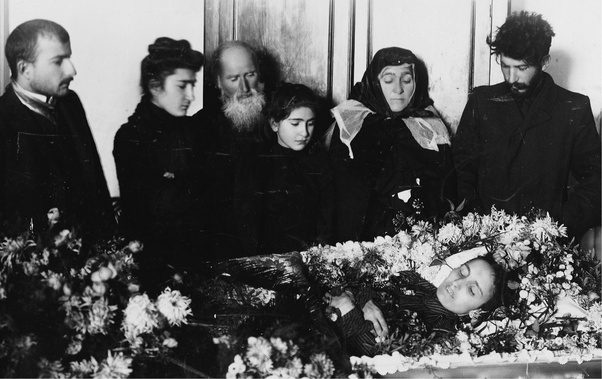
Stalin (far right), seeing off his deceased wife Kato on her last journey (1907)
His son Jacob served in the army with the rank of Lieutenant during World War II. He was captured by the Germans. Learning that he was Stalin's son, the Germans sent a message to Stalin: "If you release our captured General, we will release your son."
Stalin was angered by the proposal and shouted, "Being Stalin's son does not give Jacob any special privilege." He gave the order: "Tell the Germans: Why should I exchange a General for an ordinary Lieutenant? I do not accept."
Jacob was sent to the Sachsenhausen Concentration Camp. He was killed by camp officials on April 14, 1943. Some historians state that Jacob committed suicide.
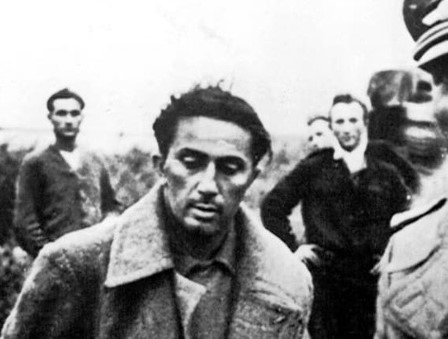
Stalin's son Jacob in a German Prisoner of War Camp
One of the sons of Stalin's real father, Jacob Egnatashvili, was named Alexander Egnatashvili. Alexander ran a restaurant in Tiflis. When the Soviet Union was established, Alexander, like many private businesses, went bankrupt. Stalin extended a helping hand to his half-brother. Stalin had his half-brother, who was imprisoned for tax evasion, released. He brought him to Moscow. Alexander became Stalin's private chef, fond of Georgian food and wine, and also served as an officer in the KGB.
Alexander held the rank of General when he died.
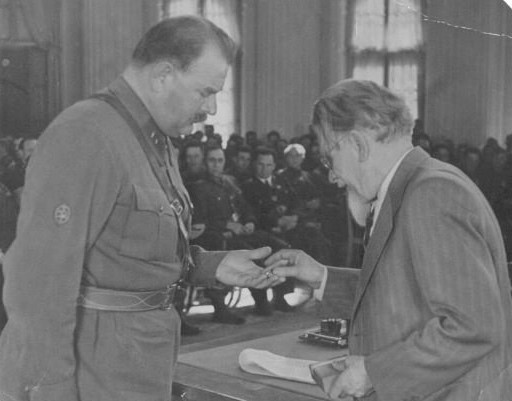
Stalin's half-brother Alexander Egnatashvili (right), receiving an award from Mikhail Kalinin
ZOYA
Nazi Germany attacked the Soviet Union in 1941. It advanced rapidly. At such a time, an 18-year-old Russian girl named Zoya joined a resistance organization and carried out sabotage acts against the Germans. Zoya's partisan organization besieged the village of Petrischevo, which was occupied by the Germans and used as a military base, on November 27, 1941. Zoya set fire to the buildings where German soldiers were staying. A Russian collaborator reported Zoya's location in exchange for a bottle of vodka. Zoya was captured. She was subjected to brutal torture to confess where her friends were hiding, but she did not utter a single word.
Having lost hope in Zoya, the Germans decided to execute her. On the morning of November 29, they hung a placard around Zoya's neck. It read "Responsible for Fires."
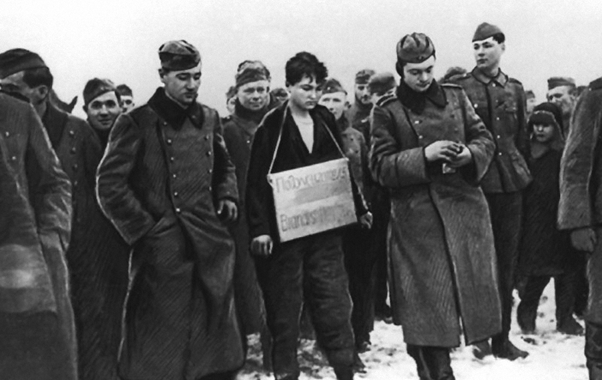
Zoya, being led to the gallows with a placard around her neck
The people, gathered on both sides of the road, watched Zoya being led to the gallows with fearful eyes. Zoya's execution scene was to be filmed and sent to Berlin. While the cameraman was preparing for the shoot, Zoya seized the opportunity and first addressed the crowd:
"Comrades, where are you? Why do you look so sad? I am not afraid of death. Dying for my people makes me happy."
Then she addressed the German soldiers:
"You are taking me to my execution, but do not forget that I am not alone. There are 200 million people like me. Do you think you can hang them all? My comrades will surely avenge me! Surrender before it's too late! Victory is ours."
Zoya's words were unknowingly recorded by the camera's audio.
Zoya was executed. Her body remained hanging on the rope for a month. Soldiers committed unspeakable atrocities on her swinging body. Finally, they buried Zoya in an unknown location.
A year later, the Russian army liberated the village of Petrischevo. The Russian who reported Zoya was punished. Zoya was declared a "Hero of the Soviet Union." The German cameraman died in a skirmish, and pictures of Zoya were found in his pocket. Moreover, his camera contained Zoya's address to the people and the Germans before her execution.
RODINA (MOTHERLAND)
Stalin visited a car factory. Coincidentally, the factory workers had also developed a new car model.
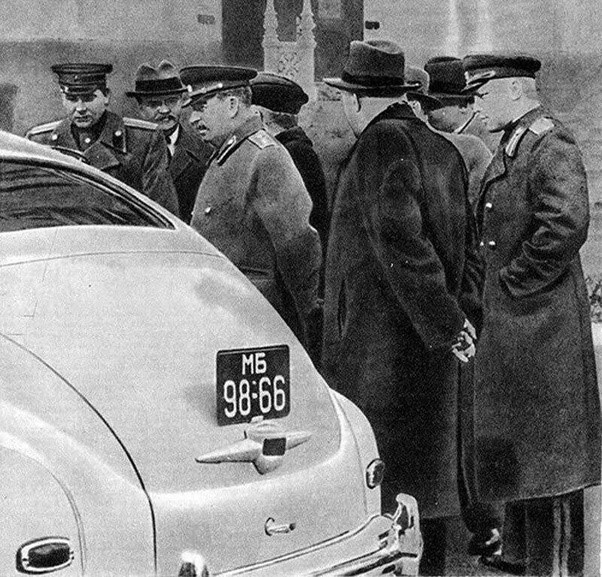
Stalin, visiting the car factory
Pleased by the news, Stalin asked:
"Comrades, I heard you've released a new model. Congratulations! What name do you plan to give the new model?"
"We've already found the name, Comrade Stalin. We will call this model RODINA (Motherland)."
Upon hearing this name, Stalin's facial features tensed, and he scowled. He took a deep puff from his pipe, his stern gaze lingering on the workers for a long time.
Stalin asked mockingly:
"Well, comrades, how many Rubles have you decided to sell the MOTHERLAND for?"
The workers, getting the message, immediately abandoned this name. The next day, they found a new name: POBEDA (VICTORY)
ASSASSINATION ATTEMPT ON LENIN
Lenin, the founding leader of the Soviet Union, was subjected to several assassination attempts throughout his life. The most well-known assassination attempt occurred on August 30, 1918. A revolutionary woman named Fanny Kaplan, affiliated with socialist-anarchist views, shot Lenin three times, severely wounding him. Two of the bullets hit Lenin. One lodged in his shoulder, the other in his lung. Although Lenin narrowly survived the attack, his health seriously deteriorated in later years, leading to his premature death in 1924.
Fanny Kaplan was executed three days after the assassination attempt, on September 3, 1918. Her body was placed in a barrel and set on fire. Thus, no trace of the assassin remained.
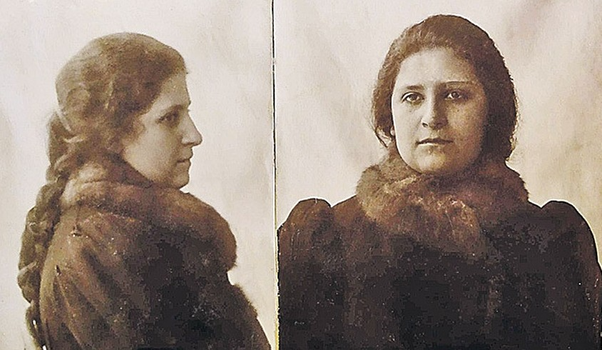
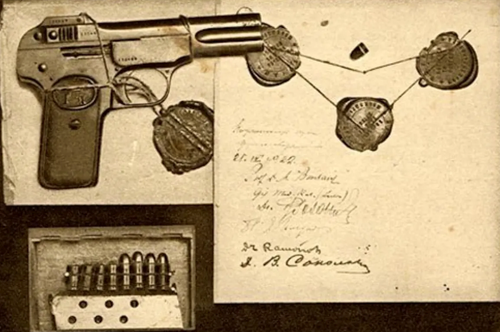
Fanny Kaplan, who attempted to assassinate Lenin, and the weapon she used
Kaplan confessed to attempting to assassinate Lenin, but the details of this event and Kaplan's true motivation have remained historically uncertain. Immediately after the incident, the Bolsheviks launched a widespread intimidation campaign to suppress the opposition, presenting the event as a conspiracy.
After Lenin's death, Stalin consolidated his power by using Lenin's legacy and adopting the ideology of "Leninism."
MATA HARI
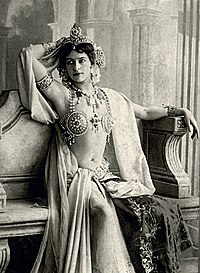
Mata Hari, whose real name was Margaretha Geertruida Zelle, was born on August 7, 1876, in Leeuwarden, Netherlands. She was arrested and executed by the French on suspicion of spying for Germany during World War I.
In her youth, Mata Hari lived in Indonesia, a Dutch colony, where she developed a special talent for dance. Upon her return, she became famous, especially in Paris, for her exotic dances. Thanks to her daring dance performances and romantic relationships, she became the most recognized and popular woman in high society.
World War I broke out. Espionage gained importance. Her access to high society made Mata Hari an ideal candidate for espionage. Some historians suggest that she might have been a double agent, working for both the Germans and the French; others claim that she was merely involved in a transactional relationship and was not actually an effective spy.
Mata Hari was arrested by the French in February 1917 and executed on October 15, 1917, on charges of espionage.
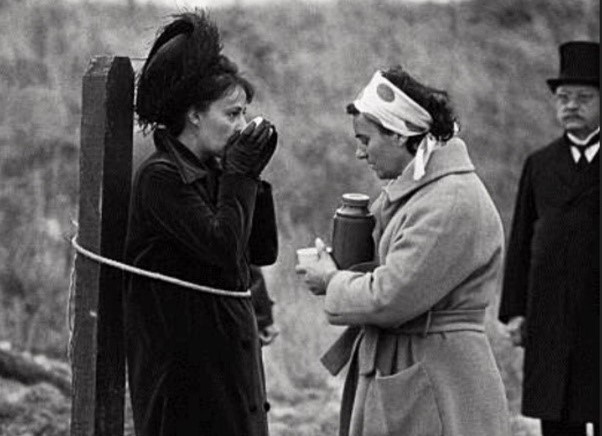
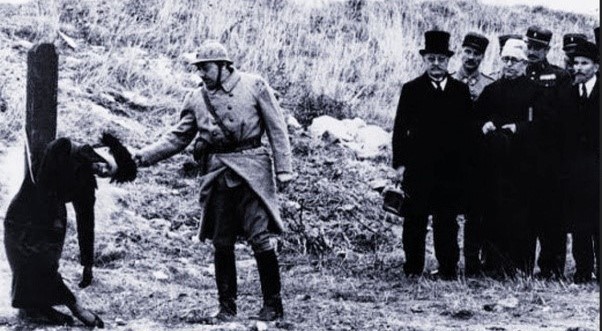
Images from Mata Hari's execution scene
On the morning of her execution, Mata Hari was taken from her cell to the prison courtyard. She bravely defied her executioners. She struggled not to be tied to the stake but failed. Her eyes were tightly covered with a handkerchief. Mata Hari found an opportunity and blew a kiss to the firing squad, as if mocking them. Shots were fired, and she died instantly.
NAZIS AND PHYSICALLY/MENTALLY DISABLED PEOPLE
Nazi ideology was built upon the idea of reviving a pure-blooded, perfect Aryan Race and dominating the world. They moved to eliminate "flawed" (!) individuals in society. In 1939, they mercilessly implemented a program known as "T4 Euthanasia / Aktion T4." The aim was to systematically kill and eliminate mentally and physically disabled people under the slogan "life unworthy of life." (The term "T4" refers to "Tiergartenstrasse 4," the street name in Berlin where the office that designed this program was located.)
According to the Nazis, disabled people were an "obstacle" to society and a threat to the genetics of the Aryan Race.
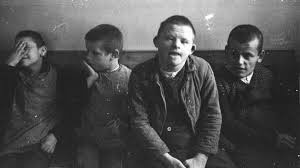
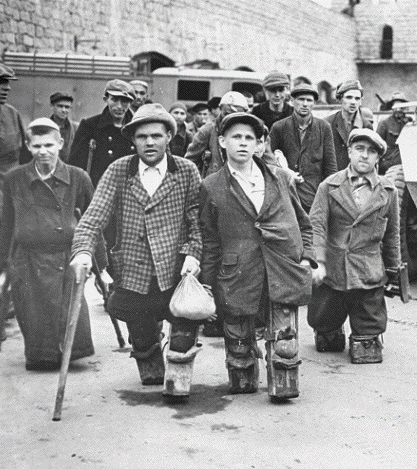
Physically and mentally disabled people being taken to a concentration camp
Collected disabled people were either taken to concentration camps, where they were locked in gas chambers and killed en masse, or eliminated by injecting poisonous needles, and sometimes by being left to starve. There were special doctors, nurses, and caregivers trained for this purpose. Of course, the doctors disregarded ethical responsibilities such as the Hippocratic Oath.
The program was first applied to disabled children. Lethal doses were injected, or the children were left to starve.
Later, disabled adults were also targeted. As the number of collected disabled people increased, the Nazis killed them with gas in concentration camps and then burned their bodies. The Nazis would soon apply the experience gained in this way to the Jews.
The Nazis mercilessly continued the program to eliminate disabled people between 1939 and 1941. However, over time, public reaction grew. The Catholic Bishop, as the voice of the opposition, delivered sermons. Thereupon, Hitler announced on August 18, 1941, that the program had been terminated. By then, 50,000 disabled people had been killed. However, the Nazis did not keep their word; they continued to secretly collect and systematically kill disabled people until the end of the war.
Hitler did not hesitate to send his disabled cousin to a death camp.
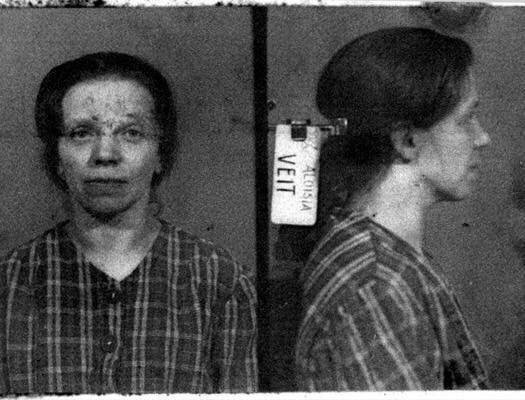
Hitler's disabled cousin