The Triumph of Will: Yusuf Akgün – Part 3
Yusuf Akgün recounts his struggle for existence in a disabled children's home, his escape attempts, and his journey to self-reliance and academic success despite his physical challenges.
MY STRUGGLE FOR EXISTENCE IN A DISABLED CHILDREN'S HOME
Being separated from my father, from Iğdır, and from my family instilled a feeling of rebellion in my heart. I was not sad about losing my arms, but about losing my father. Don't say, "What does a six-year-old child understand about separation?" As if my longing for my family wasn't enough, the Turkish language, which I spoke and understood with difficulty, stood before me as another obstacle. In short, my comfort, peace, and security had been taken away from me.
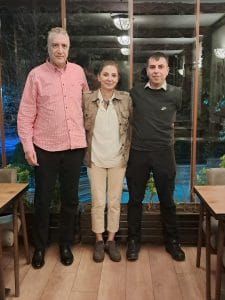
(From left to right) Mücahit Özden Hun, Şeval Hun, and Yusuf Akgün
I resisted the staff, screaming and crying, "Bavo! Bavo!" (Father! Father!). When they realized they would have difficulty controlling me, they caught me and locked me in a room. My ferocity did not subside; I continuously kicked the wall and the door, trying to harm myself. I rubbed my newly healing wounds against the wall, peeling and bleeding them.
I refused to eat. They were forced to try and feed me. Every bite placed in my mouth got stuck in my throat; I couldn't swallow. I was exhausted from crying and sorrow.
One day, when my soul had calmed and I had accepted my defeat, they took me to the rehabilitation section. In those years, disabled people were not classified according to their disability; everyone was put in the same room.
My astonishment grew when I entered the rehabilitation room. There were disabled children of all ages and types here. Some were mentally disabled. Their conditions were severe. They were tied at the waist with chains to limit their aggression. They were kept away from the wall. Otherwise, they would hit their heads against the wall at the first opportunity, harming themselves. The staff thought they had found a solution by chaining these children. They weren't wrong. There were no special sections for mentally disabled people. Seeing my disabled peers of this kind, I couldn't help but forget my own troubles and become frightened.
There was a strong odor in the room. Occasionally, they would take the children whose condition allowed it outside to air them out. I'll never forget it. The first time they took me to the garden, I attempted to escape. I ran towards the gate of the home, but they caught me before I could reach it. In my mind, my father was waiting for me on the other side of the gate, or at worst, I would find a way to go to Iğdır. They were forced to assign a staff member to guard me.
Time passed. While planning to find an opportunity to escape, I was also improving my Turkish.
TWO GOOD PEOPLE: TEACHER AYŞEGÜL AND TEACHER OSMAN
One day, a physiotherapist named Ayşegül came. She took a close interest in me. She wanted me to go to physical therapy in the physiotherapy department. I accepted. My goal was to find an opportunity to escape from there.
When I saw the physiotherapy department, my spirit lifted. It was a comfortable and spacious environment. The walls and tables were colorful. After so much trouble, my soul felt at peace, but I was still filled with the desire to escape and reunite with my family. The thought of gaining the trust of the staff and escaping was still in a corner of my mind.
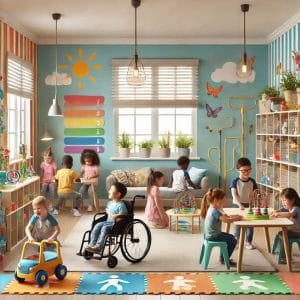
The physiotherapy department was colorful
I started to feel comfortable in the physiotherapy department. When the staff made tea, they would include me, trying to soothe my restless spirit. Teacher Osman would throw a basketball to me, and I would roll the ball on the ground using my body and half an arm, feeling happy. Sometimes Teacher Osman would form a basketball team with disabled children and include me among them. Teacher Osman would throw the ball to me, and even though I had no arms, I would somehow push the ball with my body and be a part of the game.
When the staff weren't around, I would lift weights and strengthen my remaining right arm. Sometimes I would exaggerate my workout pace so much that my armpit would bleed, but I would hide this from the staff.
One day, I muttered to myself: "If I have the strength to work with these weights, I can also dress myself."
From that day on, despite a thousand difficulties, I started to dress myself alone. With time, I began to learn to move independently.
When I was 4-5 years old, canals were being dug in the Karakuyu village pasture in Iğdır. It was hoped that these canals, which would carry water from the Aras River, would reclaim barren lands and open them up for agriculture. The village children would gather and watch the gigantic construction machines. What interested me most was the excavator. It could move huge buckets with support.

Machines digging an earth canal in Karakuyu pasture
Suddenly, I remembered this. I likened the spoon to a bucket. I learned to place the middle part of the spoon against the edge of the plate, fill the spoon using my half-arm, and bring it to my mouth. Being able to eat my own food further increased my self-confidence.
***
A year passed. One day, my father came to visit me. I realized a bitter truth: I felt that the love that bound us was worn out and our souls had drifted apart. It wasn't my father who had changed, but me. I was now looking at the world and events with different eyes. I was seven years old, but I carried an inner maturity in my heart as if I had lived for a hundred years. My father stood there, not knowing what to say, and left with a sad expression on his face and a feeling of helplessness. He strictly warned me:
"Kurê min, me ji bîr bike! Neyê Îdirê!" (My son, forget us! Don't come to Iğdır!)
***
In the home, there was constant struggle and rivalry among the children. The law of the jungle prevailed. The strong oppressed and dominated the weak. Regardless of my age, I did not bow down to anyone; I resisted. This rebelliousness and courage created discomfort among my rivals.
As I resisted injustices and protected my body, I also began to have a say in other matters. For example, I would refuse a meal I didn't want and complain about the situation to the staff.
One day, an unfortunate incident occurred for me:
There was a staff member named Teacher Kasım. We, the disabled children, were sitting on the floor in an "L" shape. Teacher Kasım was walking among us. He had a harsh approach towards the children. He would approach us, and under the pretext of caressing us, he would grab our cheeks roughly or pull our ears.
I decided to take revenge. I had learned to skillfully use my toes. I tightly tied the feet of my disabled peer sitting next to me with a sheet. The child fell when he tried to get up. He got angry. When Teacher Kasım approached the child, he hit Teacher Kasım with all his might.
A "DISABLED" CHILD AMONG NON-DISABLED CHILDREN
The administration held me responsible for all that had happened. They took me from the disabled section and placed me in the section for normal children. These children were orphans, abandoned children whose parents were absent or whose families could not afford to care for them. They had no physical disabilities. Difficult days had begun for me.
These children were fierce and cruel. Since they had no physical or mental disabilities, they could move as they pleased.
One day I fell into the water, and the right sleeve of my sweater got wet. While I was in this state, another child tried to push me into the water. Without giving him a chance, I quickly turned my body and swung the wet sweater sleeve at the child's face. The child screamed in pain. It was clear he was hurt. That day I learned something. I had no arms, but I could use the sleeves of my sweater, by wetting them and using my body, as if they were arms.
A different life now awaited me among these non-disabled children. While the children played marbles with their fingers, I would join them and be a part of the game using my toes.
A sewage line ran beneath the room we stayed in. One day, 3-4 friends and I got together, made a hole, and went down into the sewer. We traveled 2-3 km through the sewer. We were so caught up in the thrill of adventure that we didn't care about human waste or the smell. We had also found a solution to avoid losing our way back. We would place a soda bottle every three meters and tie them together with a string. This way, we would go outside, wander in the open air, and go all the way to Hasköy. This brief freedom caressed our souls and connected us to life.
***
One day, an event was to be held at the home. We had a cleaning supervisor named İsmail. While tidying up, he realized that 3-4 children were missing. They started searching. They discovered the hole leading to the sewer. They reported the situation to the gendarmerie. While we were running and having fun in the open air, the gendarmerie caught us. They brought us back to the home.
From that day on, I began to be treated as the "ringleader," because all these clever ideas came from me.
When the hole leading to the sewer was closed, we started chasing another adventure. There was a 2-3 meter gap between the balcony of our home and the hillside. We would find a way to climb the hillside, remove car tires, and slide down on them. Once, while sliding, I couldn't control my speed and hit my head against the wall. They took me to the hospital. After recovering, I returned to the home. This time, I was after a different adventure. We removed the cabinet door. We soaped the bottom to make it slippery and started sliding down the stairs with pleasure. Again, I hit my head against the wall and found myself in the hospital.
THE TRIUMPH OF HOLDING A PEN
When schools opened, we were sent as a group to Ayyıldız Primary School in Pursaklar. I was the only child with a physical disability among my peers. The teachers pitied me, saying, "Oh, poor thing! Both disabled and a home child." Some even couldn't hold back their tears. In the mornings, when the teacher entered the classroom, she would go around the desks one by one, saying, "Good morning, children!" When it was my turn, her eyes would well up. I was bothered by this feeling of pity. I had no arms, but I was just as talented and creative as the others. I had to prove it.
I listened carefully to the teacher and took my lessons seriously. I watched my classmates intently, observing how they held and used their pens.
One day, the teacher was going to give a multiple-choice test. Only the correct option was to be marked. As the teacher distributed the test papers, she inadvertently placed one in front of me. I held the pen with my mouth and began to mark the correct answers. At that moment, the entire class turned and looked at me in great astonishment. The teacher also stood by my head. I'll never forget that I answered all 25 questions correctly. I was the only student in the class to achieve this success.
Now that I could use a pen, I understood that a new life had begun for me. In my teacher's eyes, there was now a look of admiration instead of pity. I was happy about my triumph.
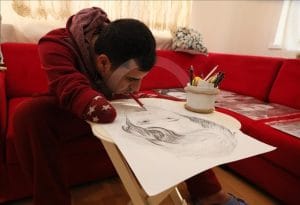
Yusuf Akgün, holding a pen with his mouth, works on a portrait
END OF PART THREE TO BE CONTINUED