The Triumph of Will: Yusuf Akgün – Part 2
This second part of Yusuf Akgün's story details his harrowing journey from an Erzurum hospital to his ancestral village, his father's desperate attempts to save him, and his eventual placement in an orphanage.
FROM ERZURUM TO ALİKÖÇEK VILLAGE
As my father and Uncle Şerif had agreed, they seized an opportune moment to spirit me away from the back door of Erzurum State Hospital and set off for Aliköçek (Alibey) village. It was a long journey… I was five years old, my arms burned, my body riddled with fractures, and they laid me on the back seat. The only thing I remember was seeing sometimes lights, sometimes clouds, from where I lay.
My father and uncle conversing, perhaps arguing, loudly in Kurdish, resonated through my motionless body like a buzzing sound. Every now and then, I would break the silence or interrupt their conversation by saying, “Bavo! Ez avê dixwazim!” (Father! I want water!).
Aliköçek is a village located 20-25 km from Iğdır city center, built on the side of a mountain. This place is actually both a village and a summer pasture. In the summer months, the villagers would not go to other pastures but grazed their animals in the meadows stretching towards the mountainside and the valleys we call “neval.” Some even set up their goat-hair tents here. My father and grandfather were born in this village. I don't know why, but in 1983, my father left Aliköçek village and settled in Karakuyu village, where the Gêloî tribe also lived.
My father had committed a crime by abducting me. The gendarmerie was after him. Knowing he was wanted everywhere, it was no longer possible for him to return to Karakuyu village. He hoped to find a hiding place among relatives in Aliköçek village.
The fear of the gendarmerie was so great that instead of keeping me in a house, they hid me in a tandoor shed, a place no one would think of. My pain was indescribably great and unbearable. According to what my Aunt Halime later told me, my screams were so loud and disturbing that those living in houses near the tandoor shed would visit distant relatives to avoid hearing my voice.
Because my arms were burned, a heavy odor constantly emanated from my body. Relatives who came to see me would cover their faces, bothered by the smell, approach cautiously, and look at me with pity. I have hated the feeling of "pity" ever since that day.
Relatives tried to persuade my father: "This child cannot live. Let's give him an injection to put him to sleep (kill him). You'll be free, and the child will be free from this pain!"
They brought the injection twice, but they couldn't convince my father. They waited for me to die, but my body and soul resisted; I didn't want to die.
My father would secretly go down to the city (Iğdır) from time to time, get tincture of iodine, cream, and gauze from a relative working at Iğdır State Hospital, and return to the village. My father was trying to treat me with his own strength. In fact, no one else but my father could endure the heavy odor emanating from my body and approach me.
My father was crushed under a heavy psychological burden. His financial resources were depleted. He had no one to lean on. He wandered around, not knowing what to do, tormented by remorse and guilt.
There were white maggots on my wounds. No matter how hard my father tried, he couldn't prevent them from multiplying. I could barely lift my head and quickly glance around. My body and limbs were not moving.
I don't remember how long I stayed in this state. One day, I had a strange dream. In my dream, I was lying at a three-way intersection leading to Aliköçek village. Three or four old men in white clothes approached me. One sat to my right, one to my left. Another sat at my head, placing a bowl full of sugar on my chest. I had arms. I was happy.
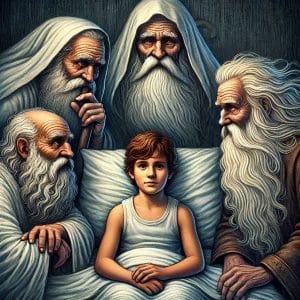
Yusuf sees old men with white beards and radiant faces in his dream
The next day, I told my dream to my father. His eyes filled with hope.
A few days passed. I could now turn from side to side. One day, alone in the tandoor shed, I decided to get rid of my burned arms. My left arm was completely burned. I don't remember how I did it, but I tore off my left arm. My right arm was burned up to above the elbow. This time, I tried with all my might to tear off the burned part of my right arm. Turning to my right, I put my body weight on my right arm and pushed with all my strength. I heard a bone snap. I separated my right arm from my body from the elbow upwards. The bones protruding from the fracture were visible.
At that moment, my Aunt Halime came into the tandoor shed. When she saw what I had done, she screamed and fainted.
It was a sunny day. There was a wooden pole in the garden. My mother spread a bed next to the pole, and they laid me there. Interestingly, I realized I could move my body and feet. Every now and then, I would try to sit up, rolling from side to side. As my wounds healed, I began to regain strength. I was filled with a longing to walk, to run. I remembered the days when we chased the tractor with the village children, and I wanted to return to those days. Sometimes I would stand up by leaning my back against the pole, trying to take steps. It was as if I was learning to walk again.
A few months passed. I could walk now. The joy of being able to walk made me forget, in a way, the absence of my arms.
When the gendarmerie caught my father, they took me to court. I had just turned six. I could express myself in Kurdish, for better or worse. They were going to bring me before the judge. My relatives strictly warned me to say, "I have no complaint against my father."
The judge was moved when he saw my father, standing dejectedly before him, and the six-year-old child with no arms. My statement was taken. It was translated into Turkish. The judge advised my father:
"It's not possible for you to care for this child. Our state has institutions for this. You should apply there."
My father was acquitted. His first task was to gather information about these institutions. Friends who knew about the matter told him, "You must go to Ankara. You can solve this problem there," so my father decided to go to Ankara.
In later years, my father recounted: As the bus traveled between Iğdır and Erzurum, an armed group stopped the bus. They made propaganda. They even tried to forcibly collect money under the guise of donations. My father had a sum of money he had borrowed from here and there with great difficulty. They wanted to seize it. My father was already in a psychological breakdown. He was fed up with life, angry at life and everything. He stood up angrily, grabbed the armed young man by the collar, and cursed him. They were going to take my father out of the bus and shoot him. There was an Iğdır native among them. He knew my father and the family. He explained the situation to his friends, and they didn't touch my father.
It was the summer of 1991. My father went to Ankara. He didn't know his way around. He went back and forth. He got no results. He succumbed to a feeling of helplessness and fell into depression. As a lesson, he decided to end his life. He tried to set himself on fire in front of Çankaya Köşkü (the Presidential Palace). They intervened.
Mesut Yılmaz was the Prime Minister. Mrs. Berna Yılmaz, the Prime Minister's wife, learned about what had happened. She assigned Mr. Adil Aşırım from Iğdır to take care of my father.
My father returned to Iğdır. We were going to Ankara. I needed to learn Turkish. My father sent me to my Aunt Halime. The spirit of adventure and curiosity in me was rekindled. I played in the garden with my aunt's son, Emrah, trying to speak Turkish. There was a three-wheeled vendor's cart next to the garden wall. Using the small piece of my right arm that remained, I climbed the wall with great difficulty. From there, I threw myself onto the vendor's cart. The people in the house ran out in fear.
SEPARATION FROM FAMILY
One day, my father and I set off for Ankara. We went to Mr. Adil Aşırım's office. I remember it as if it were today: My father was chatting with Mr. Adil, and I was intently watching Mr. Adil's gold-plated watch spinning on his wrist. Mr. Adil would quickly shake his arm every now and then, adjusting his inverted watch. When we went outside, I told my father what I had seen. My father's face was constantly grim and tense... I thought I was telling something funny, but my father wasn't even hearing what I was saying…
They decided to place me in the Pursaklar Saray Children's Home, affiliated with the Child Protection Agency, located on the Esenboğa road. Of course, I had no idea about this. My father and I went to the children's home. They greeted us. One of the staff at the reception approached and stroked my head. This was not a stroke of affection, but a stroke of farewell. I felt it. As a six-year-old child with no arms, my father was everything to me. I existed with him. I couldn't imagine a life without him. The possibility of others taking ownership of me filled my heart with dread.
A nurse came. She took me to a room. She dressed my armpit. I came back to my father. At one point, my father turned to me and said, "You wait here, I'll go get you some chocolate." There was a message of farewell in my father's gaze and words. When my father opened the door and left, a fear pierced my heart: what if my father didn't come back? While struggling with this fear, I was also recording everything I saw in my memory. Supposedly, I would tell my mother all about it when we returned to Iğdır.
They took me to a room. I was waiting for my father to return. 4-5 minutes passed, but my father was nowhere to be seen. I pushed the infirmary door open with my right shoulder. In front of me were two corridors opening to the right and left. I questioned myself, wondering which corridor my father had taken. I turned left. I started running quickly down the corridor. It was as if I was going to catch my father and return to Iğdır with him. The staff caught me. I was crying and shouting in Kurdish in the corridor:
“Bavo, bavo. Tu li ku yî?” (Father, father. Where are you?)
(NOTE: I extend my endless thanks and gratitude to my esteemed fellow citizen, Mr. Adil Aşırım, who extended a helping hand to Yusuf Akgün in his most difficult days. Mücahit)
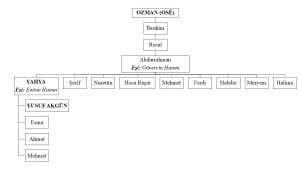
Yusuf Akgün's family tree
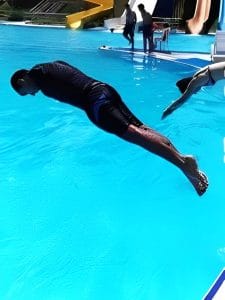
Our national swimmer Yusuf Akgün diving
END OF PART TWO. TO BE CONTINUED