Two Paths, One Goal: Missionaries and Dervishes
This essay explores the parallels and differences between Christian missionaries and colonizing dervishes in Turkish and Kurdish history, highlighting their shared goal of societal transformation despite their distinct methods and allegiances.

Dear Readers:
In recent years, a concept has frequently circulated in Turkey: the fear of missionary activity. Whenever this word appears on television, in columns, or on social media, a sense of unease emerges on people's faces. It's as if the missionary is perceived as a "bogeyman" carrying a Bible, going door-to-door, and trying to detach people from their faith. This fear has grown so much that it is now associated not only with religious conversion but also with cultural invasion.
But let's pause and consider: Didn't we have a similar figure in our history, in our lands? Of course, we did. In our history, there was another figure who carried faith, lived closely with the people, and transformed society: the colonizing dervishes.
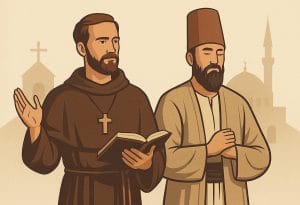
Missionary and dervish
I am writing this article precisely to remind us of this forgotten balance. What we call missionary activity is not just a Western concept. We also had people who walked similar paths in shaping religion, culture, and society. There are both similarities and differences between the Christian missionary and the Turkish and Kurdish dervish. But first, being able to acknowledge this similarity requires looking at the past with a more open mind.
MISSIONARIES
History is not written solely by wars, sultans, or generals. Sometimes, a small dervish lodge established in a village, a monastery opened on a mountaintop, or a dervish or missionary teaching a child to read and write can change the course of history.
Today, I want to introduce you to two figures from history whose impact was immense but who are not widely known: Christian missionaries and colonizing Turkish dervishes.
One comes from the West, the other from the East. One carries the Bible, the other the breath of Sufism. Although their goals may seem different, their intention is actually the same: to change people, to transform hearts, to establish a faith and a way of life.
Christian missionary activity is a very old tradition. This movement, which began with the disciples of Jesus Christ, quickly spread from Rome to the interior of Europe. Over centuries, orders like the Jesuits and Franciscans set out to carry Christianity to other continents. In Africa, America, and Asia, they established schools and opened hospitals. While spreading their religion, they also brought their own cultures with them.
But here we must pause and ask: Was missionary activity merely about spreading faith, or was it a form of cultural pressure, sometimes even the soft face of colonialism?
In many instances, we see that the missionary was the first person to disembark from the ship. Maps followed, then traders, then military units. In other words, the missionary often served as the vanguard of an empire.
DERVISHES
Now let's turn to us, to Anatolia. From the 11th century onwards, after the Battle of Manzikert, Turks poured into Anatolia. These migrations included not only warriors but also dervishes. Most of these dervishes, coming from the Yesevi tradition, entered Anatolia with Sufism, morality, and spiritual discourse. They carried words, not swords.
Hacı Bektaş-ı Veli, Sarı Saltuk, Geyikli Baba, Abdal Musa… These were not just people who preached religion. They were carriers of culture, founders of society, and even the breath that infused the spirit of the state.

Hacı Bektaş-ı Veli
Through the Ahi organization and Bektashi lodges, they established order in Anatolia, organized tradesmen, and promoted mutual aid. Without these dervishes, perhaps even the foundation of the Ottoman Empire could not have been laid.
Look, even the Janissary Corps was affiliated with the Bektashi order. The spiritual leader of a military institution was a dervish. This is something rarely seen in the world.
So, dervishes were not civil servants of an empire; they were the ground that caused that empire to emerge.
Missionaries were in the service of a state. Dervishes, on the other hand, leavened the soil that would give birth to a state.
BEING A DERVISH IN KURDISTAN
Dervishes were as influential in Kurdistan as they were in Anatolia. They not only spread faith but also gained spiritual authority within the tribal structure. In some places, they even became more influential than tribal chiefs.
The most widespread Sufi orders among Kurds were Naqshbandiyya and Qadiriyya. Figures such as Sheikh Ubeydullah Nehri, Sheikh Said, and Sheikh Mahmud Barzanji were known not only for their dervishhood but also for their power to organize the people. These individuals were both religious and political leaders. In difficult times, the Kurdish people often listened more to the sheikh of a lodge than to a tribal chief.
Even today, some shrines in Kurdish mountain villages are still visited. Some sheikh families still have great influence over the people. This is because the dervish there is not just someone who prays, but also a mediator, teacher, healer, and guide.
DERVISHHOOD WITH THE PEN: EHMEDÊ XANÎ
One of the greatest literary and intellectual figures of the Kurdish people, Ehmedê Xanî (1650–1707), was also a dervish. He was affiliated with the Qadiriyya order. His most famous work, Mem û Zîn, is both a love story, a nationalist awakening text, and a thoroughly Sufi text.
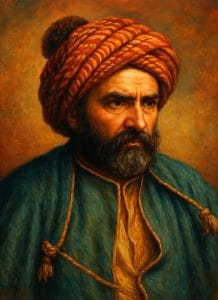
Ehmedê Xanî
Mem is the lover searching for divine beauty. Zîn is divine beauty itself. And this love, though it appears worldly, is actually a symbol of spiritual ascent.
Xanî's deep Islamic knowledge, Sufi language, and commitment to Kurdish identity make him not just a poet, but a dervish-revolutionary.
SIMILAR PATHS, DIFFERENT INTENTIONS
When we compare missionaries and dervishes, we see many similarities:
- Both live closely with the local people.
- Both establish structures such as schools, lodges, and monasteries.
- Both engage with the people in areas of health, education, and morality.
- Both try to transform society by winning hearts.
But their paths diverge here.
The missionary is usually in the service of an empire.
The dervish, on the other hand, often acts without a state, or even despite the state.
The missionary goes by command, the dervish comes uninvited.
And perhaps for this reason, a community forms around the dervish, then a city, then a state.
CONCLUSION
History is written not by great wars, but by silent transformations.
Missionaries and dervishes belonged to different faiths, but they walked similar paths. Both tried to win hearts. Both guided societies.
But let's not forget:
Missionaries worked on behalf of the state.
Dervishes gave birth to the state.
And perhaps for this reason, one remained in the footnotes of history; the other continued to live in the prayers of a people.
In conclusion, if we can look at our own dervishes with admiration, there is no need for us to shy away from someone else's missionary with blind fear.