Hêvîya Derve: Opportunity and Defeat in Kurdish History
This essay explores the recurring cycle of hope and defeat in Kurdish history, arguing that reliance on external powers has consistently led to disappointment and strategic missteps.

- Dear Readers,
For over a century, the Kurdish people have strived to preserve their identity and build their future amidst powers that have fragmented their geography. Yet, every major upheaval they have faced throughout history has restarted the same cycle for the Kurds: a hope emerged, an opportunity arose, but it always ended in disappointment. Hêvîya derve, meaning hope tied to external forces, has become a chronic syndrome of Kurdish politics. Along the line stretching from Koçgiri to Mahabad, from Mount Ararat to Rojava, relying on the promises of external powers instead of generating solutions from their own internal dynamics has once again postponed this people's destiny. This article was written to question this dramatic oscillation between opportunity and defeat in Kurdish history.
KOÇGİRİ AND THE MISSED HISTORICAL ALLIANCE
In late 1919, Anatolia was under occupation. In Istanbul, the Sultan was still on the throne, but his rule had effectively ended. Izmir had been handed over to the Greeks through the French; cities like Adana, Maraş, and Urfa were under British and French occupation. The Turkish people faced the deadliest threat of extinction in their history. It was precisely during such a period that a new will for liberation began to sprout in Anatolia: under the leadership of Mustafa Kemal Pasha, the spirit of popular resistance was being organized through the Erzurum and Sivas Congresses.
However, during the same period, a different path was being chosen in the Koçgiri region, part of Sivas province. Believing that breaking away from the Ottoman Empire was an opportunity, the Alevi Kurdish tribes in Koçgiri acted with the goal of independence. This rebellion erupted precisely at a time when the Turkish army was fighting a life-and-death struggle on the eastern and western fronts. The rebellion not only distracted the new government in Ankara but also revealed how fragmented and fragile the Kurds' quest for national unity was.
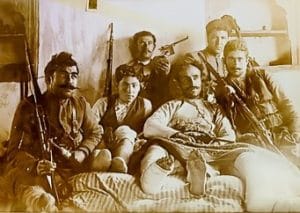
Koçgiri Rebellion fighters
Yet, in the same years, the Kurdistan Teali Cemiyeti (Society for the Advancement of Kurdistan), established in Istanbul, was one of the most organized and conscious initiatives in Kurdish political history. This society claimed to transform Kurdish identity into a political project in the modern sense. If this society had chosen to participate in the War of Independence movement in Anatolia with a Kurdish identity, instead of negotiating with imperial powers at the table in Paris, a historical brotherhood agreement could have been built between Turks and Kurds. Moreover, Mustafa Kemal Pasha had opened the door to this unity by inviting many Kurdish sheikhs, aghas, and tribal representatives to the Erzurum and Sivas congresses. However, the leading figures of the society believed that Kurdistan could be established as part of a colonial project; they entrusted their fate to the Paris Peace Conference.
The Koçgiri rebellion was also an extension of this flawed strategy. The Kurdish intellectuals and leaders who supported the rebellion sabotaged the process with a move from behind at the most fragile period of a national resistance. This rebellion created deep distrust towards Kurds among the founding cadres of the Republic of Turkey. Unfortunately, this distrust laid the groundwork for the Republican regime's refusal to recognize Kurds as an ethnic community and for the policies of denial and assimilation in the years that followed.
However, with correct timing and strategy, the Kurdish people could have been recognized as a nation, and Turks and Kurds could have built a new state together as equal founding peoples in this geography. This opportunity was missed. Instead, "hêvîya derve," or hope tied to external forces; expectations placed on the tables in Paris, meetings in London, and Wilson's Principles took its place. That hope, however, left the Kurdish people alone in every period of history.
SHEIKH MAHMUD BARZANJI AND THE SHORT-LIVED KINGDOM OF KURDISTAN: AN ANATOMY OF AN ILLUSION
As the map of the Middle East was redrawn after World War I, the doors of history seemed to open for the Kurdish people. With the dissolution of the Ottoman Empire, the Kurds had never been so close to the dream of establishing a modern nation-state. During this period, the British occupied the Mosul Vilayet and began to develop pragmatic relations with local leaders to keep the Kurdish tribes in the region under control.
In this context, the British first appointed Sheikh Mahmud Barzanji, who had a strong influence in the region centered in Sulaymaniyah, as governor. The aim was to control the Kurds in the region under their supervision, with an indirect governance model. However, Sheikh Mahmud realized that the British intended to permanently occupy the region and would not recognize the right of the Kurdish people to self-determination. Moreover, he believed that the political vacuum created after the Ottoman Empire was a historical opportunity for the Kurds. Therefore, in 1922, he declared the Kingdom of Kurdistan.
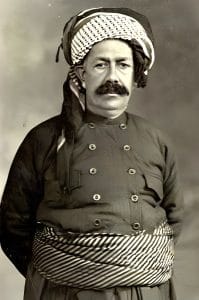
Sheikh Mahmud Barzanji
However, this move openly contradicted British imperial interests. For them, Sheikh Mahmud had become a threat rather than a partner. Immediately after the declaration of the kingdom, the British dispersed this autonomous structure with a harsh intervention and sent Sheikh Mahmud into exile. Although he organized rebellions again until the early 1930s, these efforts did not achieve lasting success.
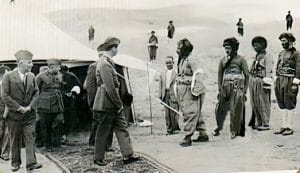
Sheikh Mahmud Barzanji visiting the British Military Headquarters in Sulaymaniyah (1919)
Sheikh Mahmud's experience was another version of "hêvîya derve." The British first supported him and then withdrew that support for their own interests, once again revealing the Kurds' position in the eyes of imperial powers. Although Sheikh Mahmud's kingdom held symbolic significance in Kurdish history, it could not sustain its existence as a structure based on external support, lacking internal legitimacy and institutional foundation.
This example once again brought to light the fundamental dilemma of Kurdish politics: the fate of movements that relied on external support but could not establish sufficient institutional power and national unity internally was always the same: defeat. Moreover, such failures deepened the sense of hopelessness and fragmentation within the Kurdish people. Sheikh Mahmud's kingdom was an "opportunity," yes – but it was also a striking example of "defeat" that showed how fragile a ground external dynamics offered.
SHEIKH SAID REBELLION AND THE HOPE LOST IN THE SHADOW OF MOSUL
The proclamation of the Republic meant not only a change of regime but also the molding of Anatolia's multi-ethnic, multi-identity structure into a "nation-state" framework. Following the Koçgiri Rebellion and the failed diplomatic games played by the Kurdistan Teali Cemiyeti with external powers, the founding cadres in Ankara turned to another strategy regarding the Kurds: denial and assimilation.
Mustafa Kemal's calls for "brotherhood" to Kurdish tribal leaders during the Erzurum and Sivas Congresses between 1919 and 1921 went unanswered due to the externally supported and fragmented nature of Kurdish nationalism at the time. The Kurdistan Teali Cemiyeti, instead of developing a mass movement based on popular support, had pinned its hopes on the Paris Conference and the British-French tables. This wrong strategy had proven to Mustafa Kemal that the Kurds were an unreliable and fragmented force. Therefore, with the proclamation of the Republic, the vague promises made lost all their binding force. Because there was no strong and institutional Kurdish interlocutor to remind them of these promises.
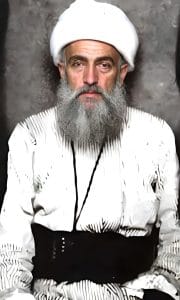
Sheikh Said
In the early years of the Republic, Kurds began to see that the promises made to them were not kept, and that the new administration was turning towards a policy of denial. This situation created deep resentment, especially among the aghas, beys, and sheikhs who had supported Ankara during the war. However, this discontent could not turn into an organized objection; because the Kurdish movement still lacked ideological and political unity.
Meanwhile, a much bigger issue was at the door for Turkey: the Mosul Question. Mosul, considered a province in the late Ottoman period, was accepted within the borders of Misak-ı Millî (National Pact). Mustafa Kemal, the founding leader of the Republic, was determined to incorporate Mosul into the new Turkey. However, these lands were now under British protection, and the British had no intention of withdrawing.
The British were arming Kurdish tribes around Mosul against a possible Turkish military intervention, positioning them as a buffer force against Turkey. This situation created great hope among some Kurdish circles within Turkey – especially in the Azadî organization led by Cibranlı Halit Bey. The idea that "if the Turks attack Mosul, the British will support the Kurds in return" spread rapidly. Secret communications, intelligence traffic, and meetings intensified. Azadî regarded this possibility as a "historical opportunity" and was preparing for a comprehensive Kurdish rebellion.
However, when Cibranlı Halit Bey was captured in Erzurum on December 20, 1924, and transferred to Bitlis, the Azadî organization suffered a heavy blow. After Halit Bey, who was executed by firing squad in Bitlis on April 14, 1925, the organization largely disintegrated. When Cibranlı Halit Bey was captured, his brother-in-law, Sheikh Said, came to the fore. He had now become the new leader of the Kurds.
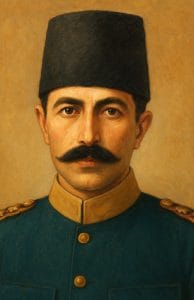
Cibranlı Halit Bey
The Sheikh Said Rebellion, starting from the Bingöl–Genç region in February 1925, quickly spread. However, due to weak military preparation and limited popular support, the movement was suppressed within a month. During the days the rebellion was ongoing, the British had further consolidated their dominance over Mosul. Turkey, on the other hand, was facing the rebellion internally and a power like Britain externally. While dealing with the rebellion, Mosul was lost.
The Republic of Turkey no longer had the power to actually take Mosul. Under diplomatic pressure, Mosul was officially ceded to Iraq (to the British) with the 1926 Ankara Agreement. This was not only a loss of territory but also a new historical disappointment for the Kurds. Because the British had not kept any of the hints and promises they had made before the rebellion, nor had they offered Sheikh Said the slightest logistical support. The Kurds had once again become useful pawns in imperial calculations.
This tragedy revealed one of the most fundamental dilemmas of Kurdish political history: disorganization, externally dependent expectations, and strategic blindness. Every civil war or geopolitical crisis was perceived as an "opportunity" for the Kurds; but these opportunities were always evaluated with the wrong actors, at the wrong times, and with the wrong tools.
MOUNT ARARAT REBELLION: KURDS IN AN IMPERIAL CHESS GAME
By the late 1920s, Kurdish national demands remained unanswered. The suppression of the Sheikh Said Rebellion, exiles, and executions had once again pushed the Kurds out of history. But this silence did not last long. This time the stage was Mount Ararat. However, the powers behind the curtain were no longer just the Republican regime in Ankara or regional Kurdish tribes. The big game was more complex. It smelled of oil.
Baku oil was a force that determined the fate of the world at the beginning of the twentieth century. During World War I, Germany persuaded the Ottoman Empire to undertake the Eastern Campaign to meet its oil needs, but the result was a disaster: 60,000 Ottoman soldiers froze to death in Sarıkamış. This tragedy was the first major strategic mistake made to reach oil. Britain did not want to repeat this mistake. This time, a more subtle, more covert intervention was needed.
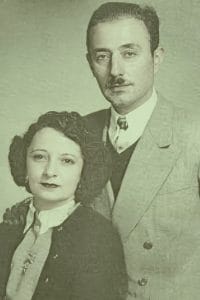
İhsan Nuri Pasha and his wife Yaşar Hanım
While the British kept Mosul under their control, they were looking for a passage extending to the Caucasus. A buffer state would both prevent the Soviets from pushing south and expand their sphere of influence over Iran. In this context, a Kurdish state to be established around Mount Ararat seemed compatible with British regional interests. As a result of this strategic thinking, the Xoybûn (Khoyboun) Society was founded in 1927. This organization, formed by bringing together Kurdish and Armenian intellectuals in Beirut, united two peoples who had previously been enemies in war around a common goal. This alone was an indicator of "a new engineering."
The rebellion was launched. From 1927 onwards, armed forces organized on the slopes of Mount Ararat put up serious resistance, especially under the command of İhsan Nuri Pasha. The Armenians provided both financial support and diplomatic ground for this movement. The goal was clear: an independent Kurdistan state would be established, and this state would serve Britain's interests in the Caucasus. However, this move only considered one corner of the imperial chess game.
Baku oil was vital not only for Britain but also for the Soviet Union. The Soviets realized this threat early by developing close relations with Turkey. They shared information and support directly with the Ankara government. Similarly, Iran, seeing that a Kurdish state would inspire millions of Kurds within its borders, took a firm stance against this project. Thus, by 1930, the Turkey-Soviet-Iran tripartite agreement surrounded and suppressed the Ağrı Rebellion.
The Kurds were once again pushed into a position where they could not determine their own destiny. This movement, launched with external support and the strategy of an external mind, lacked social legitimacy, economic foundation, and institutional structure internally. This rebellion, which held the mountains for a while with warrior courage, began to disintegrate rapidly when left alone in the international equation. In the summer of 1930, Mount Ararat fell silent.
But memory did not fall silent. The Kurds had once again believed in the promise of an external power, but in the end, they bequeathed the pain of defeat to their own generations. The Mount Ararat Rebellion, like Sheikh Mahmud Barzanji's Kingdom, like Sheikh Said; took its place in the Kurdish national memory as both hope and defeat. And this historical cycle brought back the simple question:
"A demand for freedom not based on one's own strength, behind which mountain can it flourish?"
MAHABAD KURDISH REPUBLIC: HISTORY REPEATED ITSELF ONCE AGAIN
When World War II ended, a historical turning point was reached where the world was being rebuilt. Germany and Japan were defeated, Britain was exhausted, France was broken. The Soviet Union, having shouldered the burden of victory, emerged as a new superpower. It was in this conjuncture that the old wounds of the Middle East began to bleed again. A great political vacuum had formed in Iran. The Allies, especially, had occupied Northern Iran, and the Soviets had used these occupied areas as both military bases and spheres of influence. And once again, the Kurds appeared on the scene.
This time, the center of the movement was Mahabad. This city, predominantly inhabited by Sunni Kurmanji and Sorani Kurds, became the capital of the Mahabad Kurdish Republic at the beginning of 1946. This republic, established under the leadership of Qazi Muhammad, had a constitution, a flag, a parliament, and a regular army for the first time in Kurdish history. Mahabad was the most organized example of the modern political experience of the Kurds.
However, the power that made this dream possible was again external support: the Soviet Union. Stalin's regional calculations were based on pressuring Tehran with friendly regimes to be established in northern Iran, extracting oil concessions from Iran, and limiting Britain in the south. The Mahabad Republic was a temporary tool of this strategy.
Indeed, history followed its familiar course. The Soviets withdrew their support from Mahabad when they obtained the desired oil concessions in negotiations with Iran. The Tehran regime seized this vacuum as an opportunity. Soon, the army was sent in, and the republic was overthrown. Qazi Muhammad and his friends were executed. Gallows were erected in Mahabad Square. The flag was lowered, the parliament was dissolved.
And history was rewritten: the Kurds were once again used as pawns on the chessboard of great powers, and then abandoned. The same scenario was replayed, this time in a different geography, with a different actor. Neither the grandeur of the mountain, nor the existence of the constitution, nor the excitement of the people had been enough. Because destiny was once again drawn by someone else's hand.
The Mahabad Republic remained the name of an ideal in Kurdish history. But at the same time, it became a symbol of the bitter reality of history: states established with external support are destroyed by external decisions.
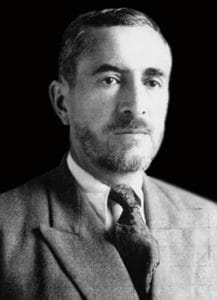
Qazi Muhammad
Qazi Muhammad, who became the head of the Republic, was not only a political leader but also a man of conviction deeply dedicated to the freedom of the Kurdish people. He identified his own existence with the survival of Kurdistan. That is why when the state collapsed, he felt that he too had collapsed. He could have fled, but he did not. He surrendered. Without compromising his stance, he was willing to pay the price for the values he believed in. The Iranian central government captured him and executed him in Mahabad on March 31, 1947.
Qazi Muhammad's story is the most striking example in Kurdish history of how idealism can take a tragic turn when hope is placed in external powers. He never abandoned his people, but the international actors he defended his people against easily abandoned him. The Soviets withdrew from the region after obtaining the oil concessions they demanded from Iran. The Mahabad Kurdish Republic was left to its own devices. This dramatic isolation historically demonstrated how risky it is for Kurdish political movements to rely too heavily on external powers.
THE SUB-CONTRACTOR OF IMPERIAL STRATEGY: THE FOUNDING STORY OF THE PKK
The example of the PKK is also a modern reflection of the tendency to rely on external powers in Kurdish history. This structure, which began to take shape in the 1970s, was particularly nurtured by Syrian intelligence (El Muhaberat) after the 1980 coup, and the organization's leadership operated under the protection of Damascus for many years. Abdullah Öcalan resided in the Bekaa Valley in Lebanon, in camps controlled by Syria, and the military and ideological structure was shaped in this region. However, when Syria withdrew this support in 1998 due to Turkey's determined pressure, Öcalan was soon left alone; he sought asylum in countries such as Russia, Greece, and Italy, respectively, and was finally captured in Kenya and handed over to Turkey.
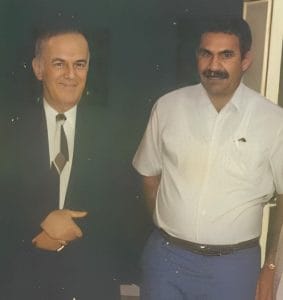
PKK leader Abdullah Öcalan with Syrian Intelligence Chief Cemil Esat
This event clearly revealed the organization's dependence on external support and its political fragility. Apart from Syria, Iran also provided tactical and limited support to the PKK at certain times, using the organization as a bargaining chip in its tensions with Turkey. Some circles within the European Union, using arguments such as human rights and freedom of expression, created a ground that protected the organization, if not directly, then indirectly. The US, especially within the framework of operational needs in Iraq and Syria, entered the same cycle by providing arms and logistical support to structures organically linked to the PKK. The support of all these external actors is conjunctural; it does not involve a permanent political solution or a project based on peoples. Therefore, the PKK's presence on the stage of history appears to be an imperial tool positioned in line with the interests of regional and global powers, rather than an independent popular will. This situation has been a unsustainable, fragile, and tragic path for the Kurdish people.
SYRIAN KURDS: A NEW ACT OF REPEATED DELUSION
The historical cycle, seen repeatedly in similar scenes throughout the twentieth century, once again emerged in Syrian territory. The civil war that erupted in 2011 created a political vacuum in many regions of Syria as the Assad regime lost control across the country. This vacuum seemed like a historical opportunity for the Syrian Kurds, who had been treated as second-class citizens and systematically denationalized for many years.
Indeed, self-governing regions were quickly established in Rojava, and military and civilian structures were built. The Kurds gained influence not only in their own regions but also, over time, in areas with Arab and Syriac populations. At one point, armed Kurdish forces comprised over a hundred thousand fighters and played a decisive role on the ground against ISIS with the direct support of US and European forces. Towards the end of the Syrian civil war, many elements such as military power, diplomatic support, and local legitimacy were in the hands of the Kurds. A historical moment had been seized.
However, history once again proceeded with a familiar script. The Kurds chose to use these powers not to establish a joint democratic regime with local peoples, but in line with the demands of the external powers providing support. The doors to Damascus were open. It was possible to establish a new central government together with Arabs, Druze, Alawites, and other peoples, and to have a say in the future of Syria. But this path was not taken. The strategic interests of the US and its Western allies determined the course of the Kurdish movement. Silence was turned into strategy. The policy of waiting resulted in the opportunity being missed right before their eyes.
Finally, the scene changed again. The Arab opposition approached Damascus, gaining control in some regions. The Kurds, on the other hand, were reduced to the position of an insurgent force trying to stand against the central government. Hopes fueled by words of federation, autonomy, and even independence gave way to political isolation as Western states completed their mission and withdrew from the scene.
This picture once again revealed a bitter continuity in Kurdish history: the end of every structure built with external support begins on the day that support is withdrawn.
The Syrian Kurds repeated what happened a hundred years ago on Mount Ararat, in Mahabad, in Sulaymaniyah. Instead of building a common future with the peoples living alongside them, they pursued a fragile dream based on the interests of external actors. And this dream, once again, turned into a great disappointment.
FINAL WORD: TO THE FUTURE WITH THE BURDEN OF MEMORY
History sometimes offers a compass for a people to confront their own pains, and sometimes to prevent the repetition of the same mistakes. Every "moment of opportunity" experienced by the Kurdish people in modern history has also been the beginning of a great "defeat." Whenever a hope emerged, this hope was often part of the strategic calculations of external powers. And whenever a movement began, the hands that charted its course were mostly not the will of the Kurdish people, but imperial centers prioritizing their own interests.
This uninterrupted cycle, extending from World War I to the Mount Ararat Rebellion, from the Mahabad Republic to the Syrian civil war, revealed this truth every time: every dream built on the support of external powers was either abandoned or stifled and shelved in history.
However, seeking the conditions for common life, striving to build a political future together with all peoples in the geography one lives in, is not only a strategy but also a virtue. The brotherhood of peoples is not just a slogan, but a genuine line of salvation. No people can achieve independence without relying on their own strength, their own memory, their own intellect.
Today, looking back, the question that needs to be asked is: What should the Kurdish people forget, and what should they remember?
What should be forgotten are the external agendas shaped by superficial promises. What should be remembered is that they were left alone on the path they started every time, and that political blindness lay behind every defeat. What should be remembered is that self-determination is only possible with common sense, true allies, and peaceful social contracts.
Now, a generation of Kurds who think, question, and learn from the past must turn "Hêvîya Derve" not only into an expectation but also into the name of an awakening.