From Göbeklitepe to the Digital Age: The Mind's Journey and Universal Consciousness
This essay traces the evolution of the human mind from hunter-gatherer societies to the digital age, arguing that civilization is a history of software updates to the same brain, culminating in the need for universal consciousness.

Dear Readers:
The human journey is an invisible history written within our brains. The hands that shaped the stones of Göbeklitepe and the hands that touch phone screens today, in fact, possess the same hardware. For tens of thousands of years, our brains haven't changed in size, but in each era, new software has been uploaded to them. Rituals, writings, laws, science, and algorithms… All are software developed by the same brain in different periods. What we call civilization is precisely the story of these software updates.
GÖBEKLİTEPE AND THE BIRTH OF "WE" CONSCIOUSNESS
In the hunter-gatherer period, the human mind worked to observe nature, track animals, and cooperate in small groups. Memory was strong because life depended on it. Cave paintings and oral narratives were like the first memory cards where information was stored. The mental software of this period was based on understanding nature and short-term survival.
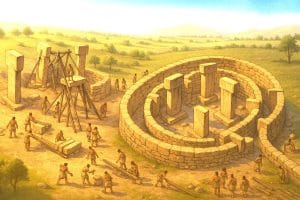
Göbeklitepe
At Göbeklitepe, something entirely new happened. For the first time, humanity erected enormous stones and arranged them in a circle. This required hundreds of people to work together. This was the human mind's transition to "we" mode. The community, not the individual, was now paramount. Shared symbols, sculptures, and rituals turned the mind in a new direction: cooperation and common purpose. Göbeklitepe was not just a temple made of stones, but also the moment when new software was uploaded to the human mind.
SUMER AND THE MAGIC OF WRITING
With the Sumerians, a new need arose: to record increasing production, regulate trade, and track debts. This need led humanity to writing. Cuneiform was not just a collection of signs; it was a new tool that expanded the mind's capacity for abstraction. Humans could now think not with images, but with symbols. This also laid the foundation for law, calculation, and bureaucracy.
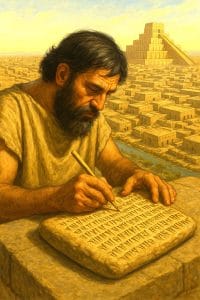
Even today, Sumerian tablets tell us the magnitude of this transformation. A merchant's debt record, the measure of an agricultural product, or a king's law… All are indicators that the human mind was adapting to a new order. The mind had learned to plan not only for today but also for the future. Every piece of recorded information expanded the boundaries of memory.
AKKADIANS, ASSYRIANS AND ROME
When the Akkadians and Assyrians began to establish empires, the new software of the mind was hierarchy and logistics. Managing vast territories, building roads, and deploying armies required complex ways of thinking. The mind developed new patterns that could organize thousands of people simultaneously.
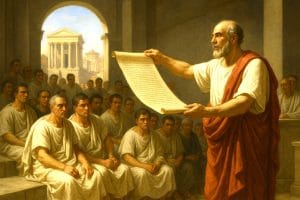
Principle of Citizenship in Rome
Rome took this software a step further. It systematized law, developed the idea of citizenship, and planned cities. Roman roads were not just paved stones; they were concrete traces of the mind's search for order. A Roman citizen, no matter where in the world they went, could feel part of the same legal order. This was one of the first signs of universal consciousness, but it was still limited: it applied only to Roman citizens.
THE MODERN AGE AND THE SCIENTIFIC MIND
In the modern age, experimentation and observation came to the fore. Galileo looking at the sky with a telescope, Newton turning a falling apple into a law, Pasteur discovering microbes under a microscope… All these showed that the mind was uploading new software. Doubting, measuring, and proving became the new normal for humans.

Industrial Revolution
This software gave birth to the industrial revolution. Steam engines, factories, railways… The human mind was now working to solve nature and apply it. This mental transformation, while increasing prosperity, also paved the way for war machines. As the mind understood nature, it increased both its power of production and destruction.
THE DIGITAL AGE AND THE NETWORKED MIND
Today we are in the digital age. The mind now operates across multiple screens, through networks and algorithms. Speed, connectivity, and instant reaction have become the dominant mental mode of our era. A young person can simultaneously watch a video, write a message, play a game, and read the news. This increases mental flexibility but also leads to superficiality and distraction. The capacity for deep thought weakens, while the ability to react quickly strengthens.

THE DUAL NATURE OF LANGUAGE
Throughout this journey, language has been humanity's most powerful software. Language enabled the carrying of the past and the building of the future. Homer's epics, Mesopotamia's Gilgamesh tablets, the Quran, the Bible, or the Vedas… All demonstrate the universal carrying power of language. But language also defined the boundaries of thought. Each language shaped the world according to its own mold. It created identity, but often closed the doors to universality.
Religions also emerged from these languages. They united communities but also separated them. The distinctions between "God in our language" and "God in your language" weakened common consciousness. While humanity shared its common heritage, it struggled to create a common consciousness.
Today, we still live with the same paradox. When languages are forbidden or belittled, identities are often defined through hatred. When a language is suppressed, it becomes a symbol of resistance rather than a means of communication. Thus, the liberating aspect of language (preserving identity) and its confining aspect (limiting with hatred) come into play simultaneously. Yet, language should be the language of production and universal contribution, not hatred. Humanity recognizes a people not by their anger, but by the values they contribute to the world.
THE MISSING LINK OF UNIVERSAL CONSCIOUSNESS
All these historical examples show us this: The human mind developed new software in every era but still failed to produce universal consciousness. Göbeklitepe's "we" consciousness was for a small community. Sumer's writing belonged to its own city-state. Rome's law to its own citizens. Even the reason of modern science often remained within the limits of national interests. Humanity shares the same internet, the same electricity, the same planet; but still divides itself into "us" and "them."
This means that mental evolution is not yet complete. Universal consciousness is humanity's missing link. Global crises — climate disaster, pandemics, migrations, wars — necessitate this consciousness. The human mind has produced new software countless times since the Stone Age. Now it faces a new test: to become the brain of humanity, not of tribes.
CONCLUSION
This long journey from Göbeklitepe to the digital age tells us this: Civilization is the history of different software for the same brain. But the journey is not over.
The future universal step of humanity should aim not to destroy languages and religions, but to create a new sense of belonging by gathering them under its umbrella. Language united people but did not erase their differences; religion transcended languages to form broader communities but did not eliminate their existence. Therefore, tomorrow's great step must be taken with the same logic: to build a new, overarching consciousness that encompasses existing identities without eliminating them.
Experiments like communism failed at this point because they tried to suppress religions and languages. However, the future of humanity is only possible through the preservation of differences meeting under a common umbrella. This umbrella should contain the melody of languages and the beliefs of religions, but transcend them to offer an identity that can say "we are human" to everyone. Without destroying, as language does, by encompassing, as religion does; but beyond both, a new consciousness that comprehends humanity as a single whole, that is, UNIVERSAL CONSCIOUSNESS.
The day we can upload universal consciousness, humanity will have crossed the greatest threshold in its history. On that day, the brain will transform into a true human mind, carrying not only the legacy of the past but also the common hope of the future.
Mücahit Özden Hun
September 3, 2025