From Traditional Exploitation to Digital Exploitation
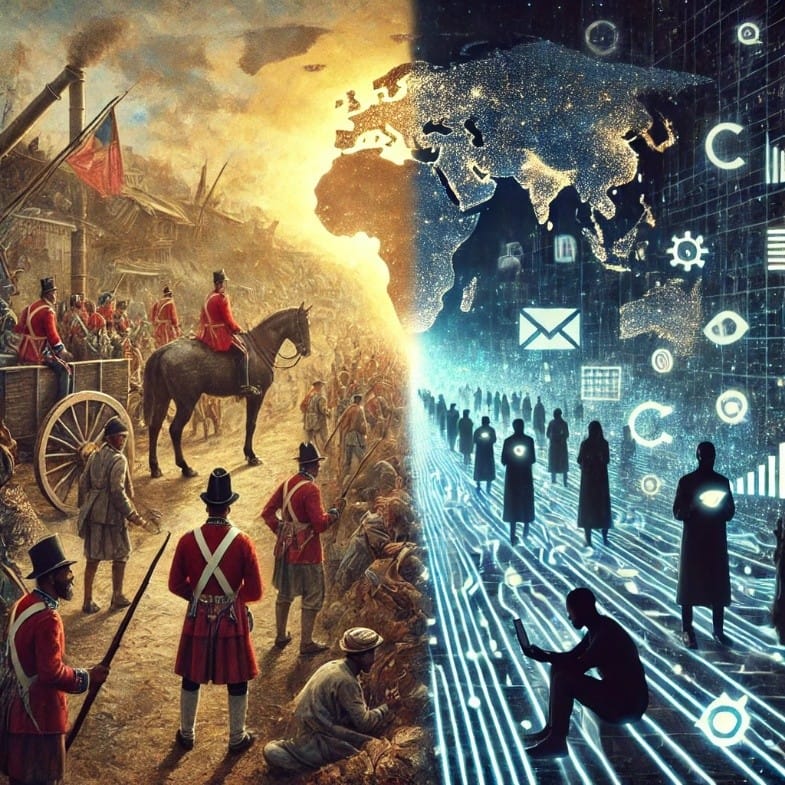
This article examines the historical background of traditional colonialism, analyzes how digital colonialism is a contemporary extension of this structure, and discusses how countries can develop resistance against it today.

DEAR READERS:
In 1986, while working as an IT manager at a French company in Paris, I transferred the company's traditional filing system to a computer environment. Using Dbase-like programs, I developed algorithms, digitized business processes, and accelerated access to information. In those years, I couldn't even imagine that algorithms would one day evolve into self-learning, human-like artificial intelligence systems.
Today, artificial intelligence has permeated every aspect of our lives. However, this technological advancement does not create equal opportunities for everyone. On the contrary, AI and digital technologies have become a new area of opportunity for some peoples, while for others, they have transformed into a new mechanism of exploitation and oppression.
INTRODUCTION
Colonialism has historically been one of the primary means of achieving wealth, power, and global dominance. With the expansionist activities of European empires in Asia, Africa, and the Americas starting from the 15th century, people and lands were subjected to physical occupation and cultural assimilation. However, even though classical colonial systems formally disappeared in the second half of the 20th century, exploitation continued in new forms. In the 21st century, physical occupation has been replaced by a new form of dominance based on data and technology, known as "digital colonialism."
This article will examine the historical background of traditional colonialism, analyze how digital colonialism is a contemporary extension of this structure, and discuss how countries can develop resistance against this structure today.
- THE STRUCTURE AND EFFECTS OF TRADITIONAL COLONIALISM
- Economic Exploitation: Raw materials and labor were transferred to the center, and the labor of indigenous people was exploited.
- Cultural Assimilation: Local languages, religions, and traditions were suppressed, and Western values were imposed.
- Military and Political Oppression: Resistance was suppressed, and local administrations were controlled from the center.
- THE EMERGENCE AND RISE OF DIGITAL COLONIALISM
Key Features of Digital Colonialism:
- Data Exploitation: Collection of user behavior and its conversion into economic value.
- Attention Economy: Platforms using user attention for advertising and manipulation.
- Cultural Homogenization: Local cultures fading due to global algorithms.
- Algorithmic Control: The flow of information being directed by corporations.
- STAGES OF TRANSITION TO DIGITAL EXPLOITATION
- Infrastructure Dependency: Hardware, software, and internet services are dependent on Western companies.
- Data Exploitation: User data is collected without permission and processed for commercial interests.
- Algorithmic Domination: Content visibility and access to information are controlled by algorithms.
- Cultural Imposition: Local cultures are suppressed by universal entertainment and news algorithms.
- Digital Labor Exploitation: Masses working for low wages on platforms lead to the centralization of value.
- HARMFUL EFFECTS OF TRADITIONAL AND DIGITAL EXPLOITATION
- Identity Erosion: Both classical and digital colonialism weaken local identities.
- Class Inequality: In the digital age, wealth and power are still concentrated in the hands of the center.
- Cognitive Manipulation: Individuals' behavior and perceptions are shaped by algorithms.
- Weakening of Democracy: Elections and public opinion are guided by algorithms.
- VALIDITY OF TRADITIONAL CONCEPTS IN THE DIGITAL AGE
- Can control society even without physical sovereignty.
- Establishes mental, cultural, and information-based dominance.
- Colonialism is no longer represented by a "flag" but by a "data center."
- METHODS OF STRUGGLE: WHAT SHOULD BE DONE AGAINST TRADITIONAL AND DIGITAL EXPLOITATION?
- Hybrid Resistance: Digital independence strategies should be developed alongside economic independence.
- Indigenous Technology Production: Hardware and software independence must be ensured.
- Data Sovereignty: Data should be collected and protected within national infrastructures.
- Open Source and Free Software: Alternative solutions against monopolistic companies should be supported.
- Digital Literacy: Societies should be made aware of algorithmic manipulation.
- NEW COLONIES: DIGITAL EXPLOITATION IS BECOMING UNIVERSAL
- Even countries like Germany and France are dependent on external social media and data infrastructure.
- Election processes and public opinion are shaped by algorithms.
- Global trends are replacing cultural content.
- ACTORS AND STRUCTURE OF DIGITAL COLONIALISM
- Companies like Meta (Facebook), Google, Amazon, Apple, Microsoft have transformed into non-state but supra-state powers.
- The structures established through these companies are modern digital empires.
- They operate above laws, are multinational, and have low accountability.
Traditional colonialism was based on physical occupation and raw materials. Digital colonialism, on the other hand, is based on data, the attention economy, and cultural guidance. The issue is no longer just land, but algorithms. Unless every society achieves digital sovereignty, independence will remain an illusion.
- The struggle for freedom in the 21st century is the struggle for data, technology, and digital consciousness.