French or Spanish? The Basque Dilemma in Turkey's Kurdish Question
This essay explores the Basque experience in Spain and France as a model for Turkey's Kurdish question, weighing cultural versus political autonomy.

Dear Readers,
In the west of Europe, a small people spread across two slopes of the Pyrenees sheds light on one of Turkey's biggest political issues: the Basques.
The same people are experiencing two different realities within two different states. The Basque Autonomous Community in Spain has its own parliament, police force, and financial system; the Euskara language is officially recognized alongside Spanish.
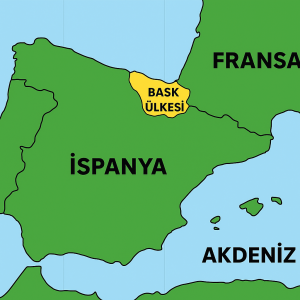
The Basque Country, as seen on the map, is divided between Spain and France.
In contrast, in the Basque region of France, identity can only exist in the cultural sphere. Within the unitary structure of the French state, Basque is not an official language, and education in the mother tongue is only possible to a limited extent and through the efforts of civil society.
Two different paths, two different experiences for the same people…
The dilemma facing Turkey is precisely this: will the solution to the Kurdish question be the limited cultural autonomy of the French model, or the broad political autonomy of the Spanish model?
Or will it be somewhere in between, suited to Turkey's realities?
The Spanish Basque experience shows that when political autonomy is recognized, identity demands can be met more permanently. An organization like ETA, which waged an armed struggle for many years, disarmed within the political framework provided by this autonomy arrangement, and the conflict was channeled into democratic avenues. Powers such as the right to collect taxes, its own parliament, and its own security force were not merely symbolic but mechanisms that directly affected daily life.
In France, the situation is different. There, Basque identity persists, but political representation is limited. Euskara is not official; it is taught only as an elective subject or through private schools. France did not compromise on the principle of a unitary state, limiting identity mostly to the cultural sphere. For this reason, Basque identity is visible at the cultural level but has remained politically marginalized.
Turkey's reality lies somewhere between these two extremes. The state does not want to abandon its unitary structure; however, the Kurdish community will not be content with merely folkloric or symbolic cultural rights. Therefore, a solution should be sought at a level more advanced than the French model but more limited than the Spanish model. That is, the issue is to find a middle ground that preserves both the integrity of the state and the dignity of the Kurds. So, how can this middle ground be shaped?
The first possibility is enhanced cultural autonomy. In this model, the safeguarding of Kurdish in the public sphere, the establishment of bilingual education programs in state schools, and the support of institutes and cultural funds for Kurdish language and history are envisaged. The unitary state structure is preserved; political autonomy is not an issue. This model strongly addresses cultural demands but may not satisfy the Kurdish movement due to limited political representation.
The second possibility is strong local governments. Here, municipalities would have more say over education, culture, social services, and partial financial resources. Tax sharing would be supported by transparent budgets and fair transfer mechanisms. The central government's powers over security and foreign policy would be preserved, but the quality of services in daily life would improve. This model both preserves the unitary structure of the state and provides a reasonable balance in meeting societal demands by increasing local participation.
The third possibility is a regional council or limited parliament. In this model, an elected assembly in regions with a high Kurdish population would have a say in areas such as culture, education support policies, regional development, and planning. Fundamental powers such as security, criminal law, and foreign policy would remain with the center. Thus, unity would be preserved, but the political representation of Kurds would increase. However, this model could raise concerns for the state about "transition to federalism" and might be the most politically controversial option.
Which of these three models would be more realistic for Turkey? Enhanced cultural autonomy is a solution that the state could easily accept but which Kurds might find limited. A regional council is an attractive formula for Kurds but risky for the state. The most balanced possibility is strong local governments; it provides power-sharing without disrupting unity and can respond to the cultural and administrative demands of the Kurdish community.
In conclusion, the Basque experience reminds Turkey that the issue of identity cannot be resolved merely with folklore or symbolic cultural rights. But at the same time, broad political autonomy may not always be a path that the state can accept. The solution should be sought in a middle model where cultural rights are guaranteed, local governments are strengthened, and, if necessary, limited political representation mechanisms are established. The two faces of the Basque experience present a dilemma to Turkey. Resolving this dilemma could open the door to peace and democratization.
Mücahit Özden Hun
September 18, 2025